Elvis Presley: 40 Best Deep Cuts (Part 3) [Pastimescapes blog]

Elvis Presley in 1958

Elvis Presley in 1958

This is Part 3 of a countdown of Elvis Presley’s 40 greatest “deep cuts,” songs that did not appear as singles in the United States during his lifetime.

#20 Whole Lotta Shakin’ Goin’ On (1970)
Elvis Country – I’m 10,000 Years Old

#19 As Long As I Have You (1958)
King Creole

#18 Twenty Days And Twenty Nights (1970)
That’s The Way It Is

#17 When It Rains, It Really Pours (1957)
Elvis For Everyone!

#16 Funny How Time Slips Away (1970)
Elvis Country – I’m 10,000 Years Old

#15 Amazing Grace (1971)
He Touched Me

#14 Run On (1966)
How Great Thou Art – As Sung By Elvis

#13 Tomorrow Never Comes (1970)
Elvis Country – I’m 10,000 Years Old

#12 Power Of My Love (1969)
From Elvis In Memphis

#11 I’ll Be Home On Christmas Day (1971)
Elvis Sings The Wonderful World Of Christmas

To Be Continued . . .

Elvis Presley: 40 Best Deep Cuts (Part 2) [Pastimescapes blog]

Elvis Presley in 1957

Elvis Presley in 1957

This is Part 2 of a countdown of Elvis Presley’s 40 best “deep cuts,” recordings that did not appear as singles in the United States during his lifetime.


#30 Stranger In My Own Home Town (1969)
From Memphis To Vegas/From Vegas To Memphis

#29 So High (1966)
How Great Thou Art – As Sung By Elvis

#28 My Babe [Live] (1969)
From Memphis To Vegas/From Vegas To Memphis

#27 Runaway [Live] (1969)
On Stage – February, 1970

#26 Early Morning Rain (1971)
Elvis Now

#25 I’m Comin’ Home (1961)
Something For Everybody

#24 Baby, I Don’t Care (1957)
A Date With Elvis

#23 I Want You With Me (1961)
Something For Everybody

#22 After Loving You (1969)
From Elvis In Memphis

#21 Wearin’ That Loved-On Look (1969)
From Elvis In Memphis

To Be Continued . . .

Elvis Presley: 40 Best Deep Cuts (Part 1) [Pastimescapes blog]

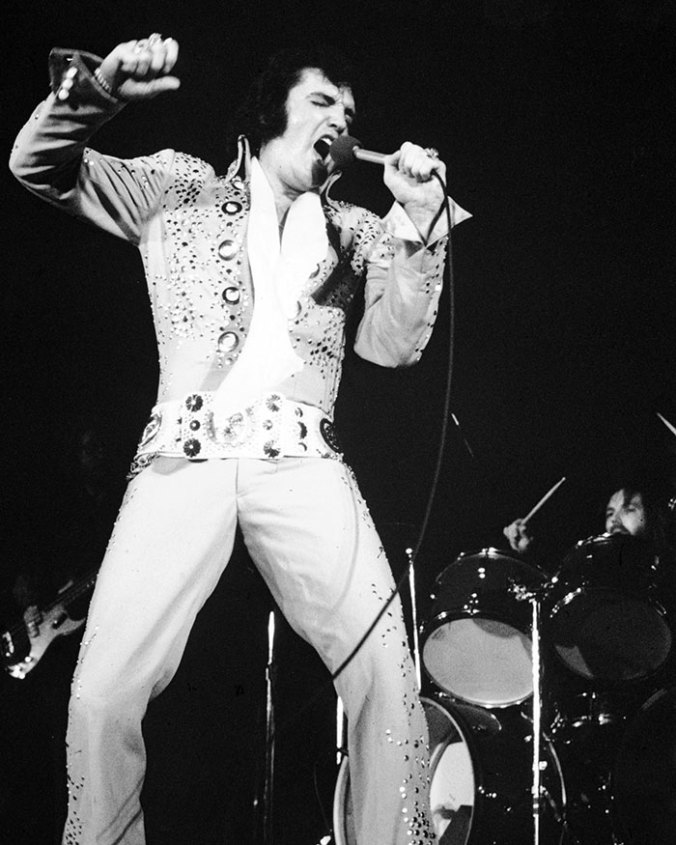
Elvis Presley in 1970

Elvis Presley in 1970

At Graceland in Memphis, 40 years ago this week, Elvis Presley passed away at the age of 42.

In his 23-year career as an entertainer, Elvis released 711 master recordings, 198 of which appeared as single A or B sides – including classic hits like “Suspicious Minds,” “Jailhouse Rock,” and “Burning Love.”

What of those other 513 recordings that never became singles in the United States during his lifetime?

This week, I present a countdown of what I currently consider the 40 best “deep cuts” from the body of work that Elvis left behind. These recordings only appeared on Long Play (LP) or Extended Play (EP) albums.

I have been an Elvis fan for as long as I have been listening to music, and I consider these deep cuts among his best work, though the general public is not as familiar with them.

To prevent this list from simply becoming “greatest hits live,” note that I also disqualified from consideration over 50 subsequent live versions and alternate takes of songs that were originally singles.

As always, this is one fan’s opinion.

#40 You Asked Me To (1973)
Promised Land

#39 Holly Leaves And Christmas Trees (1971)
Elvis Sings The Wonderful World Of Christmas

#38 Do You Know Who I Am (1969)
From Memphis To Vegas/From Vegas To Memphis

#37 By And By (1966)
How Great Thou Art – As Sung By Elvis

#36 I’ll Be Home For Christmas (1957)
Elvis’ Christmas Album

#35 Silent Night (1957)
Elvis’ Christmas Album

#34 Make The World Go Away (1970)
Elvis Country – I’m 10,000 Years Old

#33 Like A Baby (1960)
Elvis Is Back!

#32 Long Black Limousine (1969)
From Elvis In Memphis

#31 Good Time Charlie’s Got The Blues (1973)
Good Times

To Be Continued . . .

AXS TV to feature Elvis documentaries in August [Pastimescapes blog]

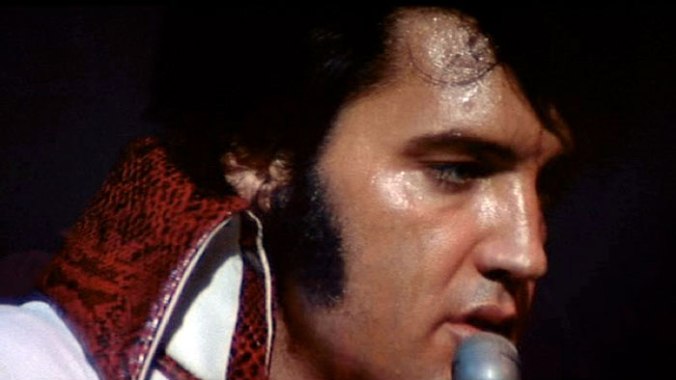
Elvis Presley on stage in 1970. (Image courtesy of AXS TV, used with permission.)

Elvis Presley on stage in 1970. (Image courtesy of AXS TV, used with permission.)

North American television network AXS TV will feature multiple Elvis Presley documentaries next month, including the 2000 “Special Edition” version of Elvis: That’s The Way It Is (1970) as well as Elvis On Tour (1972).

Providing a glimpse of the real Elvis, That’s The Way It Is features the singer in rehearsals and on stage for his third concert series at the International Hotel in Las Vegas. Highlights of this must-see film include killer renditions of “Suspicious Minds” and “Polk Salad Annie.” The documentary was Elvis’ 32nd movie, and it airs Tuesday, August 1, at 10 PM Eastern.

Less than two years later, the cameras rolled again for Elvis’ 33rd and final movie, Elvis On Tour. A concert at the Hampton Coliseum in Virginia provides the bulk of the live performances, with other cities including Greensboro, North Carolina and San Antonio, Texas. Studio work, rehearsals, and other behind-the-scenes action demonstrate a hectic yet repetitive schedule. Elvis On Tour airs Tuesday, August 22, at 10 PM.

Though both movies are an important part of the Elvis legacy, the difference between the vibrant performer of That’s The Way It Is and his subdued counterpart in Elvis On Tour is striking. Elvis On Tour certainly has its moments, though, picking up steam in the last half.

The 1981 documentary This Is Elvis mixed archival Elvis footage with reenactments by “actors.” The Elvis footage more than makes up for nauseating, voice-over narration by Ral Donner as “Elvis.” The documentary does a decent job recounting Elvis’ life and career. An updated version, sans imitations, was released as The Great Performances in 1990. The concept is in sore need of updating again, but This Is Elvis is certainly worth a watch. It airs on Tuesday, August 8, at 10 PM.

Wednesday, August 16, marks the 40th anniversary of Elvis’ death. At 9 PM, AXS TV goes back to the early years with the 2001 documentary Classic Albums: Elvis Presley, a look at his 1956 debut album.

AXS TV also serves up Clambake (1967), one of the worst Elvis movies. Check out his 25th film on Tuesday, August 29, at 10 PM, if you dare.

A 2016 fictional movie about “Elvis” (Jonathan Nation) going undercover holds no interest for me. Elvis Lives! airs on Tuesday, August 15, and Wednesday, August 16, at 10 PM if you are into that kind of thing.

Here is the full schedule (all times Eastern):

  • August 1, 10 PM: Elvis: That’s The Way It Is – Special Edition (1970/2000)
  • August 8, 10 PM: This Is Elvis (1981)
  • August 15, 10 PM: Elvis Lives! (2016)
  • August 16, 9 PM: Classic Albums: Elvis Presley (2001)
  • August 16, 10 PM: Elvis Lives! (2016)
  • August 22, 10 PM: Elvis On Tour (1972)
  • August 29, 10 PM: Clambake (1967)
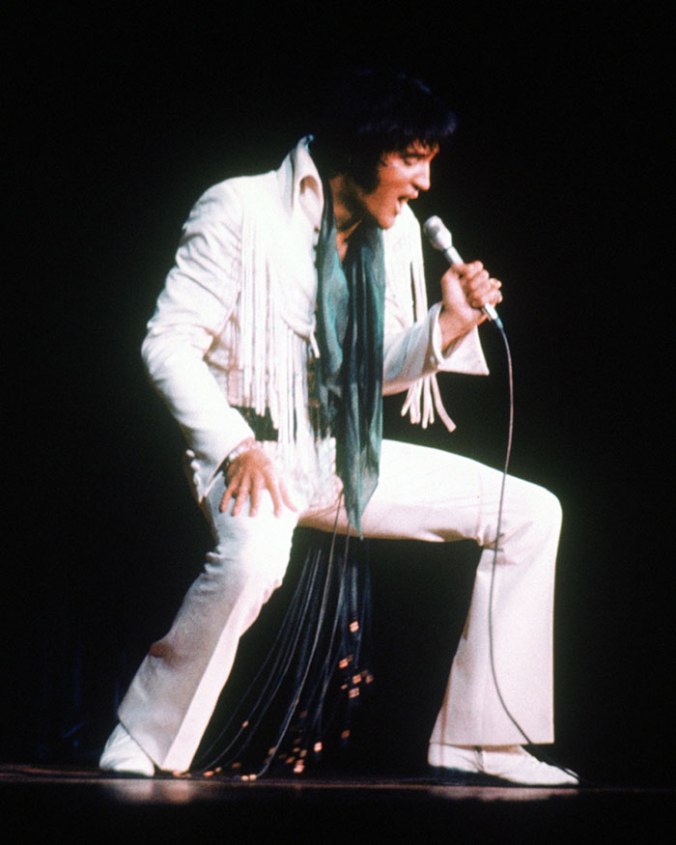
Elvis Presley as he appeared in 1972's ELVIS ON TOUR. (Image courtesy of AXS TV, used with permission.)

Elvis Presley as he appeared in 1972’s ELVIS ON TOUR. (Image courtesy of AXS TV, used with permission.)


UPDATE: August 12, 2017

HDNET MOVIES, sister network of AXS TV, will broadcast an Elvis movie marathon the night of Wednesday, August 16. The marathon will include two of the best (Elvis: That’s That’s The Way It Is and Elvis On Tour) and two of the worst (Paradise, Hawaiian Style and Clambake). At least all of them feature the real Elvis. None of this Elvis Lives! business.

Here is the August 16-17 HDNET MOVIES Elvis schedule (all times Eastern):

  • August 16, 8:30 AM: This Is Elvis (1981)
  • 7:00 PM: Frankie And Johnny (1966)
  • 8:30 PM: Paradise, Hawaiian Style (1966)
  • 10:05 PM: Elvis: That’s The Way It Is – Special Edition (1970/2000)
  • 11:45 PM: Clambake (1967)
  • August 17, 1:35 AM: Elvis On Tour (1972)
  • 3:20 AM: This Is Elvis (1981)
  • 5:10 AM: Paradise, Hawaiian Style (1966)
  • 6:45 AM: Frankie And Johnny (1966)
  • 8:15 AM: Clambake (1967)

Many of the same films will run again throughout the rest of August.

Vinyl Elvis: 1977’s MOODY BLUE Closes a Lonely Journey [Pastimescapes blog]

Today marks the 40th anniversary of the July 19, 1977, release of Moody Blue, an album that turned out to be the last Elvis Presley record before his death four weeks later.

MOODY BLUE (RCA, 1977) [Photo by the author]

MOODY BLUE (RCA, 1977) [Photo by the author]

Moody Blue
Label: RCA
Catalog Number: AFL1-2428
Recorded: 1974-1977 | Memphis, TN; Ann Arbor, Michigan; Kalamazoo, Michigan
Released: 1977
Ranked: #7 in Pastimescape’s 50 Greatest Elvis Albums of All Time

Before I had Elvis records of my own, I remember checking out a couple of his albums from the public library. I must have been about ten-years-old.

The two records I took home that day in 1985, which I believe represented the entirety of the library’s Elvis music collection, were The Sun Sessions and Moody Blue. The irony that I had borrowed both his very last record and a compilation of his very first records escaped me.

I enjoyed both albums, but the one that really drew me in was Moody Blue. For one thing, the record was pressed on blue vinyl. I had never seen anything like that. Plus, I just loved the sound of the album — particularly “Way Down,” which I played over and over. I even thought it was Elvis doing the low vocals, which were actually supplied by JD Sumner.

I played “Way Down” for my older brother later that day to show off knowing a “new” Elvis song, only for him to inform me that he had his very own copy of Moody Blue.

At that time, I was not allowed to touch my brother’s records. Today, his copy of Moody Blue is mine.

Side A of MOODY BLUE (RCA, 1977) [Photo by the author]

Side A of MOODY BLUE (RCA, 1977) [Photo by the author]

Side A

  1. Unchained Melody (1977)
    A compelling live version of “Unchained Melody” leads off the album. I normally prefer to open with a rocker, but this choice works perfectly for Moody Blue. Overdubs conceal that much of the fire had unfortunately gone out of Elvis’ live shows by this point.
  2. If You Love Me (Let Me Know) (1977)
    I distinctly remember recognizing this live song from the Elvis In Concert album and wondering why this one sounded better. Part of the reason was that it was actually recorded a couple of months earlier than the version on Elvis In Concert. Some debate whether this song, made popular by Olivia Newton-John, should have been in his setlist. No matter, this is his best version of a song that obviously spoke to him.
  3. Little Darlin’ (1977)
    Next up is another live recording, Elvis’ fun take on the 1950s classic, “Little Darlin'”, which also provides a much-needed change in tempo. I love his ad-lib of “To hold in mine…your little foot…uh, hand!”
  4. He’ll Have to Go (1976)
    The tempo slows back down for “He’ll Have To Go,” the last studio recording ever made by Elvis. In addition to the resonance of the Elvis vocals, I love the guitar work of James Burton here. Six of the songs on this album were recorded at Graceland in 1976 in an effort to make the artist feel more comfortable, as Elvis in later years had become reluctant to record in a formal studio setting. Two sessions at a makeshift studio in his den resulted in sixteen songs, ten of which had already been used on the From Elvis Presley Boulevard album by the time RCA was assembling Moody Blue.
  5. Let Me Be There (1974)
    In early 1977, Elvis backed out of a planned session in Nashville to finish the album. Instead, a few live performances were recorded that April. Only three suitable songs were captured, however, which brought the album’s total to nine. In desperation, RCA re-released “Let Me Be There” from 1974’s Recorded Live On Stage In Memphis album to round out Side A of Moody Blue. Another Olivia Newton-John hit, “Let Me Be There” fits well on Moody Blue, despite being slightly older than the other recordings. It is certainly the weakest aspect of the album, however.

Side B

Side B of MOODY BLUE (RCA, 1977) [Photo by the author]

Side B of MOODY BLUE (RCA, 1977) [Photo by the author]

  1. Way Down (1976)
    All of the songs on Side B of Moody Blue were recorded at Graceland. I probably have the master of “Way Down” on at least a half dozen CDs. None of them sound as incredible as listening to this record. Is it all in my head? Possibly, but if it is, do not tell me. “Way Down” really rocks, making it an appropriate A-side for what turned out to be Elvis’ last single before his death.
  2. Pledging My Love (1976)
    “Pledging My Love” is another terrific performance by Elvis. He might have lost much of the joy in his life by this point, but you can still hear it on this song.
  3. Moody Blue (1976)
    I find it cool that the album’s title song is buried in the middle of Side B. “Moody Blue,” another great song, almost sounds like disco. Compare the guitar licks on “Moody Blue” with Kool & the Gang’s “Celebration” (1980), for instance.
  4. She Thinks I Still Care (1976)
    Elvis recorded many country songs, particularly in the 1970s. “She Thinks I Still Care” is a stellar performance. At the end, he just will not let the song go, either.
  5. It’s Easy For You (1976)
    Elvis covered the gamut when it comes to break-up songs. This one is aimed at the other woman. “It’s Easy For You” was written by Broadway legends Andrew Lloyd Webber and Tim Rice, bringing to a close an album that was almost as varied as Elvis’ entire career: Adult Contemporary, Country, and Rock ‘n’ Roll. It is hard to ask for more in an Elvis album, and I still consider Moody Blue one of his best. A fun bit of trivia: Note the misspelling of Webber’s name on the Moody Blue Side B label in the image above. Proofreading has apparently never been a strong point for Elvis’ music label.

I mentioned that my brother did not let me touch his records when I was young. This turned out to be a good thing for me, as Moody Blue sounds flawless. Not a crackle or a pop to be heard on either side.

Back cover of MOODY BLUE (RCA, 1977) [Photo by the author]

Back cover of MOODY BLUE (RCA, 1977) [Photo by the author]

The interesting thing about Moody Blue is that such a fantastic album could result from not only a hodgepodge of recordings but also such a low point in Elvis’ life. “You don’t have to face the music, you don’t have to face the crowd,” he laments on “It’s Easy For You.” Depression, loneliness, and various personal demons were consuming his life by this point. Years of prescription drug addiction and abuse were beginning to take a public toll.

Part of the credit for the unlikely strength of Moody Blue must go to producer Felton Jarvis. While he occasionally went too far with overdubs on previous Elvis projects, Moody Blue is all the better for his extra work and attention to detail–particularly on the 1977 live recordings. Credit must also go to the musicians and vocalists who worked with Elvis on the album. On occasion, they carry Elvis. Finally, credit is due to Elvis as well, who managed to pull these performances from somewhere inside himself, despite not being in the right frame of mind to record.

Inner sleeve (front) from MOODY BLUE (RCA, 1977) [Photo by the author]

Inner sleeve (front) from MOODY BLUE (RCA, 1977) [Photo by the author]

I love the inner sleeves on vintage Elvis albums. Check out the ads for other albums, which must have acted as combination check lists and wish lists for fans of the time. In some cases, it was also a way to see some alternate cover designs. For example, note the Moody Blue concept artwork in the bottom left of the image below.

Inner sleeve (front) from MOODY BLUE (RCA, 1977) [Photo by the author]

Inner sleeve (back) from MOODY BLUE (RCA, 1977) [Photo by the author]

The fall of the curtain came much too early for Elvis, but Moody Blue certainly made for an impressive last act. If you collect Elvis on vinyl, this one is a must.

"The Blue Album" [Photo by the author]

“The Blue Album” [Photo by the author]


Thank you to my brother for giving me the Elvis records that inspired this series of posts.

Vinyl Elvis: 1954’s THAT’S ALL RIGHT/BLUE MOON OF KENTUCKY Launches the Quest [Pastimescapes blog]

Today marks the 63rd anniversary of the release of Elvis Presley’s first record on July 19, 1954.

I have two near-mint copies of That’s All Right/Blue Moon of Kentucky.

By far, they would be the most valuable pieces of my entire record collection, or of all of my collections of anything, for that matter, except that they were both pressed in 2009, rather than 1954. Oh well.
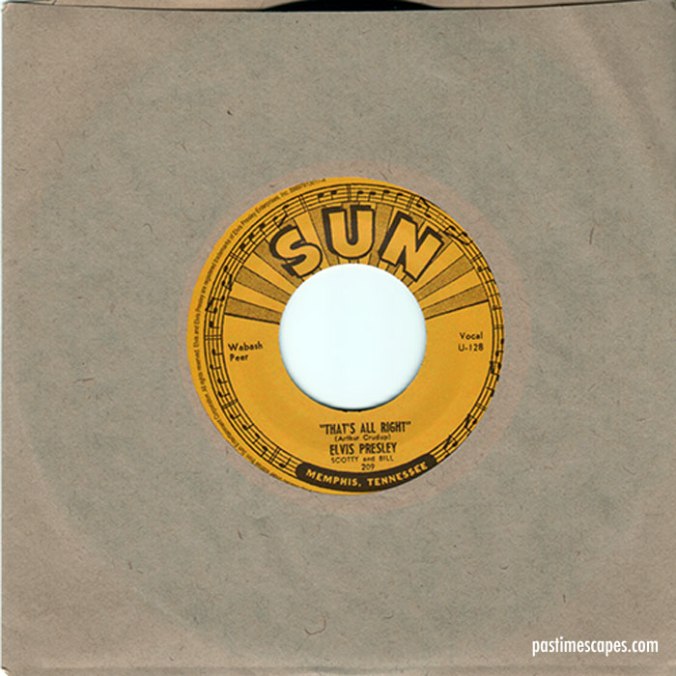
THAT'S ALL RIGHT/BLUE MOON OF KENTUCKY (Single), SUN 1954; Reissue: Sony RCA/Legacy 2009--included as bonus with the Franklin Mint's ELVIS: THE COMPLETE MASTERS COLLECTION CD set. (From the author's collection.)

THAT’S ALL RIGHT/BLUE MOON OF KENTUCKY (Single), SUN 1954; Reissue: Sony RCA/Legacy 2009–included as bonus with the Franklin Mint’s ELVIS: THE COMPLETE MASTERS COLLECTION CD set. (From the author’s collection.)

That’s All Right/Blue Moon of Kentucky (Single)
Label: SUN [Reissue: Sony RCA/Legacy]
Catalog Number: 209 [Reissue: 88697613017 (Label) / 88697673597 (2010 Outer Sleeve)]
Recorded: 1954 | Memphis, TN
Released: 1954 [Reissue: 2009]
Ranked: #31 in Pastimescape’s 100 Greatest Elvis Songs of All Time for “That’s All Right”

Packaged in a plain, brown sleeve much like the original, my first copy of the record was included with Franklin Mint’s Elvis: The Complete Masters Collection CD set from 2009. I framed the record back when I bought the set on clearance in 2012, and it remains on the wall here in my Fortress of Solitude.

With today’s feature in mind, and not wanting to disturb my framed version, I recently acquired my second copy of That’s All Right/Blue Moon of Kentucky. Sony released it back in April 2010 for Record Store Day. It includes a gaudy cover, but I was surprised to discover that the record contained within is actually identical to the one that shipped with the Franklin Mint set. Sony must have been thinking ahead and pressed extra copies for the Record Store Day promotion.

Side A
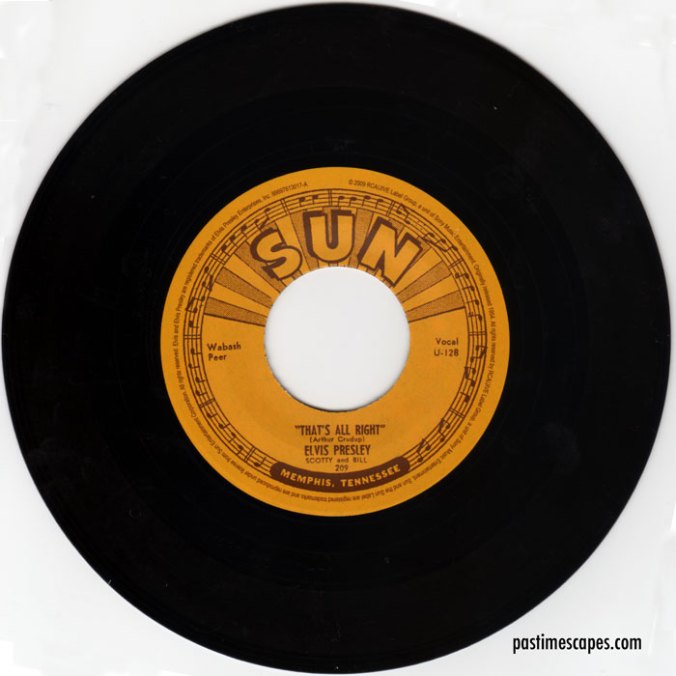
Side A of THAT'S ALL RIGHT/BLUE MOON OF KENTUCKY (Single), SUN 1954; Reissue: Sony RCA/Legacy 2009. (From the author's collection.)

Side A of THAT’S ALL RIGHT/BLUE MOON OF KENTUCKY (Single), SUN 1954; Reissue: Sony RCA/Legacy 2009. (From the author’s collection.)

“That’s All Right” (1954)
One of the endearing aspects of this performance of “That’s All Right” is the sheer joy in the voice of Elvis as he sings. He finally has his opportunity in the studio, and he is making the most of it.

Elvis in 1970 reflected on his style, stating that it was “a combination of country music and gospel and rhythm & blues […]. That’s what it really was. As a child, I was influenced by all that.”

He added, “Of course, the Grand Ole Opry is the first thing I ever heard, probably, but I liked the blues, and I liked the gospel music–gospel quartets–and all that.”

On this first single, the blues and country influences are as clear as they ever would be. Some credit That’s All Right/Blue Moon of Kentucky as the first rock ‘n’ roll record, but to say Elvis invented the style is to make a false assumption that any one person did.

Rock ‘n’ roll evolved from the very sources that Elvis himself described. Besides, “Rocket 88,” “Rock Around the Clock,” and other potential contenders pre-date Elvis’ version of “That’s All Right.”

What Elvis did with his early records for SUN and RCA, though, was ignite the smoldering evolution of rock ‘n’ roll into a full-blown blaze. By melding country into the blues of “That’s All Right,” Elvis in 1954 unleashed a sound that not only built upon the foundation established by Arthur “Big Boy” Crudup‘s original 1946 recording, but took the song in a new direction. Absorbing the music of his youth, Elvis knew instinctively that blues and country explore many of the same themes, which allowed him to re-interpret these kinds of songs in a unique way.

Unfortunately, despite what the beautiful record label would have you believe, this reissue actually contains an RCA mastering of “That’s All Right,” with added echo, rather than the original SUN mastering. I suspect it is the version from 2004’s Elvis At SUN, though I do not have that release to verify.

A few years after this reissue of SUN 209, the “dry” version of “That’s All Right” finally became available again via FTD’s A Boy From Tupelo in 2012. If you missed that collectors set back then, you will have another chance to obtain the material later this month when Sony RCA/Legacy re-releases it in a package for mainstream retail.

The dry version of “That’s All Right” is superior, though it takes some getting used to because the echo versions were used in every official release of the song from December 1955 through 2011. Unless, of course, you have been spinning a SUN original.

Side B
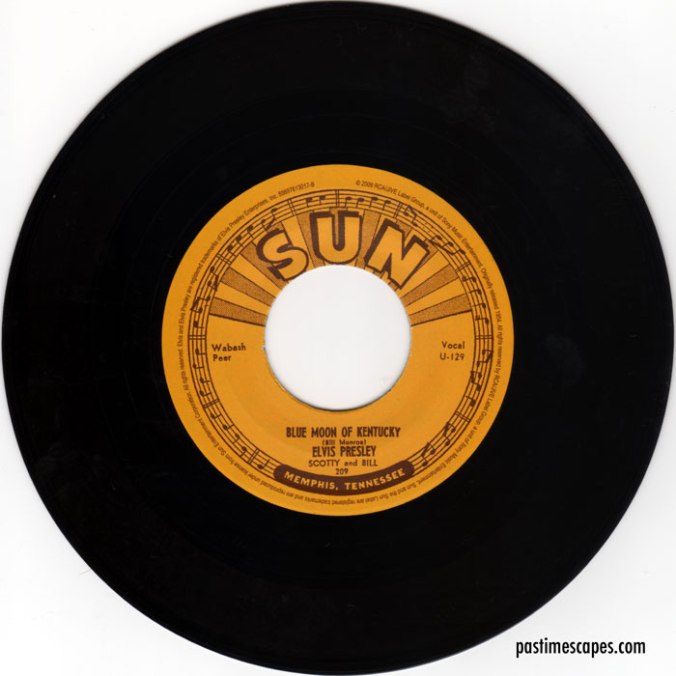
Side B of THAT'S ALL RIGHT/BLUE MOON OF KENTUCKY (Single), SUN 1954; Reissue: Sony RCA/Legacy 2009. (From the author's collection.)

Side B of THAT’S ALL RIGHT/BLUE MOON OF KENTUCKY (Single), SUN 1954; Reissue: Sony RCA/Legacy 2009. (From the author’s collection.)

Blue Moon of Kentucky (1954)
While Elvis added country to the blues of “That’s All Right,” he created a literal flip side by melding rhythm & blues into the country bluegrass of “Blue Moon of Kentucky.” Again, the sound is markedly different from Bill Monroe’s 1946 original. Again, there is that joy in his voice.

A fun tidbit is that this record contains only three musicians: Elvis on acoustic guitar, Scotty Moore on electric guitar, and Bill Black on the upright bass.

One of the earliest rock ‘n’ roll records, and no drummer to be heard. Credit goes to Black, whose bass makes it sound like there must be a drummer.

DJ Fontana did not join the group in the studio on drums until the early 1955 session that produced “I’m Left, You’re Right, She’s Gone,” the flip side of Elvis’ fourth record for SUN.
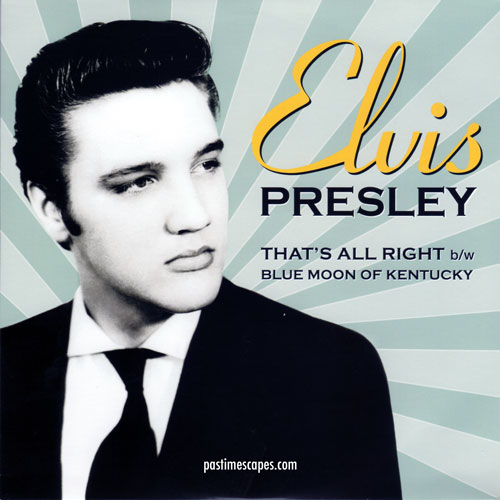
Front of THAT'S ALL RIGHT/BLUE MOON OF KENTUCKY (Single), SUN 1954; Reissue: Sony RCA/Legacy 2009--with 2010 cover for Record Store Day. (From the author's collection.)

Front of THAT’S ALL RIGHT/BLUE MOON OF KENTUCKY (Single), SUN 1954; Reissue: Sony RCA/Legacy 2009–with 2010 cover for Record Store Day. (From the author’s collection.)

Though I much prefer the simplicity of the brown sleeve, I am including full coverage here of the 2010 version, particularly since that is the single I actually played when writing this entry.
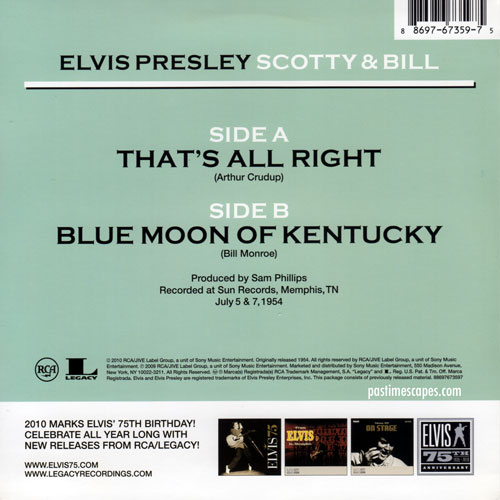
Back of THAT'S ALL RIGHT/BLUE MOON OF KENTUCKY (Single), SUN 1954; Reissue: Sony RCA/Legacy 2009--with 2010 cover for Record Store Day. (From the author's collection.)

Back of THAT’S ALL RIGHT/BLUE MOON OF KENTUCKY (Single), SUN 1954; Reissue: Sony RCA/Legacy 2009–with 2010 cover for Record Store Day. (From the author’s collection.)

Hype sticker from 2010 Record Store Day reissue of THAT'S ALL RIGHT/BLUE MOON OF KENTUCKY (Single), Sony RCA/Legacy 2009. (From the author's collection.)

Hype sticker from 2010 Record Store Day reissue of THAT’S ALL RIGHT/BLUE MOON OF KENTUCKY (Single), Sony RCA/Legacy 2009. (From the author’s collection.)
Hype sticker from 2010 Record Store Day reissue of THAT'S ALL RIGHT/BLUE MOON OF KENTUCKY (Single), Sony RCA/Legacy 2009. (From the author's collection.)

Hype sticker from 2010 Record Store Day reissue of THAT’S ALL RIGHT/BLUE MOON OF KENTUCKY (Single), Sony RCA/Legacy 2009. (From the author’s collection.)
Front of insert from 2010 Record Store Day reissue of THAT'S ALL RIGHT/BLUE MOON OF KENTUCKY (Single), Sony RCA/Legacy 2009. (From the author's collection.)

Front of insert from 2010 Record Store Day reissue of THAT’S ALL RIGHT/BLUE MOON OF KENTUCKY (Single), Sony RCA/Legacy 2009. (From the author’s collection.)
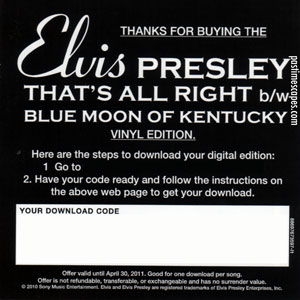
Back of insert from 2010 Record Store Day reissue of THAT'S ALL RIGHT/BLUE MOON OF KENTUCKY (Single), Sony RCA/Legacy 2009. (From the author's collection.)

Back of insert from 2010 Record Store Day reissue of THAT’S ALL RIGHT/BLUE MOON OF KENTUCKY (Single), Sony RCA/Legacy 2009. (From the author’s collection.)

“That’s All Right” and “Blue Moon of Kentucky” became regional hits for Elvis. He would follow-up the single with four more records on the SUN label before signing with RCA in late 1955.
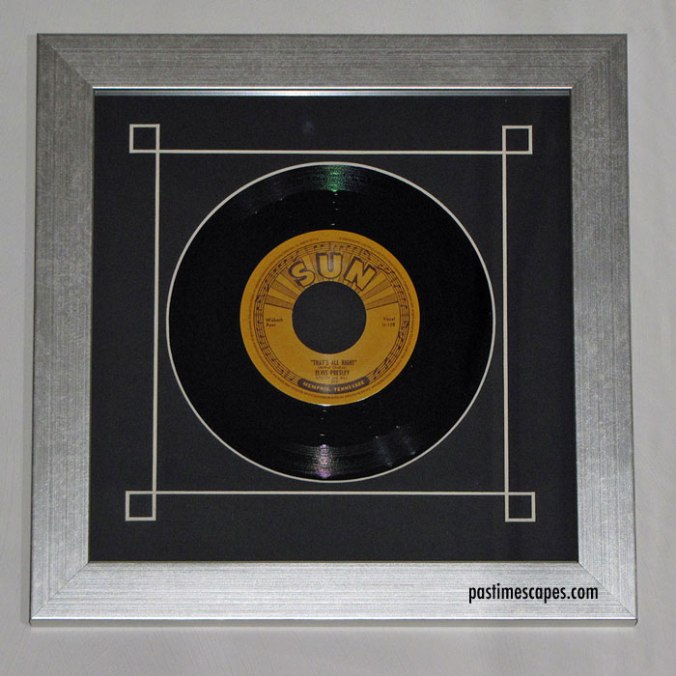
THAT’S ALL RIGHT/BLUE MOON OF KENTUCKY (Single), SUN 1954; Reissue: Sony RCA/Legacy 2009–included as bonus with The Franklin Mint’s ELVIS: THE COMPLETE MASTERS COLLECTION CD set. (Photo by the author.)

July 19 Represents a Beginning and an End for Elvis Presley [Pastimescapes blog]

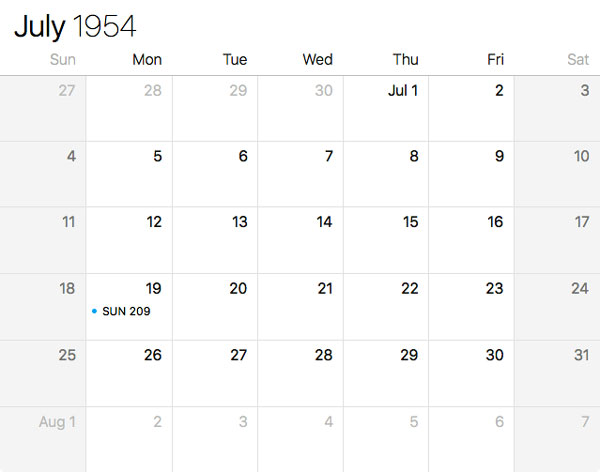
July 19, 1954

The date is July 19, 1954, and SUN releases the debut record of 19-year-old Elvis Presley. Produced by Sam Phillips, the single consists of “That’s All Right” backed with “Blue Moon of Kentucky.” Elvis, who in childhood dreamed of being “the hero of the comic book,” begins his adventure.

The years come and go. Elvis achieves many of his dreams, including becoming a musical hero throughout the world. Like everyone, he also loses other dreams along the way.

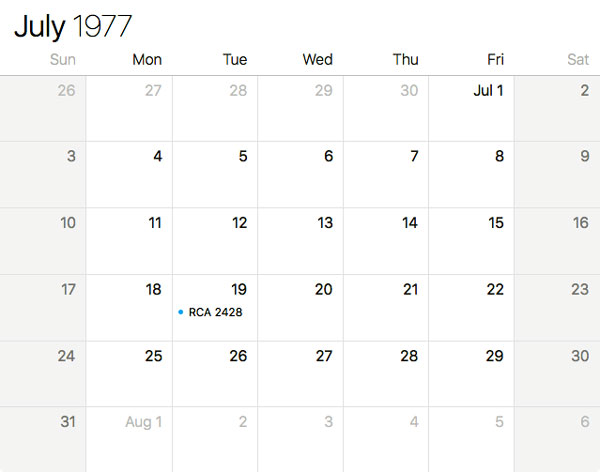
The date is July 19, 1977, and RCA releases Moody Blue, an album that proves to be the final Elvis record before his death exactly four weeks later at the age of 42. An unprecedented level of fame helped Elvis place himself on a path that brought his journey to a tragic end.

Only 23 years, a mere blink of history’s eye, separate the release of the last Elvis record from the first.

More time passes. Other heroes come and go, yet Elvis somehow remains. As some fans fade away, others take their place.

The date is now July 19, 2017, but those 23 years continue to resonate.

Journey with Pastimescapes today to the beginning and the end with two editions of Vinyl Elvis:

July 19, 1977