Cinematic Justice: NOBODY short film to focus on 18-year-old Elvis Presley

“He said he was a singer. I said, ‘What kind of a singer are you?’ He said, ‘I sing all kinds.’ I said, ‘Who do you sound like?’ He said, ‘I don’t sound like nobody.'” –Memphis Recording Service office manager Marion Keisker recalling her Summer 1953 meeting with Elvis (1)

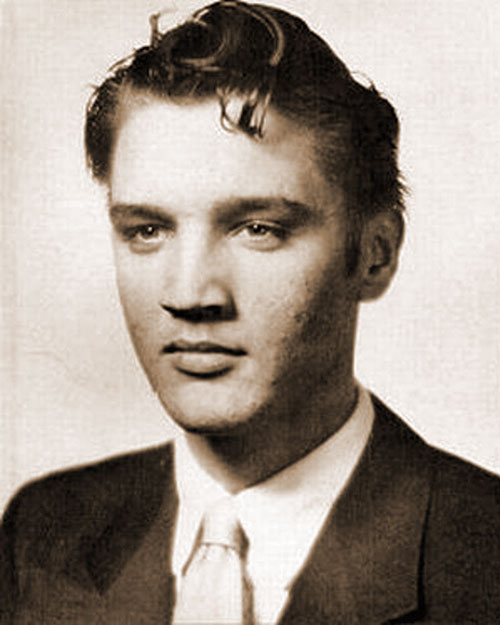
Elvis, circa. 1953

Elvis, circa. 1953

“My ultimate goal with Nobody is to give Elvis Presley the cinematic justice he deserves, even if only through an independent short film,” said William Bryan, writer/director/producer of Nobody. The film, currently seeking funding on Kickstarter, will portray Elvis in the waning days of his senior year in high school. A key event will be his performance at the April 1953 Humes High School talent show, which gave the shy singer enough confidence to walk into Memphis Recording Service just weeks later to record a demo.

Bryan, an Elvis fan since he was 11-years-old, has made an annual visit to Memphis for the last ten years. While studying at Columbia College Chicago, he made numerous short films. His goal for Nobody, which is also produced by 2011 Columbia College graduate Tom Radovich, is that it inspire today’s dreamers.

“Sure, this might sound a bit romanticized,” Bryan explained, “but think about who Elvis Presley was at the time of our story. He was a senior in high school who wasn’t the sports hero, didn’t have a girlfriend…he really was a nobody.”

While Nobody focuses on early Elvis, Bryan does not limit his fandom to that era. “I’ve been listening to a lot of ballad numbers that Elvis recorded between 1969 and 1971. ‘I’ll Never Know’ and ‘I’ve Lost You’ have been two of my favorites this week,” he said.

Nobody‘s Kickstarter campaign ends on June 1. If it can secure enough funding to proceed, the independent production promises a new look at Elvis compared to previous dramatizations of his life. “With all due respect to the filmmakers who have come before me and already told an Elvis story, many of the ‘Hollywood’ productions have unfortunately been less-than-tasteful, historically inaccurate, or worse, both,” said Bryan.

Reference

(1) ELVIS: The Biography by Jerry Hopkins, Plexus, London, 2007, p. 41.


Considering that as recent as four days ago, I noted that I no longer care to watch dramatizations of Elvis’ life, you may wonder why I chose to cover this particular story. I believe Nobody has a chance to distance itself from many of the other films made about Elvis over the years due to the most important ingredient in any creative endeavor: Passion. Bryan seems to have a strong passion for the subject, which will hopefully translate into a special film.

As with all Elvis dramatizations, though, another important aspect will be casting. This is even more important for a short film, I would say, because there is less time for the audience to connect with the character. For a movie such as Nobody to be taken seriously, a strong actor needs to be cast – not someone doing an Elvis caricature.

This should be a fun story to keep an eye on in the coming months. My thanks to William Bryan for taking part in an email interview for this article.

New and upcoming Elvis releases focus on slices of a diverse career

Get those sound systems (and wallets) ready, folks, new Elvis releases are on the way.

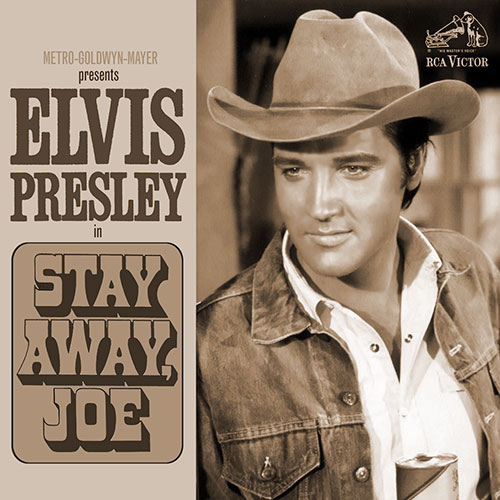
Stay Away, Joe

Stay Away, Joe (concept cover art)

May 2013

Follow That Dream Records, Sony’s collectors label for Elvis fans, is releasing this month:

  • From Elvis In Memphis (2-CD): One of Elvis’ best albums finally receives the FTD Classic Album treatment. This should make an excellent companion to the recent Back In Memphis release. Surely an “imaginary album” will be in the works at some point to feature the rest of the recordings from the 1969 American Sound Studio sessions.
  • Stay Away, Joe (CD): Speaking of imaginary albums, here is one that compiles October 1967 and January 1968 sessions. In addition to the Stay Away, Joe soundtrack, it includes “Too Much Monkey Business” and “US Male.” The January session features Jerry Reed on guitar, which is why I consider this a follow-up of sorts to the fantastic Elvis Sings Guitar Man.
  • On Stage-February 1970 (2-LP): This vinyl release includes the original On Stage-February 1970 album, recorded live in 1969 and 1970, as well as additional material Elvis recorded during his early 1970 Las Vegas engagement.
  • Summer of ’61 (Book & CD): In conjunction with Flaming Star publications, this book primarily focuses on the making of the movie Follow That Dream. A brief CD containing previously released Elvis tracks and two demos for “What A Wonderful Life” is also included.

June 2013

FTD has scheduled the following for release in June:

  • Sold Out! (2-CD): The ambiguous title of this one could refer to almost any Elvis concert from 1956 and beyond. [May 19, 2013, Update: The concerts on this release will be March 1, 1974, Tulsa, Oklahoma and June 21, 1974, Cleveland, Ohio.] This one is from the creative team behind Forty-Eight Hours To Memphis: Recorded Live On Stage In Richmond, Virginia – March 18, 1974 and 3000 South Paradise Road, so a quality presentation is expected.
  • Hot August Night (CD): This one features the August 25, 1969, Midnight Show in Las Vegas. The 1969 shows are all must-haves. Portions of this one contributed to the From Memphis To Vegas/From Vegas To Memphis (Elvis In Person) release in 1969. Many tracks are previously unreleased, however.
  • Elvis Recorded Live On Stage In Memphis (2-LP): This vinyl release features the complete March 20, 1974, Memphis concert, from which selections made up the original 1974 version of this album. I have to admit, I enjoy the truncated version of this show more than the full version. Other than “Steamroller Blues,” the songs edited out of the 1974 1-LP release featured some disappointing performances by Elvis.
  • Best of British: The HMV Years (Book): This is a reprint of the popular book exploring Elvis’ 1956-1958 releases on the HMV label in Great Britain, which sold out upon release in February. Though not noted in the press release, presumably the two CDs of previously released Elvis material from the original printing are also included.

The only physical store in the US authorized to sell FTD releases is Good Rockin’ Tonight, a Graceland gift shop in Memphis. However, FTD products may be obtained online from a variety of other Elvis stores, including Graceland’s ShopElvis.com.

August 2013

Sony has scheduled Elvis At Stax: Deluxe Edition, a 3-CD boxed set, as a main label, wide release in August. The set will include all of the masters Elvis recorded in Memphis at Stax Recording Studio in July and December of 1973. It will also include alternate takes of many of the songs. Here is the track listing:

DISC 1: The R&B and Country Sessions – The Outtakes

1. I Got A Feelin’ In My Body – take 1
2. Find Out What’s Happening – take 8/7
3. Promised Land – take 4
4. For Ol’ Times Sake – take 4
5. I’ve Got A Thing About You, Baby – take 14
6. It’s Midnight – take 7
7. If You Talk In Your Sleep – take 5
8. Loving Arms – take 2
9. You Asked Me To – take 3A
10. Good Time Charlie’s Got The Blues – take 8
11. Talk About The Good Times – take 3
12. There’s A Honky Tonk Angel – take 1
13. She Wears My Ring – take 8
14. Three Corn Patches – take 14
15. I Got A Feelin’ In My Body – take 4
16. If You Don’t Come Back – take 3
17. Promised Land – take 5

DISC 2

Part 1 – The Pop Sessions – The Outtakes

1. Mr. Songman – take 2
2. Your Love’s Been A Long Time Coming – take 4
3. Spanish Eyes – take 2
4. Take Good Care Of Her – takes 1,2,3
5. It’s Diff’rent Now (unfinished recording)
6. Thinking About You – take 4
7. My Boy – take 1
8. Girl Of Mine – take 9
9. Love Song Of The Year – take 1
10. If That Isn’t Love – take 1

Part 2 – The July 1973 Masters

11. Raised On Rock
12. For Ol’ Time Sake
13. I’ve Got A Thing About You, Baby
14. Take Good Care Of Her
15. If You Don’t Come Back
16. Three Corn Patches
17. Girl Of Mine
18. Just A Little Bit
19. Find Out What’s Happening
20. Sweet Angeline

DISC 3: The December 1973 Masters

1. Promised Land
2. It’s Midnight
3. If You Talk In Your Sleep
4. Help Me
5. My Boy
6. Thinking About You
7. Mr. Songman
8. I Got A Feelin’ In My Body
9. Loving Arms
10. Good Time Charlie’s Got The Blues
11. You Asked Me To
12. There’s A Honky Tonk Angel
13. Talk About The Good Times
14. She Wears My Ring
15. Your Love’s Been A Long Time Coming
16. Love Song Of The Year
17. Spanish Eyes
18. If That Isn’t Love

I have mixed feelings on this release. I think it is wonderful for the main label to focus on an overlooked period in the recording career of Elvis Presley. For those fans who do not already have the corresponding FTD Classic Album 2-CD sets (Raised On Rock, Good Times, and Promised Land), this is an excellent, budget-conscious alternative to hear highlights of this material.

However, the first thing I noticed is that Sony really blew the sequencing of these tracks. Why, oh, why would the compiler of this collection choose to kick things off with the dreadful “I Got A Feelin’ In My Body”? Especially when “Promised Land” is sitting there, practically begging to begin this set in the right manner?

Short of starting from scratch, one simple alternative that I can suggest would be the following:

  • Swap Disc 1 with Disc 3
  • Swap Disc 2 – Part 1 with Disc 2 – Part 2

Just making the simple changes above would result in a much better listening experience from start to finish. Again, it is great to see a release focusing on 1973, but it should not just be grudgingly thrown together. While Sony’s Elvis team may disagree, some of us love this material. Treat it right.

Sony is also releasing in August a 1-CD version and a 2-LP version collecting some of the above Stax material.

One for Mom, the rock ‘n’ roll rebel

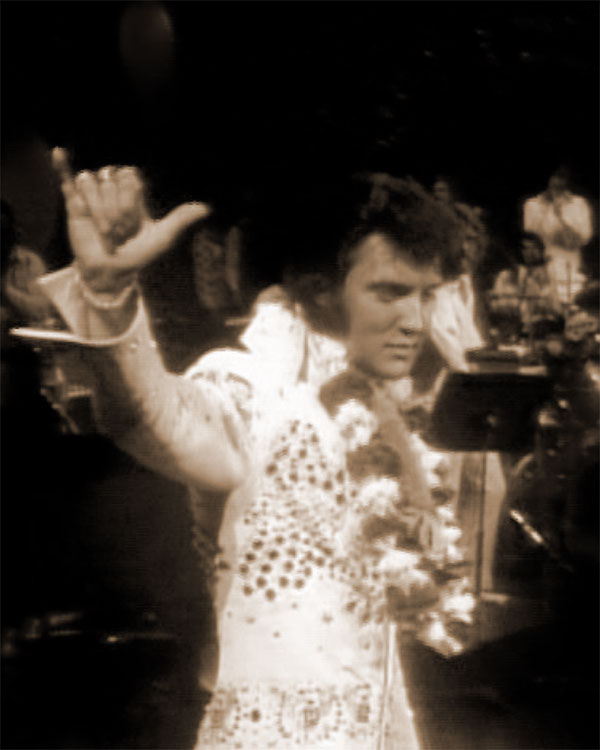
Elvis Aloha Finale

Elvis, 1973

I am a second-generation Elvis fan. My mom first heard Elvis in 1956, during the initial wave of his national success. By the end of that year, after multiple television appearances and a movie role in Love Me Tender, Elvis had earned millions of new fans. Mom was one of them.

Through marriage and kids, good times and bad times, she stuck with Elvis over the years. By the time I came along in the mid-1970s, both my mom and my brother were fans. You could say I was born an Elvis fan.

Many of the first records I ever heard were Mom’s old 45s from the 1950s and 1960s. Though I remember listening to them when I was about two-years-old, I cannot recall specific songs. The earliest ones that I can remember are “My Way” and “America The Beautiful,” two sides of a single that came out in the months after Elvis’ death in 1977.

I have told stories here before about Mom blasting cassette tapes of As Recorded At Madison Square Garden and Elvis In Concert in the car when I was young. Though she has upgraded to CDs and expanded her selection of albums, she still does this.

Though Mom is a first-wave Elvis fan, she does not turn her nose up at his post-Army work like some of her contemporaries. She actually prefers his 1970s music above all.

That being said, she also prefers songs with a beat. This makes my work difficult when trying to buy her a CD, as Elvis had evolved beyond rock ‘n’ roll in her favorite time period.

I will share a couple of recent examples. I was playing a bit of A Boy From Tupelo for her. This is the ultimate boxed set collecting his 1953 to 1955 recordings. I wanted her to hear the “dry” 45-RPM SUN version of “That’s All Right.”

Ty: Listen to this. Isn’t this cool? This is how it sounded back in 1954, before RCA changed it.
Mom: I never did like that song.
Ty: You don’t like “That’s All Right”? That was his first record. The one that started it all!
Mom: I just never liked it.
Ty: You like the 1970s versions, though, right? Like on Madison Square Garden?
Mom: No, not even that one.
Ty: I can’t believe you don’t like it. I never knew that, after all of these years.
Mom: I’m sorry.
Ty: All I can say is… that’s all right, Mom.

I also gave her the FTD compilation Our Memories of Elvis, which contains alternate mixes of various 1970s songs. I had enjoyed the release the first time I heard it, so I thought the unique mixes would be a sure-fire winner.

Ty: What did you think of Our Memories of Elvis?
Mom: Oh, I liked it. I think I played it once.
Ty: Wait. You played it once? Are you sure you liked it?
Mom: It was okay. It just wasn’t fast enough. Too many slow songs.
Ty: I know, it didn’t have “Suspicious Minds” on it. [Any album that has a 1970 or later version of “Suspicious Minds” on it is an instant hit for Mom.]
Mom: I like a beat!
Ty: I know, Mom. I know!

I am actually picking on her a little here, which is not a nice thing to do on Mother’s Day. For one thing, even I did not not enjoy Our Memories of Elvis as much the second time through. I must have been in a fantastic mood the first time I played it. I actually thought it was one of the best releases ever. I am sure glad I did not review it, because then my initial overreaction would be preserved on the Internet for all to see.

For every example like the above, I should point out, there are dozens of examples of Elvis recordings and albums that Mom does love. Her favorite album is Aloha From Hawaii via Satellite. Her favorite song, as you might have guessed, is “Suspicious Minds,” especially the version on The Alternate Aloha, which has the drums more prominent in the mix.

Though she may not enjoy 1950s recordings as much anymore, Mom still has a rebellious streak in her. She likes to do things her way, no matter what anyone says. I have inherited that trait, I must admit.

Another funny thing is, while most moms are after their sons to get haircuts, my mom thinks I get my hair cut too short.

We joke around often. I love talking about Elvis and other topics with her. Elvis music is but one of many gifts she has given me. I am very proud to have such a gentle and loving woman as my mom.

With much love, here is a playlist in her honor.

Elvis: Sweet Rock ‘n’ Roll

  • Burning Love [Burning Love And Hits From His Movies, Volume 2]
  • Johnny B. Goode (Rehearsal) [Elvis On Tour: The Rehearsals]
  • Proud Mary (Live) [Close Up]
  • Suspicious Minds (Live) [Prince From Another Planet (Disc 1)]
  • Polk Salad Annie (Live) [3000 South Paradise Road]
  • One Night (Live) [Memories]
  • Blue Suede Shoes (Live) [Burbank 68]
  • Jailhouse Rock (Live) [Burbank 68]
  • Don’t Be Cruel (Live) [Burbank 68]
  • Stranger In The Crowd (Master, Rough Mix) [That’s The Way It Is (2008 FTD Edition)]
  • Baby, Let’s Play House (Rehearsal) [A Life In Music]
  • A Fool Such As I (Rehearsal) [That’s The Way It Is (2000 Special Edition)]
  • Whole Lotta Shakin’ Goin’ On [Walk A Mile In My Shoes]
  • Wearin’ That Loved-On Look (Alternate) [Memphis Sessions]
  • Rubberneckin’ [Almost In Love]
  • Hey Jude [Elvis Now]
  • Power Of My Love (Alternate) [A Life In Music]
  • After Loving You [From Elvis In Memphis]
  • Any Day Now (Alternate) [Memphis Sessions]
  • Runaway (Live) [Elvis: Viva Las Vegas (2007 Limited Edition)]
  • My Babe (Live) [Today, Tomorrow & Forever]
  • Baby, What You Want Me To Do (Live) [Elvis At The International]
  • All Shook Up (Live) [Live In Vegas: August 26, 1969 Dinner Show]
  • Hound Dog (Live) [Live In Vegas: August 26, 1969 Dinner Show]
  • Mystery Train/Tiger Man (Live) [Live In Vegas: August 26, 1969 Dinner Show]
  • A Big Hunk O’ Love (Live) [Aloha From Hawaii via Satellite]
  • Promised Land [Promised Land]
  • Steamroller Blues (Live) [A Life In Music]

Thank you, Mom.

A mess of blues on a cloudy day

In his lifetime, Elvis Presley released 19 different songs with some form of the word “blue” in the title. Here’s how I rank them:

Elvis rehearsing in 1970

Elvis rehearsing in 1970

#1 Blue Moon
#2 A Mess Of Blues
#3 Good Time Charlie’s Got The Blues
#4 Indescribably Blue
#5 Moody Blue
#6 Mean Woman Blues
#7 When My Blue Moon Turns To Gold Again
#8 Blue Suede Shoes
#9 Blue Eyes Crying In The Rain
#10 G.I. Blues
#11 Something Blue
#12 Blue Moon Of Kentucky
#13 Steamroller Blues
#14 Blueberry Hill
#15 Blue Christmas
#16 Blue Hawaii
#17 Milkcow Blues Boogie
#18 Beach Boy Blues
#19 Blue River

Your weather may vary, but today has been dreary here. Here’s hoping for some blue skies soon.

Never say goodbye to Aloha From Hawaii

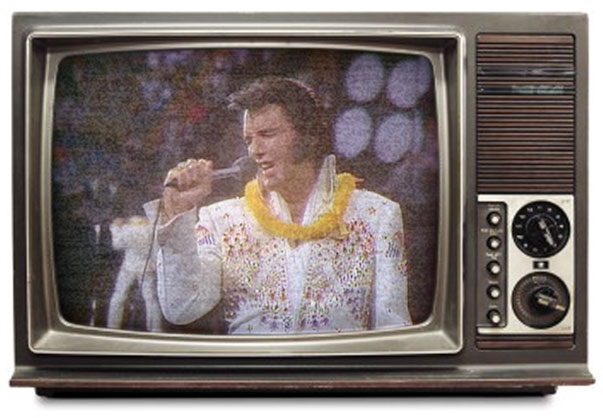
Elvis on NBC, 1973

NBC aired the Elvis: Aloha From Hawaii special on April 4, 1973

Yesterday marked the 40th anniversary of the United States television broadcast of Elvis: Aloha From Hawaii on NBC. The special had been taped in January 1973 during a “live via satellite” broadcast to certain parts of the world. With all of the hype surrounding the first live satellite broadcast by an entertainer, many Americans to this day wrongly believe they saw 38-year-old Elvis perform the show live. Little did they know that he was watching the TV special, too.

The NBC version of Elvis: Aloha From Hawaii aired from 8:30 PM to 10:00 PM on April 4, 1973. It became the most-watched show of the week. Among the viewers was indeed Elvis himself, who tuned-in from his home in Los Angeles. This edition of the show included the one-hour January 14 concert as well as four post-concert insert songs that Elvis recorded after the audience emptied from the venue.

Among Elvis fans today, the show receives mixed reviews. Some see it as the pinnacle of his career and success, while others see it as one of the first indicators of his decline. My Mom is one of those who adores Aloha From Hawaii. An Elvis fan since 1956, Aloha From Hawaii represents her ideal version of Elvis. I have a hard time getting her to watch anything else Elvis-related with me, unless we look at this one first.

As a second-generation fan, I wasn’t even born when Aloha first aired. In fact, I’m now the same age (almost to the day) Elvis was when he performed this show. While I prefer the ’68 ELVIS special and 1970’s That’s The Way It Is, I definitely enjoy Aloha From Hawaii. Though it was not his best show ever, in many ways it represented his final triumph in the eyes of the world.

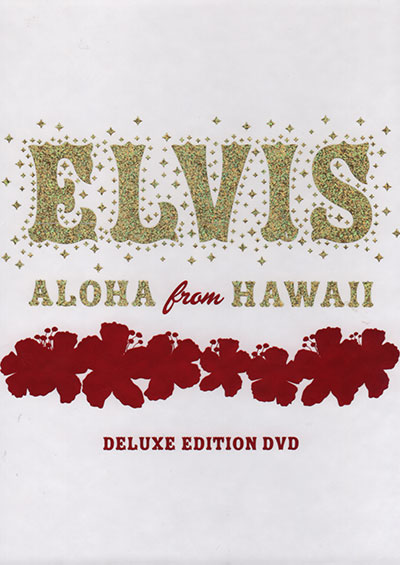
Elvis Aloha From Hawaii, 2004 Deluxe Edition

Elvis Aloha From Hawaii, 2004 Deluxe Edition

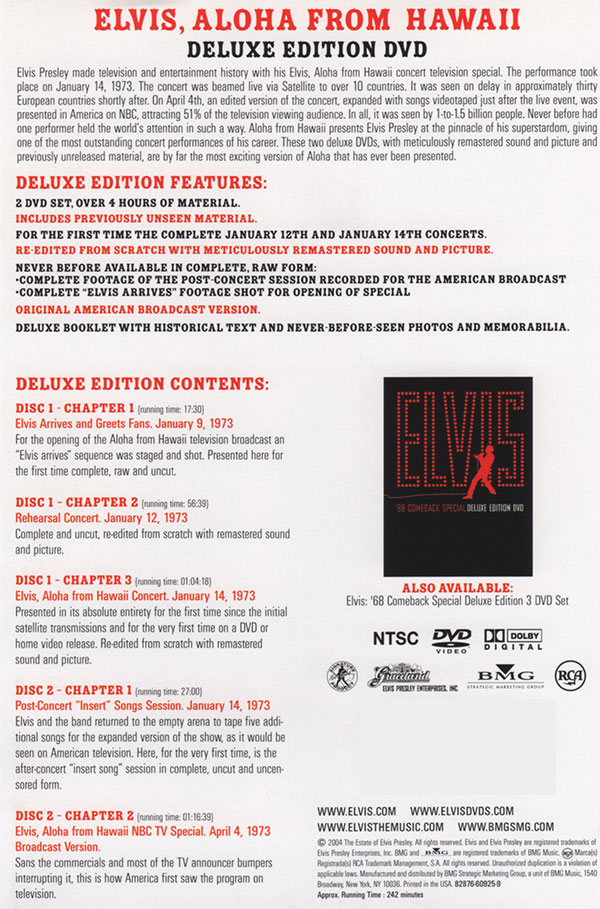
Though the show had appeared on home media several times before, Elvis Presley Enterprises and BMG released an ultimate version in 2004 as the 2-DVD set Elvis: Aloha From Hawaii – Deluxe Edition. Here are the contents:

DVD 1
1. January 9, 1973: Elvis Arrives and Greets Fans (17:30)
2. January 12, 1973: Rehearsal Concert (56:39)
3. January 14, 1973: Elvis: Aloha From Hawaii Concert (1:04:18)

DVD 2
1. January 14, 1973: Post-Concert Insert Songs Session (27:00)
2. April 4, 1973 (broadcast): Elvis: Aloha From Hawaii NBC TV Special Version (01:16:39)

Contents of Elvis Aloha From Hawaii, 2004 Deluxe Edition

Contents of Elvis Aloha From Hawaii, 2004 Deluxe Edition

2004 was a milestone year for Elvis fans. On the same day as the above, EPE and BMG also released the 3-DVD ELVIS: ’68 Comeback Special – Deluxe Edition set. I could barely contain my excitement when both sets arrived at my house nearly a decade ago now.

Executive Produced by Gary Hovey and the late Todd Morgan, both of these deluxe sets turned out to be among the most important Elvis releases ever. For obsessive Elvis fans like me, these DVDs represent essential viewing. I return to them often.

Though DVD 2 also holds interest, when it comes to Elvis: Aloha From Hawaii – Deluxe Edition, I tend to watch DVD 1 most often. The 2004 re-edits of the rehearsal and satellite shows represent the best releases of this material to date.

Last night, however, I plopped in DVD 2 in order to watch the April 4, 1973, version of Aloha From Hawaii. Before “Burning Love” could even finish, to my horror, the image on my screen began pixelating. It finally froze. An examination of the disc revealed scratches. I skipped ahead to the next song, but the problem kept occurring. I ended up watching about twenty minutes of the show in fits and starts.

I think I am very careful with my discs, so I’m not sure how these phantom scratches sometimes occur. I guess I have to chalk it up to equipment oddities. Either that or my dog plays my CDs and DVDs when I’m not around.

In any event, the reason I was horrified was not due to having to halt my 40th anniversary viewing of Aloha From Hawaii, but because I knew Elvis: Aloha From Hawaii – Deluxe Edition was now hard-to-find.

In fact, only a few months ago I had searched for it as a potential Christmas gift for someone. At that time, it was only available from third-party sellers at three times the original price. I love Elvis, but I refuse to pay exorbitant prices to such speculators. A quick check last night revealed the pricing to be the same.

Naturally, I did what any self-respecting fan would do in such a situation. I took to twitter to whine.

By this time, it was around midnight. I do not always get along with the twitter late at night, so I managed to tweet the following message to myself: My 2004 Aloha From Hawaii Deluxe Edition is giving out. If only @ElvisPresley would re-release this essential 2-DVD set.

Tweeting to myself

Tweeting to myself

I wish I could blame tweeting to myself on having a few too many, but I never drink. I don’t need to imbibe in order to do stupid things, it seems.

Fortunately, my message somehow managed to get through to @ElvisPresley, the official Elvis Presley Enterprises twitter account. Apparently the people over there at EPE actually know how to work twitter, for they sent me a link via direct (private) message to where the Deluxe Edition was still available on ShopElvis.com.

Now, why didn’t I think of that? I spend more money than I will ever admit on ShopElvis.com, but missed checking for the Elvis: Aloha From Hawaii – Deluxe Edition in this most obvious of places last night. Sure enough, it was there, in stock, and at a fair price.

  • Replacement copy of Elvis: Aloha From Hawaii – Deluxe Edition? Ordered.
  • Backup copy of ELVIS: ’68 Comeback Special – Deluxe Edition? Ordered. [This one is also now “hard-to-find” and is at crazy prices from third-party sellers.]

There is an Aloha From Hawaii for everyone. If you are not quite as obsessive as me when it comes to wanting to view all possible footage, 2006’s Elvis: Aloha From Hawaii – Special Edition DVD features only the 2004 edit of the January 14 main show. It is less expensive than the 2-DVD version and will certainly satisfy more casual fans.

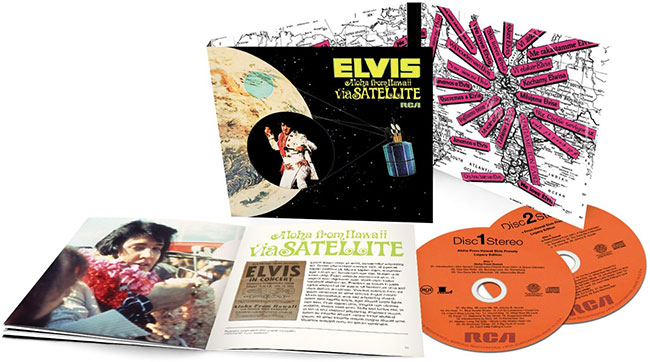
Last month, Sony released the Legacy Edition of the Aloha From Hawaii via Satellite soundtrack album as a 2-CD set. Note that this is only the music, no video.

I’ve not picked this one up as of yet, but be sure to read this fantastic review of the Legacy Edition of Aloha From Hawaii via Satellite over on The Second Disc.

Here are the contents of the Legacy Edition:

CD 1
January 14, 1973: Aloha From Hawaii via Satellite (original album, 1973 vintage mix, remastered by Vic Anesini)

CD 2
1. January 12, 1973: Rehearsal Concert (2013 mix and mastering by Steve Rosenthal and Rob Santos)
2. January 14, 1973: Post-Concert Insert Songs

Elvis Aloha From Hawaii via Satellite, 2013 Legacy Edition

Elvis Aloha From Hawaii via Satellite, 2013 Legacy Edition

King Creole: The Making Of The Movie

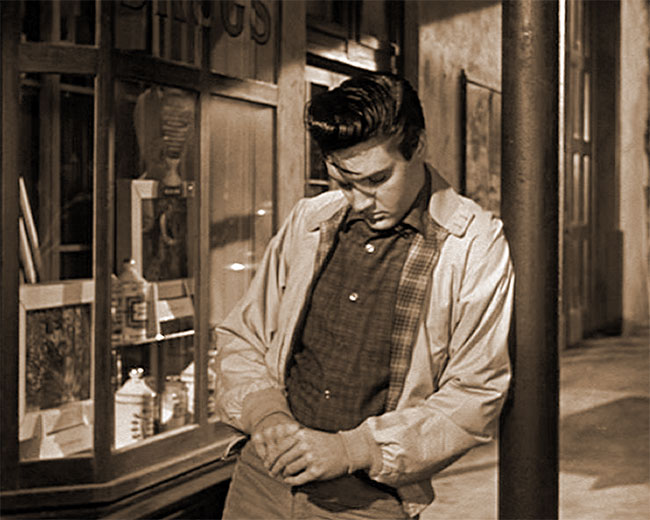
Elvis Presley, 1958

Elvis Presley in King Creole, 1958

King Creole was based on the 1952 novel A Stone For Danny Fisher by Harold Robbins. The novel’s protagonist is a boxer in New York, which the movie adapted into a singer in New Orleans to better suit audience expectations of its star, Elvis Presley. Elvis read the novel as part of his preparations for the role of Danny Fisher.

Producer Hal Wallis had been trying to get the film version of A Stone For Danny Fisher off the ground since 1955, long before Elvis was attached to the project. At that time, A Stone For Danny Fisher was also playing as an off-Broadway production.

James Dean was even rumored to have been in the running for the movie’s lead at one point. This was Wallis’ second Elvis movie. He would go on to produce nine Elvis movies in all.

Hal Wallis: “Michael Curtiz directed the film and he has a very sharp but romantic instinct. Walter Matthau made an excellent heavy and we had marvelous locations in New Orleans” (1).

Controversy swirled around King Creole before shooting even began. In late 1957, Elvis received his draft notice ordering him into the US Army as of January 1958.

With production slated to begin in Hollywood that same month, Paramount requested a deferment from the Memphis draft board, citing $300,000 it had already pumped into the movie during pre-production. Milton Bowers of the draft board replied that a deferment might be possible under the circumstances, but that Elvis would have to be the one to request it.

On Christmas Eve, 1957, Elvis wrote a letter requesting extra time before reporting to the Army in order to make King Creole. He completed the letter by wishing a “Merry Christmas” to the draft board members. Bowers and the draft board indeed granted his extension request, but soon received heat from other organizations – including the national chapter of the American Legion – calling for the immediate induction of Elvis.

Milton Bowers: “You know what made me angry about the entire thing is that he would have automatically gotten the extension if he hadn’t been Elvis Presley the superstar” (2).

Elvis Presley: “I’m glad they were nice enough to let me make this picture because I think it will be the best one I’ve made” (3).

On January 10, 1958, just two days after celebrating his 23rd birthday, Elvis departed Memphis on a train for Los Angeles. He brought along several friends, including Alan Fortas.

Alan Fortas: “Every town we passed through, no matter what time of morning or night, the whole station was jam-packed. These people knew as soon as Elvis finished this movie, he was going in the Army, so most of them considered it the last time to see him. […] People knew and they were lined up along the tracks all the way across America” (4).

Elvis arrived in Hollywood on January 13 and reported for pre-production. During the week, he also began work on the soundtrack at Radio Recorders.

During pre-production, the movie was titled Sing, You Sinners. This title was changed to Danny, and finally King Creole, based on the strength of the rock ‘n’ roll tune Jerry Leiber and Mike Stoller wrote for the soundtrack.

Filming began on January 20. Many of Elvis’ early scenes were with Jan Shepard, who played his sister, Mimi.

Jan Shepard: “[W]e worked together alone for about a week, because we did the opening of the show. He was […] just a lot of fun and buoyant, not guarded at all. There was a five-and-dime store on our set, and in the morning I would find earrings and little bracelets, little five-and-dime stuff on my dressing room table. I used to call him the last of the big-time spenders!” (5)

Because of his character’s name, Elvis often sang “Danny Boy” on set. He would return to the folk song many times over the years, including a 1959 home recording captured while he was stationed in Germany (available on the posthumous release A Golden Celebration). He formally recorded the song in 1976 at Graceland for the album From Elvis Presley Boulevard, Memphis, Tennessee. An organist played the song at the beginning of Elvis’ funeral in 1977.

Dolores Hart appeared as Nellie, one of Danny’s love interests. She had previously appeared with Elvis in 1957’s Loving You, also a Hal Wallis production.

Elvis Presley: “[King Creole] was quite a challenge for me because it was written for a more experienced actor” (6).

Dolores Hart: “Elvis, no matter what anyone says, deserves credit as a person of talent. There is no reason he shouldn’t soar to the heights the kings [of the screen] occupy now” (7).

Jan Shepard: “[Elvis] was very concentrated, very focused on playing Danny. For a kid coming in and just beginning his career he had a great sense of timing; there was great honesty in his acting. He was a very good listener, and he just became the young boy […]. Just like in his music, he really got involved in his acting” (5).

Walter Matthau played Fisher’s antagonist, Maxie Fields. It was his sixth film.
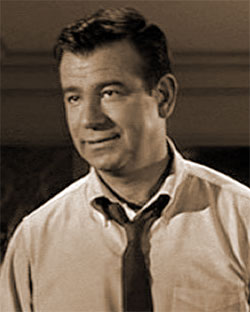
Walter Matthau, 1958

Walter Matthau in King Creole

Walter Matthau: “I almost hesitate, I creep up to the sentence, [Elvis] was an instinctive actor. Because that is almost a derogation of his talents. That’s saying, ‘Well, you know, he’s just a dumb animal who does it well by instinct.’ No, he was quite bright, too. He was very intelligent. Also, he was intelligent enough to understand what a character was and how to play the character simply by being himself through the means of the story” (8).

Michael Curtiz’s directing credits extended back to 1912. In addition to 1942’s Casablanca, for which he won an Oscar, his other work, from among nearly 200 films, included the 1937 original version of Kid Galahad, Yankee Doodle Dandy (1942), and White Christmas (1954). Curtiz was attached to King Creole before it was transformed into an Elvis movie.

Jan Shepard: “Curtiz said he thought Elvis was going to be a very conceited boy, but when he started working with him, he said, ‘No, this is a lovely boy, and he’s going to be a wonderful actor'” (5).

Walter Matthau: “Michael Curtiz used to call him Elvy and he’d call me Valty. He’d say, ‘Now Elvy and Valty, come here, now Valty, this is not Academy Award scene. Don’t act so much. You are high-price actor. Make believe you are low-price actor. Let Elvy act.’ But Elvy didn’t overact. He was not a punk. He was very elegant, sedate . . . refined and sophisticated” (8).

Jan Shepard: “You just didn’t have a lot of fooling around with Curtiz […]. But no matter what Curtiz would ask of Elvis, he would say, ‘Okay, you’re the boss'” (5).
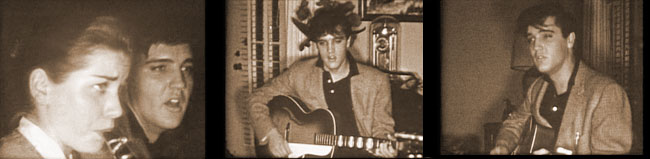
Elvis at a party in 1958

Elvis performing at Jan Shepard’s birthday party on February 22, 1958. Also pictured is Dolores Hart on clarinet.

Hart threw a birthday party for Shepard on February 22. Elvis showed up with a stuffed tiger that he named “Danny Boy.” His birthday gift for Shepard was a movie camera, definitely not from the five-and-dime store. He also played guitar and sang at the party.

King Creole was the first Elvis movie to include location shooting. On March 1, the film’s cast and crew headed for New Orleans by train. At this point, Red West, Elvis’ friend since his high school days, and actor Nick Adams, who Elvis had befriended in 1956, joined up with the rest of his entourage for the trip.

Carolyn Jones played Ronnie, Danny’s other love interest. She brought her husband, actor Aaron Spelling, along for the train ride to New Orleans. The couple would divorce in 1964. Spelling later went on to produce dozens of television series, including Charlie’s Angels and Beverly Hills 90210.

Tom Parker, Elvis’ manager, expressed concerns about security on the location shoot to Wallis. Wallis assured Parker that they could handle it. After all, he had worked with Dean Martin and Jerry Lewis at the peak of the duo’s popularity.

Alan Fortas: “There were thousands of people. Hal Wallis couldn’t believe it. […] I never saw so many people in my life. They declared it Elvis Presley Day and let the kids out of school and it took us two hours to get back to the hotel no matter where we were, even from across the street” (9).

In the French Quarter, the car carrying Elvis was almost overturned by the massive crowd.

Carolyn Jones: “[Elvis] had to ride in an old sedan, lying on the floor in the back, so his fans couldn’t mob him” (10).

Elvis took over the tenth floor of the Roosevelt Hotel, one block from where they were filming in the French Quarter. Hotel security was so tight that no one was admitted to the tenth floor. As a joke, Hart, Jones, and Adams armed themselves with toy guns and held up the elevator operator to force their way to Elvis’ floor. The elevator operator was not in on the joke and was apparently still shaken the next day.

Alan Fortas: “[W]e got on the elevator and we said, ‘Tenth floor, please.’ The elevator operator said, ‘No, sir, I can’t stop on the tenth floor. Mr. Presley is up there and we just can’t stop.’ Elvis was on the elevator with us and he said, ‘Yeah, I know. I’m Elvis.’ The elevator operator looked straight at him and said, ‘I’m sorry, sir, I can’t stop on that floor for anybody.’ We had to go to the eleventh floor and walk down” (9).

The film’s climax was shot at a house on stilts at Lake Pontchartrain. Elvis and Jones shared scenes there.

Carolyn Jones: “[Elvis] was always asking a lot of questions. God, he was young! I didn’t think anyone could be that young. He was always talking about his folks and about the house [Graceland] he’d just bought them” (8).

When onlookers at Lake Pontchartrain became unmanageable, Elvis had to escape through the back of the house to a motorboat that whisked him away.

Though Memphis was tantalizingly close, the group had to return by train to Hollywood to be released from King Creole. Elvis attended a wrap party on March 12, and then he and his friends were on yet another train. Destination: Memphis.

Alan Fortas: “We’d just sit and talk [on the train], try to write songs, try to sing. You know, just typical ol’ boys. But it got to us by the time we got to Dallas. We couldn’t take it any longer. So we got off that train and rented some Cadillacs and drove the rest of the way home” (11).

Elvis arrived home on March 14 and was inducted into the Army on March 24.

Paramount released King Creole throughout the United States on July 2. It peaked at #5 on the Variety charts. At this time, Private Presley was still stationed at Fort Hood in Texas.

Hal Wallis: “Now, although I don’t have all the figures, I believe that one of the least successful of Elvis’s films was King Creole. But that was my favorite!” (1)
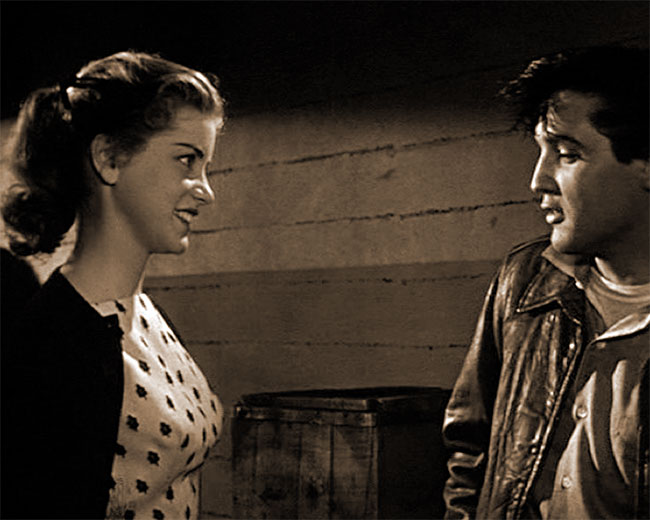
Dolores Hart and Elvis Presley in King Creole

Dolores Hart and Elvis in King Creole

Dolores Hart: “Elvis is a young man with an enormous capacity of love . . . but I don’t think he has found his happiness. I think he is terribly lonely” (12).

According to longtime friend Sonny West, if Elvis had his way, he would have reunited with director Michael Curtiz when Elvis was cast in a remake of Kid Galahad, which filmed in late 1961 (13). This time, Elvis actually played a boxer, albeit a singing one. Despite Elvis’ campaign, Phil Karlson received the directing nod instead. Curtiz passed away in April 1962 at the age of 74.

Elvis later reunited with Jan Shepard in 1966’s Paradise, Hawaiian Style, in which she played Betty Kohana. Shepard had maintained a friendship with Hart after King Creole. By this time, the quality of Elvis’ movies had declined. While King Creole is a contender for Elvis’ best movie, Paradise, Hawaiian Style is a contender for his worst.

Jan Shepard: “One time [Elvis] asked about Dolores Hart, and we had a little bit of a conversation. In the quiet moments, he was still very sweet. When we reminisced about Creole, he said, ‘Honey, that was my favorite picture'” (14).


Bibliography

  • Careless Love: The Unmaking Of Elvis Presley by Peter Guralnick, Little, Brown And Company, Boston, 1999.
  • Down At The End Of Lonely Street: The Life And Death Of Elvis Presley by Peter Harry Brown and Pat H. Broeske, Dutton, New York, 1997.
  • ELVIS: The Biography by Jerry Hopkins, Plexus, London, 2007.
  • Elvis Commemorative Edition, compiled by Bill DeNight, Sharon Fox, and Ger Rijff, Publications International, Lincolnwood, IL, 2002.
  • Elvis Day By Day: The Definitive Record Of His Life And Music by Peter Guralnick and Ernst Jorgensen, Ballantine Books, New York, 1999.
  • The Elvis Encyclopedia by Adam Victor, Overlook Duckworth, New York, 2008.
  • Elvis: The Great Performances, dir. Andrew Solt, perf. Elvis Presley, 1989, DVD, SOFA, 2011.
  • Elvis: His Life From A To Z by Fred L. Worth and Steve D. Tamerius, Wings Books, New York, 1990.
  • Elvis In Private, edited by Peter Haining, St. Martin’s Press, New York, 1987.
  • Elvis: Still Taking Care Of Business by Sonny West with Marshall Terrill, Triumph Books, Chicago, 2007.
  • Good Rockin’ Tonight: Twenty Years On The Road And On The Town With Elvis by Joe Esposito and Elena Oumano, Avon Books, New York, 1994.
  • Internet Movie Database, accessed March 23, 2013.
  • King Creole, dir. Michael Curtiz, perf. Elvis Presley, Carolyn Jones, and Walter Matthau, 1958, DVD, Paramount, 2000.
  • Last Train To Memphis: The Rise Of Elvis Presley by Peter Guralnick, Little, Brown And Company, Boston, 1994.
  • Viva Las Elvis: Celebrating The King, compiled by Peggy Thompson, Arsenal Pulp Press, Vancouver, 1994.

References

(1) Elvis In Private, p. 92
(2) Down At The End Of Lonely Street, p. 137
(3) Last Train To Memphis, p. 446
(4) ELVIS: The Biography, p. 129
(5) Last Train To Memphis, p. 450
(6) Last Train To Memphis, p. 456
(7) Elvis Commemorative Edition, p. 112
(8) Last Train To Memphis, p. 451
(9) ELVIS: The Biography, p. 130
(10) Down At The End Of Lonely Street, p. 139
(11) ELVIS: The Biography, p. 131
(12) Elvis: His Life From A To Z, p. 85
(13) Elvis: Still Taking Care Of Business, p. 120
(14) Careless Love, p. 209


My grandmother worked in the ticket booth of a theater for decades. I dedicate this series of movie posts to her, who would have turned 103 this month. I often remember her when I watch movies.