Read Phil Arnold’s foreword to Elvis: The Early Years

ElvisBlog‘s Phil Arnold has released online the full text of his foreword to the latest Alfred Wertheimer photography book, Elvis: The Early Years. The cover of this 120-page hardbound volume from earBOOKS features an iconic 1956 image of Elvis on his Harley.

Phil’s well-written essay for the October 2010 book explores the details behind Wertheimer’s various experiences with Elvis in 1956-1958, illuminating how he was able to gain closer access to the singer than any other photographer.

While other sources have indicated that Wertheimer took nearly 4,000 photographs of Elvis, Phil reveals that this number is exaggerated. “After culling out the unusable shots (too dark, out of focus, etc.), Wertheimer says he has around 2000 commercially viable photos to license for future ventures,” he notes in the foreword. Elvis: The Early Years contains 96 of those images.

The book, available in the United Kingdom, also includes 3 CDs of Elvis music from the same time period.

Read Phil Arnold’s foreword to Elvis: The Early Years over at ElvisBlog.

Rolling Stone misses the point in review of The Complete Elvis Presley Masters

Rolling Stone magazine stopped being relevant a long time ago, but I do occasionally find their music reviews interesting – when the publication bothers to cover music, that is. Their October 26 online review of Sony’s The Complete Elvis Presley Masters is an interesting study in absurdity. The point of this release, as indicated by the title, is to collect all of Elvis’ masters into one collection. Here’s what reviewer Anthony DeCurtis had to say:

[T]he later tracks in particular could use some cherry-picking: You shouldn’t have to hear his deeply moving gospel recordings and hits like 1969’s ‘Suspicious Minds’ in the context of his long, dispiriting downward spiral.”

Besides the all-too-typical jab at his later years, this is just about the most idiotic statement I’ve ever read in a professional review. DeCurtis would prefer a Complete Elvis Presley Masters collection that is incomplete in order to satisfy his warped image of who Elvis really was? He should stick with compilations like Elv1s 30 #1 Hits, then, and leave the deep catalog diving to people who actually want to study and understand the real Elvis.

Of course, idiotic statements are unfortunately not confined to Rolling Stone. I’ve also read fan reviews in more than one place lately that criticize the top-notch Viva Elvis: The Album release for having an overblown Vegas sound. That release is the soundtrack to a Las Vegas show – what exactly did they expect? Elvis unplugged?

Listen to Elvis again for the first time in Viva Elvis-The Album

Viva Elvis: The Album is the Elvis surprise of the year for me. Since I have no interest in the Cirque du Soleil show that inspired it, I was pretty much ignoring this release until a preview trailer appeared before the theatrical showing of Elvis On Tour. That preview perfectly sets up this album – in fact, it is essentially the opening track. Next, I heard the modernized version of “Suspicious Minds” and I was hooked. (The accompanying music video released yesterday on elvis.com, however, is atrocious.)

From the sound clips on Amazon and other sites, I was pretty sure this album would be about one-third great, one-third okay, and one-third awful. I missed the mark on that assessment, by a mile. The entire album is a creative show of force that left me in absolute shock. The out-of-context song clips do not even begin to do this artistic album justice. Not even the “Suspicious Minds” single is an adequate representation, for this album is an experience.

Unlike other remix-type albums, I recommend listening to Viva Elvis in one sitting from beginning to end – rather than in the segmented form that iPod convenience so often brings us. Though the Elvis vocals are mostly from studio masters, this often feels like a live show – that is, if Elvis was alive in 2010 and gave a multimedia extravaganza concert reflecting on his career.

The backing on these tracks may have changed from the familiar versions, but the heart of this music remains the same. The originals will always maintain their rightful prominence over fancy remixes, but Viva Elvis: The Album offers a chance to listen to Elvis for the first time – all over again. It is so great that I wish I could shout about it from mountaintops – but I’m really not much of a climber. Instead, I’ll just have to use my little blog.

Viva Elvis The Album, 2010

Viva Elvis The Album, 2010

Hear the once and future Elvis on Viva Elvis: The Album – now available

Viva Elvis: The Album arrives in stores today. The release features twelve main tracks, with remixes designed to make Elvis sound as if he were recording today.

1. Opening: Also Sprach Zarathustra (instrumental)
2. Blue Suede Shoes
3. That’s All Right
4. Heartbreak Hotel
5. Love Me Tender
6. King Creole
7. Bossa Nova Baby
8. Burning Love
9. Memories (instrumental)
10. Can’t Help Falling In Love
11. You’ll Never Walk Alone (instrumental)
12. Suspicious Minds

Some versions of this album include one of several bonus tracks, with Elvis singing a “duet” with a present-day performer.

Memories of yesterday, dreams of today

The Huffington Post today published in-depth interviews with Ernst Jorgensen on The Complete Elvis Presley Masters and Erich van Tourneau on Viva Elvis: The Album. The first run of the 30-disc Complete Elvis Presley Masters is sold out, with more to be available next year. The single disc Viva Elvis: The Album hits stores tomorrow. While both projects feature Elvis, one release focuses on preserving the past in a historically accurate fashion, while the other uses modern techniques to speculate on what might have been if Elvis recorded in 2010.

Van Tourneau oversaw Viva Elvis: The Album and mixed five of the release’s twelve main tracks. “[M]y mandate was to first, really contemporize the Elvis catalog and bring him into ’10. The idea was to recreate the music as if Elvis were recording the song in ’10, so I’ve created new beats, new chord changes, or new instrumental changes for each and every song,” he says. The interview also reveals that a second volume of Viva Elvis recordings may be in the works.

Ernst Jorgensen has been the man behind Elvis Presley music releases for the last two decades. Somewhere between working on a dozen FTD Elvis collectors label releases a year, not to mention Elvis projects for the main Sony label, he managed to find time to oversee the restoration work that went into The Complete Elvis Presley Masters. “It’s like everything you hope would one day happen when you do what I do–when you compile records and you write books–to be able to put all your favorite artist’s master recordings in one box set, and be given the privilege to do a two-hundred forty page book with text and illustrations describing the entire career. It doesn’t get better than that,” says Jorgensen. It does not get much better than the work Jorgensen has done for Elvis’ musical legacy, either.

Read the full interviews at the Huffington Post.

Complete Elvis masters collections put focus where it belongs – on the music

This week, fans began receiving The Complete Elvis Presley Masters – Sony’s limited edition 30-CD set containing 711 master recordings and 103 rarities (alternates, informal recordings, rehearsals, etc.). The first run of 1,000 copies sold out, but Sony reports there will be additional sets available next year. Sony’s premium release is a luxurious and finely packaged collection of Elvis’ music. It also includes a 240-page book and a display case. For the most part, songs are sequenced in the order in which they were recorded.

Still available is Elvis: The Complete Masters Collection, Franklin Mint’s 36-CD set that contains essentially the same 711 master recordings, but with none of the “rarities.” It includes a 24-page booklet, a record-player style display case, and a reproduction of Elvis’ first single, the Sun record “That’s All Right” backed with “Blue Moon of Kentucky.” Songs are arranged thematically by CD, so they often appear in a non-standard order.

Perhaps the packaging and sequencing of the Franklin Mint set are chintzy in comparison with the Sony version, but it does check in at about half the price. It also includes individual sleeves for the CDs, while the Sony version has them inserted into the cardboard of the display case.

Which set is better? That depends on your preferences and your budget. No full-scale reviews of the Sony set are available yet. It is, after all, over 35 hours of music. However, I have been following several threads on the subject over at the For Elvis CD Collectors Forum. As with most message board forums for passionate fans of any subject, there is a lot of drama. If you can get past that, though, it is a great resource for learning more about Elvis.

Here are links to some of the relevant threads for the new Sony set:

I have to give a special mention to frequent FECC poster ElvisSessions, who has provided in depth coverage of the box set in many of the threads above.

For me, the most important thing about either of these sets is that they shine the spotlight on Elvis’ music. Forget potato heads dressed in so-called tribute, collector plates, rubber duckies, mugs, and all of the other junk that clutters up his legacy. Elvis is about music, and that is what deserves to be showcased.

[Updated 11/9/2010 with additional thread links. The folks on FECC are hard to keep up with, boy! Also, thanks to LuckyJackson1 for his Complete Masters track reviews and for providing a link to this blog.]

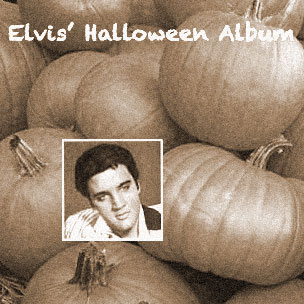
Elvis Sings The Spooktacular World Of Halloween

Elvis’ two Christmas albums were among the strongest of his career, but what if he had assembled an album of spookier-themed cuts? You’ve just crossed over into . . . the edge of reality.

Elvis' Halloween Album

Elvis' Halloween Album

Elvis’ Halloween Album

Side A
Devil In Disguise
Mystery Train
Dark Moon
How The Web Was Woven
City By Night

Side B
Witchcraft
Ghost Riders In The Sky
Blue Moon
It’s Midnight
Edge Of Reality