Elvis’ Last Concert Steps Out Of The Bootleg Shadows

“Ladies and gentlemen, the picture you have just seen was the last live performance of Elvis on stage,” announced Vernon Presley, Elvis Presley’s father, at the end of Record 1 of 1977’s Elvis In Concert soundtrack album.

For years, this and a similar message from Vernon at the end of the CBS television special caused the general public and casual fans to believe the project was indeed Elvis’ last concert.

Elvis In Concert was a compilation of highlights from two shows during Elvis’ last tour – Omaha, Nebraska, on June 19, 1977, and Rapid City, South Dakota, on June 21.

Elvis actually performed a few more concerts after Rapid City, which were not captured on professional video or audio. His last was on June 26 in Indianapolis, Indiana.

After making the bootleg rounds for decades, an audience recording of Elvis’ last concert will soon be officially released for the first time by Follow That Dream (FTD) Records. FTD began in 1999 and is Sony’s collectors label for Elvis fans.

The performance headlines a 3-CD set called Elvis: The Last Concert – Market Square Arena, Indianapolis, June 26, 1977. New audio work on the recording was performed by Anthony Stuchbury, known for his Elvis “Mono II Stereo” CD series in Europe.

The other shows on the set will be October 18, 1976, Sioux Falls, South Dakota (CD 2), and December 30, 1976, Atlanta, Georgia (CD 3). These are two of the soundboard shows FTD previously bundled with a re-release of the Bruce Jackson On The Road With Elvis book.

Jackson, who died in 2011, worked as part of Elvis’ audio team for shows in the final years and taped many of them direct from the soundboard for various purposes. Though he is rumored to have taped the last concert, it has never surfaced in any form.
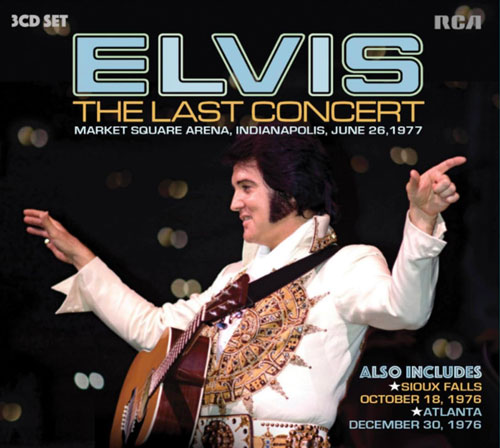
Cover of ELVIS: THE LAST CONCERT (2026, FTD)

Cover of ELVIS: THE LAST CONCERT (2026, FTD)

I’m selective when it comes to Elvis releases, including FTD, but this set is a must-have for me due to the historical significance of the Indianapolis show. I usually avoid 1976 shows, but my understanding is that the December 30 Atlanta concert is among the best for that year. I’m always in favor of FTD re-releasing CDs previously bundled with their exorbitantly-priced books, so including two of Jackson’s soundboard recordings is a good move here.

While The Mystery Train is not a news site – I leave that to Kees’ incredible Elvis Day By Day site – this is one of those times where a story is so important to me that I had to share it with you. Check out Elvis Day By Day for the full tracklisting, as provided by FTD.

Circling back to Vernon, who was obviously still overcome with grief during his message just six weeks after Elvis’ death, presumably the “last live performance” myth was written for him in order to better promote the special. He was almost surely unaware of which concerts were taped when.

Forty-nine years later, in my offline Apple Music playlist, Vernon’s message will now have its proper home on Elvis: The Last Concert.


Elvis’ Last Tour

June 17, 1977: Springfield, Missouri
June 18: Kansas City, Missouri
June 19: Omaha, Nebraska
June 20: Lincoln, Nebraska
June 21: Rapid City, South Dakota
June 22: Sioux Falls, South Dakota
June 23: Des Moines, Iowa
June 24: Madison, Wisconsin
June 25: Cincinnati, Ohio
June 26: Indianapolis, Indiana


“The LORD is close to the brokenhearted; he rescues those whose spirits are crushed.”
Psalm 34:18 NLT
Vinyl Elvis: MOODY BLUE (1977)

Today marks the 45th anniversary of the July 19, 1977, release of Moody Blue, an album that turned out to be the last Elvis Presley record before his death four weeks later.

MOODY BLUE (RCA, 1977; from TY's collection)

MOODY BLUE (RCA, 1977; from TY’s collection)

Moody Blue
Label: RCA
Catalog Number: AFL1-2428
Recorded: 1974-1977 | Memphis, TN; Ann Arbor, Michigan; Kalamazoo, Michigan
Released: 1977

Before I had Elvis records of my own, I remember checking out a couple of his albums from the public library. I must have been about ten-years-old.

The two records I took home that day in 1985, which I believe represented the entirety of the library’s Elvis music collection, were The Sun Sessions and Moody Blue. The fact that I had borrowed both his very last record and a compilation of his very first records escaped me.

I enjoyed both albums, but the one that really drew me in was Moody Blue. For one thing, the record was pressed on blue vinyl. I had never seen anything like that. Plus, I just loved the sound of the album — particularly “Way Down,” which I played over and over.

I played “Way Down” for my older brother later that day to show off knowing a “new” Elvis song, only for him to inform me that he had his very own copy of Moody Blue.

At that time, I was not allowed to touch my brother’s records (and rightly so, as I was often unintentionally destructive of his things). Today, as he generously gave me all of his Elvis records several years ago, his copy of Moody Blue is mine.

Side A of MOODY BLUE (RCA, 1977; from TY's collection)

Side A of MOODY BLUE (RCA, 1977; from TY’s collection)

Side A

  1. Unchained Melody (1977)
    A compelling live version of “Unchained Melody” leads off the record. I normally prefer to open with a rocker, but this choice works perfectly for Moody Blue. Incidentally, this is my beloved bride’s favorite Elvis song she has heard so far, and she notes Elvis’ emphasis on the word “God” versus versions of this song by others. Indeed, in Elvis’ hands, the lyric “God speed your love to me” can be heard as “God, speed Your love to me.” Similarly, “I’ll be coming home, wait for me,” can be interpreted as “I’ll be coming Home, wait for me” in Elvis’ version. Elvis seems to be calling out not to a lost love, but to God.
  2. If You Love Me (Let Me Know) (1977)
    When I was listening to the library’s copy as a 10-year-old, I distinctly remember recognizing this live song from the Elvis In Concert album and wondering why this one sounded better. Part of the reason was that it was actually recorded a couple of months earlier than the version on Elvis In Concert. Some debate whether this song, made popular by Olivia Newton-John, should have been in his setlist. No matter, this is his best version of a song that obviously spoke to him.
  3. Little Darlin’ (1977)
    Next up is another live recording, Elvis’ fun take on the 1950s classic, “Little Darlin'”, which also provides a much-needed change in tempo. I love his ad-lib of “To hold in mine…your little foot…uh, hand!”
  4. He’ll Have to Go (1976)
    The tempo slows back down for “He’ll Have To Go,” the last studio recording ever made by Elvis. In addition to the resonance of the Elvis vocals, I love the guitar work of James Burton here. Six of the songs on this album were recorded at Graceland in 1976 in an effort to make the artist feel more comfortable, as Elvis in later years had become reluctant to record in a formal studio setting. Two sessions at a makeshift studio in his den resulted in sixteen songs, ten of which had already been used on the From Elvis Presley Boulevard album by the time RCA was assembling Moody Blue.
  5. Let Me Be There (1974)
    In early 1977, Elvis backed out of a planned session in Nashville to finish the Moody Blue album. Instead, a few live performances were recorded that April. Only three suitable songs were captured, however, which brought the album’s total to nine. In desperation, RCA re-released “Let Me Be There” from 1974’s Recorded Live On Stage In Memphis album to round out Side A of Moody Blue. Another Olivia Newton-John hit, “Let Me Be There” fits well on Moody Blue, despite being slightly older than the other recordings. In addition to the Newton-John connection tying it to “If You Love Me,” it was also recorded in Memphis like the majority of the other songs on this album.

Side B

Side B of MOODY BLUE (RCA, 1977; from TY's collection)

Side B of MOODY BLUE (RCA, 1977; from TY’s collection)

  1. Way Down (1976)
    All of the songs on Side B of Moody Blue were recorded at Graceland. I probably have the master of “Way Down” on at least a half dozen CDs. None of them sound as incredible as listening to this record. Is it all in my head? Possibly, but if it is, do not tell me. “Way Down” really rocks, making it an appropriate A-side for what turned out to be Elvis’ last single before his death.
  2. Pledging My Love (1976)
    “Pledging My Love” is another terrific performance by Elvis. He might have lost much of the joy in his life by this point, but you can still hear it on this song.
  3. Moody Blue (1976)
    I find it cool that the album’s title song is buried in the middle of Side B. “Moody Blue,” another great song, almost sounds like disco. Compare the guitar licks on “Moody Blue” with Kool & the Gang’s “Celebration” (1980), for instance.
  4. She Thinks I Still Care (1976)
    Elvis recorded many country songs, particularly in the 1970s. “She Thinks I Still Care” is a stellar performance. At the end, he just will not let the song go, either.
  5. It’s Easy For You (1976)
    “It’s Easy For You” was written by Broadway legends Andrew Lloyd Webber and Tim Rice, bringing to a close an album that was almost as varied as Elvis’ entire career: Adult Contemporary, Country, and Rock ‘n’ Roll. It is hard to ask for more in an Elvis album, and I still consider Moody Blue one of his best. A fun bit of trivia: Note the misspelling of Webber’s name on the Moody Blue Side B label in the image above. Proofreading has apparently never been a strong point for Elvis’ music label.

I mentioned that my brother did not let me touch his records when I was young. This turned out to be a good thing for me, as Moody Blue sounds flawless. Not a crackle or a pop to be heard on either side.

Back cover of MOODY BLUE (RCA, 1977; from TY's collection)

Back cover of MOODY BLUE (RCA, 1977; from TY’s collection)

The interesting thing about Moody Blue is that such a fantastic album could result from not only a hodgepodge of recordings but also such a low point in Elvis’ life. “You don’t have to face the music, you don’t have to face the crowd,” he laments on “It’s Easy For You.” Depression, loneliness, and various personal demons were consuming his life by this point. Years of prescription drug addiction and abuse were beginning to take a public toll.

Part of the credit for the unlikely strength of Moody Blue must go to producer Felton Jarvis. While he occasionally went too far with overdubs on previous Elvis projects, Moody Blue is all the better for his extra work and attention to detail–particularly on the 1977 live recordings. Credit must also go to the musicians and vocalists who worked with Elvis on the album. On occasion, they carry Elvis. Finally, credit is due to Elvis as well, who managed to pull these performances from somewhere inside himself, despite not being in the right frame of mind to record.

Inner sleeve (front) from MOODY BLUE (RCA, 1977; from TY's collection)

Inner sleeve (front) from MOODY BLUE (RCA, 1977; from TY’s collection)

I love the inner sleeves on vintage Elvis albums. Check out the ads for other albums, which must have acted as combination check lists and wish lists for fans of the time. In some cases, it was also a way to see some alternate cover designs. For example, note the Moody Blue concept artwork in the bottom left of the image below.

Inner sleeve (back) from MOODY BLUE (RCA, 1977; from TY’s collection)

The fall of the curtain came much too early for Elvis, but Moody Blue certainly made for an impressive last act. If you collect Elvis on vinyl, this one is a must.


“Anyone who believes in Me may come and drink! For the Scriptures declare, ‘Rivers of living water will flow from His heart.'”
John 7:38

Amarillo ’77 for completists only

Amarillo '77I originally planned to write a full review of Follow That Dream’s Amarillo ’77, but I just don’t have the heart to do it. I enjoy much of the 1977 material on Elvis In Concert, Spring Tours 77, and Unchained Melody, so I was looking forward to this release.

I’ve played it twice now, and I’m going to have to put it away for awhile. It pains me to write this, but Amarillo ’77 is the worst Elvis concert album I’ve ever heard. I don’t own every FTD release, so perhaps there are some worse ones out there. If so, I don’t need to hear them. I have never felt like this after listening to an Elvis album. Unless this is the last CD you need to complete your collection, I can’t recommend Amarillo ’77.

Despite its misleading title, Amarillo ’77 is actually a compilation of songs from five different concerts. While it could be said that the performances on Spring Tours 77 were cherry-picked to cover only highlights, I believe the opposite is true of Amarillo ’77.

This is one of only four official albums ever released that is devoted to 1977 material. Given how rarely this Elvis year is visited, why were these particular performances chosen? Rather than picking cherries, I believe someone intentionally plucked a bunch of sour grapes this time.

I don’t believe in kicking a man while he is down, even if it is 34 years after the fact, so I’m just going to leave my thoughts on this depressing disc at the above.

I can really use a good laugh right now, so I’m going to pull out FTD’s All Shook Up, which covers Elvis’ August 26, 1969, Midnight Show at the International Hotel in Las Vegas. It features Elvis in good spirits and at the top of his game.

Where Elvis never stood alone

I enjoy exploring all different areas of Elvis’ career. With Follow That Dream’s recent announcement that Amarillo ’77 will be among its June CD releases, I thought this would be a good time to take a look back at the 1977 recordings officially available to this point.

Not including the post-midnight tracks on FTD’s New Year’s Eve audience recording, there have been three key official releases of 1977 concert material in the years since the death of Elvis:

  • Unchained Melody (2007, FTD, covering February)
  • Spring Tours 77 (2002, FTD, covering March through May)
  • Elvis In Concert (1977, RCA, covering June; serves as soundtrack to TV special of same name)

All three of these releases have something to offer fans who are willing to listen.

Unchained Melody contains one of my favorite Elvis performances from any time, a stirring rendition of “Where No One Stands Alone,” with Elvis leading the way on piano. Recorded February 16 in Montgomery, Alabama, this marks the only known instance of Elvis performing this song live.

I actually prefer this nearly heart-wrenching version over his 1966 studio master of the song, recorded for How Great Thou Art. After hearing the raw emotions of this live version, the studio version sounds almost antiseptic – as if in 1966 Elvis had not really lived enough to fully convey the song compared to eleven years later.

Just a few days later, on February 21 in Charlotte, North Carolina, Elvis pulls out a blues number that he seemed to always have ready in his back pocket – “Reconsider Baby.”

Though Elvis formally recorded the song in 1960 for Elvis Is Back!, a 1956 version of the song from “The Million Dollar Quartet” jam at Sun Records made its debut on The King of Rock ‘n’ Roll in 1992. Live versions from 1961, 1969, and 1972 have also been released, all of which, like this 1977 track and its predecessor on New Year’s Eve, feature a committed Elvis. Lowell Fulson first recorded the song in 1954, around the same time that Elvis recorded “Good Rockin’ Tonight.” In Charlotte, “Reconsider Baby” is a good performance. Elvis never lost his feel for the blues.

At that same February 21, concert, Elvis also performs the only known live version of “Moody Blue” (outside of giving up after a false start in the same city the night before). This is another good performance. It is sometimes amazing how well Elvis could sing a song that he admittedly did not know. It is also a testament to the work of the TCB Band, that they could carry him when all he had was a lyric sheet. Lyric sheet or not, this is still a worthy listen.

At a Valentine’s Day show in St. Petersburg, Elvis takes over the piano momentarily from Tony Brown to show him how to play the intro to “Blueberry Hill.” What follows is a fantastic, though all too brief, take on the song – which Elvis first recorded in 1957.

A February 18 performance of “Release Me” in Columbia, South Carolina, is another highlight. For the briefest of moments, it sounds like it could be 1970 – but only a moment.

The highlight of Spring Tours 77 is beyond a doubt his March 26 performance of “Blue Christmas” in Norman, Oklahoma. The song takes on a different tone here than his bluesier 1968 live versions or his 1957 studio version. He sounds desperately sad, which is only underscored by our knowledge that he has already celebrated his final Christmas by this point. While I like the performance, this is not something I’ve added to my normal Christmas rotation. It’s just too sad.

The often-underrated Elvis In Concert contains a number of fine performances, including one of his best ever versions of “My Way” on June 21 in Rapid City. A brief snippet of “I Really Don’t Want To Know” from that same show also illustrates that he could still tap into his power. Even Omaha on June 19, sometimes described by others as one of his worst concerts, offers up a decent version of “How Great Thou Art” and an entertaining performance of “And I Love You So.”

My original intent in all of this was not to go through track-by-track highlights of 1977, but to point out that even one of Elvis’ lesser years can still hold magic. It is a mistake to focus only on certain aspects of Elvis’ career and to ignore the rest. While 1968-1971 may indeed be my personal favorite span, I would not want that to be the only Elvis I ever hear.

It is also unfair to use peak moments like 1968-1972 or 1954-1958 as the measuring sticks for everything else. Of course, everything is going to pale in comparison to those very special times in his life, but that does not mean that it lacks value. 1977 should not be ignored, not by Elvis Presley Enterprises, not by Sony & FTD, and most of all, not by us – his fans. I commend FTD for deciding to release Amarillo ’77.

So, pull out those 1977 recordings and give them a spin. He was on that stage for his fans, and he left these and other recordings as part of his legacy. They are an essential part of understanding the whole Elvis.

* * *

The Amarillo ’77 concert took place on March 24, 1977. Below is the track listing:

01 That’s All Right
02 Are You Lonesome Tonight
03 Reconsider Baby (intro only)
04 Love Me
05 If You Love Me
06 You Gave Me a Mountain
07 Jailhouse Rock
08 O Sole Mio/It’s Now or Never
09 Little Sister
10 Teddy Bear/Don’t Be Cruel
11 My Way
12 Band Introductions/Early Mornin’ Rain
13 What’d I Say/Johnny B. Goode
14 Band Introductions
15 School Days
16 Hurt
17 Hound Dog
18 Can’t Help Falling in Love
Bonus Tracks
19 And I Love You So
20 Fever
21 Love Me Tender
22 Blue Suede Shoes
23 Steamroller Blues
24 Help Me
25 Why Me, Lord
26 Bosom of Abraham
27 You Better Run
28 How Great Thou Art
29 Trying to Get to You

Elvis Music Never Dies [The Film Frontier blog]

We focus on Star Trek, Star Wars, and Superman here on The Film Frontier, though we do branch out to other genre projects whenever possible. I’m actually as big of a fan of Elvis Presley as I am of those three franchises, but I generally don’t cover him here since he doesn’t quite fit our format.

However, rules are made to be broken. August 16th marks the 30th anniversary of Elvis’ death (one of my earliest memories, actually), so I’m going to indulge myself a bit in today’s post.

My favorite song is “If I Can Dream,” recorded in June 1968 for the ELVIS television special on NBC. “If I Can Dream” is as relevant today as it was to those turbulent times.

[Video source: ElvisPresleyCentral–YouTube]

“If I Can Dream” is how I like to remember Elvis, the real Elvis. Not the impersonator buffoons and tall-tale myths that the media likes to showcase.

In addition to his serious side, though, I also like remembering his humorous side, as shown in this collection of bloopers, outtakes, and other fun moments from the same ELVIS special.

[Video source: ElvisPresleyCentral–YouTube]

Incidentally, ELVIS is now known as “The ’68 Comeback Special” since it marked the end of an unfortunate concentration on silly movies and soundtracks and the beginning of the best phase of his career. “I’m never going to sing another song I don’t believe in. I’m never going to make another movie I don’t believe in,” Elvis said at the time.

Only nine years later, he was gone. But the music is still here.


August 21 marks the tenth anniversary of The Film Frontier. I actually started it out as a little site on AOL covering the Star Trek movies. At the time, the movies were not very well represented on the web, particularly those involving the classic crew.

I actually used Microsoft Publisher to create that first version of the site. I was pushing that program to its limits, let me tell you. Somewhere along the line, I learned enough HTML to be dangerous and also upgraded to Macromedia Dreamweaver. Nowadays, though, focus has shifted to the blogs so Google Blogger does most of the work. That’s fine, because I’m lazy anyway.

I was a college student back when I first began the site. Now, I’m about to become a college student again. I guess some things never change.

June 1977: The Final Concert Tour [The Elvis Beat newsletter]

I was 22 when I wrote this review back in 1997 for The Elvis Beat #16, which turned out to be the final issue of my official Elvis Presley Fan Club newsletter. Though I did not formally dissolve the club until 2000, it went on hiatus after I released this issue. A couple of months later, on August 21, 1997, I started my first website – Star Trek: The Film Frontier, devoted to the first six Trek movies. I added a blog element to The Film Frontier in 2006 and, before I knew it, I was writing about Elvis again. In many ways, I have gone full circle for this path eventually led to The Mystery Train.


“We’re here to entertain you and to make you happy. So, just enjoy yourself, and leave the driving to us,” said Elvis to an adoring crowd in Rapid City, South Dakota on June 21, 1977. Elvis had been doing just that for over 20 years – entertaining his fans and making them happy.

What was to be Elvis’ last concert tour began on June 17, 1977, in Springfield, Missouri. The tour was a short one compared to many of his others, with concerts in ten cities in ten days.

The following day, the tour moved to Kansas City. The June 19 appearance in Omaha, Nebraska was taped for a CBS television special set to air that fall. Only three songs were used from the Omaha performance in the Elvis In Concert special, which was broadcast posthumously.

“If you think I’m nervous,” Elvis said quietly on stage, “you’re right.”

Many fans were interviewed on camera for Elvis In Concert, which is not officially available on video. Perhaps the most genuine in his responses was a young black man who said:

I give Elvis a lot of credit for bringing blues into rock and country. He’s the first guy to ever do that, and I admire him for it. He has a lot of courage. He’s my number one singer of all time. I hope to name my kid after him someday. . . .

I just love the guy. I know that sounds kinda weird, but I just love the guy, and I wish him many years of success. . . .

I have about four of his gospel albums, and my favorite is How Great Thou Art. It makes you feel good when he sings it. It brings tears to your eyes.

The next day, Elvis performed in Lincoln, Nebraska. CBS also taped his concert in Rapid City on June 21. It was from this performance that most of the songs in the Elvis In Concert special were drawn.

“If you haven’t guessed by now, you’re on television,” Elvis said with a characteristic grin to the audience. “Don’t let the lights and cameras throw you, and try not to throw the lights and cameras if you can help it.”

Elvis In Concert was Elvis’ first television special in four years after the blockbuster Elvis: Aloha From Hawaii. The contrast in his appearance between the two shows is striking.

“He was obviously way overweight,” said Elvis’ friend Joe Esposito a few years after the singer’s death. “Despite his age, only 42, we knew he was in bad health. It was rough for him, but Elvis accepted his appearance, and so did his fans.”

Although he did look ill, that special Elvis smile was still there. The love and magic was still there. He was Elvis. Through all the ups and downs, the fans always loved him and still do.

With CBS’s taping complete for the special, the concert tour continued through Sioux Falls, Des Moines, Madison, and Cincinnati over the next several days.

The Market Square Arena in Indianapolis hosted Elvis on June 26 for the last stop of the tour. The concert would prove to be his last before dying six weeks later at his home, Graceland.

For the last performance of his life, Elvis sang:

  • See See Rider
  • I Got A Woman/Amen
  • Love Me
  • Fairytale
  • You Gave Me A Mountain
  • Jailhouse Rock
  • It’s Now Or Never
  • Little Sister
  • Teddy Bear/Don’t Be Cruel
  • Release Me
  • I Can’t Stop Loving You
  • Bridge Over Troubled Water
  • Early Morning Rain
  • What’d I Say
  • Johnny B. Goode
  • I Really Don’t Want To Know
  • Hurt
  • Hound Dog
  • Can’t Help Falling In Love

Joe Esposito said it best, “Just six weeks before his death, he still poured his heart out. To the end, Elvis’ greatest gift – his incredible voice – never failed him.”

When all is said and done, after all the books have been written, and when all the tales have been spun, the only question that will be important is, “What did Elvis do?”

He made people happy.

That was his life.


Note: Years later, portions of the above circulated in bootleg promotional material without permission. It is reproduced here in its original context.

Is Greed Alive? [The Elvis Beat newsletter]

I was 19 when I wrote this piece back in 1994 for The Elvis Beat #10, my official Elvis Presley Fan Club newsletter.


The headline “Elvis is alive” on the front page of The Richmond Times-Dispatch, a legitimate and respectable newspaper, was a bit surprising. Unfortunately, the theories presented in the article were old news, worthy only of The National Enquirer.

Phil Aitcheson called a press conference on September 16 in Moneta, Virginia, to announce the findings of his two-year investigation into Elvis’ death. He alleges that the singer faked his death.

Aitcheson explained that Elvis had been made a federal agent at large in 1971 after meeting with President Richard Nixon, and then became involved in a major FBI investigation of organized crime. Aitcheson says that Elvis faked his death on August 16, 1977, to enter the federal witness protection program. “Elvis wanted to help his country out any way he could,” he said.

Aitcheson’s “Presley Commission,” which consisted of 14 other members who apparently wish to remain anonymous, assembled The Presley Report, a 300-page document that supposedly proves their findings.

A 1981 recording, made four years after Elvis died, was played for reporters at the press conference. The recording was analyzed by an “expert” who found that the voice on the recording was Elvis Presley.

Similar claims were made by author Gail Brewer-Giorgio in her 1990 book The Elvis Files. Her book and a 1991 television special of the same name, hosted by Bill Bixby, used similar documents and the same recording as “evidence.”

Brewer-Giorgio previously wrote The Most Incredible Elvis Presley Story Ever Told (1987) and Is Elvis Alive? (1988) about Elvis faking his death. She also wrote a 1979 novel, Orion, about a singer loosely based on Elvis who faked his death.

Brewer-Giorgio’s evidence was shot down in a 1992 follow-up television special, The Elvis Conspiracy. Also hosted by Bixby, the second special had the tape analyzed by a new expert who found that the voice was not that of Elvis. The program also found all of the other major evidence false as well and concluded that Elvis is dead.

One can only speculate if Brewer-Giorgio is somehow connected with Aitcheson’s project as well, attempting to cash in on Elvis’ loyal fans once again. The Presley Report sells for $29.95, and Aitcheson claims that profits will go to the National Multiple Sclerosis Society in Elvis’ name.

The Elvis Beat recommends that fans contribute to their favorite charities in a more direct fashion.