Elvis Presley Enterprises to release ALOHA FROM HAWAII: 40th ANNIVERSARY EDITION DVD in mid-August

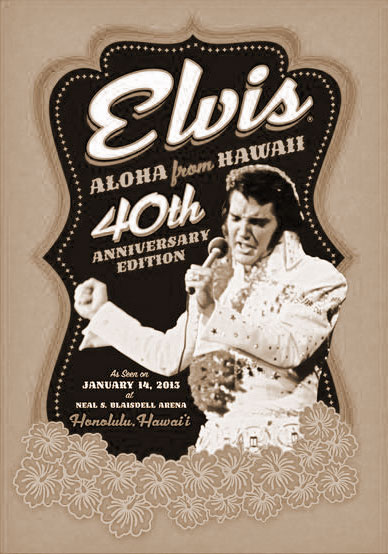
ALOHA FROM HAWAII: 40th ANNIVERSARY EDITION DVD (2013)

ALOHA FROM HAWAII: 40th ANNIVERSARY EDITION DVD (2013)

This product snuck up on me in the recent official Elvis products catalog. As far as I can tell, there has been absolutely no publicity thus far about a DVD release of Aloha From Hawaii: 40th Anniversary Edition. Nevertheless, Elvis Presley Enterprises is set to release the new DVD in less than two weeks, on August 16.

It will contain the 2013 edit of the concert as shown earlier this year in Hawaii. The new edition features split screen visuals that expand the viewing area, resulting in a more theatrical presentation than the standard television editions seen in the past. Time will tell, but I’m hopeful this expanded width will look terrific on modern 16:9 widescreen TVs.

Here is the item description:

Elvis Presley made television and entertainment history with his “Elvis, Aloha from Hawaii” concert television special. The performance took place at the Honolulu International Center, now known as the Neal Blaisdell Arena, on January 14, 1973. It was beamed live via Globecam Satellite to various countries, on a delayed basis to approximately 30 European countries and first aired in the U.S. on April 4 on NBC. The viewing audience was estimated at over one billion worldwide.

In celebration of the 40th anniversary of “Elvis, Aloha from Hawaii,” fans from around the world gathered in Honolulu in January 2013 for five days of celebrations. The highlight of the week was a screening of a special re-edited version of “Elvis, Aloha from Hawaii,” that was shown at the Blaisdell Arena on January 14, exactly 40 years to the day Elvis performed there.

The re-edited version, which includes rarely-seen footage and audio, received rave reviews from critics and fans alike. This special 40th anniversary edition offers a new look at Elvis during one of his most outstanding concert performances of his career.

ELVIS ALOHA FROM HAWAII
• Re-edit of “Elvis, Aloha from Hawaii” as seen at the Blaisdell Arena in Honolulu on January 14, 2013

BONUS FEATURES • Event footage from the “40th Anniversary Aloha from Hawaii Celebration” in Honolulu in January 2013
• A Look Inside the New “Elvis’ Hawaii: Concerts, Movies and More! Exhibit” at Graceland
• Clips from Elvis’ “Aloha from Hawaii” Press Conferences
• Replica Booklet of Program from January 14, 2013 Screening Event

I’ve read this a few times, and it sounds almost too good to be true. In the back of my mind, there is a nagging question that I wish would go away: Have any songs been removed from the 2013 edit of the concert?

August 7, 2013, Update: According to a Shop Elvis email blast that went out today, the release date on this item is now August 19. Unfortunately, no further details on the the technical specifications.

August 22, 2013, Update: Check out my full review of Aloha From Hawaii: 40th Anniversary Edition DVD.

Never say goodbye to Aloha From Hawaii

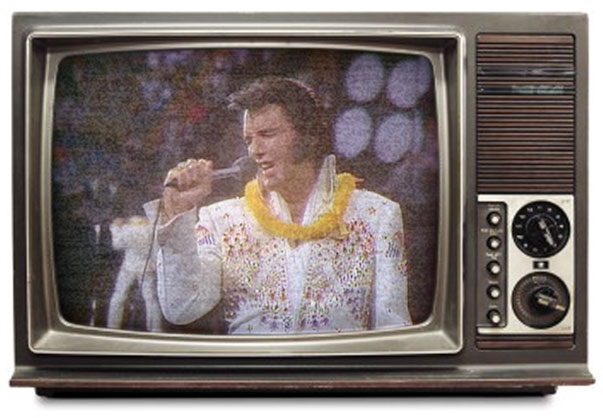
Elvis on NBC, 1973

NBC aired the Elvis: Aloha From Hawaii special on April 4, 1973

Yesterday marked the 40th anniversary of the United States television broadcast of Elvis: Aloha From Hawaii on NBC. The special had been taped in January 1973 during a “live via satellite” broadcast to certain parts of the world. With all of the hype surrounding the first live satellite broadcast by an entertainer, many Americans to this day wrongly believe they saw 38-year-old Elvis perform the show live. Little did they know that he was watching the TV special, too.

The NBC version of Elvis: Aloha From Hawaii aired from 8:30 PM to 10:00 PM on April 4, 1973. It became the most-watched show of the week. Among the viewers was indeed Elvis himself, who tuned-in from his home in Los Angeles. This edition of the show included the one-hour January 14 concert as well as four post-concert insert songs that Elvis recorded after the audience emptied from the venue.

Among Elvis fans today, the show receives mixed reviews. Some see it as the pinnacle of his career and success, while others see it as one of the first indicators of his decline. My Mom is one of those who adores Aloha From Hawaii. An Elvis fan since 1956, Aloha From Hawaii represents her ideal version of Elvis. I have a hard time getting her to watch anything else Elvis-related with me, unless we look at this one first.

As a second-generation fan, I wasn’t even born when Aloha first aired. In fact, I’m now the same age (almost to the day) Elvis was when he performed this show. While I prefer the ’68 ELVIS special and 1970’s That’s The Way It Is, I definitely enjoy Aloha From Hawaii. Though it was not his best show ever, in many ways it represented his final triumph in the eyes of the world.

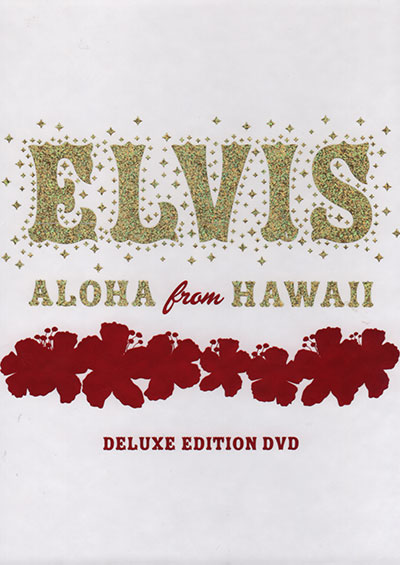
Elvis Aloha From Hawaii, 2004 Deluxe Edition

Elvis Aloha From Hawaii, 2004 Deluxe Edition

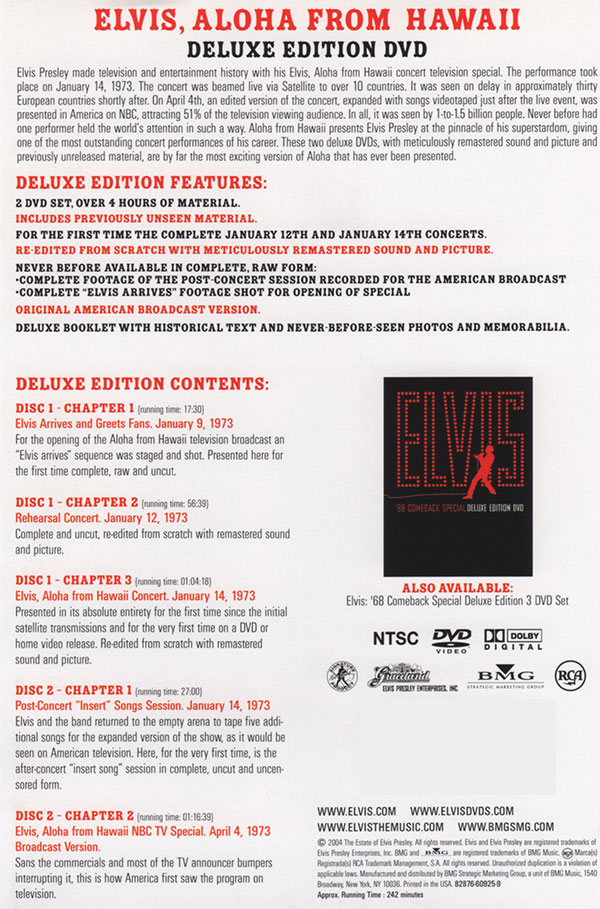
Though the show had appeared on home media several times before, Elvis Presley Enterprises and BMG released an ultimate version in 2004 as the 2-DVD set Elvis: Aloha From Hawaii – Deluxe Edition. Here are the contents:

DVD 1
1. January 9, 1973: Elvis Arrives and Greets Fans (17:30)
2. January 12, 1973: Rehearsal Concert (56:39)
3. January 14, 1973: Elvis: Aloha From Hawaii Concert (1:04:18)

DVD 2
1. January 14, 1973: Post-Concert Insert Songs Session (27:00)
2. April 4, 1973 (broadcast): Elvis: Aloha From Hawaii NBC TV Special Version (01:16:39)

Contents of Elvis Aloha From Hawaii, 2004 Deluxe Edition

Contents of Elvis Aloha From Hawaii, 2004 Deluxe Edition

2004 was a milestone year for Elvis fans. On the same day as the above, EPE and BMG also released the 3-DVD ELVIS: ’68 Comeback Special – Deluxe Edition set. I could barely contain my excitement when both sets arrived at my house nearly a decade ago now.

Executive Produced by Gary Hovey and the late Todd Morgan, both of these deluxe sets turned out to be among the most important Elvis releases ever. For obsessive Elvis fans like me, these DVDs represent essential viewing. I return to them often.

Though DVD 2 also holds interest, when it comes to Elvis: Aloha From Hawaii – Deluxe Edition, I tend to watch DVD 1 most often. The 2004 re-edits of the rehearsal and satellite shows represent the best releases of this material to date.

Last night, however, I plopped in DVD 2 in order to watch the April 4, 1973, version of Aloha From Hawaii. Before “Burning Love” could even finish, to my horror, the image on my screen began pixelating. It finally froze. An examination of the disc revealed scratches. I skipped ahead to the next song, but the problem kept occurring. I ended up watching about twenty minutes of the show in fits and starts.

I think I am very careful with my discs, so I’m not sure how these phantom scratches sometimes occur. I guess I have to chalk it up to equipment oddities. Either that or my dog plays my CDs and DVDs when I’m not around.

In any event, the reason I was horrified was not due to having to halt my 40th anniversary viewing of Aloha From Hawaii, but because I knew Elvis: Aloha From Hawaii – Deluxe Edition was now hard-to-find.

In fact, only a few months ago I had searched for it as a potential Christmas gift for someone. At that time, it was only available from third-party sellers at three times the original price. I love Elvis, but I refuse to pay exorbitant prices to such speculators. A quick check last night revealed the pricing to be the same.

Naturally, I did what any self-respecting fan would do in such a situation. I took to twitter to whine.

By this time, it was around midnight. I do not always get along with the twitter late at night, so I managed to tweet the following message to myself: My 2004 Aloha From Hawaii Deluxe Edition is giving out. If only @ElvisPresley would re-release this essential 2-DVD set.

Tweeting to myself

Tweeting to myself

I wish I could blame tweeting to myself on having a few too many, but I never drink. I don’t need to imbibe in order to do stupid things, it seems.

Fortunately, my message somehow managed to get through to @ElvisPresley, the official Elvis Presley Enterprises twitter account. Apparently the people over there at EPE actually know how to work twitter, for they sent me a link via direct (private) message to where the Deluxe Edition was still available on ShopElvis.com.

Now, why didn’t I think of that? I spend more money than I will ever admit on ShopElvis.com, but missed checking for the Elvis: Aloha From Hawaii – Deluxe Edition in this most obvious of places last night. Sure enough, it was there, in stock, and at a fair price.

  • Replacement copy of Elvis: Aloha From Hawaii – Deluxe Edition? Ordered.
  • Backup copy of ELVIS: ’68 Comeback Special – Deluxe Edition? Ordered. [This one is also now “hard-to-find” and is at crazy prices from third-party sellers.]

There is an Aloha From Hawaii for everyone. If you are not quite as obsessive as me when it comes to wanting to view all possible footage, 2006’s Elvis: Aloha From Hawaii – Special Edition DVD features only the 2004 edit of the January 14 main show. It is less expensive than the 2-DVD version and will certainly satisfy more casual fans.

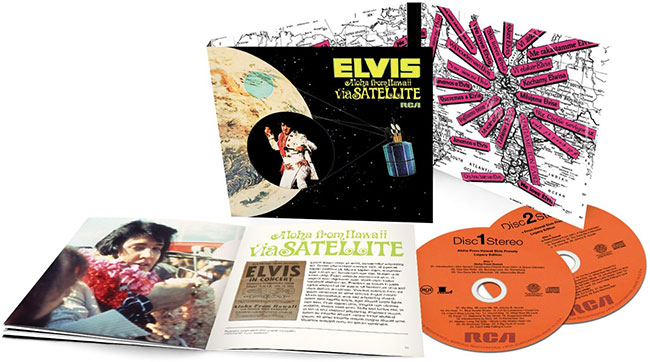
Last month, Sony released the Legacy Edition of the Aloha From Hawaii via Satellite soundtrack album as a 2-CD set. Note that this is only the music, no video.

I’ve not picked this one up as of yet, but be sure to read this fantastic review of the Legacy Edition of Aloha From Hawaii via Satellite over on The Second Disc.

Here are the contents of the Legacy Edition:

CD 1
January 14, 1973: Aloha From Hawaii via Satellite (original album, 1973 vintage mix, remastered by Vic Anesini)

CD 2
1. January 12, 1973: Rehearsal Concert (2013 mix and mastering by Steve Rosenthal and Rob Santos)
2. January 14, 1973: Post-Concert Insert Songs

Elvis Aloha From Hawaii via Satellite, 2013 Legacy Edition

Elvis Aloha From Hawaii via Satellite, 2013 Legacy Edition

REVIEW: Elvis – The Complete Masters Collection (Part 3)

This is Part 3 of an ongoing series reviewing Elvis: The Complete Masters Collection. Read Part 2.


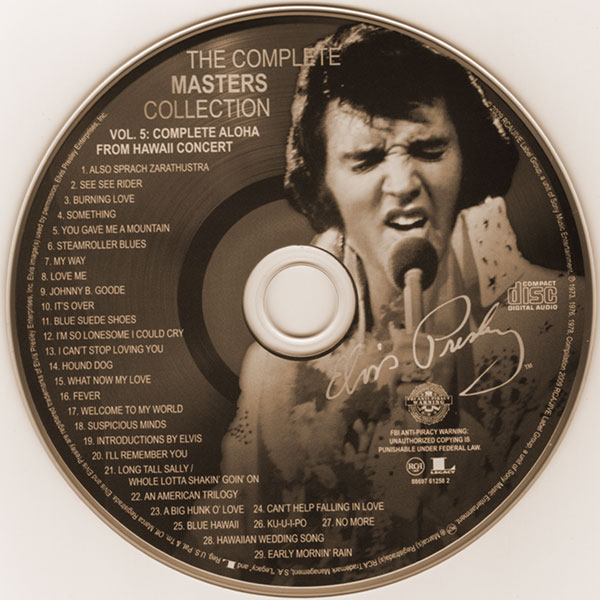
CD Vol. 5: Complete Aloha From Hawaii Concert

Volume 5 of The Franklin Mint‘s 36-disc Elvis: The Complete Masters Collection (mastered by Vic Anesini) presents the 1973 concert album Aloha From Hawaii via Satellite as well as bonus songs recorded for insertion into the NBC version of the Elvis: Aloha From Hawaii TV special.

Elvis: The Complete Masters Collection - Volume 5

This disc features the original mix of the 1973 double album. In 1998, BMG/RCA released a CD with a new mix and mastering by Dennis Ferrante. At that time, I tried to keep my Elvis CD collection consolidated. Since I much preferred the new mix, I gave away my older Aloha From Hawaii via Satellite CD with the original mix. Therefore, I do not have anything to make fair sound comparisons against for this CD. These days, I put more stock into owning the original mixes as released during Elvis’ lifetime than I did back then.

Elvis recorded all songs on the Complete Aloha From Hawaii Concert on January 14, 1973. Though it aired live in some parts of the world, Aloha From Hawaii did not air in the United States until April 4 of that year. To this day, many Americans wrongly believe they saw the special live. In reality, it had an even longer “tape delay” than NBC’s abysmal Summer Olympics 2012 coverage.

01. Also Sprach Zarathusta/02. See See Rider: “Also Sprach Zarathustra” (used as the theme for 2001: A Space Odyssey) was the perfect way to open Elvis concerts in the 1970s. This is a particularly fine version, beginning with low rumbles and building into a fantastic crescendo as Elvis appears on stage and quickly rocks into “See See Rider.” Listen to James Burton’s guitar work on the solo, sounding better than I remember it.

03. Burning Love: Elvis moves right into another rocker, “Burning Love.” The sound on this CD is so incredible, I can already tell I may go back to this mix when I want to listen to Aloha, over the 1998 version. Elvis just kills the song on the end during the “Hunka’ hunka’ burnin’ love” segment. What a fantastic opening to the live broadcast. Sounding sheepish, Elvis quietly tells the audience after the song, “Good evening, and I hope you enjoy our show tonight. We’re gonna try to do all the songs you wanna hear, you know.”

04. Something: For this third song of the international event, Elvis launches into a Beatles number, “Something.” The performance is okay, but a bit of a letdown after the concert’s stellar opening. Wow, this CD sure does sound awesome, though. It can make an okay song sound a little better.

05. You Gave Me A Mountain: Elvis had first tackled Marty Robbins’ “You Gave Me A Mountain” while on tour in 1972, including one performance used in the 1972 documentary Elvis On Tour. While this version is a step down from that one, Elvis still sounds great here.

06. Steamroller Blues: Next up, Elvis takes on James Taylor with “Steamroller Blues,” adding some much-needed energy back into the show. Elvis earned a top 20 hit when RCA released this performance as a single (backed with the 1972 studio cut “Fool”). Authentic to the original album (the end of side 1), the CD fades on the applause after the song ends.

07. My Way: As with the original album, “My Way” begins with the piano strains, leaving out Elvis’ introduction of the song. This is a fine, though not very compelling, version of the Frank Sinatra hit. In the first six songs of his live event, Elvis has already tackled the blues, rock ‘n’ roll, the Beatles, country, James Taylor, and Frank Sinatra.

08. Love Me: Before the song, Elvis mentions that he’s planning to do a medley of his records later in the show, to which an audience member shouts, “Do all of them!” Elvis hears this and replies, “Okay, I’ll do it, all 429 of ’em. I’ll do it.” He then dips back into his own catalog for a disappointing version of 1956’s “Love Me.” The song borders on being a throwaway, which is a shame.

09. Johnny B. Goode: James Burton carries this Chuck Berry classic on guitar, as Elvis forgets some of the lyrics early on (the song was added to fill time when a rehearsal revealed the planned show was too short). Still, Elvis rocks the song and the show benefits from its inclusion.

10. It’s Over: “I’ll watch you walk away somehow, I have to let you go, because it’s over,” Elvis sings in what must have been another heart-wrencher for him, as his own marriage was ending at this time. Unfortunately, “It’s Over” is otherwise forgettable.

11. Blue Suede Shoes: It’s back to rock ‘n’ roll, this time with a rousing but short rendition of Carl Perkins’ “Blue Suede Shoes.”

12. I’m So Lonesome I Could Cry: Elvis introduces the Hank Williams classic “I’m So Lonesome I Could Cry” as “the saddest song I’ve ever heard” and proceeds to do a commendable job.

13. I Can’t Stop Loving You: Next, Elvis moves right into “I Can’t Stop Loving You.” Though the arrangement is the same, Elvis sounds much more subdued here compared to the rocking version found on the previous year’s As Recorded At Madison Square Garden.

14. Hound Dog: Elvis then launches into a perfunctory version of “Hound Dog,” lasting a mere 45 seconds and leaving me to wonder, “Why bother?” As with the record, the CD fades out shortly after the song ends, leaving out Elvis’ joke about first performing that song when he was twelve-years-old.

15. What Now My Love: Elvis gets serious again and puts more effort into “What Now My Love” than his own hit material. This is one of the highlights of the show, and the sound quality on this CD makes it shine even more.

16. Fever: Maybe it’s because I heard this one first, but I’ve always preferred this live version of “Fever” over Elvis’ 1960 recording of the song for the Elvis Is Back! album. The song just works better in a concert setting. I also see this as the point in Aloha From Hawaii where Elvis finally shakes off the rest of his nerves and really loosens up – making for a better second half to the show.

17. Welcome To My World: This is a lightweight song that serves as a breather for Elvis between “Fever” and “Suspicious Minds.”

18. Suspicious Minds: Growing up, the first versions I heard of “Suspicious Minds” were on this album and the similar one released on As Recorded At Madison Square Garden. It took me a long time to become accustomed to the studio version. While I now prefer the studio and early live versions best, I still enjoy the 1972 and 1973 versions. Great to hear Elvis rocking on one of his more contemporary hits.

19. Introductions By Elvis: I’m not going to start reviewing band introduction tracks, but I will point out that this is the edited version as released on the original album (i.e., Elvis calling Charlie Hodge a “general flunky” and later mentioning Hawaii Five-O star Jack Lord have been omitted).

20. I’ll Remember You: Also omitted is Elvis explaining that proceeds from the concert would benefit the Kui Lee Cancer Fund. “I’ll Remember You,” first recorded by Elvis in 1966, was written by Kuiokalani Lee, who passed away from cancer that same year. The lyrics take on even more signficance if you listen with that in mind: “I’ll remember you long after this endless summer is gone. I’ll be lonely, oh so lonely, living only to remember you.” Though a decent live version that matches the mood of the show, “I’ll Remember You” really does not live up to Elvis’ 1966 recording – both in terms of the vocals and the percussion.

21. Long Tall Sally/Whole Lotta Shakin’ Goin’ On: The closest thing the show gets to the promised medley is this combination of Little Richard’s “Long Tall Sally,” which Elvis recorded in 1956, and “Whole Lotta Shakin’ Goin’ On,” popularized by Jerry Lee Lewis in 1957 and recorded by Elvis in 1970. While the medley works in the show and picks up the pace as needed, both songs pale next to Elvis’ studio efforts. “Whole Lotta Shakin’ Goin’ On” in particular has a completely different, watered-down arrangement compared to Elvis’ version from less than 3 years earlier.

22. An American Trilogy: Reportedly, when asked what kind of costume he wanted for the live broadcast, Elvis noted that he wanted something that said “America.” The custom-designed American Eagle jumpsuit fit the bill visually, while “An American Trilogy” sealed the deal on the musical side. This is both the climax of the show and the most impressive performance on the album. An argument could even be made that this moment was the climax of his career as well. Though not evident on the record, Elvis throws his jewel-studded belt into the audience shortly after this song.

23. A Big Hunk O’ Love: Serving as a bookend of sorts with the similar “Burning Love,” Elvis reaches back to 1958 for this hit and serves up a great rendition. If only he had treated his other classics with this respect for this show. “A Big Hunk O’ Love” provides a powerful rock ‘n’ roll ending for the live broadcast.

24. Can’t Help Falling In Love: Finally, Elvis closes out the show with a quick version of “Can’t Help Falling In Love.” It is not in the same league as his 1968 or 1969 live versions, but it almost does not matter at this point. The power of the overall concert wins out, and it ends in utter excitement. What a performer.

25. Blue Hawaii [Re-recording]: For the NBC version of the special, Elvis recorded several “insert” songs without an audience to extend the length of the special. This is a fine version of the title song to his 1961 movie Blue Hawaii.

26. Ku-U-I-Po [Re-recording]: The remaining songs on this CD were first released after Elvis’ death, on the 1978 album Mahalo From Elvis. Though they are technically outside of the parameters of Franklin Mint’s Elvis: The Complete Masters Collection, I am happy to have them as bonuses. This is a great re-recording of “Ku-U-I-Po” from Blue Hawaii.

27. No More [Re-recording]: Though recorded for the NBC version of the show, “No More” actually went unused. The visual portion of this performance was first released on DVD in 2004. This is another strong re-recording of a song from Blue Hawaii.

28. Hawaiian Wedding Song [Re-recording]: “Hawaiian Wedding Song” was featured in the finale of Blue Hawaii. Elvis does another good job on this re-recording. Perhaps he should have performed one or two of these Blue Hawaii songs during the actual concert. Why not drop “Welcome To My World” or “It’s Over” for one of these? (Other than the fact that the other two songs had never been released before by Elvis.)

29. Early Mornin’ Rain [Re-recording]: Though Elvis had first recorded it only two years earlier, this re-recording of “Early Mornin’ Rain” has a different vibe. I enjoy both versions. Again, this would have made a great number for the actual concert.

The sound is terrific, and so is the show. This will now become my go-to edition of Aloha From Hawaii.

* * *

I was about 13-years-old before my older brother would allow me to touch his record collection. As a small child, I had a bad habit of accidentally destroying his stuff (Star Trek posters, a trumpet, and pretty much anything else I could get my curious little hands on), so his records were off limits for a long time.

Of his fifty or sixty Elvis albums, the one I considered the most special was Aloha From Hawaii via Satellite. I was sure at the time that this was the greatest Elvis concert ever. Though I could name dozens of live recordings now that would top it, I did relive some of that youthful exuberance when listening to the Complete Aloha From Hawaii Concert. While I do not have the older release to compare, I am sure this album has never sounded better on CD.

* * *

With thirty-one CDs still to go, continue to look for future installments here on The Mystery Train.


Read Part 4.

From Sweden To Richmond/From Richmond To Sweden: A Little More Conversation

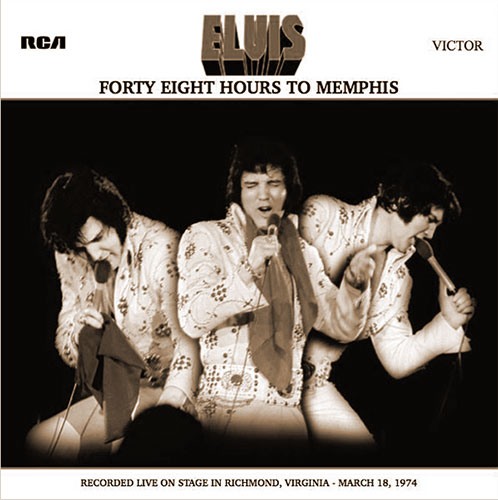
Welcome to the first ever simultaneous post of Elvis Today Blog and The Mystery Train. We’re going to try something a little different and present a discussion of Forty-Eight Hours To Memphis: Recorded Live On Stage In Richmond, Virginia – March 18, 1974, one of the latest CDs from Sony’s Follow That Dream Records collectors label for Elvis fans.

The Forty-Eight Hours To Memphis title reflects that Elvis closed out his tour two days after the Richmond concert with a show in Memphis – portions of which became the 1974 album Elvis Recorded Live On Stage In Memphis.
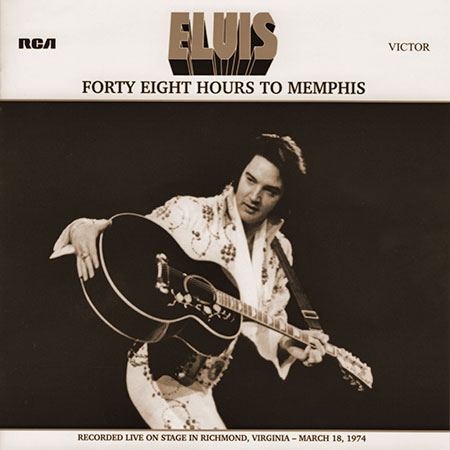
Forty-Eight Hours To Memphis (2011 FTD, booklet cover)

Forty-Eight Hours To Memphis (2011 FTD, booklet cover)

TY [The Mystery Train]
I’m glad you thought of this idea, Thomas.

Thomas [Elvis Today Blog]
Yeah, well, it must have been exciting when you heard of this release. What was your first impression when you listened to it?

TY
That this was obviously the best Elvis Presley release in history, as I’m sure you’ll agree! Just kidding… The first time I played it, I just tried to imagine being there, in the Richmond Coliseum that night.

Thomas
I would’ve loved to be there, that’s for sure. The atmosphere during that particular tour in the southern states obviously was an indescribably electric one, and the shows were of high quality. Have you noticed the joyful laughter from one person in the audience when “Also Sprach Zarathustra” begins? A safe bet is he’s one excited man.

TY
That almost nervous laughter was the first thing I noticed. My other first impression, I was really happy to hear Elvis make Richmond-related references not once, not twice, but three times during the show. I think you’ve heard more Elvis concerts than I have, Thomas, but I believe it is rare for him to mention what city he is in – outside of Las Vegas, that is.

Thomas
And multiple times at that! Also, I was pleased that he mentioned Sweden as well!

TY
This is probably the only concert where he mentions both Richmond and Sweden. Now that I think about it, I suppose he very well could have mentioned both during the March 12 show in Richmond, too. This March 18 Richmond show was added because the March 12 one sold out so quickly. So there might be two concerts where he mentions both Richmond and Sweden

Thomas
The reason Elvis mentioned my country is because Sweden’s Per-Erik “Pete” Hallin was playing piano for the group Voice at the time. I actually interviewed him once, but that’s another story.

TY
He was a second piano player on the stage at the same time as Glen Hardin? Or just when Voice was opening?

Thomas
I think he was just playing the piano when Voice was opening, and then sang together with them on stage while Elvis was on. Elvis actually mentions Pete at the end of this concert, during “Can’t Help Falling In Love,” when he sings “… some things, you know, Pete, are meant to be…” He did this two days later in Memphis as well, where he also introduced Pete and the other members of Voice individually.

TY
I had always wondered who “Pete” was on the Memphis show, so that clears it up. Funny that he gets the exact same mention here on the Richmond concert. As far as I could tell, it is just Elvis doing the same joke, not an audio repair or anything where they pulled it from the Memphis show.

Thomas
I agree, it’s the same joke. Elvis obviously liked to recycle his jokes, like the “I saw J.D., with baldheaded Sally” that was used both in Richmond and in Memphis during the “Rock Medley.”

TY
I’m also pretty sure, outside of Vegas, I’ve never heard Elvis reference the hotel where he stayed. After the introductions on Forty-Eight Hours To Memphis, he thanks Richmond’s John Marshall Hotel.

Thomas
Yes, I was actually surprised to hear him mention the hotel. That is unusual.

TY
So, that first time through, I was really happy with this CD. I was all kinds of worried that I would be disappointed with either the sound or the show itself.

Thomas
Glad you liked the show as well as the sound. Now there’s been a lot written about the sound, this being a newly discovered 2-track copy of a 16-track tape.

TY
Right, we should address the sound controversy. I was already excited about this release when it was first announced. This represents the first official release of an Elvis concert in Richmond, after all. However, when the news later came out that the source of this concert was a 16-track professional recording, rather than the expected soundboard, I think that brought the rest of the Elvis World to where I already was in anticipating this CD.

Thomas
Yes, I was excited when I heard of this, also. A newly discovered 16-track professional recording, where did that one come from?

TY
That’s right. All the fans were excited until FTD essentially said, “Oops, did we mention this was mono?” Then, I think FTD took a lot of heat for that. Some of it deserved, for poor communication. At the same time, I think the reaction by some fans was way overblown. But, hey, I guess that’s what Elvis fans do. How did you feel when you found out Forty-Eight Hours To Memphis would actually be in mono?

Thomas
At first, a little disappointed, maybe, but I was looking forward to the album anyway, and I have to say I was pleasantly surprised when I listened to the show for the first time. I think the sound is great!

TY
I agree, the sound is incredible, especially considering that it is from a mono tape. I was glad to be able to put that concern to rest. I’m not someone who hates mono recordings, though. After all, Elvis has quite a few more mono songs that maybe a few of the complainers should try hearing someday. Such “unknowns” as “Mystery Train,” “Jailhouse Rock,” “One Night,” “Baby, Let’s Play House,” “Love Me,” “Santa Claus Is Back In Town,” and “Don’t Be Cruel” – to name but a few. There are also some 1960s movie soundtrack songs that I think sound better in mono than their stereo counterparts. “Viva Las Vegas” is one that immediately comes to mind. You can never please everyone, though.

Thomas
Yes, they should give them a spin. I remember when RCA made “electronically created stereo” out of a lot of the mono albums – they sounded terrible!

TY
I’m glad they didn’t try that here.

Thomas
Yeah, me too. Thinking about it, it’s really incredible that a show in this sound quality surfaces so many years after it was recorded.

TY
That is the real mystery here, and the liner notes really do nothing to clear that one up. Just the same kinds of speculation all of us were doing when we first heard.

Thomas
So, what about the actual show, TY? No doubt Elvis is in good spirits and enjoying his work, wouldn’t you agree? He sounds happy and close to laughter on many occasions. “Fever” is probably as close to a laughing version as it gets. “That’s a fun song to do!” he says. At the same time, he delivers good, solid renditions of many of the songs. “Steamroller Blues” is one of the highlights to me, as is “Polk Salad Annie” and “An American Trilogy.” Not to mention “Trying To Get To You,” where he really uses his voice to the fullest.

TY
Well, jumping right into “Fever,” I’ve never been a big fan of the “I light up when you call my name… ELVIS!” versions of this song, for some reason. So, that is my least favorite track on the album.

Thomas
In a way I agree, but I think the version two days later in Memphis is even worse.

TY
I agree that the Richmond Fever is better than the Memphis Fever, but it’s a bad bug, either way. At times, “Let Me Be There” also grates on my nerves, and don’t even get me started on J.D. Sumner’s “Amen” dive-bomb routine. However, those are just about the only negatives I ultimately found about this show.

Thomas
Maybe that was a song that was more fun to watch than only hear.

TY
I was also worried about “Suspicious Minds” – a favorite of mine.  I was really disappointed by the Memphis live version of that one when it finally came out a few years ago. So, I was worried that I wouldn’t like the Richmond version, either. But it’s great, very energetic. It would’ve been great to see.

Thomas
Yes, by this time he’d performed “Suspicious Minds” for five years or something, and I always thought he was tired of it, when I heard the version from Memphis. But in Richmond he does sound happier with it, that’s true, TY!
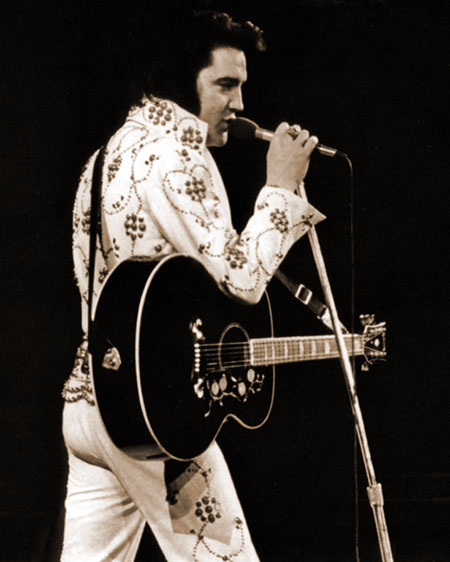
Elvis at the Richmond Coliseum, March 18, 1974 (FTD)

Elvis at the Richmond Coliseum, March 18, 1974 (FTD)

TY
The other highlights for me were “Also Sprach Zarathustra”/”See See Rider,” for the excitement of imagining Elvis taking the Richmond Coliseum stage by storm. “Steamroller Blues,” which I might like even better than Memphis version, my favorite rendition until this point.

Thomas
I just love the way he shouts “Aargh!” at the intro of “Steamroller Blues,” and what then follows really lives up to the song’s name.

TY
Let’s see, I also enjoyed the “Rock Medley” – what a great idea for Elvis to link together all those songs. Rather than just do the typical “Hound Dog” throwaway, I think it worked somewhat better like this, at the tail end of the medley. It’s still too fast, but not as disappointing as most of the other post-1970 Hound Dogs.

Thomas
For some reason I thought the “Rock Medley” rocked even more than it did in Memphis, and I love the tail end too!

TY
Yes, the “Rock Medley” was another one that Elvis performed better than its Memphis counterpart.
“Polk Salad Annie” was one I didn’t care for on Memphis, but loved it in Richmond.

Thomas
I always enjoy hearing Elvis saying things I’ve never heard in songs before, like during the guitar solo in “Polk Salad Annie” by James Burton where he says something like “Sneak up on him, Ronnie!” I can just imagine him casting a glance in Tutt’s direction while saying this.

TY
Yeah! I guess because we’ve heard so many of his shows, that’s the kind of stuff that stands out to us. While the general public would say, “Why do I need another ‘Polk Salad Annie’?”

Thomas
The two songs that got the most serious renditions were the gospel songs, “Why Me, Lord” and “Help Me.”

TY
I was relieved that “Why Me” wasn’t a laughing/joking version. Not that I mind some joking, but it seems ill-suited for a gospel song. I think I like the Memphis version of “Why Me” better, though.

Thomas
Elvis cared deeply for that kind of music.

TY
You know, that’s one of the terrific things about his show, especially from this time period, the way it brings together so many kinds of music – gospel, country, blues, rock ‘n’ roll. What other so-called “rock star” could do that?

Thomas
That’s true, TY, Elvis sang “Something for Everybody.” Speaking of the gospel stuff, I did miss “How Great Thou Art.” But hey, that’s a minor complaint.

TY
Funny, I was just about to say the same thing about “How Great Thou Art,” which of course featured prominently on the Memphis concert album. I had a slight twinge of disappointment when I saw the Richmond track listing and it wasn’t there.

Thomas
I just love it when he sings the ending one more time in Memphis. And his voice, so powerful, it gives me goose bumps!

TY
At least the Grammys got that one right. So, what did you think about the bonus songs, recorded in Tulsa and Memphis? I thought it was cool to hear “Sweet Caroline” in 1974. I don’t remember hearing that one outside of 1970 before. Also, “Johnny B. Goode” is always welcome.

Thomas
I think the most important thing was that they showed what a difference there is in sound quality between a soundboard and the professionally recorded Richmond concert. And once again I was reminded how very similar “My Baby Left Me” and “That’s All Right” sound.

TY
It was really awesome to hear a 1974 version of “That’s All Right” in Memphis. That live performance was just a few months shy of the 20th anniversary of Elvis first recording it at Sun Studio there – the record that started it all.

Thomas
I hadn’t thought of that. That is indeed awesome!

TY
What do you think about Forty-Eight Hours To Memphis being presented in the oversized, 7-inch digipack format usually reserved for FTD’s Classic Albums series?

Thomas
I thought it was great that it was presented this way. I’m a bit tired of the live material not getting treated as serious as the classic album series.

TY
Agreed. If I remember correctly, they originally planned this treatment for As Recorded At Boston Garden last year, but a production issue or something caused them to put it in the standard, smaller format.

Thomas
Or was it the latest 1969 concert, I don’t remember.

TY
That’s right, it was actually the Live In Vegas release they originally planned for the larger format. Maybe, FTD now intends to use that format more often? Perhaps, at least on “special” releases of live material where the sound and/or show is of a high quality.

Thomas
Here’s hoping the last couple of August 1969 and 1970 concerts will get this treatment.

TY
That would be great. I hope that’s the case as well.

Thomas
Hopefully the 1972 concert in Richmond will also get an official release soon, together with the other shows recorded for Elvis On Tour.

TY
Yes, that is the Richmond show that has the best chance of also getting an official release at some point.  I just hope it’s sooner, rather than later. Do you think the release of this 1974 show will mean that there will be less of a chance of the 1972 Richmond show coming soon?

Thomas
I hope not, TY. I’ve heard that Ernst Jorgensen is waiting for Turner/Warner Home Video to make a move with the unreleased footage, to do a combo of sorts, but that won’t happen anytime soon, I’m afraid. I just hope he realizes this and releases the shows from Elvis On Tour anyway. For now I’m really pleased with FTD for releasing this Richmond show, it’s not an album that’s going to collect a lot of dust on the shelf for a long time yet.

TY
I’m definitely happy about this release as well. This is a special CD that I’ll be playing often for the rest of my life. What are your final thoughts on this CD? What are you going to remember most about it?

Thomas
You know what I thought halfway into listening to it the first time? It hit me how happy I am being an Elvis fan, and what a pleasure it gives me to listen to a great concert like the one from Richmond. Also, that Elvis was in great shape during the March 1974 tour, delivering the goods in style! But I guess, I’m gonna remember the most how incredible it is that a professionally Elvis concert like this can suddenly make an appearance out of the blue. It was almost as exciting waiting for it as listening to it. Well, not really, but hopefully you see my point.

TY
Yes . . . it shows hope that there is still more out there, waiting to be discovered. Things not even rumored to exist.
For me, it was really something to finally hear an Elvis concert recorded here in Richmond, where he appeared 15 times. This is number 14, yet he still sounds engaged, like he’s having a great time. Obviously, the audience was, too. It was a fantastic show. Though he came back to Richmond once more in 1976, my understanding is that this 1974 concert was his last great show in Richmond.
Thanks again, Thomas. This has been a fun little experiment, but I wonder if people will enjoy reading this kind of post?

Thomas
I sure hope so. At least it was enjoyable to write, so thank you, TY!


As with other FTD releases, the only physical store in the US authorized to sell the Forty-Eight Hours To Memphis CD is Good Rockin’ Tonight, a Graceland gift shop in Memphis. However, the CD may be obtained online from a variety of other Elvis stores – including Graceland’s ShopElvis.com.

Forty-Eight Hours To Memphis

Live At The Richmond Coliseum, March 18, 1974
01) Also Sprach Zarathustra/
02) See See Rider
03) I Got A Woman/Amen [edited with Memphis, March 20, 1974]
04) Love Me
05) Tryin’ To Get To You
06) All Shook Up
07) Steamroller Blues
08) Teddy Bear/Don’t Be Cruel
09) Love Me Tender
10) Long Tall Sally/Whole Lotta Shakin’ Goin’ On/Your Mama Don’t Dance/Flip, Flop & Fly/Jailhouse Rock/Hound Dog
11) Fever
12) Polk Salad Annie
13) Why Me
14) Suspicious Minds
15) Introductions By Elvis
16) I Can’t Stop Loving You
17) Help Me
18) An American Trilogy
19) Let Me Be There
20) Funny How Time Slips Away
21) Can’t Help Falling In Love/
22) Closing Vamp
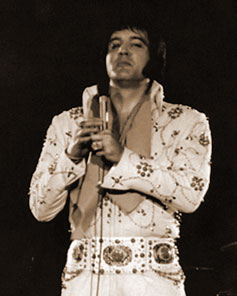
Elvis at the Richmond Coliseum, March 18, 1974 (FTD)

Elvis at the Richmond Coliseum, March 18, 1974 (FTD)

Bonus Songs
23) Sweet Caroline [Tulsa, March 1, 1974]
24) Johnny B. Goode [Memphis, March 17, 1974]
25) That’s All Right [Memphis, March 17, 1974]
Elvis Back In Richmond: Forty-Eight Hours To Memphis now available

Forty-Eight Hours To Memphis: Recorded Live On Stage In Richmond, Virginia – March 18, 1974, the latest Elvis Presley release from Sony’s Follow That Dream collectors label, hit the United States on November 1.

Ernst Mikael Jørgensen & Roger Semon produced the CD, which captures Elvis’ fourteenth appearance in Richmond—his third at the Richmond Coliseum.

The Richmond show has received a new mastering by Vic Anesini. Though presented in mono from a tape copy, apparently the concert was professionally recorded and mixed in multi-track.

According to Robert Frieser’s liner notes, the original multi-track recording is either missing or erased. Speculation is that it was a backup for the album Elvis Recorded Live On Stage In Memphis, which took place two days later at the Mid-South Coliseum.

The March 18 Richmond Coliseum concert was only six days after his March 12 appearance there. After visiting other cities, the tour swung back through Richmond due to a rapid sell out of the earlier show.

Richmond references
Track 04 at 0:02: Elvis says, “It’s a pleasure to be back here in Hampton Roads, uh, Richmond! Just kidding, just kidding.”
Track 15 at 2:23: Elvis says, “I’d like to thank the John Marshall hotel, where everybody’s staying, for taking care of us over there.”
Track 21 at 0:00: Elvis says, “You’re a fantastic audience, you really are. Until the next time here in Richmond, I’d like to wish you an affectionate adiós.”

As with other releases on Sony’s FTD collectors label for Elvis fans, the only physical store in the US authorized to sell the CD is Good Rockin’ Tonight, a Graceland gift shop in Memphis. However, the CD may be obtained online from a variety of other Elvis stores, including Graceland’s ShopElvis.com.

The CD comes in an oversized, 7-inch digipack that includes a 16-page booklet with photographs from the show. It marks the first official release of a Richmond Elvis concert.

Forty-Eight Hours To Memphis (2011)

Forty-Eight Hours To Memphis (2011)

Forty-Eight Hours To Memphis

Live At The Richmond Coliseum, March 18, 1974
01) Also Sprach Zarathustra/
02) See See Rider
03) I Got A Woman/Amen [edited with Memphis, March 20, 1974]
04) Love Me
05) Tryin’ To Get To You
06) All Shook Up
07) Steamroller Blues
08) Teddy Bear/Don’t Be Cruel
09) Love Me Tender
10) Long Tall Sally/Whole Lotta Shakin’ Goin’ On/Your Mama Don’t Dance/Flip, Flop & Fly/Jailhouse Rock/Hound Dog
11) Fever
12) Polk Salad Annie
13) Why Me
14) Suspicious Minds
15) Introductions By Elvis
16) I Can’t Stop Loving You
17) Help Me
18) An American Trilogy
19) Let Me Be There
20) Funny How Time Slips Away
21) Can’t Help Falling In Love/
22) Closing Vamp

Bonus Songs
23) Sweet Caroline [Tulsa, March 1, 1974]
24) Johnny B. Goode [Memphis, March 17, 1974]
25) That’s All Right [Memphis, March 17, 1974]
48 Hours To Memphis: Recorded Live On Stage In Richmond available for pre-order

Available now for pre-order is the anticipated-turned-controversial CD 48 Hours To Memphis: Recorded Live On Stage In Richmond, Virginia — March 18, 1974.

The North America/Worldwide version of Elvis Presley Enterprise’s ShopElvis.com reports that the CD should arrive to US addresses on or around October 31. I know what’s going to be cranked up at my house Halloween night!

Direct link: Pre-Order Elvis Forty Eight Hours to Memphis FTD CD (Mono) — ShopElvis.com

As with other releases on Sony’s Follow That Dream collectors label for Elvis fans, the only physical store in the US authorized to sell the CD is Good Rockin’ Tonight, a Graceland gift shop in Memphis.

Online, FTD CDs can be obtained from a variety of other Elvis stores.

In the 1970s, Elvis performed live on four dates at the Richmond Coliseum, spanning 1972 through 1976. The March 18, 1974, concert was only six days after his March 12 appearance there. The tour swung back through Richmond due to a rapid sell out of the earlier show.

Elvis fans around the world highly anticipated the CD after revelations several weeks ago that it would feature a previously unknown multi-track recording of the event.

However, a more recent announcement that the source of the CD is a mono tape thought to have been mixed down from the apparently lost multi-track has made the release controversial and anti-climactic for some. As for me, I’m still excited about it.

48 Hours To Memphis (concept cover art)

The 48 Hours To Memphis title reflects that Elvis closed out his tour two days later with a concert in Memphis. An edited version of the Memphis show became the July 1974 album Elvis Recorded Live On Stage In Memphis. A song from that album earned Elvis his third and final Grammy Award.

48 Hours To Memphis marks the first official audio release of an Elvis concert in Richmond. Though MGM filmed a 1972 concert at the Richmond Coliseum for the movie Elvis On Tour, it used only a tiny portion of it in the documentary. Warner Brothers has never released the remaining Richmond footage, nor has Sony made any plans as of yet to release the audio. Elvis On Tour instead prominently featured a concert in Hampton Roads, Virginia.


From ShopElvis.com, here is the full product description:

Please note: Contrary to previous informal information given, please be advised that this is a MONO release.

Derived from what must have been a full professional 16-track multi track recording, the sound is absolutely great, and Elvis is in top form. The booklet is full of great pictures from the actual show and informative notes. The CD comes in a 7″ digi format with a 16 page booklet.

Recorded Live on stage in Richmond, Virginia. March 18, 1974″

Tracklisting

Live At The Richmond Coliseum: March 18, 1974
01) Also Sprach Zarathustra/
02) See See Rider
03) I Got A Woman/Amen [edited with Memphis, March 20, 1974]
04) Love Me
05) Tryin’ To Get To You
06) All Shook Up
07) Steamroller Blues
08) Teddy Bear/Don’t Be Cruel
09) Love Me Tender
10) Long Tall Sally/Whole Lotta Shakin’ Goin’ On/Your Mama Don’t Dance/Flip, Flop & Fly/Jailhouse Rock/Hound Dog
11) Fever
12) Polk Salad Annie
13) Why Me
14) Suspicious Minds
15) Introductions By Elvis
16) I Can’t Stop Loving You
17) Help Me
18) An American Trilogy
19) Let Me Be There
20) Funny How Time Slips Away
21) Can’t Help Falling In Love/
22) Closing Vamp

Bonus Songs
23) Sweet Caroline [Tulsa, March 1, 1974]
24) Johnny B. Goode [Memphis, March 17, 1974]
25) That’s All Right [Memphis, March 17, 1974]
Guest Post: Fashion For A King doesn’t fit diehard fan

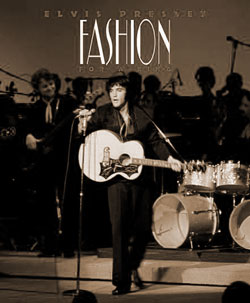
Fashion For A King (2011)

Fashion For A King (2011)

Let me just start out by saying that I am not an Elvis book collector. I buy very, very few Elvis books, and the ones I do usually tend to be reference type books, along the lines of Joe Tunzi’s Sessions books. In other words, I am a discerning Elvis book collector and don’t simply pick up every single tome with Elvis’ picture on the cover. Simply put, there has to be a good reason for me to buy one. Being a jumpsuit fanatic, I had always wanted a book that would document the suits Elvis wore in minute detail. Thus, when I heard about Fashion for a King I knew it would have to be one of my rare Elvis book purchases.

When I saw the press release for Fashion for a King, I was thrilled. An entire book (500+ pages) about Elvis’ jumpsuits? What could be better? (For me, anyway. I know some people groan at the thought.) According to the press release, the book promised to be “a full documentary of Elvis’ jumpsuits,” covering “the background story of each and every suit” – a “fully documented story and pictures of Elvis Presley’s stage outfits” and “an encyclopedia for fans…to learn more about these great original stage outfits.”

Needless to say I was excited. An encyclopedia of each and every suit, with documentation? My head filled with visions of unseen photographs and close-ups of each suit, along with documentation about when each suit was worn. Although not explicitly stated, I did get the impression that each concert would be individually documented, if not with a photo, then at least with a date and a listing of which suit was worn. In short, the press release promised a lot, and since the book had been written by fans, who often obsess about such details, I was very much looking forward to a reference that I would look at time and time again, much like I do with my Sessions books.

Unfortunately, upon paging through the book after I got it, it immediately became clear that it was much less than was I was anticipating. The majority of the photos in the book were ones I had seen before, either from well known sources, Follow That Dream releases, or simply from surfing the Internet. Only about 20 or so were new to my eyes, and it seemed as though the rest had been cobbled together from various sources that almost anyone could find. I felt a bit cheated paying over $100 US for a book full of photos that I probably could assemble most of myself given a few days of Internet usage. However, I could forgive the lack of rare photos if the rest of the book (the jumpsuit specifics) made up for it. Unfortunately the book failed in that area as well.

The text was bland and repetitive and followed exactly the same format in each section: Elvis’ tour lasted from this date to this date, he wore XYZ jumpsuits during the tour and he had Y band members with him. While the descriptions of which jumpsuits were worn on what dates were sadly lacking, oddly, the authors saw fit to inject commentary within the descriptions about Elvis’ health, state of mind, girlfriends or spending habits, often in the form of generalizations. I found it hard to distinguish whether or not the authors were trying to sympathize with Elvis or to condemn him. Regardless, in my opinion, a simple list of shows, dates, suits, capacities, grosses, and band members would have been much superior to prose that alternated from factual statements about dates and locations to editorial comments about Elvis’ state of mind. Somehow, in a work billed as an encyclopedia of Elvis’ jumpsuits, I wasn’t expecting to read about Elvis’ love life, or his spending, or the Colonel’s gambling habits. All of these things have been covered elsewhere. As it stands, the text came across to me as a canned, generic version of the stereotypical Elvis timeline that a non-fan might parrot back to you when talking about Elvis. In other words, lots of generalities, few actual facts, and most glaringly, very little relevance to what the book was ostensibly about. Oddly, though, given the lack of actual text concerning the specifics of Elvis’ jumpsuit usage, almost every section has specific details about the types of microphones Elvis used on a given tour, even down to the color of the tape used to secure the microphone windscreen – if only the jumpsuit information was this detailed and orderly!

To be fair, some of Elvis’ jumpsuits are described in detail, although I personally found the descriptions hard to follow, as often the authors would mention that Elvis wore ‘X’ jumpsuit with ‘Y’ belt during a specific Vegas engagement while not having a photo of said jumpsuit (and particularly said belt) to accompany the text. This was especially confusing when describing jumpsuits and belts that were originally created in previous years (say, when talking about jumpsuits and belts worn in both 1973 and 1974, for example). The text more often than not wound up reading like “Elvis wore jumpsuit X with original belt 1, although sometimes with non-original belt 2, along with jumpsuit Y” – I found myself having to page backwards through the book to remind myself if I actually saw a photo of “original belt 1” at some point. Given that I am a lifelong Elvis fan and a jumpsuit aficionado, I can only imagine how confused an average Elvis fan, or a new Elvis fan, might be with the descriptions. Having some photos of the jumpsuits as displayed at Graceland when talking about minutiae like how many buttons were on the sleeves of the given jumpsuit or how belt X had two chains per loop while belt Y had only one would have provided some excellent visual counterpoints to the printed details. Again, I am approaching this from the standpoint of someone who LOVES reading about things like how the differing versions of the flame suit can be determined by the color of the kick pleat in the legs, and even I found some of the text hard to follow.

Design-wise, the book is laid out well, but I did find that the authors included photos of Elvis wearing a given jumpsuit in a later year placed within the discussions from a previous year (with shots of Elvis from 1972, for example, appearing in sections covering Elvis’ November 1971 tours). While I can understand using shots from different periods when describing a specific jumpsuit, the book is primarily organized about specific tours and engagements, so personally I would have found it more stylistically interesting to include 72 shots with 72 tours where a given suit was worn. Again, including some static shots of the jumpsuits themselves when talking about their design would have been more interesting and appropriate to this reader.

The book is clearly a labor of love on the part of the authors, and one can tell that they enjoyed putting it together, but overall, I can’t really find much in the book that will interest the diehard fan, and in particular the diehard jumpsuit fan. The book has the feel of a project that fans might do in their spare time for their own enjoyment, which is essentially what this sprang from, according to the press release. As mentioned, I could see myself doing something similar just for the fun of it, although if I were to put it in book form for wider consumption I personally would feel an obligation to provide something, even if not necessarily new, at least useful as a reference.

Although this release is not produced by FTD, it was released in conjunction with them, and as with previous FTD book products, some Elvis music is included, this time in the form of Elvis’ Omaha, Nebraska show from July 1, 1974, and a Las Vegas show from December 14, 1975. Both of these have been around on the CD/CDR circuit, with parts of the former also being available in the form of some very good 8mm footage, but neither has appeared on soundboard. Both are a welcome treat, showing Elvis in good form, with the 1975 show providing an excellent set list. I remember hearing this show years ago as an audience recording and really enjoying it and the soundboard version confirms what I thought at the time. Elvis seems relaxed and in a good mood, and gives some very committed and unrushed performances. The oldies are tossed together and dispensed with in the first third of the show, leaving the remaining two-thirds for more powerhouse material, including “How Great Thou Art” (with a reprise of the ending), “Just Pretend,” “You Gave Me A Mountain,” and a rare (for this time period) performance of “Until It’s Time For You To Go.” Even more unusually, the show even features a performance of “It’s Now or Never” with Elvis singing the Italian lyrics. The show is also quite long for Vegas, running about 75 minutes. Overall, this show alone more than makes up for the book in my opinion, and I am very happy that this particular show has finally been released on soundboard.

The Omaha show is also of a good standard, with Elvis’ performance (in my opinion) being more serious and energetic than other releases from this time period, like June 19 in Amarillo or June 29 in Kansas City. Again, a nice bonus and nice compensation after my disappointment with the book.

In short, I was disappointed by Fashion for a King in almost every respect. On a scale of 1 to 10, I’d have to rate it right down the middle, with only the authors’ obvious love for the subject and the two included CDs saving it from a bottom of the barrel rating. Ironically, in thinking about it, this book might actually be more appealing (from a content standpoint) to a casual fan, as it does offer some nice photos in a coffee table book format. But for the diehard jumpsuit lovers like me, there is unfortunately little new on offer.

/Bryan Gruszka, Strange Paradise Online


Bryan Gruszka has been an Elvis fan since he was 6-years-old. A self-confessed jumpsuit afficionado, his favorite period is the 1970s. When not occupied with Elvis, Bryan is developing a book and website about Strange Paradise, an obscure Canadian gothic soap opera. Feel free to drop him a line or check out his website.