Elvis’ Last Concert Steps Out Of The Bootleg Shadows

“Ladies and gentlemen, the picture you have just seen was the last live performance of Elvis on stage,” announced Vernon Presley, Elvis Presley’s father, at the end of Record 1 of 1977’s Elvis In Concert soundtrack album.

For years, this and a similar message from Vernon at the end of the CBS television special caused the general public and casual fans to believe the project was indeed Elvis’ last concert.

Elvis In Concert was a compilation of highlights from two shows during Elvis’ last tour – Omaha, Nebraska, on June 19, 1977, and Rapid City, South Dakota, on June 21.

Elvis actually performed a few more concerts after Rapid City, which were not captured on professional video or audio. His last was on June 26 in Indianapolis, Indiana.

After making the bootleg rounds for decades, an audience recording of Elvis’ last concert will soon be officially released for the first time by Follow That Dream (FTD) Records. FTD began in 1999 and is Sony’s collectors label for Elvis fans.

The performance headlines a 3-CD set called Elvis: The Last Concert – Market Square Arena, Indianapolis, June 26, 1977. New audio work on the recording was performed by Anthony Stuchbury, known for his Elvis “Mono II Stereo” CD series in Europe.

The other shows on the set will be October 18, 1976, Sioux Falls, South Dakota (CD 2), and December 30, 1976, Atlanta, Georgia (CD 3). These are two of the soundboard shows FTD previously bundled with a re-release of the Bruce Jackson On The Road With Elvis book.

Jackson, who died in 2011, worked as part of Elvis’ audio team for shows in the final years and taped many of them direct from the soundboard for various purposes. Though he is rumored to have taped the last concert, it has never surfaced in any form.
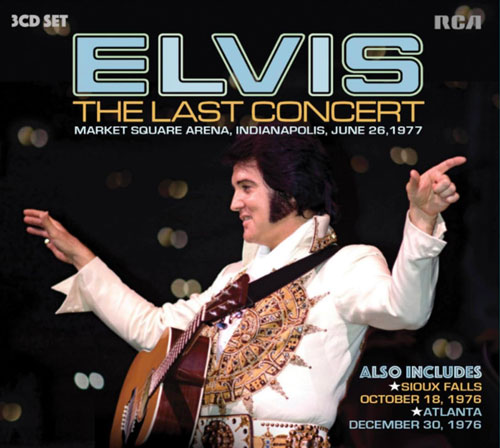
Cover of ELVIS: THE LAST CONCERT (2026, FTD)

Cover of ELVIS: THE LAST CONCERT (2026, FTD)

I’m selective when it comes to Elvis releases, including FTD, but this set is a must-have for me due to the historical significance of the Indianapolis show. I usually avoid 1976 shows, but my understanding is that the December 30 Atlanta concert is among the best for that year. I’m always in favor of FTD re-releasing CDs previously bundled with their exorbitantly-priced books, so including two of Jackson’s soundboard recordings is a good move here.

While The Mystery Train is not a news site – I leave that to Kees’ incredible Elvis Day By Day site – this is one of those times where a story is so important to me that I had to share it with you. Check out Elvis Day By Day for the full tracklisting, as provided by FTD.

Circling back to Vernon, who was obviously still overcome with grief during his message just six weeks after Elvis’ death, presumably the “last live performance” myth was written for him in order to better promote the special. He was almost surely unaware of which concerts were taped when.

Forty-nine years later, in my offline Apple Music playlist, Vernon’s message will now have its proper home on Elvis: The Last Concert.


Elvis’ Last Tour

June 17, 1977: Springfield, Missouri
June 18: Kansas City, Missouri
June 19: Omaha, Nebraska
June 20: Lincoln, Nebraska
June 21: Rapid City, South Dakota
June 22: Sioux Falls, South Dakota
June 23: Des Moines, Iowa
June 24: Madison, Wisconsin
June 25: Cincinnati, Ohio
June 26: Indianapolis, Indiana


“The LORD is close to the brokenhearted; he rescues those whose spirits are crushed.”
Psalm 34:18 NLT
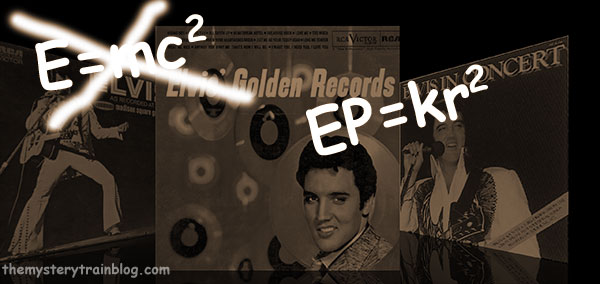
“Slow versions” support Theory of Relativelvisity

The Theory Of RelativelvisityHow we perceive something is often relative to our starting point. For instance, people who became fans when Elvis first rose to fame in the mid-1950s often view him differently than those who became fans after his comeback of 1968 or his death in 1977.
Many of those earliest fans seem to favor the 1950s recordings. That is, after all, how they first discovered Elvis. Being the rebel that she is, my mom is actually an exception to that generalization. She became an Elvis fan in 1956, but she definitely favors his 1968-1977 recordings – often to the exclusion of anything else.

I’ve mentioned before that the first Elvis record I can remember listening to is “My Way” backed with “America, The Beautiful,” recorded live in 1977 and 1975 respectively. I had definitely heard Elvis music before that record came out, but those are the earliest specific songs I can remember.

After that, the next major Elvis recording in my life was a cassette tape of 1972’s As Recorded At Madison Square Garden. My mom played that tape just about every time we went for a car ride in the early-to-mid-1980s. It may still hold the record as the concert I’ve heard most often.

She would always crank it up when certain songs came on, especially “Suspicious Minds.” She still does that, in fact. If you are ever in my town and a car drives past you blaring Elvis, it is far more likely to be my mom than me behind the wheel.

Eventually, the Madison Square Garden tape began to wear thin. She next switched to a tape copy of the 1977 album Elvis In Concert. Though it lost a few points for not including “Suspicious Minds,” she played that one almost as much as she did Madison Square Garden.

For the longest time, other than the occasional radio song or record album that my family played around the house, those two live concerts tapes were Elvis to me.

Eventually, I started to collect my own albums. One of the first ones I acquired was Elvis’ Golden Records, which compiles some of his hits from 1956 and 1957.

Keeping in mind that my perception of most of them was based almost entirely on As Recorded At Madison Square Garden and Elvis In Concert, I was sure in for a shock when I played the original studio versions of some of the songs from those live albums:

  • Hound Dog
  • All Shook Up
  • Heartbreak Hotel
  • Jailhouse Rock
  • Love Me
  • Don’t Be Cruel
  • Teddy Bear
  • Love Me Tender

Though I loved the overall sound of the record, many of the songs initially seemed “off” to me. I began to think of them as the “slow versions.” It took years for my perception of those songs to change.

While I came to love and appreciate the 1950s material, I am glad that my Elvis journey started like it did. I believe it allowed me to be much more sympathetic towards his later years than I otherwise might have been.

Besides, I wouldn’t trade those memories for anything. Thanks, Mom. Keep cranking it up!

Where Elvis never stood alone

I enjoy exploring all different areas of Elvis’ career. With Follow That Dream’s recent announcement that Amarillo ’77 will be among its June CD releases, I thought this would be a good time to take a look back at the 1977 recordings officially available to this point.

Not including the post-midnight tracks on FTD’s New Year’s Eve audience recording, there have been three key official releases of 1977 concert material in the years since the death of Elvis:

  • Unchained Melody (2007, FTD, covering February)
  • Spring Tours 77 (2002, FTD, covering March through May)
  • Elvis In Concert (1977, RCA, covering June; serves as soundtrack to TV special of same name)

All three of these releases have something to offer fans who are willing to listen.

Unchained Melody contains one of my favorite Elvis performances from any time, a stirring rendition of “Where No One Stands Alone,” with Elvis leading the way on piano. Recorded February 16 in Montgomery, Alabama, this marks the only known instance of Elvis performing this song live.

I actually prefer this nearly heart-wrenching version over his 1966 studio master of the song, recorded for How Great Thou Art. After hearing the raw emotions of this live version, the studio version sounds almost antiseptic – as if in 1966 Elvis had not really lived enough to fully convey the song compared to eleven years later.

Just a few days later, on February 21 in Charlotte, North Carolina, Elvis pulls out a blues number that he seemed to always have ready in his back pocket – “Reconsider Baby.”

Though Elvis formally recorded the song in 1960 for Elvis Is Back!, a 1956 version of the song from “The Million Dollar Quartet” jam at Sun Records made its debut on The King of Rock ‘n’ Roll in 1992. Live versions from 1961, 1969, and 1972 have also been released, all of which, like this 1977 track and its predecessor on New Year’s Eve, feature a committed Elvis. Lowell Fulson first recorded the song in 1954, around the same time that Elvis recorded “Good Rockin’ Tonight.” In Charlotte, “Reconsider Baby” is a good performance. Elvis never lost his feel for the blues.

At that same February 21, concert, Elvis also performs the only known live version of “Moody Blue” (outside of giving up after a false start in the same city the night before). This is another good performance. It is sometimes amazing how well Elvis could sing a song that he admittedly did not know. It is also a testament to the work of the TCB Band, that they could carry him when all he had was a lyric sheet. Lyric sheet or not, this is still a worthy listen.

At a Valentine’s Day show in St. Petersburg, Elvis takes over the piano momentarily from Tony Brown to show him how to play the intro to “Blueberry Hill.” What follows is a fantastic, though all too brief, take on the song – which Elvis first recorded in 1957.

A February 18 performance of “Release Me” in Columbia, South Carolina, is another highlight. For the briefest of moments, it sounds like it could be 1970 – but only a moment.

The highlight of Spring Tours 77 is beyond a doubt his March 26 performance of “Blue Christmas” in Norman, Oklahoma. The song takes on a different tone here than his bluesier 1968 live versions or his 1957 studio version. He sounds desperately sad, which is only underscored by our knowledge that he has already celebrated his final Christmas by this point. While I like the performance, this is not something I’ve added to my normal Christmas rotation. It’s just too sad.

The often-underrated Elvis In Concert contains a number of fine performances, including one of his best ever versions of “My Way” on June 21 in Rapid City. A brief snippet of “I Really Don’t Want To Know” from that same show also illustrates that he could still tap into his power. Even Omaha on June 19, sometimes described by others as one of his worst concerts, offers up a decent version of “How Great Thou Art” and an entertaining performance of “And I Love You So.”

My original intent in all of this was not to go through track-by-track highlights of 1977, but to point out that even one of Elvis’ lesser years can still hold magic. It is a mistake to focus only on certain aspects of Elvis’ career and to ignore the rest. While 1968-1971 may indeed be my personal favorite span, I would not want that to be the only Elvis I ever hear.

It is also unfair to use peak moments like 1968-1972 or 1954-1958 as the measuring sticks for everything else. Of course, everything is going to pale in comparison to those very special times in his life, but that does not mean that it lacks value. 1977 should not be ignored, not by Elvis Presley Enterprises, not by Sony & FTD, and most of all, not by us – his fans. I commend FTD for deciding to release Amarillo ’77.

So, pull out those 1977 recordings and give them a spin. He was on that stage for his fans, and he left these and other recordings as part of his legacy. They are an essential part of understanding the whole Elvis.

* * *

The Amarillo ’77 concert took place on March 24, 1977. Below is the track listing:

01 That’s All Right
02 Are You Lonesome Tonight
03 Reconsider Baby (intro only)
04 Love Me
05 If You Love Me
06 You Gave Me a Mountain
07 Jailhouse Rock
08 O Sole Mio/It’s Now or Never
09 Little Sister
10 Teddy Bear/Don’t Be Cruel
11 My Way
12 Band Introductions/Early Mornin’ Rain
13 What’d I Say/Johnny B. Goode
14 Band Introductions
15 School Days
16 Hurt
17 Hound Dog
18 Can’t Help Falling in Love
Bonus Tracks
19 And I Love You So
20 Fever
21 Love Me Tender
22 Blue Suede Shoes
23 Steamroller Blues
24 Help Me
25 Why Me, Lord
26 Bosom of Abraham
27 You Better Run
28 How Great Thou Art
29 Trying to Get to You

“Together all alone”

I’ve recently been playing Elvis’ last couple of non-compilation albums, From Elvis Presley Boulevard and Moody Blue, as well as associated outtakes on The Jungle Room Sessions and other releases. He recorded many of these songs in the den at Graceland in February and October of 1976.

I’ve also been listening to songs from Elvis In Concert, the first album released after he passed away, containing songs from his last concert tour in June 1977.

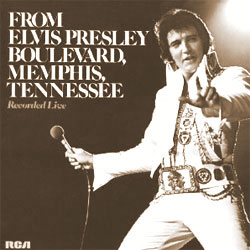
From Elvis Presley Boulevard (1976)

From Elvis Presley Boulevard (1976)

These recordings represent the last audio documentation we have of Elvis Presley the artist. From Elvis Presley Boulevard and Moody Blue are two of his finest albums. By this time, Elvis was apparently reluctant to record, so it is only through the efforts of people like producer Felton Jarvis that we have these recordings at all.

Boulevard has a thematically dark tone, established right from the beginning. If your Elvis experience is limited to the likes of “Blue Suede Shoes” and “Hound Dog,” it can make for some revealing and, at times, difficult listening.

I’m so hurt to think that you lied to me. I’m hurt way down deep inside of me. You said our love was true, and we’d never part. Now you want someone new, and it breaks my heart.” –From “Hurt,” Elvis Presley song, 1976 (written by Crane/Jacobs)

The pain is so evident in his voice as he pours out what is left of that broken heart. Reluctant or not, the results are some of the most honest music of his life.

What will become of me when you’re no longer here? If I can’t stop loving you, what am I to do? You’ll be free, but where will I be?” –From “Never Again,” Elvis Presley song, 1976 (written by Wheeler/Chesnut)

Let there be no doubt that Elvis could still rock, though. In the midst of Boulevard‘s otherwise slow songs suddenly appears “For The Heart,” and Elvis tears it up.

Though a gloomy tone is still present, Moody Blue lightens things up a bit compared to Boulevard. Rockers “Way Down,” “Moody Blue,” and a fun 1977 live version of “Little Darlin'” help in this regard, as does a 1974 live recording of “Let Me Be There” – first released on Elvis Recorded Live On Stage In Memphis.

I can still remember the first time I played Moody Blue. It was an album I borrowed from the local library, before I had any Elvis records of my own. I was fascinated by the fact that the record was blue rather than black. It began with a beautiful, haunting version of “Unchained Melody.” That song, as well as “Little Darlin'” and “Way Down” caught my attention, though I remember listening to the whole record over and over. What a perfect Elvis album.

You don’t have to face the music. You don’t have to face the crowd. Just go back where you came from. You ain’t even proud.” –From “It’s Easy For You,” Elvis Presley song, 1976 (written by Webber/Rice)

This turned into a longer post than I first planned. All I really wanted to say was how much joy listening to these songs has brought me in the last couple of days. Sometimes, you can listen to something in a whole new way. A song you’ve heard a hundred times can suddenly sound new.

That’s the great thing about being an Elvis fan, there is so much music out there to explore. I’ll never stop listening.

News From The Frontier: Get Smart trailer; Star Trek and Twilight Zone episodes online; Elvis & Star Wars [The Film Frontier blog]

Good morning, folks. It’s catch-up time, so I have a lot of news for you today.

Get Smart movie news roundup
Now that Paramount has moved Star Trek to 2009, the movie I’m most excited about this year is the revitalization of Get Smart, starring Steve Carell and Anne Hathaway. I have been watching the original Get Smart on DVD to get ready. The new preview trailer released last week by Warner Brothers looks fantastic. Check it out on the official Get Smart movie site. Get Smart hits theaters on June 20.

SCI FI Wire has a number of interesting articles on Get Smart. Carell wisely decided not to imitate the legendary Don Adams while portraying the character. “There’s no way to improve upon what he did,” said Carell, who says he instead tried to evoke the spirit of the character.

“Honestly, for me the catch phrases were the toughest part, because it’s hard to say them or think of them in any other way than the way that Don Adams did them. So, again, I tried not to do an impersonation of him, but I tried to sort of let them come out of the situation and not feel like they should stick out in any way,” he said.

This is actually not the first time Carell has tackled a character from a legendary 1960s television series. In 2005’s Bewitched, he appeared as Uncle Arthur to counsel Will Ferrell. Uncle Arthur was made famous by Paul Lynde on the television version of Bewitched. Carell’s Bewitched cameo was a slightly different situation than his Get Smart role, though. In Bewitched, he really is supposed to be the exact same fictional incarnation of Uncle Arthur portrayed by Lynde. Even stock footage of Lynde is shown earlier in the movie. The Get Smart movie, on the other hand, is a total restart of the franchise.

Within a couple weeks of the release of Get Smart to theaters, Warner Brothers will also release a direct-to-DVD movie, Get Smart’s Bruce and Lloyd Out of Control. The spinoff film stars Masi Oka (Heroes) and Nate Torrence (Studio 60 on the Sunset Strip), who also have supporting roles in Get Smart.

CBS releases Star Trek and The Twilight Zone for free online viewing in the US
Every episode of all three seasons of the original Star Trek is now available over at CBS.com for free viewing by those in the United States. These are unaltered versions of the shows, not the versions shown in syndication for Star Trek: Remastered. The first two seasons of the original The Twilight Zone, which lasted five seasons, are also available online.

· CBS.com: Star Trek video episodes
· CBS.com: The Twilight Zone video episodes

Elvis & Star Wars
Don’t worry, I’m not going to start covering “Elvis Trooper” here. However, there are some legitimate connections between Elvis Presley and Star Wars. As a member of both fanbases, I’ve observed a lot of this stuff first-hand over the years. Thomas over at the Elvis Today blog compiles some of them in his article “Elvis, Star Wars style.”

When I visited Graceland in 1990, one of the things mentioned on the tour was that on the last night of his life, Elvis tried to obtain a copy of Star Wars to show his daughter, Lisa Marie, but none were available. Elvis and Star Wars will always share 1977, which really had two huge entertainment headlines–one was the launch of the legendary Star Wars in May and the other was the loss of the legendary Elvis Presley in August. Both stories have had rippling effects all the way to the present.

In 1968, Steve Binder directed ELVIS, a Christmas special that became the most-watched show of the year and revitalized Elvis’ career. Today, it is known as ELVIS: ’68 Comeback Special. When I watch this special, sometimes I think about how only a decade later, Elvis would be gone and Binder would be directing another Christmas special – 1978’s infamous Star Wars Holiday Special. In a unique way, Binder was there for the best of Elvis and the worst of Star Wars.

In June 1977, just six weeks before his death, Elvis was filmed for another television special, Elvis In Concert. The director of that special, which did not air until about six weeks after Elvis’ death, was Dwight Hemion. Hemion, who passed away just over a month ago, teamed up with Binder the next year for that very same Star Wars Holiday Special, for which he served as Executive Producer. Like the Star Wars Holiday Special, the complete version of Elvis In Concert is not officially available for purchase.

I stumbled across the top-notch Elvis Today blog while looking up info about another Elvis project, This Is Elvis. I watched the 1981 theatrical cut of this rockumentary for the first time in years the other day. Elvis Today is an extremely well-written blog. I was so thrilled to find it that I actually went back and read all 90 or so of its entries. I’ve not done this for any other blog out there, including the myriad of ones available for Star Trek (there are some Elvis connections there, too; I’ll also save them for another day).

In one posting, Thomas sums up what it feels like to be an Elvis fan better than anything else I’ve ever read:

“On the highway I put the fourth CD from the Today, Tomorrow & Forever box set in the car stereo and there was ‘See See Rider’ from February 1970 blasting through the speakers. It’s hard to explain what I felt, but I remember thinking ‘Man, I’m gonna listen to Elvis and his music until the very day I die.'”

That makes two of us.

* * *

And that’s about all the time we have for this installment of News From The Frontier. Have a great day, everyone.

June 1977: The Final Concert Tour [The Elvis Beat newsletter]

I was 22 when I wrote this review back in 1997 for The Elvis Beat #16, which turned out to be the final issue of my official Elvis Presley Fan Club newsletter. Though I did not formally dissolve the club until 2000, it went on hiatus after I released this issue. A couple of months later, on August 21, 1997, I started my first website – Star Trek: The Film Frontier, devoted to the first six Trek movies. I added a blog element to The Film Frontier in 2006 and, before I knew it, I was writing about Elvis again. In many ways, I have gone full circle for this path eventually led to The Mystery Train.


“We’re here to entertain you and to make you happy. So, just enjoy yourself, and leave the driving to us,” said Elvis to an adoring crowd in Rapid City, South Dakota on June 21, 1977. Elvis had been doing just that for over 20 years – entertaining his fans and making them happy.

What was to be Elvis’ last concert tour began on June 17, 1977, in Springfield, Missouri. The tour was a short one compared to many of his others, with concerts in ten cities in ten days.

The following day, the tour moved to Kansas City. The June 19 appearance in Omaha, Nebraska was taped for a CBS television special set to air that fall. Only three songs were used from the Omaha performance in the Elvis In Concert special, which was broadcast posthumously.

“If you think I’m nervous,” Elvis said quietly on stage, “you’re right.”

Many fans were interviewed on camera for Elvis In Concert, which is not officially available on video. Perhaps the most genuine in his responses was a young black man who said:

I give Elvis a lot of credit for bringing blues into rock and country. He’s the first guy to ever do that, and I admire him for it. He has a lot of courage. He’s my number one singer of all time. I hope to name my kid after him someday. . . .

I just love the guy. I know that sounds kinda weird, but I just love the guy, and I wish him many years of success. . . .

I have about four of his gospel albums, and my favorite is How Great Thou Art. It makes you feel good when he sings it. It brings tears to your eyes.

The next day, Elvis performed in Lincoln, Nebraska. CBS also taped his concert in Rapid City on June 21. It was from this performance that most of the songs in the Elvis In Concert special were drawn.

“If you haven’t guessed by now, you’re on television,” Elvis said with a characteristic grin to the audience. “Don’t let the lights and cameras throw you, and try not to throw the lights and cameras if you can help it.”

Elvis In Concert was Elvis’ first television special in four years after the blockbuster Elvis: Aloha From Hawaii. The contrast in his appearance between the two shows is striking.

“He was obviously way overweight,” said Elvis’ friend Joe Esposito a few years after the singer’s death. “Despite his age, only 42, we knew he was in bad health. It was rough for him, but Elvis accepted his appearance, and so did his fans.”

Although he did look ill, that special Elvis smile was still there. The love and magic was still there. He was Elvis. Through all the ups and downs, the fans always loved him and still do.

With CBS’s taping complete for the special, the concert tour continued through Sioux Falls, Des Moines, Madison, and Cincinnati over the next several days.

The Market Square Arena in Indianapolis hosted Elvis on June 26 for the last stop of the tour. The concert would prove to be his last before dying six weeks later at his home, Graceland.

For the last performance of his life, Elvis sang:

  • See See Rider
  • I Got A Woman/Amen
  • Love Me
  • Fairytale
  • You Gave Me A Mountain
  • Jailhouse Rock
  • It’s Now Or Never
  • Little Sister
  • Teddy Bear/Don’t Be Cruel
  • Release Me
  • I Can’t Stop Loving You
  • Bridge Over Troubled Water
  • Early Morning Rain
  • What’d I Say
  • Johnny B. Goode
  • I Really Don’t Want To Know
  • Hurt
  • Hound Dog
  • Can’t Help Falling In Love

Joe Esposito said it best, “Just six weeks before his death, he still poured his heart out. To the end, Elvis’ greatest gift – his incredible voice – never failed him.”

When all is said and done, after all the books have been written, and when all the tales have been spun, the only question that will be important is, “What did Elvis do?”

He made people happy.

That was his life.


Note: Years later, portions of the above circulated in bootleg promotional material without permission. It is reproduced here in its original context.