iTunes Speedway: Race for the Elvis Cup

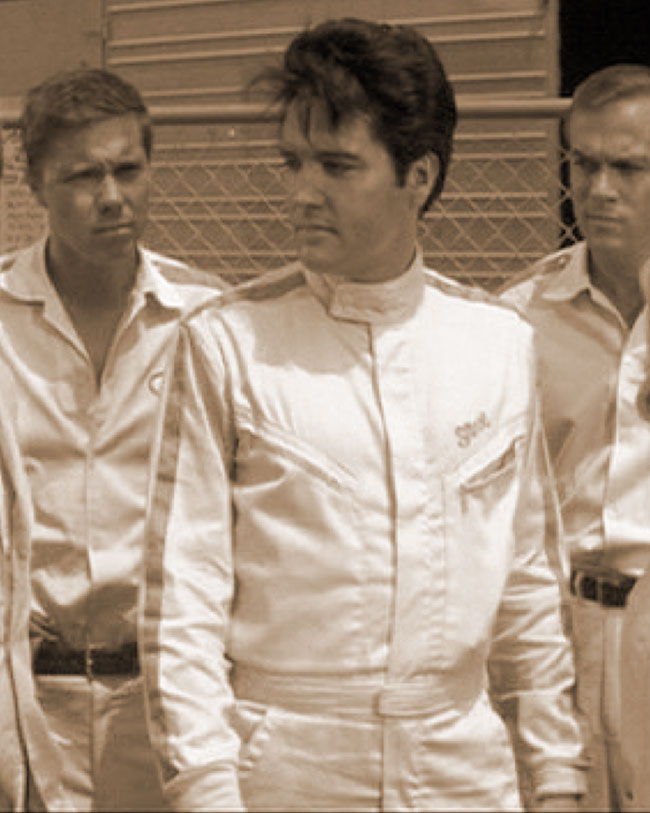
Elvis Presley is Steve Grayson in SPEEDWAY (1968)

Elvis Presley is Steve Grayson in SPEEDWAY (1968, MGM)

On the iTunes Speedway

Ever since I finished backing up all of my Elvis music to iTunes, I have been wanting to do some number-crunching. I usually rate a song when I first place it on iTunes, using the built-in star ratings of 1-5 (I reserve 0 stars to mean “not yet rated”). I then update the rating, if necessary, whenever the track plays.

For updates, I only allow myself to move the song one star rating in either direction per play. That way, if I am in an extremely bad or good mood, it will not overly influence the rating of a given song.

I now have nearly five years worth of data about how I really feel about the songs within my Elvis collection. This will allow me to determine which individual years and multi-year spans are truly my favorites, at least according to the numbers.

My Picks

Before crunching those numbers, though, I used my heart to answer some basic questions. I thought this would make for an interesting comparison against the iTunes race results.

Favorite Elvis Year: 1970
Top Five Elvis Years: 1970, 1968, 1969, 1957, 1955
Favorite 5-year Elvis Span: 1968-1972
Elvis Decade Ranking: 1970s, 1950s, 1960s

Race for the Elvis Cup: The Rules

For this analysis, I eliminated any years for which I had less than 40 Elvis tracks. This resulted in the removal of 1953 (2 tracks) and 1959 (19 tracks). I also eliminated all non-musical tracks (e.g., “Introductions By Elvis,” “Elvis Talks”).

For each of the remaining 23 years, I determined the average star rating for all applicable tracks. I also determined the percentage of tracks from that year that earned a perfect 5-star rating. For instance, the results for 1956 were:

1956
Total Tracks: 164
Average Rating: 3.91 (out of 5)
Perfect 5-star Tracks: 40.24%

The year with the highest average rating received 23 points on down to the year with the lowest average rating, which received 1 point. I then applied this same logic down the line by year for the percentage rankings for perfect 5-star tracks.

This gave each year a score ranging from a low of 2 to a high of 46. However, there were several ties down the line. The tie-breakers were:

1.) Average Rating (i.e., the tied year with the highest average rating wins the position)
2.) (If necessary) Perfect 5-Star Tracks (i.e., the year with the highest 5-star tracks percentage wins the position)

Victory Lane

The results were interesting. Leading the pack was the year 1968, with a perfect score of 46 points.

Nearly 85% of the Elvis tracks I had from 1968 were connected to the ELVIS television special project in some way, so that definitely helped stack the deck. Among them were “If I Can Dream,” one of my all-time favorite songs, and other tracks from Memories: The ’68 Comeback Special, a stellar album that includes the full June 27, 6 PM “Sit Down” show.

Top Five Elvis Years
#1 1968 (46 points)
#2 1970 (43 points, wins 2nd position over 1969 on Average Rating tie-breaker)
#3 1969 (43 points)
#4 1967 (38 points)
#5 1955 (37 points, wins 5th position over 1957 on Average Rating tie-breaker)

The real surprise for me was 1967 making the Top Five. Highlights for 1967 included the September sessions in Nashville that produced standouts like “Guitar Man,” “You’ll Never Walk Alone,” and “You Don’t Know Me.” In fact, alternate takes from that session, many of which are collected on FTD’s Elvis Sings Guitar Man, helped propel 1967 ahead due to the number of five-star ratings.

1965 came in last place, with a minimal score of 2 points (no surprise there). I was surprised that 1977 (5 points) was not able to overtake 1964 (8 points) and wound up as Elvis’ second-worst year.

5-Year Mission

I was also interested in determining my favorite 5-year span. As noted above, I usually say my favorite Elvis time period is 1968-1972, with 1954-1958 running a close second. How did the numbers match against my picks?

To my surprise, it turned out that my favorite 5-year Elvis span was actually 1966-1970, which came in at a whopping 198 points. 1968-1972 earned a collective 183 points, while 1954-1958 came in at 146 points. In other words, this race was not even close.

I often state that the opening salvos of Elvis’ comeback were actually fired in 1966 during the How Great Thou Art sessions, so perhaps I should have seen this coming. 1969 included the Memphis sessions that produced “Suspicious Minds,” “Kentucky Rain,” and “In The Ghetto,” his return to live performances, and even a strong soundtrack on the Change of Habit film. 1970 featured the That’s The Way It Is project, including the Nashville sessions, the summer rehearsals, and the August live performances.

The five-year span that earned the least points was 1961-1965, with a combined total of only 50, barely more than the single year of 1968.

Elvis Decades

Now, to answer that age-old question, what is your favorite Elvis decade? Though 1964 and 1965 are hard to love, I otherwise enjoy Elvis’ entire career. When pressed, however, I state that my favorite decade is the 1970s. What did the numbers say?

Again, they proved me wrong. The 1950s won out, with an average of 29.2 points. Second place was the 1970s, well behind at an average of 22.88 points. This barely edged out the 1960s, which had an average of 22.3 points.

Elvis professionally recorded during only five years in the 1950s, and the quality of his output was much more consistent in that time than in the 1960s and 1970s. The 1970s were brought way down by outliers like 1977 (5 points) and 1974 (10 points), while the same occurred for the 1960s with 1965 (2 points), 1962 (8 points), and 1964 (8 points). However, even the 1950s had its own outlier of 1958 (10 points).

Awarding the Elvis Cup

The analytical side of my personality loved reviewing these numbers. The emotional side of me, though, still believes that 1970 is my favorite Elvis year, no matter what iTunes says.

For me, feelings always rule out in the end, so the Elvis Cup is hereby awarded to 1970, the reigning champion.

We can solve the mystery if we try

Frequent commenter Ray Faithfull recently emailed me the following mystery:

I watched a clip posted on facebook for the song “We Can Make The Morning”….then it dawned on me that it was longer than the Now album release and the FTD release by almost 30 seconds..I figured you would be the person to go to for some insight as to how many takes of this song were actually done and what and where have they been released??

Was take 1 the master take that went for over 4:30 and was simply faded at 3:48 for the final cut ??

I have included the link to the video i am referring to with the version i had not heard or at least not completely?? http://www.youtube.com/watch?v=GGIMKq-qwOM

Though I did not know the answer right off the top of my head, Ray had obviously placed a lot of faith in me (no pun intended . . . I think), so I felt compelled to research this for him.

First, I checked iTunes, where I have meticulously cataloged every unique Elvis track I own. To my surprise, the only version of “We Can Make The Morning” I have is the master recording, as released on Elvis Now.  My iTunes version of the 1971 track, sourced from the circa-2007 Vic Anesini remastering effort as released on Elvis: The Complete Masters Collection, clocks in at 3:59. However, the last five seconds of that are silence.

"We Can Make The Morning" on iTunes

“We Can Make The Morning” on iTunes

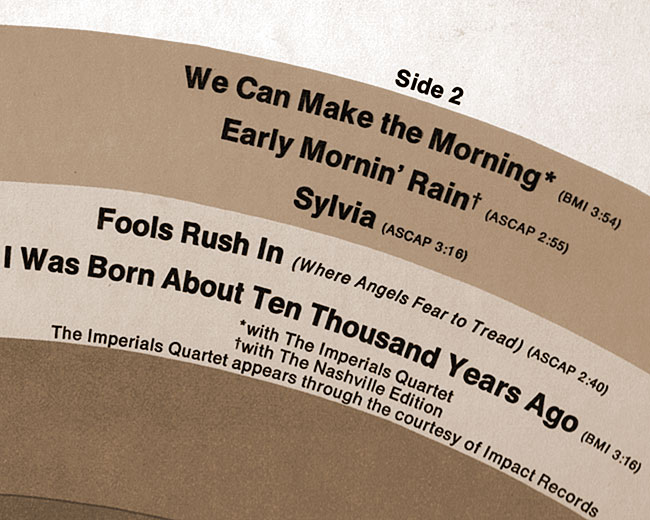
I pulled out my vintage 1972 vinyl edition of the Elvis Now album, and it indicated a run time of 3:54 for “We Can Make The Morning.” So, I had approximately six seconds more song than Ray’s 3:48 source, but nowhere near the 4:44 of the YouTube video. Though I am fairly obsessive about obtaining alternate takes of songs that Elvis formally recorded between 1969 and 1976, I certainly do not own every Elvis release. Perhaps this extended version was on an album I did not have.

Checks of the Elvis Now FTD edition liner notes and Ernst Jorgensen’s essential Elvis Presley: A Life In Music – The Complete Recording Sessions book provided no useful information in this case. Next, I went to my favorite source for alternate take information, the incredible Elvis Recording Data/Session Notes section of the Elvis In Norway site. There, I also found only one entry for “We Can Make The Morning,” the master recording (B-side single), with time listed as 3:54.

I only collect official releases, so my next thought was that the 4:44 version might be from a bootleg. Elvis In Norway’s Session Notes section fortunately does not muddy the water by including those, so I went to another reliable source that does incorporate bootleg information, the Recording Sessions section of Keith Flynn’s Elvis Presley Pages site.

There I found three matches for “We Can Make The Morning”:

A note on the May 20 / 21 page indicates, “Tape reel #2 from this session is missing, and this is the reel that would have included […] the outtakes of We Can Make The Morning,” so that effectively ruled out an alternate take of the song.

The undubbed master has apparently never been released, nor has the May 25 string overdubs version. Only the completed June 21 version, with overdubbed brass and strings, has been released (i.e., the one from Elvis Now).

However, the site lists the track as 4:11. That’s 17 seconds closer to 4:44, but still not enough. The 4:11 version of the song was released on the bootleg Unedited Masters: Nashville 1971 by the Venus label. There, “We Can Make The Morning” is listed as the “unedited, overdubbed master.” I do not have the album to verify whether the track fades at the end but, assuming the Venus information is correct, that leaves at least 33 unaccounted seconds that are in the video.

After all of this, I finally decided to take a listen to the YouTube video, which had been created by a fan. The visual imagery, interspersing photos of Elvis in life with photos of fans at candlelight vigils in the years after his death, was not to my liking, so I stopped paying attention to the video and just listened to the audio. Not only did it go to 4:44, but the song had not even fully faded at that point.

What was going on here? Though I did not detect anything the first time through, my guess was that a portion of the song had been re-looped somewhere (i.e., a part of the recording had been replayed to artificially make the song longer). On my second listen to the 4:44 video, I played the Elvis Now version at the same time. Whatever potential monkey business had occurred within the song was definitely happening near the end.

My third and fourth listens revealed that 3:28 in the video is a repeat of 2:48. For example, listen how Elvis draws out “night” at 3:33, which is an exact duplicate of how he sings it at 2:53 in the video.

Essentially, someone has artificially added at least 40 seconds to the audio track on the “We Can Make The Morning” YouTube video by repeating a portion of the song – most likely to suit the purposes of the photo montage. Other than the abrupt ending, the audio editing is actually quite seamless. However, I will stick with the original version.

Thanks for the great question, Ray, and for inspiring today’s post.

Case closed.

Close-up of ELVIS NOW back cover (1972)

Close-up of ELVIS NOW back cover (1972)

3,510: An Elvis Obsession

In 2008, I obtained my first iPod. I didn’t think much would come of it because I mostly listened to CDs. Once I had that iPod in my hands, though, an obsession slowly took hold. I found that listening to Elvis in shuffled mode gave me a much broader view of his career than simply relying on whatever CD I happened to spin. Over time, it also allowed me to rediscover songs from CDs that I otherwise did not play very often.

I have been collecting Elvis music since 1987 and have purchased hundreds of his CDs. The iPod has allowed me to truly experience the power of that collection, rather than just having it sit on a shelf.

In iTunes, I created a series of smart playlists to make various shuffle themes for my iPod. I think of these as my own private radio stations. They are not completely random, as I build out the smart playlists with certain rules.

For example, one of the rules in my Elvis Mix avoids 1-star songs. I only want to hear those in the context of their original albums.

In my Best Mix, I have Elvis set to play about 10% of the time. Otherwise, he would dominate that list due to how many Elvis songs I have. I also control the percentages of songs in certain genres that play. I tweaked this through the years until I made a Best Mix shuffle that suits my quirky taste.

Over time, I slowly began backing up more of my Elvis collection to iTunes. By May 2010, I had over 1,200 Elvis songs in iTunes for my iPod. This included the 711 masters released during his lifetime. At that point, rather than continuing to pick and choose from my CDs, I decided to go back and back up every unique track from every Elvis CD I owned.

I began on June 1, 2010, and figured I would be finished by the end of that year.

I finished yesterday, March 15, 2013.

This extended time period was not due to lack of diligence on my part. In fact, if anything, I have been too diligent. With only a few breaks, this has consumed more of my spare time over the last few years than I care to admit. Other things that I could have been doing, such as writing, have suffered.

So, why did it take me so long? For one thing, it turns out that I have many more Elvis songs than I realized.

I also did not simply throw in each CD, allow iTunes to look up the track names, and be done with it. If only it had been that easy. The first feature I turned off was the auto-look-up of track names, because I found this often had errors or formatting inconsistencies. Instead, I hand-typed all of that stuff in. If there were going to be errors, at least they would be my errors.

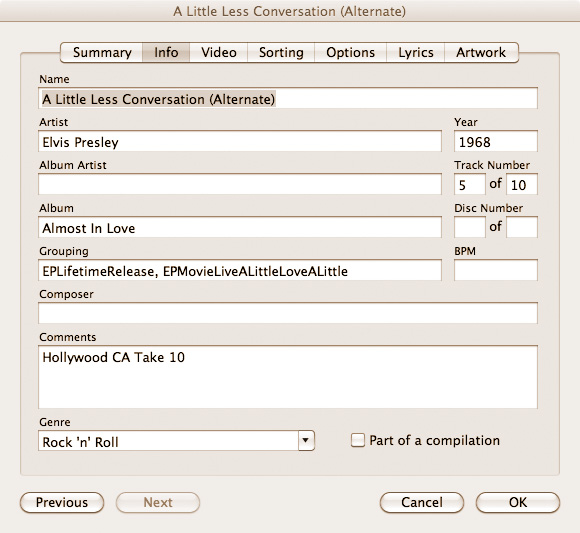
iTunes "Get Info" window

iTunes “Get Info” window

For each song, I researched its first album appearance and other tidbits, such as recording location and take number. For this, I primarily used the comprehensive Elvis Recording Data/Session Notes section of the Elvis In Norway site.

For live songs and other tracks without clean breaks in between, I added fade-ups and fade-downs. I also removed any uninteresting “false starts” and chatter from studio outtake/alternate tracks. When a false start proved to be of interest, I split it out to its own separate track.

Along the way, I also replaced those 711 core masters with new versions in better sound quality.

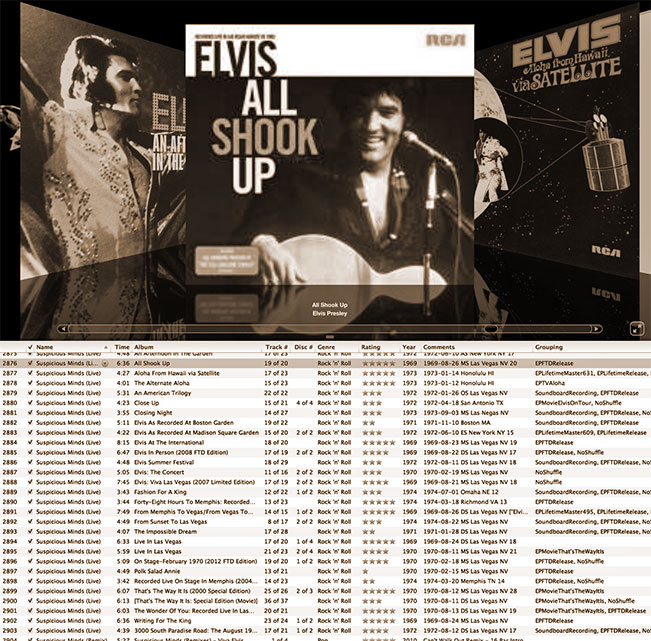
After all of that, I have 3,510 unique Elvis tracks, representing nearly 160 hours of music.

In an amazing coincidence that I really cannot believe, it turns out that I also have exactly 3,511 non-Elvis tracks backed up to iTunes, representing 208 more hours of music. I have often said Elvis represents about half of the tracks on my iPod, but I had no idea that was so precise. Over time, the non-Elvis tracks will likely grow at a faster rate now than the Elvis ones, though. [However, I am not going to start a similar project for my non-Elvis CDs. Never again.]

To keep my smart playlists working the way I like, I also rated each track. The analytical side of me has all kinds of number-crunching ideas around this, but here is a fun breakdown for starters:

  • 5 Stars: 938 tracks (27%) [example: “Always On My Mind” (1972)]
  • 4 Stars: 909 tracks (26%) [example: “It’s Now Or Never” (1960)]
  • 3 Stars: 853 tracks (24%) [example: “Love Me Tender” (1956)]
  • 2 Stars: 556 tracks (16%) [example: “Wear My Ring Around Your Neck” (1958)]
  • 1 Star: 254 tracks (7%) [example: “A Dog’s Life” (1966)]

It astonishes me that, thanks to my iPod, I can now fit the entirety of my Elvis music collection in the palm of my hand. I can literally take it with me anywhere and listen to any song at any time.

Elvis in iTunes

Elvis in iTunes

With those 3,510 tracks, I could listen to Elvis for six days straight, without sleeping, and never hear a repeated track.

I would never do that, though. I am not that obsessive of a person.

The fact that my next post will be coming out in about six days is a complete coincidence.

Honest.

“Elvis Song Of The Year” for 2012

There are still a few hours left in 2012, so I’m going to squeeze in one last post for you this year.

Live In VegasAccording to iTunes, out of 2,953 unique Elvis tracks, the one I played most often this year was “Mystery Train/Tiger Man,” as released on FTD’s 2011 CD Live In Vegas: August 26, 1969 Dinner Show. I played the track an astounding 26 times.
I listened to 7,935 Elvis songs using iTunes or my iPods in 2012 (including duplicates). That’s an average of 22 Elvis songs a day.

Out of 3,364 non-Elvis tracks, my most played song this year was “She Never Cried In Front Of Me” by Toby Keith, from his 2008 album That Don’t Make Me A Bad Guy. I played that one 17 times.

Believe it or not, this actually marks the first year since I started keeping track in 2009 that an Elvis song was my most-played recording. I sent many of the play counts for tracks in my 100 Greatest Elvis Presley Songs Of All Time list into the stratosphere when I played them repeatedly to determine the rankings.

Overall, I listened to 13,499 songs using iTunes or my iPods this year. That works out to 37 songs a day. That is actually down significantly from 55 songs a day last year. However, CD and vinyl spins are obviously not captured in these totals. Lately, I’ve been playing more CDs and vinyl.

Sure, this post was a little self-indulgent . . . but aren’t they all? See you in 2013!

“Elvis Song Of The Year” for 2011

Burning Love (1972)According to iTunes, out of 2,564 Elvis tracks, the one I played most often this year was: “Burning Love,” his 1972 single.
I listened to 10,023 Elvis songs using iTunes or my iPod in 2011 (including duplicates). That’s an average of 27 Elvis songs a day.

Out of 3,225 non-Elvis tracks, my most played song this year was: “Sweet Dreams” by Beyoncé, from her 2008 album I Am… Sasha Fierce.

Overall, I listened to 19,917 songs using iTunes or my iPod this year. That works out to 55 songs a day. My daily average in the last two years was about 44. The increase is probably due to this year having the capability to play my iPod in the car.

When I first started this blog, I mentioned that the soundtrack of my life was powered by Elvis. I’m happy to say, that hasn’t changed.

Christmas Dreams 2011: An Elvis Playlist for the Holiday Season

Nearly every year since I was about 13, I’ve made some form of an Elvis “Christmas mix” for my own personal use. This started out in the late 1980s on cassette tapes. I eventually graduated to CD-Rs in the late 1990s. The present incarnation of this concept is, of course, in the form of iPod playlists. It sure is much easier to perfect the sequencing on a playlist than it is on a tape, let me tell you.

As you might imagine, in many ways, this is simply a reshuffling of the same couple of dozen songs every year. Why bother when I could just reuse a previous year’s compilation? The main reason is that I have so much fun putting this together. It’s how I kick off the Christmas season.

This year, I thought I would share my Elvis Christmas playlist sequence with you in case you would like to try it out on your own.

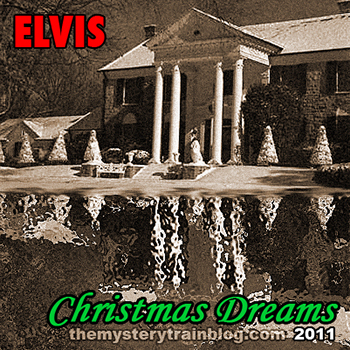
Elvis: Christmas Dreams (2011)

Elvis: Christmas Dreams (2011)

  • Santa Claus Is Back In Town/Blue Christmas (Live) [Tiger Man]
  • I’ll Be Home On Christmas Day (Alternate) [Today, Tomorrow & Forever]
  • Holly Leaves and Christmas Trees (Alternate) [If Every Day Was Like Christmas]
  • It Won’t Seem Like Christmas (Alternate) [If Every Day Was Like Christmas]
  • If Every Day Was Like Christmas [Elvis’ Christmas Album (1970 Edition)]
  • Santa Bring My Baby Back [Elvis’ Christmas Album]
  • Here Comes Santa Claus [Elvis’ Christmas Album]
  • Silver Bells [Elvis Sings The Wonderful World Of Christmas]
  • White Christmas [Elvis’ Christmas Album]
  • Winter Wonderland [Elvis Sings The Wonderful World Of Christmas]
  • I’ll Be Home For Christmas [Elvis’ Christmas Album]
  • If I Get Home On Christmas Day [Elvis Sings The Wonderful World Of Christmas]
  • I’ll Be Home On Christmas Day [Elvis Sings The Wonderful World Of Christmas]
  • Blue Christmas [Elvis’ Christmas Album]
  • It Won’t Seem Like Christmas [Elvis Sings The Wonderful World Of Christmas]
  • Holly Leaves and Christmas Trees [Elvis Sings The Wonderful World Of Christmas]
  • O Little Town of Bethlehem [Elvis’ Christmas Album]
  • On A Snowy Christmas Night [Elvis Sings The Wonderful World Of Christmas]
  • The First Noel [Elvis Sings The Wonderful World Of Christmas]
  • O Come All Ye Faithful (Alternate) [Memories Of Christmas]
  • Silent Night [Elvis’ Christmas Album]
  • Santa Lucia [Elvis For Everyone]
  • The Wonderful World Of Christmas [Elvis Sings The Wonderful World Of Christmas]
  • Santa Claus Is Back In Town [Elvis’ Christmas Album]
  • I’ll Be Home On Christmas Day (Alternate) [Memories Of Christmas]
  • Blue Christmas (Rehearsal) [Let Yourself Go! (Track 25, “Blue Christmas” portion only)]
  • Merry Christmas Baby [Elvis Sings The Wonderful World Of Christmas]

For those in the US, I also published a variant of this playlist on iTunes as Elvis: Christmas Dreams (2011).

Happy holidays, everyone!

Valentines From Elvis: His Top Ten “Love” Songs

In honor of Saint Valentine’s Day, here is my top ten list of Elvis songs released during his lifetime that contained some form of the word “love” in the title. Can you believe I had about 70 different songs to choose from to compile this list? Here are the best of the best.

#1 Can’t Help Falling In Love (1961)
Blue Hawaii
Other notable versions: 1968 live (ELVIS-TV Special); 1969 live (From Memphis To Vegas/From Vegas To Memphis).

#2 Love Me (1956)
Elvis
Other notable version: 1968 live (A Legendary Performer, Volume 1).

#3 You’ve Lost That Lovin’ Feelin’ (Live-1970)
That’s The Way It Is

#4 Burning Love (1972)
Burning Love And Hits From His Movies, Volume 2
Other notable version: 1973 live (Aloha From Hawaii Via Satellite).

#5 Pledging My Love (1976)
Moody Blue

#6 Love Me Tender (Live-1968)
ELVIS-TV Special

#7 After Loving You (1969)
From Elvis In Memphis

#8 Wearin’ That Loved-On Look (1969)
From Elvis In Memphis

#9 Power Of My Love (1969)
From Elvis In Memphis

#10 Your Love’s Been A Long Time Coming (1973)
Promised Land

Happy Valentine’s Day, everyone!