WARNING: This review contains major spoilers for Aloha From Hawaii: 40th Anniversary Edition.
Elvis Presley’s 1973 Aloha From Hawaii television special still stands as a significant milestone in his legendary career. The January 14 concert aired live via satellite to certain parts of the world. Over the next several months, it aired in other locations, including the United States on April 4.
NBC’s US version of the broadcast featured a slightly edited concert, but also included several additional “insert” songs taped after the main show when the audience left the building. With only slight modifications, this was essentially the “standard” version used for rebroadcasts and home video releases through the 1990s.
2004’s Aloha From Hawaii: Deluxe Edition DVD from Elvis Presley Enterprises and BMG featured a new edit of the full concert. In addition to showcasing some new camera angles, it removed many of 1973’s split screen techniques – which had become dated over the years. The set also contained a January 12 rehearsal show taped as a backup, the January 14 insert song session, and the April 4 NBC broadcast. This 2-DVD set is the definitive release of Aloha From Hawaii.
“Definitive” does not always mean “final,” though. On Monday, EPE released a new 2013 edit of the main show on DVD. Originally created for an Elvis celebration in Honolulu that marked the 40th anniversary of the TV event in January of this year, this edition features a wider presentation that makes use of split screens to show multiple camera angles at once.
Unfortunately, EPE has thus far spent very little effort marketing this new version of Aloha From Hawaii. Press releases and product descriptions have been high on hyperbole but low on detail. Therefore, before getting into the fun stuff, I want to start this review by explaining exactly what to expect with the new Elvis: Aloha From Hawaii – 40th Anniversary Edition DVD.
Specifications
Unlike 99% of DVDs professionally released in the last 10 to 15 years, Aloha 40th contains no technical specifications on the back cover, or anywhere else for that matter.
There are no indications of aspect ratio, running time, or audio channels. There is a “Dolby Digital” logo, but that is as close as it comes to giving technical information. Lack of standard details such as these made the product packaging appear amateurish.
Here are the key technical specifications for the main feature (concert), which I derived on my own:
- Visual format: Anamorphic widescreen (enhanced for 16:9 widescreen TVs)
- Aspect ratio: 3:1 (approximate)
- Running time: 77 minutes
- Audio: English 5.1 Surround (Dolby Digital)
- Closed captioned: No
- Disc region: All
- Disc format: NTSC
Explanation of Aspect Ratio
Aloha 40th has a radically different aspect ratio compared to previous versions. To this point, Aloha From Hawaii has always been presented in its original television aspect ratio of 1.33:1 (also known as 4:3). This means that for every 1.33 units of width, there is 1 unit of height. This new version is over twice as wide, at about 3:1. For every 3 units of width, there is now only 1 unit of height. This is actually wider than most films of today, which are usually 2.75:1.
What all of this means is that there are black bars at the top and the bottom of the Aloha 40th image, no matter the kind of television used to watch it. Old-style 4:3 televisions will have much thicker bars, however, than modern 16:9 televisions.
Below are simulations that compare the standard 1.33:1 Aloha with the widescreen 3:1 Aloha 40th, in terms of image space used on each kind of television. This is not intended to illustrate relative image quality.
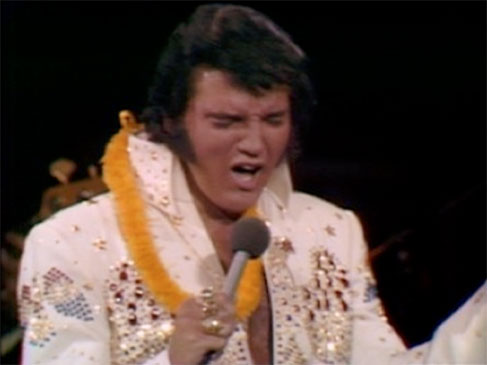
Simulation of original 1973 ALOHA FROM HAWAII image on an old-style 4:3 television
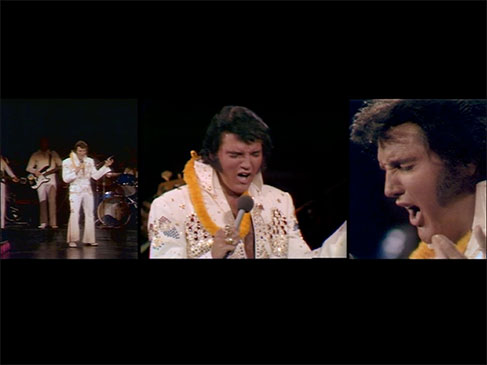
Simulation of 2013 ALOHA FROM HAWAII: 40TH ANNIVERSARY EDITION image on an old-style 4:3 television
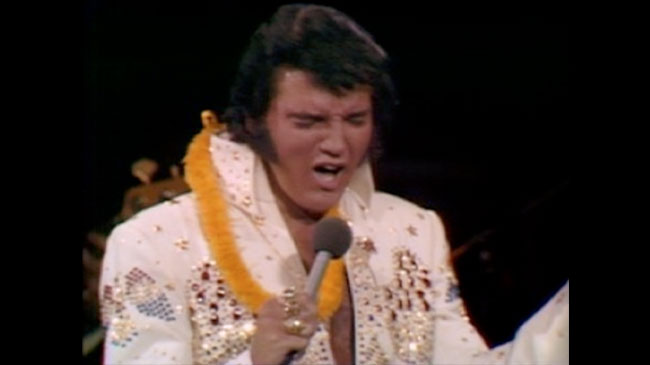
Simulation of original 1973 ALOHA FROM HAWAII image on a modern 16:9 widescreen television
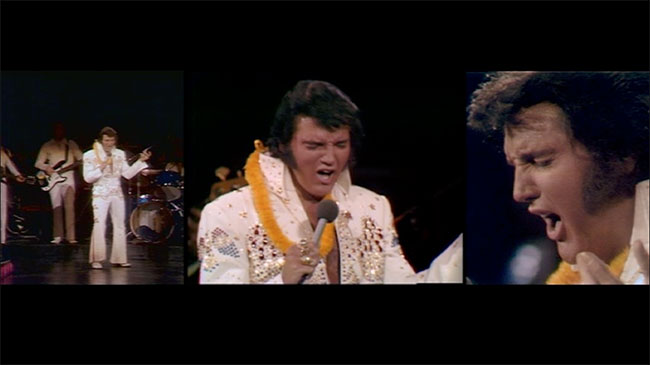
Simulation of 2013 ALOHA FROM HAWAII: 40TH ANNIVERSARY EDITION image on a modern 16:9 widescreen television
Hanging Out Upstairs at Graceland
When I place Aloha 40th in the disc player for the first time, I do not know what to expect. I am always excited to watch a new Elvis DVD, but I am also afraid that this one will be disappointing. Will the contents be treated in the same amateur fashion as the packaging?
At first, the opening moments are fantastic, with bits of the Aloha press conferences interspersed with shots of the Earth from space.
Then, it zooms down to Graceland in Memphis, Tennessee, and things quickly go awry.
As the camera closes in on Elvis’ bedroom window, there is a knock on the door. The scene cuts inside and the camera takes on the point-of-view of someone exiting his room upstairs at Graceland.
Jerry Schilling is waiting in the hallway for this person, who turns out to be an Elvis imitator wearing an American eagle jumpsuit. Though shot in the present day, the footage is made to look vintage. In fact, it is made to look much older than 1973 for some reason.
In the background, the annoying “Also Sprach Zarathustra” substitute song that was used during backstage portions of Elvis On Tour (1972) and This Is Elvis (1981) plays. With fake “Also Sprach Zarathustra” as his introduction, is fake Elvis about to take the stage for a concert right there in real Graceland?
Not quite. The real Jerry takes fake Elvis down the stairs, through the den, and out real Graceland’s back door.
In the backyard, the real Joe Esposito is waiting to take them to a blue and white helicopter that has landed in the pasture.
These opening moments are reminiscent of both This Is Elvis and Elvis Lives: The 25th Anniversary Concert (released 2007). Ignoring for a moment that the unnecessary use of an Elvis imitator made me queasy, the new opening also left me with more questions than answers:
- Jerry and Joe are both their present-day selves, so if this footage represents 2013, who exactly are they supposed to be retrieving from Elvis’ bedroom? His spirit?
- If this footage is supposed to represent 1973, then why is (fake) Elvis already wearing his jumpsuit? Graceland is over 4,000 miles from Honolulu.
- Where is that helicopter supposed to be taking fake Elvis anyway? To the airport? Elvis always took a car to the airport.
Surely, the creators of this segment are not trying to imply that fake Elvis, after being put out to pasture wearing his fake jumpsuit, rides that helicopter all the way to Honolulu? Everyone knows that when (real) Elvis arrives in Honolulu, he is in a green helicopter and wearing a corduroy suit.
Besides, if they really wanted to impress me, they would have loaded fake Elvis on the real Lisa Marie airplane and used CGI to show the plane take off for Hawaii right from Elvis Presley Boulevard. Sure, Elvis had not yet acquired his own plane at the time of Aloha, but why try to introduce logic into this insanity now?
Yes, I am nitpicking what is obviously supposed to be a fun little segment played for laughs. However, I watch Aloha to see the genuine article, not an imitation, so this poor opening almost spoiled the DVD for me.
Almost.
Then, the scene cuts to the familiar 1973 show opening – enhanced for widescreen. As the satellite graphic appears on screen, morse code begins to spell out E-L-V-I-S.
Soon enough, fake Elvis is wiped from memory as real Elvis takes the stage in all his dazzling glory. Except now, there are three of him!
The Triple Elvis Threat
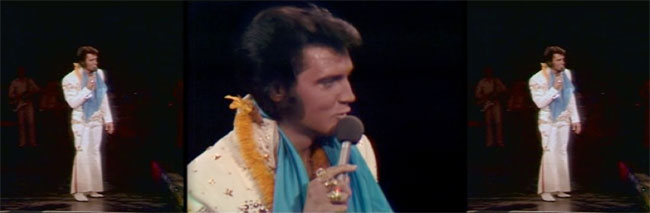
Example of the split screen technique used in ALOHA FROM HAWAII: 40TH ANNIVERSARY EDITION
Throughout most of Aloha 40th, there is a main camera angle in the middle section of the screen, with two slightly smaller, cropped angles on the left and right sections of the screen. This configuration is used in one of three ways:
- One angle: Same angle repeated in all three sections
- Two angles: One angle in middle section, a second angle repeated on both sides
- Three angles: A different angle in each section
I did not attempt to measure this, but my rough observation is that the two angle configuration of the three sections is used most often, while the three angle configuration is used least often.
The real power of Aloha 40th is being able to view multiple angles at once, so I found the one angle use to be disappointing in most cases. However, when used appropriately, it could still be effective.
With at least two different camera angles on screen at most times, there are undoubtedly some new angles mixed in there that have not been seen on previous releases. One of my favorites that I have noticed so far is Elvis giving a nervous look directly into the camera during James Burton’s “Steamroller Blues” guitar solo. I love moments like this, which humanize Elvis. He has become such a legend, such an icon in death, that his underlying humanity is sometimes lost. He was a real man, after all, who could get nervous on stage.
Watching the split screen angles is a treat, but it also gives my eyes a real workout. I keep scanning back and forth, trying not to miss anything. Meanwhile, the fast, modern editing techniques, including many jump-cuts, also leave me trying not to blink.
While the screen contains three sections most of the time, there are also segments where it splits into dozens of images at once – though still only one or two different angles. Those segments, which are thankfully brief, look like cheap gimmicks, as if someone was allowed to play with Microsoft Movie Maker too long.
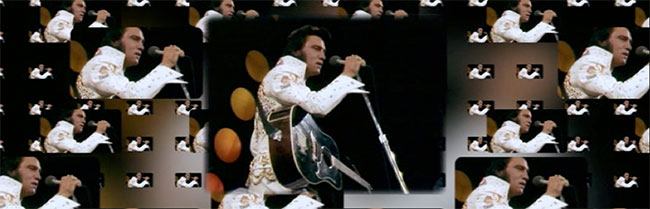
“There is nothing wrong with your television set.” Visual overloads, such as the above, are thankfully rare in ALOHA FROM HAWAII: 40TH ANNIVERSARY EDITION
To be fair, I am certain that the visual overload segments look far better in the environment for which this edit was originally created: Display on a huge movie screen in a large concert arena.
As for the concert, the complete version is used, meaning it includes the “lying like a rug,” “general flunky,” Jack Lord introduction, and other small lines cut from the NBC version.
All of the concert songs appear, including “Johnny B. Goode,” the song Warner Home Video was unable to secure usage rights for in its 2010 Blu-ray and DVD release of Elvis On Tour. EPE was either better at securing a deal with Chuck Berry than Warner, or the terms of its circa-2004 deal allowed for this release as well.
Insert Songs
Most of the “insert” songs from the NBC version of the special are included as well. Different imagery appears in these songs than in the 1973 versions, though.
Inserted between “You Gave Me A Mountain” and “Steamroller Blues,” “Early Morning Rain” contains various shots of Hawaii while Elvis is shown singing on stage after the audience has left.
“Blue Hawaii” features Elvis on stage again, but this time the additional sections are used as a scrapbook of sorts, showing various still photos of Elvis in Hawaii over the years, including production photos from Blue Hawaii, Girls! Girls! Girls!, and Paradise, Hawaiian Style. There are several images that I do not recall seeing before. However, I am not a photo collector, so they might be common.
Since Elvis sings most of “Blue Hawaii” with his eyes closed, the impression is given that he is thinking back on the events shown in the montage. It is an extremely effective sequence, though, in reality, Elvis is probably thinking, “Man, I just finished the biggest show of my career, why am I still stuck here singing to an empty room?”
While previously inserted between “Hound Dog” and “What Now My Love,” “Blue Hawaii” is now placed between “I Can’t Stop Loving You” and “Hound Dog” for some reason. Perhaps the “lying like a rug” line seemed too abrupt of a stopping point to move to the insert. I prefer it in its original position, though.
“Hawaiian Wedding Song” is omitted (as is “No More,” technically, but that was left out of the 1973 broadcast as well, so I am not counting that one). It is the only missing song, and its absence after “I’ll Remember You” does not leave near the same hole as the absence of “Johnny B. Goode” did for the opening of Elvis On Tour.
The remaining insert song is “Ku-u-i-po,” which appears in its traditional spot after “Long Tall Sally/Whole Lotta Shakin’ Goin’ On.” At first, I am annoyed that only two sections of screen appear, neither of which include Elvis singing in 1973.
Then, it happens.
The Surprise
Right there, in the middle of “Ku-u-i-po,” with no fanfare, no preparation, comes footage of Elvis appearing live in Hawaii.
In 1957.
In color.
It is 30 seconds long.
But . . . wow.
This previously unreleased footage is part of a new exhibit at Graceland, called Elvis’ Hawaii: Concerts, Movies and More.
While the split screen techniques of Aloha 40th will someday seem as dated as the 1973 versions did by 2004, the real legacy of this release, what it will be remembered for long-term, will be those 30 seconds of 1957 footage.
Audio
In no way do I claim to be an audio expert, so all I can do is present my subjective opinion on this topic as a layman. My first impression of Aloha 40th‘s 5.1 audio was that I did not like the new mix.
For instance, there seemed to be little use of the rear speakers, except for background singers. In addition, Elvis’ vocal was far too prominent for my taste.
As a comparison, I played “An American Trilogy” from the original pressing of the 2004 edit of Aloha versus the same song on the 2013 edit. While the 2004 mix also has room for improvement, it is far better, in my view, than the 2013 mix. The 2004 mix has a fuller sound with more ambience.
The difference in mixes is best exemplified by what I refer to as the musical “cannon fire” portion of “Battle Hymn of the Republic,” the part where the orchestra goes, boom! Boom!! BOOM!!!
On the 2004 mix, you are the one under fire. In the 2013 mix, the cannons are merely firing off at someone else in the distance.
My primary listening for Aloha 40th was on a six-speaker surround system that used the Dolby Digital encoding (left, center, right, left rear, right rear, and sub). I also listened to selections on a standard two-speaker stereo setup (left and right).
Unlike the 2004 edition, there is not a dedicated stereo track available. Presumably, this means it is left to one’s audio equipment to convert the 5.1 sound to 2.0. In my case, it sounded fine. In some ways, I enjoyed it more than the true 5.1 version, but that might be due to having lower expectations.
Video
As shown in the aspect ratio image examples above, the tradeoff of the multiple angles on Aloha 40th is that the visuals are now smaller overall, using less screen space.
That being said, video quality never jumped out at me as a significant issue on this release. I also do not claim to be a video expert, though, so I only present my perspective as a fan who has watched and enjoyed Aloha From Hawaii for years.
Overall image quality is about the same as the 2004 edition, which was very clean. Once again, I used “An American Trilogy” to make most of my comparisons.
Some of the video footage this time out has an occasional darker look, though, but that may be an intentional effect. Though I noted it, it was not distracting.
Coloring sometimes varies from angle to angle. For instance, Elvis’ jumpsuit sometimes looks white, while other times it is an off-white. Due to the many factors that could cause this, though, I am not prepared to blame the variances on this release in particular. In fact, I am almost sure this has always been the case. The split screens simply make it easier to detect.
One of the things that surprised me was that the 2013 image often appeared crisper than the 2004 version. Since I was watching on a high-definition television, this unexpected benefit was likely due to the comparatively low-resolution image not having to be artificially expanded as much for the increased resolution of modern TVs.
My primary viewing of Aloha 40th was on a 73-inch widescreen TV, from a distance of about ten feet. I also viewed selections on a 27-inch widescreen monitor, from a distance of about three feet. Unfortunately, I did not have ready access to an old-style TV to test how Aloha 40th appears in that format.
Due to the extremely wide aspect ratio and split screen technology, larger, widescreen televisions will obviously have better results than smaller units. However, even on the 27-inch widescreen, Aloha 40th was still enjoyable.
Extras
Aloha 40th also includes the following bonus content:
- 40th Anniversary Aloha From Hawaii Celebration: A four-minute documentary, which, combined with the main show, certainly makes this DVD a fine souvenir for those fortunate enough to participate in Graceland’s Elvis-themed Hawaiian vacation package earlier this year. It just makes the rest of us jealous, though.
- Elvis’ Hawaii: Concerts, Movies, and More! Exhibit: A five-minute documentary about Graceland’s new exhibit, narrated by Angie Marchese, EPE’s Director of Archives, who created the exhibit. This documentary does a great job in the time allotted explaining what went into creating the new exhibit, as well as giving a nice walkthrough of its contents. This is another chance to see that spectacular 1957 concert footage, by the way. This documentary also reminds me that I really need to go back to Graceland one day.
- Aloha From Hawaii Press Conferences: Five minutes worth of footage from Elvis’ September and November 1972 press conferences. I have seen this footage elsewhere in better condition.
Though I will not watch them very often, the extras are fine. I especially enjoyed the one about the exhibit, which acts as a commercial for Graceland without being obvious about it.
The only additional item I would have preferred in a release of this nature would have been a “making of” documentary about the 2013 edit.
Booklet
The booklet that accompanies the Aloha 40th DVD is actually a modified version of the program given at the 40th anniversary event in January. Though it is nicely assembled, the 12-page booklet contains typical information and pictures. It contains no further details about the DVD. Even the song-listing included is noted as supposedly being for the 1973 NBC broadcast version.
Overall Verdict
Ultimately, the wide format and split screens of Aloha 40th work better than I imagined they would, and they serve to shed new light and energy upon a concert that has become so familiar to Elvis fans. Use of split screen technology returns Aloha to its roots, albeit in modern form.
Aloha 40th should not replace previous edits of Aloha From Hawaii, though. Instead, it should stand alongside them as another viewing alternative.
I know there are some fans who do not enjoy Aloha From Hawaii. They criticize it for a multitude of reasons: Elvis is sluggish, Elvis is nervous, Elvis disrespects his older hits, etc.
While many of those kinds of observations are indeed valid to some extent, I cannot help but love Aloha From Hawaii anyway. While Elvis was alive, it was really his last moment in the international spotlight. Though it might never be in serious contention as his best show, I still find it hugely entertaining and compelling.
If you have not been a fan of Aloha From Hawaii to this point, this DVD is not likely to change your mind. No amount of special editing could ever do that.
If, on the other hand, you already enjoy Aloha From Hawaii and are willing to embrace change, then the Elvis: Aloha From Hawaii – 40th Anniversary Edition DVD is a must.
Once Elvis took the stage, I had a big smile on my face the entire time.
It’s Elvis. It’s fun. What more could I ask?
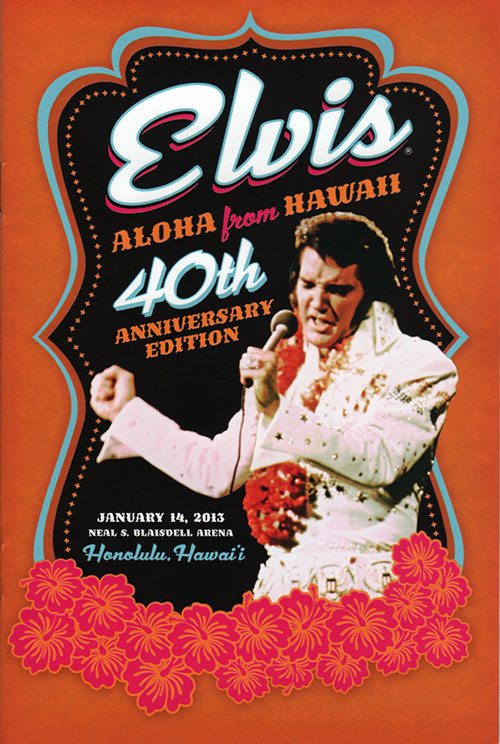
Booklet cover for ELVIS: ALOHA FROM HAWAII – 40TH ANNIVERSARY EDITION (2013)
 The Mystery Train