July 19 Represents a Beginning and an End for Elvis Presley

Portions of this post were first published on one of my pop-culture blogs, now retired.


July 19, 1954

The date is July 19, 1954, and Sun releases the debut record of 19-year-old Elvis Presley. Produced by Sam Phillips, the single consists of “That’s All Right” backed with “Blue Moon of Kentucky.” Elvis, who in childhood dreamed of being “the hero of the comic book,” begins his adventure.

The years come and go. In many ways, Elvis accomplishes far more than he could have possibly dreamed, including becoming a musical hero throughout the world. As they do for everyone, though, some of his dreams still manage to slip away from him.

The date is July 19, 1977, and RCA releases Moody Blue, an album that proves to be the final Elvis record before his death exactly four weeks later at the age of 42. An unprecedented level of fame helped Elvis place himself on a path that brought his earthly journey to a tragic end.

Only 23 years, a mere blink of history’s eye, separate the release of the last Elvis record from the first.

More time passes. Other heroes come and go, yet Elvis somehow remains. As some fans fade away, others take their places.

The date is now July 19, 2022, but those 23 years continue to resonate.

Journey with The Mystery Train Elvis Blog today to the beginning and the end with two editions of Vinyl Elvis:

July 19, 1977


“Sing to the LORD, for he has done wonderful things. Make known his praise around the world.”
Isaiah 12:5

Vinyl Elvis: MOODY BLUE (1977)

Today marks the 45th anniversary of the July 19, 1977, release of Moody Blue, an album that turned out to be the last Elvis Presley record before his death four weeks later.

MOODY BLUE (RCA, 1977; from TY's collection)

MOODY BLUE (RCA, 1977; from TY’s collection)

Moody Blue
Label: RCA
Catalog Number: AFL1-2428
Recorded: 1974-1977 | Memphis, TN; Ann Arbor, Michigan; Kalamazoo, Michigan
Released: 1977

Before I had Elvis records of my own, I remember checking out a couple of his albums from the public library. I must have been about ten-years-old.

The two records I took home that day in 1985, which I believe represented the entirety of the library’s Elvis music collection, were The Sun Sessions and Moody Blue. The fact that I had borrowed both his very last record and a compilation of his very first records escaped me.

I enjoyed both albums, but the one that really drew me in was Moody Blue. For one thing, the record was pressed on blue vinyl. I had never seen anything like that. Plus, I just loved the sound of the album — particularly “Way Down,” which I played over and over.

I played “Way Down” for my older brother later that day to show off knowing a “new” Elvis song, only for him to inform me that he had his very own copy of Moody Blue.

At that time, I was not allowed to touch my brother’s records (and rightly so, as I was often unintentionally destructive of his things). Today, as he generously gave me all of his Elvis records several years ago, his copy of Moody Blue is mine.

Side A of MOODY BLUE (RCA, 1977; from TY's collection)

Side A of MOODY BLUE (RCA, 1977; from TY’s collection)

Side A

  1. Unchained Melody (1977)
    A compelling live version of “Unchained Melody” leads off the record. I normally prefer to open with a rocker, but this choice works perfectly for Moody Blue. Incidentally, this is my beloved bride’s favorite Elvis song she has heard so far, and she notes Elvis’ emphasis on the word “God” versus versions of this song by others. Indeed, in Elvis’ hands, the lyric “God speed your love to me” can be heard as “God, speed Your love to me.” Similarly, “I’ll be coming home, wait for me,” can be interpreted as “I’ll be coming Home, wait for me” in Elvis’ version. Elvis seems to be calling out not to a lost love, but to God.
  2. If You Love Me (Let Me Know) (1977)
    When I was listening to the library’s copy as a 10-year-old, I distinctly remember recognizing this live song from the Elvis In Concert album and wondering why this one sounded better. Part of the reason was that it was actually recorded a couple of months earlier than the version on Elvis In Concert. Some debate whether this song, made popular by Olivia Newton-John, should have been in his setlist. No matter, this is his best version of a song that obviously spoke to him.
  3. Little Darlin’ (1977)
    Next up is another live recording, Elvis’ fun take on the 1950s classic, “Little Darlin'”, which also provides a much-needed change in tempo. I love his ad-lib of “To hold in mine…your little foot…uh, hand!”
  4. He’ll Have to Go (1976)
    The tempo slows back down for “He’ll Have To Go,” the last studio recording ever made by Elvis. In addition to the resonance of the Elvis vocals, I love the guitar work of James Burton here. Six of the songs on this album were recorded at Graceland in 1976 in an effort to make the artist feel more comfortable, as Elvis in later years had become reluctant to record in a formal studio setting. Two sessions at a makeshift studio in his den resulted in sixteen songs, ten of which had already been used on the From Elvis Presley Boulevard album by the time RCA was assembling Moody Blue.
  5. Let Me Be There (1974)
    In early 1977, Elvis backed out of a planned session in Nashville to finish the Moody Blue album. Instead, a few live performances were recorded that April. Only three suitable songs were captured, however, which brought the album’s total to nine. In desperation, RCA re-released “Let Me Be There” from 1974’s Recorded Live On Stage In Memphis album to round out Side A of Moody Blue. Another Olivia Newton-John hit, “Let Me Be There” fits well on Moody Blue, despite being slightly older than the other recordings. In addition to the Newton-John connection tying it to “If You Love Me,” it was also recorded in Memphis like the majority of the other songs on this album.

Side B

Side B of MOODY BLUE (RCA, 1977; from TY's collection)

Side B of MOODY BLUE (RCA, 1977; from TY’s collection)

  1. Way Down (1976)
    All of the songs on Side B of Moody Blue were recorded at Graceland. I probably have the master of “Way Down” on at least a half dozen CDs. None of them sound as incredible as listening to this record. Is it all in my head? Possibly, but if it is, do not tell me. “Way Down” really rocks, making it an appropriate A-side for what turned out to be Elvis’ last single before his death.
  2. Pledging My Love (1976)
    “Pledging My Love” is another terrific performance by Elvis. He might have lost much of the joy in his life by this point, but you can still hear it on this song.
  3. Moody Blue (1976)
    I find it cool that the album’s title song is buried in the middle of Side B. “Moody Blue,” another great song, almost sounds like disco. Compare the guitar licks on “Moody Blue” with Kool & the Gang’s “Celebration” (1980), for instance.
  4. She Thinks I Still Care (1976)
    Elvis recorded many country songs, particularly in the 1970s. “She Thinks I Still Care” is a stellar performance. At the end, he just will not let the song go, either.
  5. It’s Easy For You (1976)
    “It’s Easy For You” was written by Broadway legends Andrew Lloyd Webber and Tim Rice, bringing to a close an album that was almost as varied as Elvis’ entire career: Adult Contemporary, Country, and Rock ‘n’ Roll. It is hard to ask for more in an Elvis album, and I still consider Moody Blue one of his best. A fun bit of trivia: Note the misspelling of Webber’s name on the Moody Blue Side B label in the image above. Proofreading has apparently never been a strong point for Elvis’ music label.

I mentioned that my brother did not let me touch his records when I was young. This turned out to be a good thing for me, as Moody Blue sounds flawless. Not a crackle or a pop to be heard on either side.

Back cover of MOODY BLUE (RCA, 1977; from TY's collection)

Back cover of MOODY BLUE (RCA, 1977; from TY’s collection)

The interesting thing about Moody Blue is that such a fantastic album could result from not only a hodgepodge of recordings but also such a low point in Elvis’ life. “You don’t have to face the music, you don’t have to face the crowd,” he laments on “It’s Easy For You.” Depression, loneliness, and various personal demons were consuming his life by this point. Years of prescription drug addiction and abuse were beginning to take a public toll.

Part of the credit for the unlikely strength of Moody Blue must go to producer Felton Jarvis. While he occasionally went too far with overdubs on previous Elvis projects, Moody Blue is all the better for his extra work and attention to detail–particularly on the 1977 live recordings. Credit must also go to the musicians and vocalists who worked with Elvis on the album. On occasion, they carry Elvis. Finally, credit is due to Elvis as well, who managed to pull these performances from somewhere inside himself, despite not being in the right frame of mind to record.

Inner sleeve (front) from MOODY BLUE (RCA, 1977; from TY's collection)

Inner sleeve (front) from MOODY BLUE (RCA, 1977; from TY’s collection)

I love the inner sleeves on vintage Elvis albums. Check out the ads for other albums, which must have acted as combination check lists and wish lists for fans of the time. In some cases, it was also a way to see some alternate cover designs. For example, note the Moody Blue concept artwork in the bottom left of the image below.

Inner sleeve (back) from MOODY BLUE (RCA, 1977; from TY’s collection)

The fall of the curtain came much too early for Elvis, but Moody Blue certainly made for an impressive last act. If you collect Elvis on vinyl, this one is a must.


“Anyone who believes in Me may come and drink! For the Scriptures declare, ‘Rivers of living water will flow from His heart.'”
John 7:38

Which “Jungle Room” Elvis CD Should You Buy? [Pastimescapes blog]

[Side Note: Introducing the new look of Pastimescapes, which now leverages the Expound theme. Look for more tweaks in the coming days.]

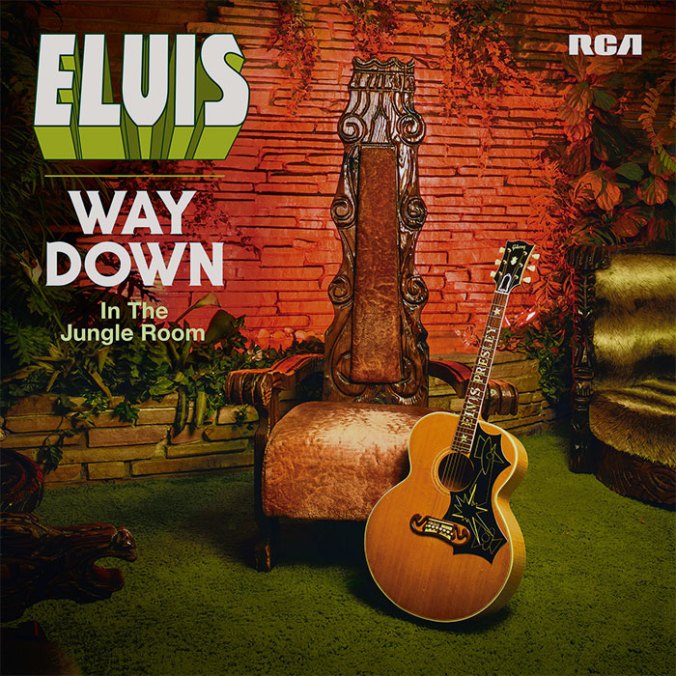
Cover of WAY DOWN IN THE JUNGLE ROOM (2016, Sony)

Cover of WAY DOWN IN THE JUNGLE ROOM (2016, Sony)

Memphis. When it comes to Elvis Presley, there is something magical about the music he created in his adopted hometown.

That magic is tangible, no matter if we are talking about his early SUN sides of 1954-1955, the American Sound sessions of 1969, the Stax recordings of 1973, the Mid-South Coliseum concerts of 1974, or the Graceland sessions of 1976 – where his home’s den was converted into a makeshift recording studio.

Those Graceland sessions, which proved to be the last “studio” recordings of Elvis’ career, initially resulted in two albums: From Elvis Presley Boulevard, Memphis, Tennessee, and the bulk of Moody Blue.

Since then, of course, alternates and outtakes from the Graceland sessions have appeared on numerous releases. The Jungle Room Sessions, for instance, is reportedly one of the best-selling CDs ever released by the Follow That Dream (FTD) collectors label for Elvis fans. The disc is so-named for the nickname given after Elvis’ death to Graceland’s uniquely decorated den.

Earlier this month, Sony released the latest compilation of these songs, Way Down In The Jungle Room. The release contains all of the Graceland master recordings on Disc 1 and selected alternates/outtakes on Disc 2.

Due to already having all of the material from both discs, I had actually planned to skip Way Down In The Jungle Room. I then found out more information about Disc 2 by reading Bob Mehr’s Memphis Commercial Appeal article on the project.

Thanks to the article, I did not skip it, and I can now highly recommend Way Down In The Jungle Room due to the incredible sound of Disc 2’s alternate/outtake versions – newly mixed by Matt Ross-Spang at Sam Phillips Recording Service.

However, my purpose today is not so much to review Way Down In The Jungle Room, but to expand upon an answer to a question I recently received from Wellsy – a Pastimescapes reader and longtime Elvis fan. A frequent commenter, he even wrote a guest post on The Mystery Train a few years back for me.

Wellsy emailed me on vacation from Memphis about some CDs he was considering purchasing. Somewhere in the course of our ongoing exchange, he asked, “What is the difference between FTD’s The Jungle Room Sessions and Sony’s Way Down In The Jungle Room?”

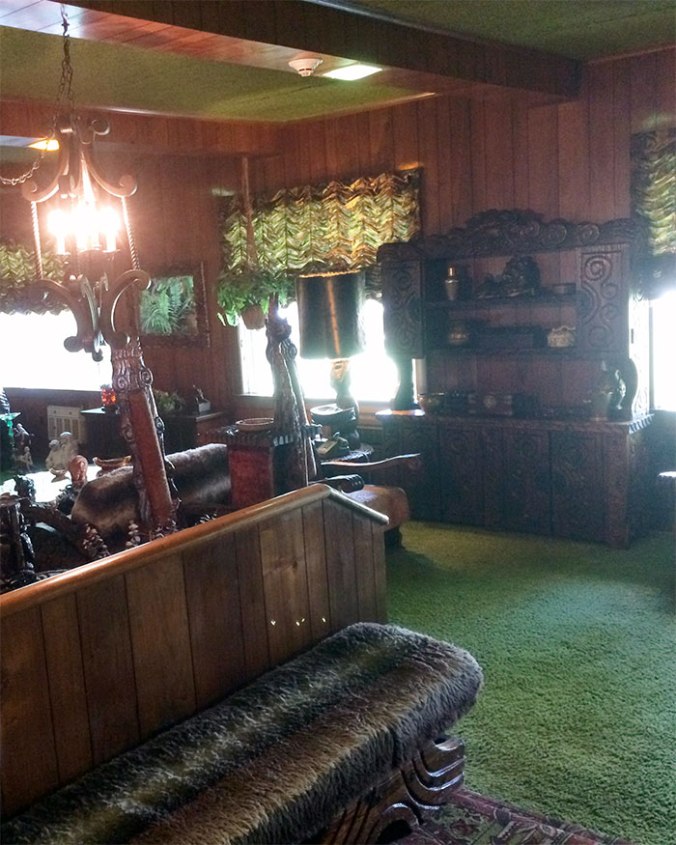
Frozen In Time: Graceland's den in 2016 essentially looks the same as it did in 1977. According to legend, Elvis bought the Witco furnishings after his father commented that it was ugliest furniture he had ever seen. (Photo by Wellsy.)

Frozen In Time: Graceland’s den in 2016 essentially looks the same as it did in 1977. According to legend, Elvis bought the Witco furnishings after his father commented that it was ugliest furniture he had ever seen. (Photo by Wellsy.)

If you are interested in the Graceland sessions, the underlying question is which of the Elvis releases covering this material should you buy? In addition to Way Down In The Jungle Room, there have been quite a few, including:

  • From Elvis Presley Boulevard (RCA): Masters from the February 1976 Graceland sessions (#19 on my recent “50 Greatest Elvis Albums” list)
  • Moody Blue (RCA): Remaining masters from the February and October 1976 Graceland sessions, supplemented with live recordings from 1974 and 1977 (#7 on my list)
  • The Jungle Room Sessions (FTD): Alternates/outtakes from the 1976 Graceland sessions
  • From Elvis Presley Boulevard (FTD Classic Album Edition): Masters and alternates/outtakes from the original RCA album, including relevant portions of The Jungle Room Sessions in improved sound quality and some previously unreleased tracks
  • Moody Blue (FTD Classic Album Edition): Masters and alternates/outtakes from the original RCA album, including relevant portions of The Jungle Room Sessions in improved sound quality and some previously unreleased tracks

People who know me offline, and I am sure some online have picked up on this as well, understand that I am a very analytical person. Sometimes to the point of annoyance, but, hey, it pays the bills. Anyway, I thought it might be interesting to compare some of the releases covering the Graceland sessions in a more visual fashion.

The below chart captures the master and other complete takes for each of the songs recorded at the Graceland sessions that have been officially released to date. In an attempt to keep this to a manageable size, I left out things like rehearsals, false starts, and FTD-generated splices.

Graceland Sessions Comparison Chart

As noted in the graphic, my key information sources for the above were:

Any mistakes you might find, though, were entirely of my own making.

So, which one should you buy?

For typical, casual, new, or would-be Elvis fans, I recommend you buy Way Down In The Jungle Room. It gives you all of the master takes as well as a manageable number of alternates in great sound quality. This 2-CD set is a real value at less than US $15. Incidentally, there is also an LP vinyl version, but it does not include the masters.

For “totally insane” Elvis fans (like me), who enjoy listening to multiple alternates of the same song, I recommend you buy the FTD “Classic Album” editions of From Elvis Presley Boulevard and Moody Blue. Each of these 2-CD sets will run you around US $30, but they are more than worth it to experience the making of these albums. However, you will probably want to pick up the seemingly redundant Way Down In The Jungle Room as well at some point – simply for the sound experience on Disc 2.

No matter which you choose, settle back and enjoy some Memphis magic, courtesy of Elvis.


Thanks to Wellsy for inspiring this topic as well as giving permission to use his photo of Graceland’s den.

“Together all alone”

I’ve recently been playing Elvis’ last couple of non-compilation albums, From Elvis Presley Boulevard and Moody Blue, as well as associated outtakes on The Jungle Room Sessions and other releases. He recorded many of these songs in the den at Graceland in February and October of 1976.

I’ve also been listening to songs from Elvis In Concert, the first album released after he passed away, containing songs from his last concert tour in June 1977.

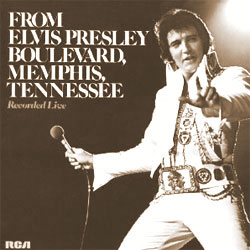
From Elvis Presley Boulevard (1976)

From Elvis Presley Boulevard (1976)

These recordings represent the last audio documentation we have of Elvis Presley the artist. From Elvis Presley Boulevard and Moody Blue are two of his finest albums. By this time, Elvis was apparently reluctant to record, so it is only through the efforts of people like producer Felton Jarvis that we have these recordings at all.

Boulevard has a thematically dark tone, established right from the beginning. If your Elvis experience is limited to the likes of “Blue Suede Shoes” and “Hound Dog,” it can make for some revealing and, at times, difficult listening.

I’m so hurt to think that you lied to me. I’m hurt way down deep inside of me. You said our love was true, and we’d never part. Now you want someone new, and it breaks my heart.” –From “Hurt,” Elvis Presley song, 1976 (written by Crane/Jacobs)

The pain is so evident in his voice as he pours out what is left of that broken heart. Reluctant or not, the results are some of the most honest music of his life.

What will become of me when you’re no longer here? If I can’t stop loving you, what am I to do? You’ll be free, but where will I be?” –From “Never Again,” Elvis Presley song, 1976 (written by Wheeler/Chesnut)

Let there be no doubt that Elvis could still rock, though. In the midst of Boulevard‘s otherwise slow songs suddenly appears “For The Heart,” and Elvis tears it up.

Though a gloomy tone is still present, Moody Blue lightens things up a bit compared to Boulevard. Rockers “Way Down,” “Moody Blue,” and a fun 1977 live version of “Little Darlin'” help in this regard, as does a 1974 live recording of “Let Me Be There” – first released on Elvis Recorded Live On Stage In Memphis.

I can still remember the first time I played Moody Blue. It was an album I borrowed from the local library, before I had any Elvis records of my own. I was fascinated by the fact that the record was blue rather than black. It began with a beautiful, haunting version of “Unchained Melody.” That song, as well as “Little Darlin'” and “Way Down” caught my attention, though I remember listening to the whole record over and over. What a perfect Elvis album.

You don’t have to face the music. You don’t have to face the crowd. Just go back where you came from. You ain’t even proud.” –From “It’s Easy For You,” Elvis Presley song, 1976 (written by Webber/Rice)

This turned into a longer post than I first planned. All I really wanted to say was how much joy listening to these songs has brought me in the last couple of days. Sometimes, you can listen to something in a whole new way. A song you’ve heard a hundred times can suddenly sound new.

That’s the great thing about being an Elvis fan, there is so much music out there to explore. I’ll never stop listening.