“Together all alone”

I’ve recently been playing Elvis’ last couple of non-compilation albums, From Elvis Presley Boulevard and Moody Blue, as well as associated outtakes on The Jungle Room Sessions and other releases. He recorded many of these songs in the den at Graceland in February and October of 1976.

I’ve also been listening to songs from Elvis In Concert, the first album released after he passed away, containing songs from his last concert tour in June 1977.
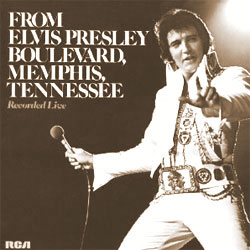
From Elvis Presley Boulevard (1976)

From Elvis Presley Boulevard (1976)

These recordings represent the last audio documentation we have of Elvis Presley the artist. From Elvis Presley Boulevard and Moody Blue are two of his finest albums. By this time, Elvis was apparently reluctant to record, so it is only through the efforts of people like producer Felton Jarvis that we have these recordings at all.

Boulevard has a thematically dark tone, established right from the beginning. If your Elvis experience is limited to the likes of “Blue Suede Shoes” and “Hound Dog,” it can make for some revealing and, at times, difficult listening.

I’m so hurt to think that you lied to me. I’m hurt way down deep inside of me. You said our love was true, and we’d never part. Now you want someone new, and it breaks my heart.” –From “Hurt,” Elvis Presley song, 1976 (written by Crane/Jacobs)

The pain is so evident in his voice as he pours out what is left of that broken heart. Reluctant or not, the results are some of the most honest music of his life.

What will become of me when you’re no longer here? If I can’t stop loving you, what am I to do? You’ll be free, but where will I be?” –From “Never Again,” Elvis Presley song, 1976 (written by Wheeler/Chesnut)

Let there be no doubt that Elvis could still rock, though. In the midst of Boulevard‘s otherwise slow songs suddenly appears “For The Heart,” and Elvis tears it up.

Though a gloomy tone is still present, Moody Blue lightens things up a bit compared to Boulevard. Rockers “Way Down,” “Moody Blue,” and a fun 1977 live version of “Little Darlin'” help in this regard, as does a 1974 live recording of “Let Me Be There” – first released on Elvis Recorded Live On Stage In Memphis.

I can still remember the first time I played Moody Blue. It was an album I borrowed from the local library, before I had any Elvis records of my own. I was fascinated by the fact that the record was blue rather than black. It began with a beautiful, haunting version of “Unchained Melody.” That song, as well as “Little Darlin'” and “Way Down” caught my attention, though I remember listening to the whole record over and over. What a perfect Elvis album.

You don’t have to face the music. You don’t have to face the crowd. Just go back where you came from. You ain’t even proud.” –From “It’s Easy For You,” Elvis Presley song, 1976 (written by Webber/Rice)

This turned into a longer post than I first planned. All I really wanted to say was how much joy listening to these songs has brought me in the last couple of days. Sometimes, you can listen to something in a whole new way. A song you’ve heard a hundred times can suddenly sound new.

That’s the great thing about being an Elvis fan, there is so much music out there to explore. I’ll never stop listening.
Education, Elvis Style (Part 1)

At this time of year in the United States, high school and university graduations are taking place. It is customary to send friends and family members gifts once they reach this milestone. Particularly for high school grads, these gifts often come in the form of money – intended for use in further education.

I graduated from high school in the early 1990s and sure enough, in the last few months of my senior year, checks from various friends and family members arrived in the mail. At the time, I was still working on obtaining my first summer job. When it came to money, I basically had none.

That had never stopped me from spending time browsing record stores, though. I can remember drooling over two Elvis CD releases in particular that had been out for about a year by that time: ELVIS: The King of Rock ‘n’ Roll – The Complete 50s Masters and Elvis Today.

The King of Rock ‘n’ Roll, of course, was the groundbreaking and critically acclaimed 5-CD boxed set that collected his 1950s material together in a coherent fashion for the first time. I can remember just staring at the track listings on the back of the box, marveling over the song titles.

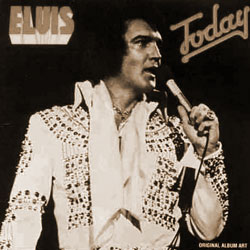
Cover of 1992 Elvis Today CD

Elvis Today was the CD debut of a 1975 album previously available only on vinyl. Since RCA had inexplicably deleted the original album from its catalog, I had been trying to track it down for years before the CD release. I only had three of the songs on it and wanted desperately to hear the others.

Both releases were part of RCA/BMG’s “Elvis In The 90s” series, which had the mission of bringing all of his master recordings to the CD format.

As I dutifully wrote out thank you notes for the gracious graduation gifts people had sent me, a plan began formulating in my head. Sure, I was starting university classes in a few months, but what did I need for that right now? I had a better idea.

Soon enough, I was at the record store and spent most of my graduation money on The King of Rock ‘n’ Roll and Elvis Today. I had just enough left over to buy a reference book I had also been eyeing up for some time: ELVIS: His Life From A to Z by Fred L. Worth and Steve D. Tamerius.

People had sent money for me to further my education, and that was exactly what I intended to do.

To be continued. . . .

Elvis On Tour: The Official Audio Releases

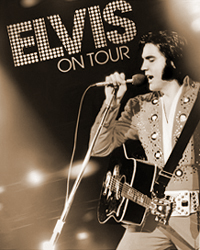
Elvis On Tour (1972)

Elvis On Tour (1972)

This is an updated re-posting of an item I first placed on my sci fi/pop culture blog back in January – prior to rolling out The Mystery Train Elvis Blog.

Warner Home Video is releasing Elvis On Tour on Blu-ray and DVD on August 3. The MGM movie features Elvis on the road and in rehearsals in the spring of 1972.

Sandwiched between 1970’s colossal That’s The Way It Is and 1973’s Aloha From Hawaii, the Golden-Globe-winning documentary often seems to be overlooked among Elvis events.

At the time, Elvis On Tour ultimately did not even garner a soundtrack album release – trumped by the As Recorded At Madison Square Garden and Aloha live albums.

Nevertheless, Elvis On Tour shows Elvis in good form, with the effects of his marriage problems with Priscilla only beginning to show their toll. It is a well-assembled film, capturing an important moment in the entertainer’s life. The second documentary produced about him, Elvis On Tour also represents Elvis’ 33rd and final completed movie.

When Warner Home Video remade That’s The Way It Is in 2000, RCA/BMG released a corresponding boxed set of audio material recorded during the filming of the movie. There have since been a number of other That’s The Way It Is themed audio releases.

Since the record label also recorded many of the rehearsals and concerts during the filming of Elvis On Tour, it seems likely that this Blu-ray release will open the floodgates for related audio material.

To celebrate the Blu-ray release, this is one of a series of Elvis On Tour related posts this year. Today, I want to take a look back at what has been officially released to this point on audio from the material recorded for this movie.

Most of these performances were not used in the actual film, though some were. Believe it or not, this is only the tip of the iceberg when it comes to the audio recordings made for Elvis On Tour. 2010 may turn out to be a very good year indeed for Elvis fans.

This Is Elvis (1981)
Always On My Mind (Rehearsal)
An American Trilogy (Live-April 9, 1972, Hampton Roads, Virginia)

Amazing Grace (1994)
Bosom of Abraham (Rehearsal)
I, John (Rehearsal)
Lead Me, Guide Me (Rehearsal)
Turn Your Eyes Upon Jesus/Nearer My God To Thee (Rehearsal)
You Better Run (Rehearsal)

From The Heart (1998)
Separate Ways (Rehearsal)

6363 Sunset (2001)
A Big Hunk O’ Love (Rehearsal)
All Shook Up (Rehearsal)
Heartbreak Hotel (Rehearsal)
See See Rider (Rehearsal)
Teddy Bear/Don’t Be Cruel (Rehearsal)
Until It’s Time For You To Go (Rehearsal)

Close Up: Live In Texas 1972 (2002)
(Live-April 18, 1972, San Antonio, Texas)
All Shook Up
An American Trilogy
Burning Love
Can’t Help Falling In Love
For The Good Times
Funny How Time Slips Away
Heartbreak Hotel
Hound Dog
How Great Thou Art
I Can’t Stop Loving You
Love Me
Love Me Tender
Never Been To Spain
Polk Salad Annie
Proud Mary
See See Rider
Suspicious Minds
Teddy Bear/Don’t Be Cruel
Until It’s Time For You To Go
You Gave Me A Mountain

Elvis On Tour: The Rehearsals (2005)
A Big Hunk O’ Love
Burning Love
For The Good Times
Funny How Time Slips Away
Help Me Make It Through The Night
Hound Dog
Johnny B. Goode
Lawdy, Miss Clawdy
Love Me
Never Been To Spain
Polk Salad Annie
Proud Mary
Release Me
See See Rider
Separate Ways
The First Time Ever I Saw Your Face
Young And Beautiful

(The Elvis Session Notes by Oven Egeland site was a valuable resource in compiling this information.)

What Might Have Been: The Home Recording Studio

On the edge of reality. . . .

The rest of the world is asleep, but Elvis Presley is on a mission. As he bursts through the door, his friends Red and Charlie are already in the studio, setting up microphones. The small facility is just big enough for a piano, a few stools, and two or three of his favorite guitars.

Ignoring the piano for now, he grabs his trusty Gibson J200 and begins picking out the song that would not leave his head. “We’re rolling,” says Red, his hands moving over the control board with ease. The year is 1964, and Elvis is about to make his third album at his Graceland studio.

* * *

At least, that’s how I like to imagine what might have been.

Little moments in time can change history. Leave a few seconds early and avoid a car crash, leave a few seconds later and never make it back home.

At least one such potential life-altering moment in Elvis’ life jumped out at me when I first read a couple of key books about him.

It took me awhile to find the passage just now in Peter Guralnick’s Careless Love: The Unmaking of Elvis Presley (1999), which covers Elvis’ life from 1958 to 1977. I thought it occurred closer to the late 1960s. Turns out, it is about 1960. Here’s the moment:

RCA [. . .] even offered to build Elvis a studio in his home so he could record whenever the inspiration took him – but the Colonel wisely urged him to turn the company down, seeing their generosity for what it was, a desperate attempt to generate more product and thereby undercut the Colonel’s unassailable bargaining position” (p. 84).

Could this have changed everything? Prior to Elvis’ June 1961 Nashville session, the home recording studio receives another mention:

The idea of a home studio had been broached again a number of months earlier; this time Elvis actually indicated his interest in building a recording facility at Graceland, and initial plans were drawn up […]” (p. 112).

Ernst Jorgensen also mentions the fate of the studio project in 1998’s Elvis Presley: A Life In Music:

After initially promoting the idea, the label realized it would be a mistake to single one of its artists out above all others; eventually, the Colonel worked out a compromise in which Elvis received, among other considerations, some up-to-date RCA stereo equipment – and RCA got to keep Nashville’s Studio B as Elvis’s recording home base” (p. 150).

Considering that Elvis Presley was RCA’s most successful recording artist, the company should have made an exception in this case and built Elvis his studio. If other artists complained, they should have just been told that they could have their own studios, too – as soon as they sold as many records as Elvis.

Another huge recording artist of the 1960s, Ray Charles, had his own studio. What if, like Charles, Elvis had been able to record whenever the mood struck him, rather than being forced to create on demand at pre-determined studio times?

What kinds of music would he have produced if left to his own devices at Graceland? Sure, we have scratchy, home recordings made by Elvis on tape recorders, but what if he had been able to professionally record in his home?

Of course, Elvis eventually did record at Graceland –  in 1976 – but under markedly different circumstances. As Guralnick describes:

So desperate was RCA to lure Elvis back into the studio that they revived the old dream of recording him at home. This time, however, both the nature and the reason for the plan were a far cry from its original conception fifteen years before. […] And far from building him a new state-of-the-art plaything, they now proposed simply to install temporary equipment in the den behind the kitchen […]” (p. 593).

While the Graceland sessions that produced From Elvis Presley Boulevard and most of Moody Blue turned out to be special, I still can’t help but wonder what might have been if plans for building a true recording studio at Graceland had come to pass?

Would it have just been another intense but soon forgotten hobby – like slot cars or the Circle G?

Or would Elvis the artist have finally been able to fully realize his dreams?

* * *

After three takes, he puts down his guitar. He wants to focus only on the vocals. He nods to his friend, who kills the lights in the studio. The year is 2010. At home, Elvis begins to sing. . . .

Review: Elvis rocks the Garden in new CD from RCA [The Elvis Beat newsletter]

I was 22 when I wrote this review back in 1997 for The Elvis Beat #16, which turned out to be the final issue of my official Elvis Presley Fan Club newsletter.


An Afternoon In The Garden (RCA), recorded by Elvis Presley, June 10, 1972, Madison Square Garden (New York). Released: March 1997 (CD).

It’s hard to go wrong when buying an Elvis concert album. The power of Elvis’ stage performances remains unmatched to this day, as demonstrated by An Afternoon In The Garden, a new album from RCA that was recorded live in 1972.

RCA recorded Elvis’ afternoon and evening concerts at Madison Square Garden on June 10 of that year. The evening performance was released only a week after the actual event on the album As Recorded At Madison Square Garden. Although a few tracks have been released from the afternoon show in various compilations over the years, this is the first time the complete concert has been available.

There are not many surprises here, since the song selection and feel of the performance is very similar to the evening show. They were recorded the same day, after all. The most unique track is “Until It’s Time For You To Go,” which has never been released in a live version to my knowledge.

An Afternoon In The Garden is an exciting album that transports listeners to a front row seat to hear Elvis in concert. The roar of the crowd is nearly a constant presence, heightening the drama. Overall, I think RCA made the right choice going with the evening concert back in 1972, but I wish I could hear it in a similar sound quality as the afternoon concert on this album.

RCA cannot be praised enough for their work over the last seven years. An Afternoon In The Garden is evidence of their continuing dedication to giving Elvis fans what they want. Elvis performed over a thousand concerts in the last decade of his career, quite a few of which were recorded. Hopefully this album is only the beginning of a string of new live releases.

Until then, sit back, relax, and enjoy an afternoon at the Garden with Elvis.

Songs:

  1. Introduction: Also Sprach Zarathustra
  2. That’s All Right
  3. Proud Mary
  4. Never Been To Spain
  5. You Don’t Have To Say You Love Me
  6. Until It’s Time For You To Go
  7. You’ve Lost That Lovin’ Feelin’
  8. Polk Salad Annie
  9. Love Me
  10. All Shook Up
  11. Heartbreak Hotel
  12. (Let Me Be Your) Teddy Bear/Don’t Be Cruel
  13. Love Me Tender
  14. Blue Suede Shoes
  15. Reconsider Baby*
  16. Hound Dog
  17. I’ll Remember You*
  18. Suspicious Minds
  19. Introductions By Elvis
  20. For The Good Times
  21. An American Trilogy
  22. Funny How Time Slips Away
  23. I Can’t Stop Loving You*
  24. Can’t Help Falling In Love

All tracks previously unreleased except *

Rating: 8.5 out of 10

“Colonel” Parker dies at age 87 [The Elvis Beat newsletter]

I was 22 when I wrote this article back in 1997 for The Elvis Beat #16, which turned out to be the final issue of my official Elvis Presley Fan Club newsletter.


“Colonel” Tom Parker, Elvis’ manager for over 20 years, died on January 21. He was 87 and lived in Las Vegas with his wife, Loanne.

Although not yet his manager, Parker began guiding Elvis’ career in mid-1955 while the singer was still on Memphis’ Sun Records label and slowly rising in popularity. He helped secure a contract for Elvis with RCA Records later that year.

Parker officially became Elvis’ manager in early 1956 for a 25 percent fee. Elvis would remain Parker’s sole client until Elvis’ death in 1977.

Parker’s innovative management style helped to transform Elvis from a relative unknown at the beginning of 1956 to an international celebrity with six number one hits, several million-sellers, and a starring role in a successful movie by the end of that same year.

Parker was often blamed for allowing Elvis’ movies to deteriorate into Grade C formula films in the 1960s. Parker once admitted that he didn’t even bother to read the scripts. “Anybody who’ll pay my boy a million dollars can make any kind of picture he wants,” Parker said. Despite the low quality of many of them, nearly all 33 of Elvis’ movies were box office successes.

In 1967, Parker renegotiated his contract with Elvis, increasing his own share to 50 percent with the argument that Elvis was his only client. [. . . .]

Parker negotiated lucrative deals for Elvis to appear in Las Vegas for extended engagements beginning in 1969. In the 1970s, Parker staged multi-city concert tours across the US for Elvis, who played 150 shows a year.

Parker orchestrated the 1973 Elvis: Aloha From Hawaii television special, which used satellite technology and drew millions of viewers.

Parker was born Andreas Cornelius van Kuijk in Holland on June 26, 1909. He immigrated to the US illegally in 1929, claiming West Virginia as his birthplace. He served in the US Army with the 64th Coast Artillery from 1929 to 1932. He married his first wife, Marie Ross, in 1932. A state governor made him an honorary Colonel in 1953.

In the 1950s, Parker became the promoter of singer Gene Austin and manager of country singers Eddy Arnold, from 1942 to 1951, and Hank Snow, from 1954 to 1956, before becoming Elvis’ manager.

In recent years, he was associated with country singer George Strait, negotiating for him to star in the movie Pure Country.

Joe Esposito, one of Elvis’ friends, said, “The bottom line is that Elvis would never have been so popular as he was without the Colonel’s brilliant management. Nor would the Colonel have had so much success with anyone else.”

Elvis releases show no signs of slowing [The Elvis Beat newsletter]

I was 22 when I wrote this article back in 1997 for The Elvis Beat #16, which turned out to be the final issue of my official Elvis Presley Fan Club newsletter.


This year, which marks the 20th anniversary of Elvis’ death, may prove to be one of RCA’s busiest yet, with several new Elvis releases and re-issues planned.

Scheduled for release in June is the new 4-CD boxed set Platinum: A Life In Music, which will include over 70 previously unreleased tracks. Elvis recorded six of the new tracks on a home tape recorder in the 1960s at Graceland. Also included will be some rehearsals for his 1968 television special ELVIS and for his August 1970 Las Vegas shows, captured for the Elvis: That’s The Way It Is documentary. Newly released alternate takes and live performances will also be featured.

A new live concert album from 1972, An Afternoon In The Garden, was released on CD in March and is reviewed on page 3.

In April, the movie soundtracks not covered in the Elvis Double Features series were issued on CD, along with bonus tracks. These albums are:

  • Loving You
  • Jailhouse Rock/Love Me Tender
  • King Creole
  • GI Blues
  • Blue Hawaii

The five-volume Elvis’ Golden Records series will be re-issued on CD in July.

Currently expected for re-release by the end of 1997 are CD re-issues of the boxed sets Elvis Aron Presley (1981) and A Golden Celebration (1985). However, sources indicate they may be delayed until 1998.