Guest Post: Fashion For A King doesn’t fit diehard fan

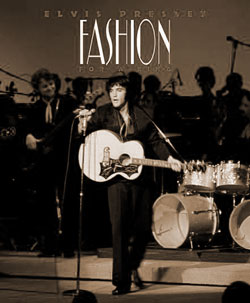
Fashion For A King (2011)

Fashion For A King (2011)

Let me just start out by saying that I am not an Elvis book collector. I buy very, very few Elvis books, and the ones I do usually tend to be reference type books, along the lines of Joe Tunzi’s Sessions books. In other words, I am a discerning Elvis book collector and don’t simply pick up every single tome with Elvis’ picture on the cover. Simply put, there has to be a good reason for me to buy one. Being a jumpsuit fanatic, I had always wanted a book that would document the suits Elvis wore in minute detail. Thus, when I heard about Fashion for a King I knew it would have to be one of my rare Elvis book purchases.

When I saw the press release for Fashion for a King, I was thrilled. An entire book (500+ pages) about Elvis’ jumpsuits? What could be better? (For me, anyway. I know some people groan at the thought.) According to the press release, the book promised to be “a full documentary of Elvis’ jumpsuits,” covering “the background story of each and every suit” – a “fully documented story and pictures of Elvis Presley’s stage outfits” and “an encyclopedia for fans…to learn more about these great original stage outfits.”

Needless to say I was excited. An encyclopedia of each and every suit, with documentation? My head filled with visions of unseen photographs and close-ups of each suit, along with documentation about when each suit was worn. Although not explicitly stated, I did get the impression that each concert would be individually documented, if not with a photo, then at least with a date and a listing of which suit was worn. In short, the press release promised a lot, and since the book had been written by fans, who often obsess about such details, I was very much looking forward to a reference that I would look at time and time again, much like I do with my Sessions books.

Unfortunately, upon paging through the book after I got it, it immediately became clear that it was much less than was I was anticipating. The majority of the photos in the book were ones I had seen before, either from well known sources, Follow That Dream releases, or simply from surfing the Internet. Only about 20 or so were new to my eyes, and it seemed as though the rest had been cobbled together from various sources that almost anyone could find. I felt a bit cheated paying over $100 US for a book full of photos that I probably could assemble most of myself given a few days of Internet usage. However, I could forgive the lack of rare photos if the rest of the book (the jumpsuit specifics) made up for it. Unfortunately the book failed in that area as well.

The text was bland and repetitive and followed exactly the same format in each section: Elvis’ tour lasted from this date to this date, he wore XYZ jumpsuits during the tour and he had Y band members with him. While the descriptions of which jumpsuits were worn on what dates were sadly lacking, oddly, the authors saw fit to inject commentary within the descriptions about Elvis’ health, state of mind, girlfriends or spending habits, often in the form of generalizations. I found it hard to distinguish whether or not the authors were trying to sympathize with Elvis or to condemn him. Regardless, in my opinion, a simple list of shows, dates, suits, capacities, grosses, and band members would have been much superior to prose that alternated from factual statements about dates and locations to editorial comments about Elvis’ state of mind. Somehow, in a work billed as an encyclopedia of Elvis’ jumpsuits, I wasn’t expecting to read about Elvis’ love life, or his spending, or the Colonel’s gambling habits. All of these things have been covered elsewhere. As it stands, the text came across to me as a canned, generic version of the stereotypical Elvis timeline that a non-fan might parrot back to you when talking about Elvis. In other words, lots of generalities, few actual facts, and most glaringly, very little relevance to what the book was ostensibly about. Oddly, though, given the lack of actual text concerning the specifics of Elvis’ jumpsuit usage, almost every section has specific details about the types of microphones Elvis used on a given tour, even down to the color of the tape used to secure the microphone windscreen – if only the jumpsuit information was this detailed and orderly!

To be fair, some of Elvis’ jumpsuits are described in detail, although I personally found the descriptions hard to follow, as often the authors would mention that Elvis wore ‘X’ jumpsuit with ‘Y’ belt during a specific Vegas engagement while not having a photo of said jumpsuit (and particularly said belt) to accompany the text. This was especially confusing when describing jumpsuits and belts that were originally created in previous years (say, when talking about jumpsuits and belts worn in both 1973 and 1974, for example). The text more often than not wound up reading like “Elvis wore jumpsuit X with original belt 1, although sometimes with non-original belt 2, along with jumpsuit Y” – I found myself having to page backwards through the book to remind myself if I actually saw a photo of “original belt 1” at some point. Given that I am a lifelong Elvis fan and a jumpsuit aficionado, I can only imagine how confused an average Elvis fan, or a new Elvis fan, might be with the descriptions. Having some photos of the jumpsuits as displayed at Graceland when talking about minutiae like how many buttons were on the sleeves of the given jumpsuit or how belt X had two chains per loop while belt Y had only one would have provided some excellent visual counterpoints to the printed details. Again, I am approaching this from the standpoint of someone who LOVES reading about things like how the differing versions of the flame suit can be determined by the color of the kick pleat in the legs, and even I found some of the text hard to follow.

Design-wise, the book is laid out well, but I did find that the authors included photos of Elvis wearing a given jumpsuit in a later year placed within the discussions from a previous year (with shots of Elvis from 1972, for example, appearing in sections covering Elvis’ November 1971 tours). While I can understand using shots from different periods when describing a specific jumpsuit, the book is primarily organized about specific tours and engagements, so personally I would have found it more stylistically interesting to include 72 shots with 72 tours where a given suit was worn. Again, including some static shots of the jumpsuits themselves when talking about their design would have been more interesting and appropriate to this reader.

The book is clearly a labor of love on the part of the authors, and one can tell that they enjoyed putting it together, but overall, I can’t really find much in the book that will interest the diehard fan, and in particular the diehard jumpsuit fan. The book has the feel of a project that fans might do in their spare time for their own enjoyment, which is essentially what this sprang from, according to the press release. As mentioned, I could see myself doing something similar just for the fun of it, although if I were to put it in book form for wider consumption I personally would feel an obligation to provide something, even if not necessarily new, at least useful as a reference.

Although this release is not produced by FTD, it was released in conjunction with them, and as with previous FTD book products, some Elvis music is included, this time in the form of Elvis’ Omaha, Nebraska show from July 1, 1974, and a Las Vegas show from December 14, 1975. Both of these have been around on the CD/CDR circuit, with parts of the former also being available in the form of some very good 8mm footage, but neither has appeared on soundboard. Both are a welcome treat, showing Elvis in good form, with the 1975 show providing an excellent set list. I remember hearing this show years ago as an audience recording and really enjoying it and the soundboard version confirms what I thought at the time. Elvis seems relaxed and in a good mood, and gives some very committed and unrushed performances. The oldies are tossed together and dispensed with in the first third of the show, leaving the remaining two-thirds for more powerhouse material, including “How Great Thou Art” (with a reprise of the ending), “Just Pretend,” “You Gave Me A Mountain,” and a rare (for this time period) performance of “Until It’s Time For You To Go.” Even more unusually, the show even features a performance of “It’s Now or Never” with Elvis singing the Italian lyrics. The show is also quite long for Vegas, running about 75 minutes. Overall, this show alone more than makes up for the book in my opinion, and I am very happy that this particular show has finally been released on soundboard.

The Omaha show is also of a good standard, with Elvis’ performance (in my opinion) being more serious and energetic than other releases from this time period, like June 19 in Amarillo or June 29 in Kansas City. Again, a nice bonus and nice compensation after my disappointment with the book.

In short, I was disappointed by Fashion for a King in almost every respect. On a scale of 1 to 10, I’d have to rate it right down the middle, with only the authors’ obvious love for the subject and the two included CDs saving it from a bottom of the barrel rating. Ironically, in thinking about it, this book might actually be more appealing (from a content standpoint) to a casual fan, as it does offer some nice photos in a coffee table book format. But for the diehard jumpsuit lovers like me, there is unfortunately little new on offer.

/Bryan Gruszka, Strange Paradise Online


Bryan Gruszka has been an Elvis fan since he was 6-years-old. A self-confessed jumpsuit afficionado, his favorite period is the 1970s. When not occupied with Elvis, Bryan is developing a book and website about Strange Paradise, an obscure Canadian gothic soap opera. Feel free to drop him a line or check out his website.
Amarillo ’77 for completists only

Amarillo '77I originally planned to write a full review of Follow That Dream’s Amarillo ’77, but I just don’t have the heart to do it. I enjoy much of the 1977 material on Elvis In Concert, Spring Tours 77, and Unchained Melody, so I was looking forward to this release.
I’ve played it twice now, and I’m going to have to put it away for awhile. It pains me to write this, but Amarillo ’77 is the worst Elvis concert album I’ve ever heard. I don’t own every FTD release, so perhaps there are some worse ones out there. If so, I don’t need to hear them. I have never felt like this after listening to an Elvis album. Unless this is the last CD you need to complete your collection, I can’t recommend Amarillo ’77.

Despite its misleading title, Amarillo ’77 is actually a compilation of songs from five different concerts. While it could be said that the performances on Spring Tours 77 were cherry-picked to cover only highlights, I believe the opposite is true of Amarillo ’77.

This is one of only four official albums ever released that is devoted to 1977 material. Given how rarely this Elvis year is visited, why were these particular performances chosen? Rather than picking cherries, I believe someone intentionally plucked a bunch of sour grapes this time.

I don’t believe in kicking a man while he is down, even if it is 34 years after the fact, so I’m just going to leave my thoughts on this depressing disc at the above.

I can really use a good laugh right now, so I’m going to pull out FTD’s All Shook Up, which covers Elvis’ August 26, 1969, Midnight Show at the International Hotel in Las Vegas. It features Elvis in good spirits and at the top of his game.

REVIEW: Stage Rehearsal CD (FTD)

Stage Rehearsal (FTD CD)

August 10, 1970. The MGM camera crew has been following Elvis around for almost a month now. This afternoon, it’s time for one final rehearsal before the opening show later tonight. No camera crew allowed this time, but RCA is rolling tape in preparation for the concert recordings. Follow That Dream Records’ latest release, Stage Rehearsal, takes us behind the scenes of this event.

One of the things I’d been wondering about this release was how FTD would deal with the fact that most of the songs from this rehearsal were incomplete, due to having a “late start.” The first several seconds of these songs were not recorded. After all, RCA never intended this rehearsal for release.

The way I saw it, FTD had at least three options:

1.) Leave the recordings alone and let them start in progress — a bit jarring, but historically accurate
2.) Fade the songs up slightly as they start in progress — a little less jarring
3.) Repair the beginnings using recordings from other summer 1970 rehearsals — requires more work and is not historically accurate

I usually try to avoid reading the opinions of others when I’m planning to review something. That way, my expectations and reactions do not get swayed one way or the other in advance. Sometimes, this is impossible with FTD releases because I am in the United States, and we tend to receive them two or three weeks after most of the rest of the world.

In the case of Stage Rehearsal, I came across a comment revealing that FTD had repaired the beginnings of the songs by using live versions. My initial reaction was shock and dismay. Why would they make such a strange choice?

Once I had the actual CD in hand last week, though, and played it for the first time, it became obvious why FTD chose this path.

The sound quality of the August 10, 1970, stage rehearsal contained on this CD is comparable to the concert recordings that began later that night and continued for the next few days. To my knowledge, there are no other That’s The Way It Is rehearsals that have this level of sound quality. Using subpar sounding rehearsals as lead-ins would have probably been too obvious as splices. Instead, FTD elected to go with the live recordings to more closely match the sound of this rehearsal.

My personal preference would have been that FTD just release the rehearsal as-is, with truncated introductions. This is supposedly a collectors label, after all.

However, I can understand and appreciate their desire to make this a quality listening experience. After all, we were Elvis listeners prior to becoming Elvis historians! In this case, entertainment value won out over historic context. Considering how much I otherwise enjoy this CD, I can forgive them that.

One thing different about this rehearsal compared to some of the others I’ve heard over the years is that it does not feature Elvis really working on the songs. It feels more like a live show in that regard. This may be because this is literally hours before the opening show (captured on One Night In Vegas, a must-have FTD) and most of the kinks have already been worked out, or it could be because the recording was obviously turned off between songs. Two of the songs are repeated, so that’s evidence they were doing some work.

The stage microphones experience feedback a number of times, foreshadowing what would happen later that night during the actual concert. I wonder why this problem was not resolved prior to the show, since it was evident in the rehearsal?

There are many loose, fun moments but, in the end, the real appeal of the 1970 portion is the sound quality. None of the versions are revelations, though “version 1” of both “You Don’t Have To Say You Love Me” and “You’ve Lost That Lovin’ Feelin'” are stellar. Oddly enough, “version 2” of both of these songs splices the exact same live introductions as used on version 1. I suppose the tempo matched better than other alternatives, but this really shows why repairing the audio in this fashion was not the way to go.

A few years ago, Warner Brothers released “The Richard Donner Cut” of Superman II, showing what that director’s version of the 1980 movie may have been like had he not been replaced midway through production. To augment the available footage, screen tests of the main actors were used. This footage looks totally different compared to the rest of the film. Stage Rehearsal‘s “what if” splices between live and rehearsal material reminds me of this.

The 1972 and 1973 bonus songs that comprise the rest of this CD were recorded on a portable tape recorder. Therefore the sound quality is akin to “When The Snow Is On The Roses” and other recordings of that nature. These are definitely listenable, though they suffer a bit in following up the near-pristine-sounding 16-track recordings from 1970. I suggest playing the bonus songs first to avoid this effect.

Finally, here, we get some rehearsal work, which is pretty much lacking from the 1970 portions of this CD.

Any Day Now: By 1972, it seemed that Elvis had all but abandoned the songs he recorded at American Sound Studios only three years earlier, save the obligatory “Suspicious Minds.” Apparently not, though, for here’s Elvis sounding awesome on “Any Day Now,” leaving me to wonder why this apparently did not become part of the show.

True Love Travels On A Gravel Road: This is a good version, but seems less concert-ready than “Any Day Now.” It could’ve worked for occasional use as something different. Who knows, maybe he did use it that way.

Portrait Of My Love: Elvis does a brief, unidentified blues number before launching into “Portrait of My Love” on a whim. This is not so much a “rehearsal,” then, as it is an off-the-cuff song. It’s pretty and probably would’ve been a decent number if further developed. Wonderful to hear a “new” Elvis song, I might add.

I’m Leavin’ It All Up To You: Another “new” Elvis song. This one sounds pretty basic, but I believe that is because Elvis severely shortened it.

The funny thing is, I bought this CD because of the 1970 material, but it is the 1972 and 1973 material that stands out.

Ultimately, Stage Rehearsal is a well-intentioned release that I recommend with reservations. It offers 1970 rehearsals in terrific sound quality, but with unfortunate splicing decisions. It also offers some 1972 and 1973 rarities, but in subpar sound quality. Be aware of what you’re buying so that you won’t be disappointed. Then, just crank it up and enjoy. That’s what Elvis is supposed to be all about anyway.

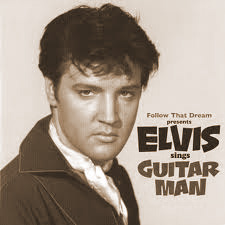
REVIEW: Elvis Sings Guitar Man 2-CD set (2011 FTD edition)

Elvis Sings Guitar Man (2011 FTD, booklet cover)

Elvis Sings Guitar Man (2011 FTD, booklet cover)

I’ve reviewed the main album masters from Elvis Sings Guitar Man in the past, so today’s review will focus on the alternate and bonus tracks that complete this latest release from Follow That Dream Records.

I should note that I don’t  have the FTD albums So High or Long Lonely Highway, so some of these tracks are new to me that may not be new to you.

“Guitar Man” [September 1967]

  • Disc 1, Track 16, Takes 1, 2, 5: After reading about this session many times over the years, it was great finally to hear for myself guitarist and singer/songwriter Jerry Reed  (the real “Guitar Man”) chatting in the studio. This is the kind of stuff that makes FTD shine, hearing a classic recording slowly come together. Sound is incredible. You can imagine you are in the studio. Take 5 is just plain fun to hear (first released on A Life In Music).
  • Disc 2, Track 11, Takes 7, 9: The ELVIS TV special may have still been a year away, but it is obvious from this track that Elvis’ comeback was already underway. Finally, he was starting to live up to his potential again. Elvis sounds inspired by Reed’s presence in the studio. Take 9 was first released on So High.
  • Disc 2, Track 12, Take 10: “Sing the living stuffing out of it, Elvis” producer Felton Jarvis encourages him just prior to this take. Oddly enough, though, take 10 is actually somewhat more subdued compared to takes 5 and 9. A decent take, but not a standout like the others. From Long Lonely Highway, this is the first take to include the “What’d I Say” jam ending.
  • Disc 2, Track 13, Takes 11, 12 (unedited, undubbed master): A treat to have the master take in its raw form here, keeping in line with the previously mentioned takes. It’s hard to sit still listening to this.

“Tomorrow Is A Long Time” [May 1966]

Disc 1, Track 17, Takes 1, 2: I mentioned above that Elvis’ comeback was underway by the September 1967 timeframe of “Guitar Man.” The opening round of the comeback actually began with the May 1966 sessions that produced this song as well as the Grammy-winning How Great Thou Art album. Though a departure for him at the time, Elvis is well-suited to this Bob Dylan tune. Take 2, first released on So High, is as good as the master, which was the very next take. Again, the sound on this CD is beyond impressive.

“Big Boss Man” [September 1967]

  • Disc 1, Track 18, Take 2: Back to the September 1967 session now, this was the second song with Jerry Reed on guitar. First heard on From Nashville To Memphis, this is overall a weak take that quickly becomes tiresome. Elvis is still trying to find his way.
  • Disc 2, Track 14, Takes 1, 3, 4, 5: This track is all false starts, but the studio chatter makes it interesting at least.
  • Disc 2, Track 15, Takes 7, 9: Jerry Reed infuses a bit of guitar-driven country into Jimmy Reed’s blues standard as the group closes in on a master. This is another impressive number. Take 9 was first released on Today, Tomorrow & Forever.

“Love Letters” [May 1966]

  • Disc 1, Track 19, Take 2: I’m not a huge fan of this song, but I will say this may well be the best version I’ve heard to date. Elvis doesn’t sound bored with it yet. In the past, I’ve generally favored his 1970 re-recording of this tune over the 1966 version. This 1966 take was first released on the Today, Tomorrow & Forever set. I don’t remember it standing out to me at the time, though.
  • Disc 2, Track 3, Takes 3, 4, 5, 7: “Too slow” Elvis announces quite correctly as the piano begins the song at what would have been a dreadful, snail’s pace. Takes 4 and 5 are also too slow, causing Elvis to end them early and call for a replay of the demo. Take 7 obviously benefits from that replay as far as tempo, but I still like Take 2 better. I’m ready to fall asleep by the end. Takes 3, 4, and 7 were first released on Collectors Gold.
  • Disc 2, Track 4, Take 8: One take back from the master. Elvis sounds weaker. Again, hard to sit through the whole thing. [First release: So High.]

“Indescribably Blue” [June 1966]

Disc 2, Track 9, Vocal Overdub Take 1: I’m not smart enough to explain why “Indescribably Blue” is a million times better than “Love Letters,” but I know that it is. One of his finest performances. Vocal overdub take 1 first released on Today, Tomorrow & Forever.

“Fools Fall In Love” [May 1966]

Disc 1, Track 20, Takes 1, 4: I think its the arrangement more than anything else that ruins what otherwise might have been a decent version of this Drifters classic. Take 4, first released on Long Lonely Highway, manages to be even more annoying than the master by including what sounds like a “chirping” trumpet in the right channel. Elvis does not yet sound as comfortable as he does on the final version.

“High Heel Sneakers” [September 1967]

  • Disc 1, Track 21, Take 5: Take 5 is more than worthy, benefiting from an awesome mix. Sounding more like a jam than a formal studio cut, this track will definitely go into heavy rotation for me. [First release: So High.]
  • Disc 2, Track 21, Takes 1, 6: Elvis sounds so good on Take 1, it’s a shame that Felton calls a halt to it early on for being too slow. Take 6 also falls apart.
  • Disc 2, Track 22, Take 7 (unedited master): First heard on From Nashville To Memphis, Elvis sings a line of “Ode To Billy Joe” before what became the master take begins. This “unedited” version runs nearly two minutes longer than the original single. As many fans have said before me, if only Elvis had gotten around to doing an entire blues album.

“Down In The Alley” [May 1966]

  • Disc 1, Track 22, Take 1 [First release: From Nashville To Memphis]
  • Disc 2, Track 1, Takes 2, 3, 4
  • Disc 2, Track 2, Take 6 [First release: So High]

Though the groove is somewhat similar, I definitely prefer “High Heel Sneakers” over “Down In The Alley.” It’s hard not to crack a smile at lyrics like, “I’ll plant you now and dig you later, because you’re a fine sweet potato,” though. Speaking of lyrics, for years I misheard one line of this song as, “The clock is striking on Uncle Sam…” so I never quite understood what that part of the song was supposed to mean. He actually says, “The clock is striking a mournful sound…” The funny thing is, I still have a hard time not hearing it as the “Uncle Sam” version, even though I know it’s wrong. In any event, if you like this song, you’ll enjoy takes 1 and 6. Takes 2, 3, and 4 are all false starts.

“Come What May” [May 1966]

  • Disc 1, Track 23, Take 2 [First release: So High]
  • Disc 2, Track 6, Takes 3, 4 [Today, Tomorrow & Forever]
  • Disc 2, Track 7, Take 6 [Collectors Gold]
  • Disc 2, Track 8, Take 7 [From Nashville To Memphis]

While fun, “Come What May” seems out-of-place on this album (right up there with “Fools Rush In”). Maybe the imaginary album should have been 12 tracks and these two listed as additional bonus songs. The more I listen to it, I think my main problem with this song is the trumpet. If only there was a version without it, I might like it more. I have nothing against trumpets in general, by the way. In fact, I used to play trumpet in middle school band way back when.

“Just Call Me Lonesome” [September 1967]

  • Disc 2, Track 19, Takes 3, 4 [First release: So High]
  • Disc 2, Track 20, Takes 5, 6

For this song, I was hoping for at least one take without the steel guitar. No such luck.

“You Don’t Know Me” [September 1967]

Disc 2, Track 23, Take 2: This alternate is a little slower. Elvis’ voice sounds like velvet. This was a perfect song for him. First released on So High.

“Singing Tree” [September 1967]

  • Disc 1, Track 24, Take 1 [First release: So High]
  • Disc 2, Track 16, Takes 2, 4 [Take 4: Close Up]
  • Disc 2, Track 17, Take 8
  • Disc 2, Track 18, Takes 10, 13 [Take 13: Long Lonely Highway]

I have a soft spot for “Singing Tree,” so I was interested to hear his first attempts at it. Take 1 is slower, but otherwise unremarkable. Take 8 has some potential, but begins to feel repetitive after awhile. One problem with all of these takes is simply too much Jordanaires for my tastes. As I’ve noted in the past, I really need a Jordanaire-specific mute button when listening to Elvis. After 13 takes without an acceptable master, they gave up on the song and moved on to “Just Call Me Lonesome” (above).

Disc 2, Track 24, Takes 1, 2, 3 (remake): The following night, Elvis and the band took another stab at “Singing Tree.” I definitely like the “remake” arrangement better. However, the background vocalists are even more annoying on take 3, so I won’t be playing it too often. Elvis throws in a somewhat incongruous “take it home, baby” near the end of the song. Remake take 5 would become the released master.

“I’ll Remember You” [June 1966]

  • Disc 1, Track 25, Vocal Overdub Take 2: Having grown up on the Aloha From Hawaii live version, I never heard the studio version of “I’ll Remember You” until release of the From Nashville To Memphis set. Though it is a remarkable performance, vocal overdub take 2, first released on So High, does not really stand out in a significant way from the master.
  • Disc 2, Track 10, Vocal Overdub (unedited master): This is a case where I prefer the edited version of a song. For my tastes, this unedited master, first released on From Nashville To Memphis, just goes on too long. As on most tracks, sound quality here is outstanding. Listen to the percussion in the right channel – awesome!

Bonus Song: “Beyond The Reef” [May 1966]

  • Disc 2, Track 5, Takes 1, 2 [undubbed master]: This has an informal feel that I enjoy. “Beyond The Reef” also fits in well as a bonus song on this album. Undubbed master first released on From Nashville To Memphis.
  • Disc 1, Track 15, Take 2 [overdubbed master]: The undubbed version is superior to this version. “Beyond The Reef” went unreleased during Elvis’ lifetime. This overdubbed version made its debut on 1980’s Elvis Aron Presley boxed set.

Source for “first release” information was the excellent Elvis In Norway site.

* * *

Cover art for Elvis Sings Guitar Man is well-done and suits the 1967 time period. The booklet is informative, and I particularly enjoyed seeing the repertoire (material submitted by Elvis’ music companies; songs requested directly by Elvis; song list sent to arranger) for a cancelled August 1967 session originally scheduled for Los Angeles. As for sound quality, it is incredible. FTD seems to be getting better and better with every release. In particular, the Classic Album series has reinvigorated the label.

The absolute highlight of this release for me is hearing Elvis Presley and Jerry Reed in the studio together on “Guitar Man” and “Big Boss Man.” It was a collaboration that would sadly prove to be all too short.

Elvis Sings Guitar Man is a unique album, compiling music from scattered releases to better document an important timeframe in Elvis’ career. The opening salvos of the comeback had been fired, but few noticed because of the release strategy around his music at that time. Whether acknowledged or not, Elvis had taken the first steps down his path of musical redemption. Big changes were just around the corner.

* * *

DISC 1

01) Guitar Man 2:22
02) Tomorrow Is A Long Time 5:24
03) Big Boss Man 2:54
04) Love Letters 2:52
05) Indescribably Blue 2:50
06) Fools Fall In Love 2:08
07) Hi-Heel Sneakers 2:48
08) Down In The Alley 2:54
09) Come What May 2:03
10) Mine 2:39
11) Just Call Me Lonesome 2:08
12) You Don’t Know Me 2:32
13) Singing Tree 2:22
14) I’ll Remember You 2:48

Bonus Song
15) Beyond The Reef (overdubbed version)

First Takes
16) Guitar Man – takes 1,2,5 4:22
17) Tomorrow Is A Long Time – takes 1,2 6:15
18) Big Boss Man – take 2 3:35
19) Love Letters –take 2 2:53
20) Fools Fall In Love – takes 1,4 2:40
21) Hi-Heel Sneakers – take 5 4:58
22) Down In The Alley – take 1 3:13
23) Come What May – take 2 2:12
24) Singing Tree – take 1 3:11
25) I’ll Remember You – vocal overdub take 2 4:14

DISC 2

May 1966 Sessions
01) Down In The Alley – takes 2,3,4 2:18
02) Down In The Alley – take 6 2:51
03) Love Letters – takes 3,4,5,7 4:39
04) Love Letters – take 8 3:12
05) Beyond The Reef – takes 1,2 (undubbed master) 5:42
06) Come What May – takes 3,4 2:27
07) Come What May – take 6 2:07
08) Come What May – take 7 – 2:21

June 1966 Sessions
09) Indescribably – (vocal overdub) take 1 2:55
10) I’ll Remember You – (unedited master) vocal overdub 1 4:10

1967 Sessions
11) Guitar Man – takes 7,9 2:52
12) Guitar Man – take 10 2:55
13) Guitar Man – takes 11, 12 (unedited/undubbed master) 4:02
14) Big Boss Man – takes 1,3,4,5 3:19
15) Big Boss Man – takes 7, 9 3:48
16) Singing Tree – takes 2,4 3:28
17) Singing Tree – take 8 3:03
18) Singing Tree – takes 10,13 3:44
19) Just Call Me Lonesome – takes 3,4 2:55
20) Just Call Me Lonesome – takes 5,6 2:31
21) Hi-Heel Sneakers – takes 1,6 2:51
22) Hi-Heel Sneakers – take 7 – (unedited master) 4:57
23) You Don’t Know Me – take 2 2:57
24) Singing Tree – (remake) takes 1,2,3 3:21

Where Elvis never stood alone

I enjoy exploring all different areas of Elvis’ career. With Follow That Dream’s recent announcement that Amarillo ’77 will be among its June CD releases, I thought this would be a good time to take a look back at the 1977 recordings officially available to this point.

Not including the post-midnight tracks on FTD’s New Year’s Eve audience recording, there have been three key official releases of 1977 concert material in the years since the death of Elvis:

  • Unchained Melody (2007, FTD, covering February)
  • Spring Tours 77 (2002, FTD, covering March through May)
  • Elvis In Concert (1977, RCA, covering June; serves as soundtrack to TV special of same name)

All three of these releases have something to offer fans who are willing to listen.

Unchained Melody contains one of my favorite Elvis performances from any time, a stirring rendition of “Where No One Stands Alone,” with Elvis leading the way on piano. Recorded February 16 in Montgomery, Alabama, this marks the only known instance of Elvis performing this song live.

I actually prefer this nearly heart-wrenching version over his 1966 studio master of the song, recorded for How Great Thou Art. After hearing the raw emotions of this live version, the studio version sounds almost antiseptic – as if in 1966 Elvis had not really lived enough to fully convey the song compared to eleven years later.

Just a few days later, on February 21 in Charlotte, North Carolina, Elvis pulls out a blues number that he seemed to always have ready in his back pocket – “Reconsider Baby.”

Though Elvis formally recorded the song in 1960 for Elvis Is Back!, a 1956 version of the song from “The Million Dollar Quartet” jam at Sun Records made its debut on The King of Rock ‘n’ Roll in 1992. Live versions from 1961, 1969, and 1972 have also been released, all of which, like this 1977 track and its predecessor on New Year’s Eve, feature a committed Elvis. Lowell Fulson first recorded the song in 1954, around the same time that Elvis recorded “Good Rockin’ Tonight.” In Charlotte, “Reconsider Baby” is a good performance. Elvis never lost his feel for the blues.

At that same February 21, concert, Elvis also performs the only known live version of “Moody Blue” (outside of giving up after a false start in the same city the night before). This is another good performance. It is sometimes amazing how well Elvis could sing a song that he admittedly did not know. It is also a testament to the work of the TCB Band, that they could carry him when all he had was a lyric sheet. Lyric sheet or not, this is still a worthy listen.

At a Valentine’s Day show in St. Petersburg, Elvis takes over the piano momentarily from Tony Brown to show him how to play the intro to “Blueberry Hill.” What follows is a fantastic, though all too brief, take on the song – which Elvis first recorded in 1957.

A February 18 performance of “Release Me” in Columbia, South Carolina, is another highlight. For the briefest of moments, it sounds like it could be 1970 – but only a moment.

The highlight of Spring Tours 77 is beyond a doubt his March 26 performance of “Blue Christmas” in Norman, Oklahoma. The song takes on a different tone here than his bluesier 1968 live versions or his 1957 studio version. He sounds desperately sad, which is only underscored by our knowledge that he has already celebrated his final Christmas by this point. While I like the performance, this is not something I’ve added to my normal Christmas rotation. It’s just too sad.

The often-underrated Elvis In Concert contains a number of fine performances, including one of his best ever versions of “My Way” on June 21 in Rapid City. A brief snippet of “I Really Don’t Want To Know” from that same show also illustrates that he could still tap into his power. Even Omaha on June 19, sometimes described by others as one of his worst concerts, offers up a decent version of “How Great Thou Art” and an entertaining performance of “And I Love You So.”

My original intent in all of this was not to go through track-by-track highlights of 1977, but to point out that even one of Elvis’ lesser years can still hold magic. It is a mistake to focus only on certain aspects of Elvis’ career and to ignore the rest. While 1968-1971 may indeed be my personal favorite span, I would not want that to be the only Elvis I ever hear.

It is also unfair to use peak moments like 1968-1972 or 1954-1958 as the measuring sticks for everything else. Of course, everything is going to pale in comparison to those very special times in his life, but that does not mean that it lacks value. 1977 should not be ignored, not by Elvis Presley Enterprises, not by Sony & FTD, and most of all, not by us – his fans. I commend FTD for deciding to release Amarillo ’77.

So, pull out those 1977 recordings and give them a spin. He was on that stage for his fans, and he left these and other recordings as part of his legacy. They are an essential part of understanding the whole Elvis.

* * *

The Amarillo ’77 concert took place on March 24, 1977. Below is the track listing:

01 That’s All Right
02 Are You Lonesome Tonight
03 Reconsider Baby (intro only)
04 Love Me
05 If You Love Me
06 You Gave Me a Mountain
07 Jailhouse Rock
08 O Sole Mio/It’s Now or Never
09 Little Sister
10 Teddy Bear/Don’t Be Cruel
11 My Way
12 Band Introductions/Early Mornin’ Rain
13 What’d I Say/Johnny B. Goode
14 Band Introductions
15 School Days
16 Hurt
17 Hound Dog
18 Can’t Help Falling in Love
Bonus Tracks
19 And I Love You So
20 Fever
21 Love Me Tender
22 Blue Suede Shoes
23 Steamroller Blues
24 Help Me
25 Why Me, Lord
26 Bosom of Abraham
27 You Better Run
28 How Great Thou Art
29 Trying to Get to You

Pieces of our lives: A look at modern Elvis fans

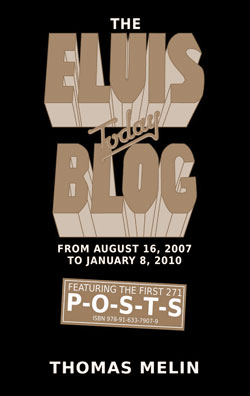
The Elvis Today Blog (book)
By Thomas Melin
274 pp. Blurb. $9.95

The Elvis Today Blog (2011)

The Elvis Today Blog (2011)

Full Disclosure: I wrote a guest post for the Elvis Today Blog back in 2009, and it appears in this book (p. 224). The last thing I want to do is start reviewing my own material, though, so the following review covers the other 99% of this compilation.

Don’t let the title of this book fool you. The Elvis Today Blog is not a book about an Elvis site. Without a doubt, The Elvis Today Blog is a book about Elvis.

However, it turns out that The Elvis Today Blog is also a book about us – modern Elvis fans.

By relating his personal experiences, author Thomas Melin crafts a unique volume that follows the triumphs and trials of being an Elvis fan in the post-1977 era.

“Sometimes it just hits me how much I love Elvis music and what a great feeling I get from listening to it,” writes Melin in “The Wonder Of Elvis” (p. 56), one of his best entries. “On the highway I put the fourth CD from the Today, Tomorrow & Forever box set in the car stereo and there was ‘See See Rider’ from February 1970 blasting through the speakers. It’s hard to explain what I felt, but I remember thinking ‘Man, I’m gonna listen to Elvis and his music until the very day I die,'” he states.

A major contribution of The Elvis Today Blog is the “Special Moments With FTD” series, Melin’s focus on specific songs released on Sony’s Follow That Dream collectors label for Elvis fans:

  • “Love Me Tender,” Dixieland Rocks (1975) – p. 65
  • “The Sound Of Your Cry,” The Nashville Marathon (1970) – p. 78
  • “You’ll Never Walk Alone,” So High (1967) – p. 92
  • “Mexico,” Out In Hollywood (1963) – p. 107
  • “It’s Easy For You,” The Jungle Room Sessions (1976) – p. 116
  • “Hey Little Girl,” Out In Hollywood (1965) – p. 182
  • “I Just Can’t Help Believin’,” One Night In Vegas (1970) – p. 182
  • “My Boy,” Dixieland Rocks (1975) – p. 183
  • “Young And Beautiful,” Elvis On Tour: The Rehearsals (1972) – p. 238
  • “Suspicious Minds,” Memphis Sessions (1969) – p. 265

Most notable of the above entries are those dealing with “You’ll Never Walk Alone,” “It’s Easy For You,” and “Suspicious Minds,” where the author uses powerful descriptions to take you inside the various studios to watch Elvis at work.

Modern Elvis fans aren’t just listening to records and CDs, though. They also enjoy listening to Elvis on their iPods or other portable music devices. “I too like buying and collecting CD’s, reading the liner notes and listening to the tracks on my stereo. But that doesn’t stop me from downloading the music into my iPod and taking it with me whenever I’m traveling somewhere. To me, that’s the real benefit of owning an iPod, that I always have access to the Elvis Presley catalog, wherever I happen to be,” Melin says (“Ku-u-i-pod,” p. 37).

I don’t normally comment on cover design and page layout of books (unless they are awful), but these elements by Staffan Melin, a brother of the author, warrant special mention. The cover is a creative take-off of the 1975 Elvis Today album cover. The interior page layout makes for easy reading, featuring the Deja Vu Serif Condensed font. Kudos to the designer.

It’s no secret that I’m a huge fan of the web version of the Elvis Today Blog. In fact, I often find inspiration there, and the Mystery Train Elvis Blog would probably not exist in its present form without the Elvis Today Blog’s influence. It has been a joy rediscovering favorite or forgotten posts as I read them in book format.

Needless to say, I’m hoping that Melin releases additional volumes of his Elvis works. One enhancement suggestion I have for the next volume would be to include an index, to make it easier to find all of the references to certain topics. If that could not be done on a large scale, it seems that at least the Labels feature in use on the web version could be converted into a short index for the book version.

Another way to enhance future volumes would be if Melin included supplemental information that was not part of the original blog posts. Using an example from this book, he mentions meeting drummer DJ Fontana (p. 28), who shared some Elvis stories with him. Maybe one or two of those stories could be noted as bonus content.

Those are just minor suggestions, though. The Elvis Today Blog is not only a great book about Elvis, but an essential examination of contemporary Elvis fandom. Highly recommended.

Elvis 1967: How Great Thou Art album

How Great Thou Art became Elvis’ first album release of 1967 when it hit record stores that February. The LP, recorded May 1966 in Nashville, featured the following songs:

SIDE 1

  • How Great Thou Art
  • In The Garden
  • Somebody Bigger Than You And I
  • Farther Along
  • Stand By Me
  • Without Him

SIDE 2

  • So High
  • Where Could I Go But To The Lord
  • By And By
  • If The Lord Wasn’t Walking By My Side
  • Run On
  • Where No One Stands Alone
  • Crying In The Chapel (October 1960)

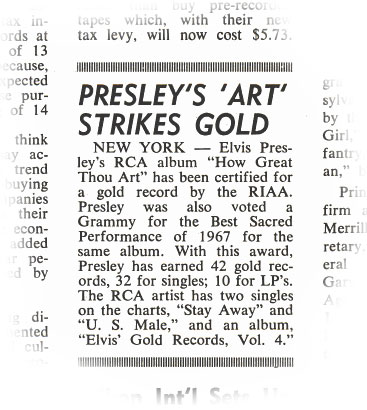
Though he had been nominated ten times in the past, Elvis went on to earn his first Grammy award for the How Great Thou Art album, which won for Best Sacred Performance of 1967. By March 1968, How Great Thou Art had also sold enough copies to earn a gold record.

Billboard article, March 30, 1968

Billboard article, March 30, 1968

After the lean years of 1964 and 1965, arguably the low points of his entire recording career, Elvis fired the opening salvos of what eventually became his comeback during that May 1966 session. How Great Thou Art features many moving performances, perhaps none more so than the title song. It also showcases the raucous energy of “Run On,” a song that rocked more than any of his recent secular efforts.

* * *
Research Sources

  • Elvis Presley: A Life In Music – The Complete Recording Sessions by Ernst Jorgensen, St. Martin’s Press, New York, 1998.
  • Billboard, Vol. 80, No. 13, Billboard Publications, Inc., March 30, 1968.
  • ELVIS: His Life From A To Z by Fred Worth and Steve Tamerius, Wings Books, New York, 1992.

Throughout 2011, The Mystery Train is commemorating the 44th anniversary of 1967. Why? Riders of this train love exploring Elvis’ entire career, not just the 1950s. Find out more here.