What Might Have Been: The Home Recording Studio

On the edge of reality. . . .

The rest of the world is asleep, but Elvis Presley is on a mission. As he bursts through the door, his friends Red and Charlie are already in the studio, setting up microphones. The small facility is just big enough for a piano, a few stools, and two or three of his favorite guitars.

Ignoring the piano for now, he grabs his trusty Gibson J200 and begins picking out the song that would not leave his head. “We’re rolling,” says Red, his hands moving over the control board with ease. The year is 1964, and Elvis is about to make his third album at his Graceland studio.

* * *

At least, that’s how I like to imagine what might have been.

Little moments in time can change history. Leave a few seconds early and avoid a car crash, leave a few seconds later and never make it back home.

At least one such potential life-altering moment in Elvis’ life jumped out at me when I first read a couple of key books about him.

It took me awhile to find the passage just now in Peter Guralnick’s Careless Love: The Unmaking of Elvis Presley (1999), which covers Elvis’ life from 1958 to 1977. I thought it occurred closer to the late 1960s. Turns out, it is about 1960. Here’s the moment:

RCA [. . .] even offered to build Elvis a studio in his home so he could record whenever the inspiration took him – but the Colonel wisely urged him to turn the company down, seeing their generosity for what it was, a desperate attempt to generate more product and thereby undercut the Colonel’s unassailable bargaining position” (p. 84).

Could this have changed everything? Prior to Elvis’ June 1961 Nashville session, the home recording studio receives another mention:

The idea of a home studio had been broached again a number of months earlier; this time Elvis actually indicated his interest in building a recording facility at Graceland, and initial plans were drawn up […]” (p. 112).

Ernst Jorgensen also mentions the fate of the studio project in 1998’s Elvis Presley: A Life In Music:

After initially promoting the idea, the label realized it would be a mistake to single one of its artists out above all others; eventually, the Colonel worked out a compromise in which Elvis received, among other considerations, some up-to-date RCA stereo equipment – and RCA got to keep Nashville’s Studio B as Elvis’s recording home base” (p. 150).

Considering that Elvis Presley was RCA’s most successful recording artist, the company should have made an exception in this case and built Elvis his studio. If other artists complained, they should have just been told that they could have their own studios, too – as soon as they sold as many records as Elvis.

Another huge recording artist of the 1960s, Ray Charles, had his own studio. What if, like Charles, Elvis had been able to record whenever the mood struck him, rather than being forced to create on demand at pre-determined studio times?

What kinds of music would he have produced if left to his own devices at Graceland? Sure, we have scratchy, home recordings made by Elvis on tape recorders, but what if he had been able to professionally record in his home?

Of course, Elvis eventually did record at Graceland –  in 1976 – but under markedly different circumstances. As Guralnick describes:

So desperate was RCA to lure Elvis back into the studio that they revived the old dream of recording him at home. This time, however, both the nature and the reason for the plan were a far cry from its original conception fifteen years before. […] And far from building him a new state-of-the-art plaything, they now proposed simply to install temporary equipment in the den behind the kitchen […]” (p. 593).

While the Graceland sessions that produced From Elvis Presley Boulevard and most of Moody Blue turned out to be special, I still can’t help but wonder what might have been if plans for building a true recording studio at Graceland had come to pass?

Would it have just been another intense but soon forgotten hobby – like slot cars or the Circle G?

Or would Elvis the artist have finally been able to fully realize his dreams?

* * *

After three takes, he puts down his guitar. He wants to focus only on the vocals. He nods to his friend, who kills the lights in the studio. The year is 2010. At home, Elvis begins to sing. . . .

REVIEW: The Christmas TV Companion book [The Film Frontier blog]

The Christmas TV Companion:
A Guide to Cult Classics, Strange Specials, & Outrageous Oddities
1701 Press, softcover
Release date: November 10, 2009
Author: Joanna Wilson

The Christmas TV CompanionI cover many subjects here on The Film Frontier. Beyond key ones like Star Trek, Star Wars, Superman, and Elvis Presley, I also give love to, among others, The Twilight Zone, Mystery Science Theater 3000, and Charles Schulz’ Peanuts gang from time-to-time. I like to think this is a rather eclectic combination not soon to be found anywhere else.
To some degree, however, all of these topics and more are covered in The Christmas TV Companion by Joanna Wilson. (Fair warning to Superman fans: the associated reference is just an “also appeared in” credit for Margot Kidder on one page.) The book’s main revelation to me is demonstrating a common thread among all of these topics I previously thought were so diverse: Christmas.

The Christmas TV Companion takes readers on a journey through some of pop-culture’s best and worst Christmas moments. Hold on tight for this ride from the traditional to the blasphemous and every point in between.

Core sections of the book are Macabre, Sci-Fi, Variety, Animation, and Dark. With dozens, perhaps hundreds of productions referenced, Wilson is obviously well-versed on her topic. When reading books like this, I fact check by looking at what the writer states about topics on which I am knowledgeable. Wilson’s Elvis, Star Trek, and Star Wars references are all correct – which leads me to trust her on the multitude of other topics covered.

While some shows warrant a line or two, 1978’s infamous Star Wars Holiday Special (is it possible to write the name of that special without including “infamous” in front?) merits five pages of coverage, including a photo of Harvey Korman and Bea Arthur from the show. The special was actually my first exposure to Star Wars, as a three-year-old. I remember very little of it, as I likely fell asleep – which is probably a good thing.

One of my favorite features of this book is the “Make Your Own Marathon” concept. We geeks have been doing this for years, and Wilson’s suggestions add new and creative elements to setting up such marathons. A Star Trek-themed marathon and an Elvis-themed marathon are among the several she provides. She also includes tips on creating your own based on a subject of your choice.

Fellow Trekkies, I can hear you asking, “The only Christmas scene was in Star Trek Generations. How can you have a Star Trek Christmas marathon?” I will not reveal all, but I will throw you a clue as to how these marathons of loose associations work: A certain Star Trek: The Next Generation actor has also appeared as Ebenezer Scrooge.

The Elvis marathon mentions the 1968 ELVIS television special, which aired during the holidays that year, as well as several other Christmas TV shows that have included Elvis in some fashion. An unfortunate omission was Perry White (Lane Smith)’s appearance as “Santa Elvis” in the 1994 “Season’s Greedings” episode of Lois & Clark: The New Adventures of Superman. Superman even pulls Santa Elvis’ sleigh to deliver toys to orphans. Written by series star Dean Cain, it is one of my favorite episodes of the series.

Very little else is left out, though, and the variety that serves as this book’s strength may also leave your head spinning at times. The Christmas TV Companion works best as a fun reference to thumb through, rather than something to read cover-to-cover. You probably want to keep this book near a computer or notepad, too, as you will find yourself wanting to seek out certain specials or look up more about some topics.

For instance, one of my favorite Christmas songs is “Have Yourself A Merry Little Christmas.” I had no idea until reading this book that the song’s original lyrics were actually quite depressing and changed at the last moment for its first appearance in the Judy Garland movie Meet Me In St. Louis. Curious about the original lyrics? You can find them here. You can bet I will start keeping an eye out for Carol for Another Christmas, Rod Serling’s take on A Christmas Carol that aired in 1964, too.

I must give credit to 1701 Press for including an index. A book like this demands one. A couple of recent Elvis books by other publishers lack indexes, and I was beginning to think they were going out of style.

If you are a Christmas special addict like me, you will be glad to know that Wilson’s current project (of which this book is actually derived) is a “comprehensive encyclopedia of Christmas on TV,” due out next year.

With about 135 pages of content outside of the thorough index, it would be easy to underestimate The Christmas TV Companion. Do not let this book’s seemingly short length fool you, though. Each page is full of information. Often Wilson even covers the margins with more trivia on the various productions, performers, or creative types mentioned. Whether by design or fortuitous accident, The Christmas TV Companion appears just small enough to make a perfect stocking stuffer.

The Christmas TV Companion goes on sale Tuesday. It is available for pre-order on Amazon.

Overall Experience: 9 (out of 10)

(1701 Press provided a review copy of this book free-of-charge.)

News From The Frontier: John Berkey; Elvis; Twilight Zone [The Film Frontier blog]

Artist John Berkey, 1932-2008
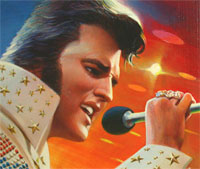
Berkey's Elvis Stamp BStarWars.com reported yesterday that artist John Berkey passed away on April 29. He was 75. Berkey painted the cover of the 1976 novelization of Star Wars, an image that continued to appear on early editions of the book. Berkey also painted a poster depicting a dogfight over the Death Star, used as an insert in the original Star Wars soundtrack LP.

The StarWars.com article includes a link to a gallery of ten Berkey Star Wars images. You can also find pictures of Berkey’s work in 2005’s The Star Wars Poster Book by Stephen J. Sansweet and Peter Vilmur. Though known for his science fiction and Star Wars art, Berkey was reportedly not a science fiction fan and never saw Star Wars.

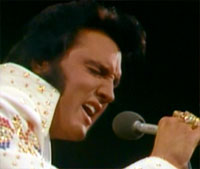
Elvis Presley, 1973For a 1992 US Postal Servicing stamp voting campaign, Berkey also painted “Elvis Stamp B” (above), which depicted Elvis Presley as he appeared in his historic 1973 Aloha From Hawaii TV special (right). Berkey’s image lost to Mark Stutzman’s “Elvis Stamp A,” which depicted Elvis in 1956, his first year of national fame. Stutzman’s 1950s Elvis image became an official US stamp the following year, while Berkey’s 1970s Elvis image was never issued.

I voted for Berkey’s Elvis stamp back in 1992 and never knew about his Star Wars connection until reading The Star Wars Poster Book a couple of years ago. Though, again, I had no idea who the artist was back then, I actually had several posters of Berkey’s science fiction and fantasy imagery hanging in my bedroom when I was growing up. He was a real talent and will be missed.

Elvis: That’s The Way It Is (FTD Classic Album Series) available this week
Follow That Dream (FTD) records, BMG’s Elvis Presley collectors label, is scheduled to release a 2-CD set of Elvis: That’s The Way It Is this week to the US as part of its “Classic Album Series.”

This 2008 edition of the 1970 album includes all of the original tracks, plus numerous alternate takes, a 20-page booklet, and other extras. The new Elvis: That’s The Way It Is CD set was first released in Europe last month.

Check out Thomas’ review, over at his Elvis Today blog, and Lex’s review, over at ElvisNews.com. To obtain FTD CDs, visit ShopElvis.com. Most FTD CDs are much more interesting than the mainstream “greatest hits”-style Elvis CDs you’ll find at your local store.

Twilight Zone graphic novels on the way for 50th anniversary
It is hard to believe that 2009 will mark the 50th anniversary of the television debut of Rod Serling’s The Twilight Zone. Next to the original Star Trek, The Twilight Zone is my favorite TV series. I grew up watching both of them, and still watch them now (yet another indication that, in fact, I never did grow up).

Publishers Weekly announced earlier this month that Walker & Co. will release a series of graphic novels based on Twilight Zone‘s original scripts, in conjunction with Rod Serling’s estate. There will be at least eight graphic novels in all. Look for the first to hit US stores in October.

News From The Frontier: Get Smart trailer; Star Trek and Twilight Zone episodes online; Elvis & Star Wars [The Film Frontier blog]

Good morning, folks. It’s catch-up time, so I have a lot of news for you today.

Get Smart movie news roundup
Now that Paramount has moved Star Trek to 2009, the movie I’m most excited about this year is the revitalization of Get Smart, starring Steve Carell and Anne Hathaway. I have been watching the original Get Smart on DVD to get ready. The new preview trailer released last week by Warner Brothers looks fantastic. Check it out on the official Get Smart movie site. Get Smart hits theaters on June 20.

SCI FI Wire has a number of interesting articles on Get Smart. Carell wisely decided not to imitate the legendary Don Adams while portraying the character. “There’s no way to improve upon what he did,” said Carell, who says he instead tried to evoke the spirit of the character.

“Honestly, for me the catch phrases were the toughest part, because it’s hard to say them or think of them in any other way than the way that Don Adams did them. So, again, I tried not to do an impersonation of him, but I tried to sort of let them come out of the situation and not feel like they should stick out in any way,” he said.

This is actually not the first time Carell has tackled a character from a legendary 1960s television series. In 2005’s Bewitched, he appeared as Uncle Arthur to counsel Will Ferrell. Uncle Arthur was made famous by Paul Lynde on the television version of Bewitched. Carell’s Bewitched cameo was a slightly different situation than his Get Smart role, though. In Bewitched, he really is supposed to be the exact same fictional incarnation of Uncle Arthur portrayed by Lynde. Even stock footage of Lynde is shown earlier in the movie. The Get Smart movie, on the other hand, is a total restart of the franchise.

Within a couple weeks of the release of Get Smart to theaters, Warner Brothers will also release a direct-to-DVD movie, Get Smart’s Bruce and Lloyd Out of Control. The spinoff film stars Masi Oka (Heroes) and Nate Torrence (Studio 60 on the Sunset Strip), who also have supporting roles in Get Smart.

CBS releases Star Trek and The Twilight Zone for free online viewing in the US
Every episode of all three seasons of the original Star Trek is now available over at CBS.com for free viewing by those in the United States. These are unaltered versions of the shows, not the versions shown in syndication for Star Trek: Remastered. The first two seasons of the original The Twilight Zone, which lasted five seasons, are also available online.

· CBS.com: Star Trek video episodes
· CBS.com: The Twilight Zone video episodes

Elvis & Star Wars
Don’t worry, I’m not going to start covering “Elvis Trooper” here. However, there are some legitimate connections between Elvis Presley and Star Wars. As a member of both fanbases, I’ve observed a lot of this stuff first-hand over the years. Thomas over at the Elvis Today blog compiles some of them in his article “Elvis, Star Wars style.”

When I visited Graceland in 1990, one of the things mentioned on the tour was that on the last night of his life, Elvis tried to obtain a copy of Star Wars to show his daughter, Lisa Marie, but none were available. Elvis and Star Wars will always share 1977, which really had two huge entertainment headlines–one was the launch of the legendary Star Wars in May and the other was the loss of the legendary Elvis Presley in August. Both stories have had rippling effects all the way to the present.

In 1968, Steve Binder directed ELVIS, a Christmas special that became the most-watched show of the year and revitalized Elvis’ career. Today, it is known as ELVIS: ’68 Comeback Special. When I watch this special, sometimes I think about how only a decade later, Elvis would be gone and Binder would be directing another Christmas special – 1978’s infamous Star Wars Holiday Special. In a unique way, Binder was there for the best of Elvis and the worst of Star Wars.

In June 1977, just six weeks before his death, Elvis was filmed for another television special, Elvis In Concert. The director of that special, which did not air until about six weeks after Elvis’ death, was Dwight Hemion. Hemion, who passed away just over a month ago, teamed up with Binder the next year for that very same Star Wars Holiday Special, for which he served as Executive Producer. Like the Star Wars Holiday Special, the complete version of Elvis In Concert is not officially available for purchase.

I stumbled across the top-notch Elvis Today blog while looking up info about another Elvis project, This Is Elvis. I watched the 1981 theatrical cut of this rockumentary for the first time in years the other day. Elvis Today is an extremely well-written blog. I was so thrilled to find it that I actually went back and read all 90 or so of its entries. I’ve not done this for any other blog out there, including the myriad of ones available for Star Trek (there are some Elvis connections there, too; I’ll also save them for another day).

In one posting, Thomas sums up what it feels like to be an Elvis fan better than anything else I’ve ever read:

“On the highway I put the fourth CD from the Today, Tomorrow & Forever box set in the car stereo and there was ‘See See Rider’ from February 1970 blasting through the speakers. It’s hard to explain what I felt, but I remember thinking ‘Man, I’m gonna listen to Elvis and his music until the very day I die.'”

That makes two of us.

* * *

And that’s about all the time we have for this installment of News From The Frontier. Have a great day, everyone.