Today, I want to point you over to an Elvis site I’ve been enjoying for a few years now. Neal Umphred’s Elvis – A Touch Of Gold is one of those factual deep-dive yet personal blogs that I love. Here are just a few of my favorite pieces:
From Graceland To Burbank To Graceland: Covers the 1968 ELVIS (Comeback) special and its aftermath. There’s a wonderful anecdote near the beginning of the post that you must read. Ironically, this same sort of thing happened to me when a couple of months back I read a great post by Neal about Mac Davis and wanted to comment on it. When I scrolled to the comments, I found that I had already responded to it years ago. The same thing has happened to me over on Sheila O’Malley’s blog as well. It’s actually kind of unnerving.
An Alternative “Back In Memphis” Album: The post title explains it, but this isn’t solely an alternate tracklisting. It includes an in-depth look at the original album, first released as one half of the double LP From Memphis To Vegas/From Vegas To Memphis, and why Neal would have released a different album.
Collecting Elvis 78 RPM Singles From The ’50s: Did I mention Neal likes to deep-dive? This fantastic post reveals his methodology around determining the rarity of Elvis’ 78 RPM singles.
Neal has an affinity for using footnotes in his posts, which actually inspired me to try that technique in my recent The Elvis Odyssey series. Neal even sent me some help on one such footnote, which you can read about here. Footnotes are fun, so you’ll probably see more of them here on certain types of posts in the future.
Neal has several other blogs, which you can access via his homepage. He is also the author of multiple record pricing guides, including two focused on Elvis.
A lot of people out there write a lot of things about Elvis. Neal’s words are worth reading.
Today marks the 68th anniversary of the release of Elvis Presley’s first record on July 19, 1954.
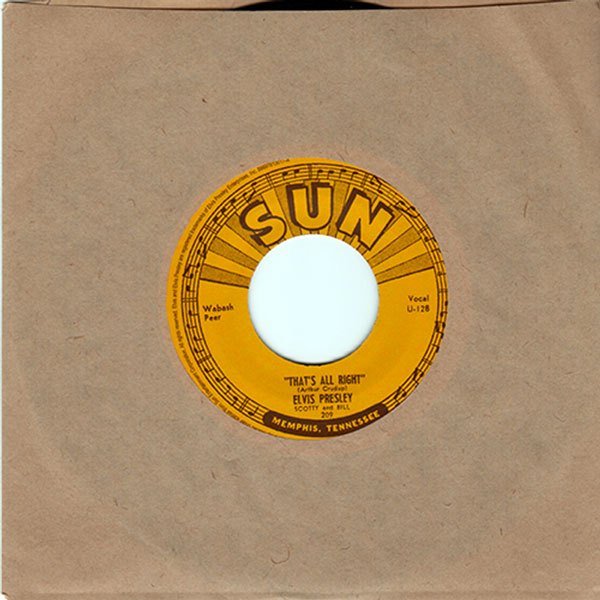
I have two near-mint copies of That’s All Right/Blue Moon of Kentucky.
By far, they would be the most financially valuable pieces of my entire record collection or of all of my collections of anything, for that matter, except that they were both pressed in 2009, rather than 1954. Oh well. It’s not about the money, it’s about the music. Always has been.
THAT’S ALL RIGHT/BLUE MOON OF KENTUCKY (Single; Sun, 1954; Reissue: Sony RCA/Legacy 2009–included as bonus with the Franklin Mint’s ELVIS: THE COMPLETE MASTERS COLLECTION CD set; from TY’s collection)
That’s All Right/Blue Moon of Kentucky (Single) Label: Sun [Reissue: Sony RCA/Legacy] Catalog Number: 209 [Reissue: 88697613017 (Label) / 88697673597 (2010 Outer Sleeve)] Recorded: 1954 | Memphis, TN Released: 1954 [Reissue: 2009]
Packaged in a plain, brown sleeve much like the original, my first copy of the record was included with Franklin Mint’s Elvis: The Complete Masters Collection CD set from 2009. A few years ago, I acquired a second copy of That’s All Right/Blue Moon of Kentucky, which Sony had released back in April 2010 for Record Store Day. Unlike the simple brown sleeve, this one included a gaudy cover, but I was surprised to discover that the record contained within is actually identical to the one that shipped with the Franklin Mint set. Sony must have been thinking ahead and pressed extra copies for the Record Store Day promotion.
Side A
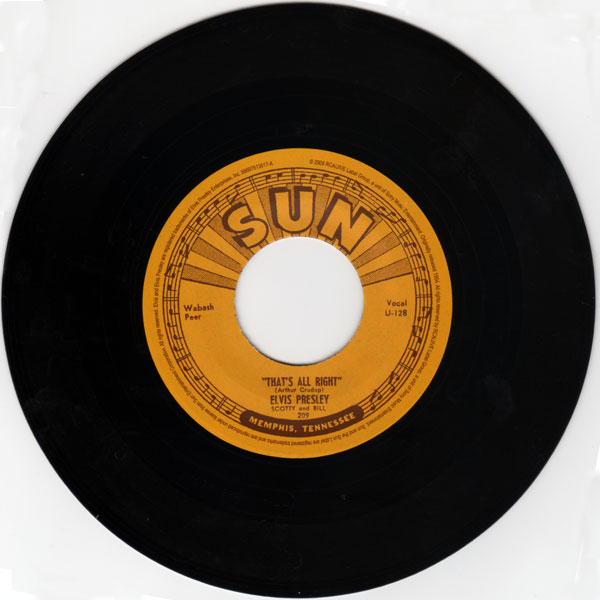
Side A of THAT’S ALL RIGHT/BLUE MOON OF KENTUCKY (Single; Sun, 1954; Reissue: Sony RCA/Legacy 2009; from TY’s collection)
“That’s All Right” (1954)
One of the endearing aspects of this performance of “That’s All Right” is the sheer joy in the voice of Elvis as he sings. He finally has his opportunity in the studio, and he is making the most of it.
Elvis in 1970 reflected on his style, stating that it was “a combination of country music and gospel and rhythm & blues […]. That’s what it really was. As a child, I was influenced by all that.”
He added, “Of course, the Grand Ole Opry is the first thing I ever heard, probably, but I liked the blues, and I liked the gospel music–gospel quartets–and all that.”
On this first single, the blues and country influences are as clear as they ever would be. Some credit That’s All Right/Blue Moon of Kentucky as the first rock ‘n’ roll record, but to say Elvis invented the style is to make a false assumption that any one person actually did.
Rock ‘n’ roll evolved from the very sources that Elvis himself described. Besides, “Rocket 88,” “Rock Around the Clock,” and other potential contenders pre-date Elvis’ version of “That’s All Right.”
What Elvis did with his early records for Sun and RCA, though, was ignite the smoldering evolution of rock ‘n’ roll into a full-blown blaze. By melding country into the blues of “That’s All Right,” Elvis in 1954 unleashed a sound that not only built upon the foundation established by Arthur “Big Boy” Crudup‘s original 1946 recording, but took the song in a new direction. Absorbing the music of his youth, Elvis knew instinctively that blues and country explore many of the same themes, which allowed him to re-interpret these kinds of songs in a unique way.
Unfortunately, despite what the beautiful record label would have you believe, this reissue actually contains an RCA mastering of “That’s All Right,” rather than the original Sun mastering. It is the same 1954 recording, but RCA added echo to its versions not present on the Sun original.
A few years after this 2009 reissue of SUN 209, the “dry” version of “That’s All Right” finally became available again via FTD’s A Boy From Tupelo boxed set in 2012. Sony RCA/Legacy re-released A Boy From Tupelo in a much more affordable package for mainstream retail in 2017.
The dry version of “That’s All Right” is superior, though it takes some getting used to because the echo versions were used in every official release of the song from December 1955 through 2011. Unless, of course, you have been spinning a Sun original.
Side B
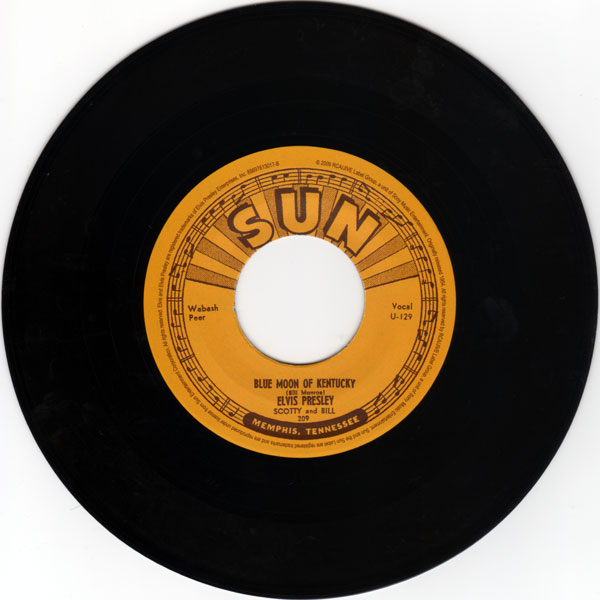
Side B of THAT’S ALL RIGHT/BLUE MOON OF KENTUCKY (Single; Sun, 1954; Reissue: Sony RCA/Legacy 2009; from TY’s collection)
Blue Moon of Kentucky (1954)
While Elvis added country to the blues of “That’s All Right,” he created a literal flip side by melding rhythm & blues into the country bluegrass of “Blue Moon of Kentucky.” Again, the sound is markedly different from Bill Monroe’s 1946 original. Again, there is that joy in Elvis’ voice.
A fun tidbit is That’s All Right/Blue Moon of Kentucky contains only three musicians: Elvis on acoustic guitar, Scotty Moore on electric guitar, and Bill Black on the upright bass.
One of the earliest rock ‘n’ roll records, and no drummer to be heard. Credit goes to Black, whose bass makes it sound like there must be a drummer.
A drummer did not join the group in the studio until the early 1955 session that produced “I’m Left, You’re Right, She’s Gone,” the flip side of Elvis’ fourth record for Sun.
“That’s All Right” and “Blue Moon of Kentucky” became regional hits for Elvis. He would follow-up the single with four more records on the Sun label before signing with RCA in late 1955.
“History merely repeats itself. It has all been done before. Nothing under the sun is truly new.” Ecclesiastes 1:9
Portions of this post originally appeared in a review I wrote of His Hand In Mine for the album’s 60th anniversary in Kees Mouwen’s Elvis Day By Day 2020: The Year In Review. The 2021 volume is available now.
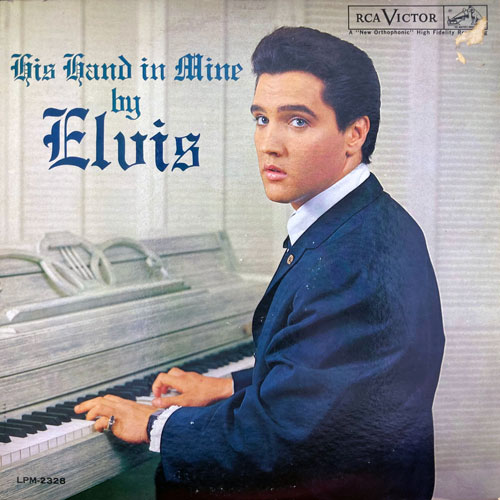
HIS HAND IN MINE (RCA, 1960; from TY’s collection) | Click image for full-color version
His Hand In Mine Label: RCA Catalog Number: LPM-2328 Recorded: 1960 | Nashville Released: 1960
1960 was Elvis Presley’s most productive year to that point in his career. He recorded 52 studio masters, released 3 albums, and filmed 3 movies; and all that with being out of commission for almost the entire first 3 months while completing his stint in the U.S. Army.
For the 25-year-old singer, the albums Elvis Is Back! and His Hand In Mine represented artistic achievements on par with his outstanding work in the previous decade. The latter title was his first Long Play (LP) sacred album, a follow-up of sorts to his 1957 Extended Play (EP) sacred album Peace In The Valley.
Elvis recorded the entire His Hand In Mine album the night of October 30, finishing in the early morning hours of October 31, 1960. Amazingly, the record was in stores within a month – presumably rushed to have it ready for the Christmas season. RCA released His Hand In Mine in both mono and stereo formats.
As a second generation Elvis fan, I first heard His Hand In Mine in the early 1990s on CD. As with so many Elvis albums, I have bought it a number of times in different CD configurations over the years since then. When Kees asked me to review the album for its 60th anniversary back in 2020, I sought out a vinyl version – a first pressing of the 1960 mono release.
One of the things I enjoy about collecting used records is pondering their history. I imagine a young Elvis fan in 1960 buying this album at her or his local record shop and taking it home to play it for the first time. What else is happening in November 1960?
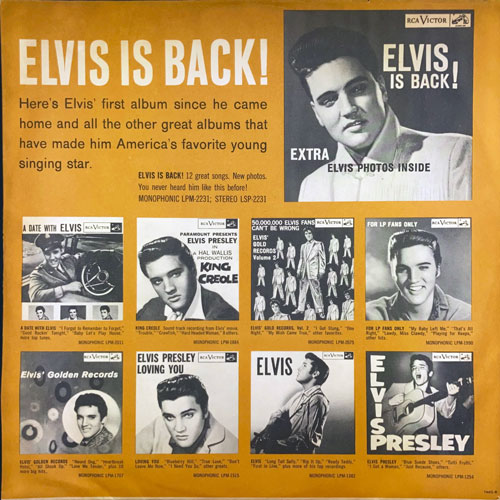
Inner sleeve of HIS HAND IN MINE (RCA, 1960; from TY’s collection) | Click image for color version
How many others owned this particular copy of His Hand In Mine before it made its way into my hands 60 years later? Whose hands will hold it 60 years from now?
The album is in remarkable condition for its age. The outer sleeve, featuring a photo of Elvis at the piano, taken during a break while filming Flaming Star, is still vibrant. Only a small tear beneath the RCA logo on the front cover, where a fan was perhaps too aggressive in removing a price tag, and minor splitting in the bottom seam betray its age. The inner sleeve, promoting Elvis Is Back!, is in great shape. On the vinyl itself, there are but a few little crackles in quiet portions. Whether this is an indication that the original owner(s) did not play this album very often or simply treated it with reverence, there is no way to know.
When I first heard His Hand In Mine nearly 30 years ago, I believed in God but had little understanding of Christianity. While I thought Elvis’ voice sounded beautiful on many of the songs, I really did not connect with them beyond that. I did occasionally play this or one of his other sacred albums on a random Sunday, seeking something.
In 2018, I accepted Jesus into my heart, and I was literally reborn (2 Corinthians 5:17). While I still stumble every day, I now have a personal relationship with Jesus through daily reading of the Bible and prayer that helps me get back on track to becoming who He created me to be.
As for Elvis’ sacred recordings, they began to take on new meaning for me. It is within this context that I want to examine His Hand In Mine.
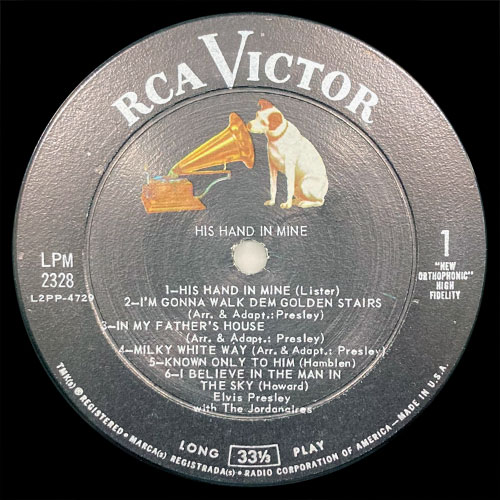
Side 1 of HIS HAND IN MINE (RCA, 1960; from TY’s collection) | Click image for full-color version
Side 1
His Hand In Mine
The album kicks off with the title track, “His Hand In Mine.” Elvis’ voice is full of new confidence and strength on this slow number – as compared to 1956’s more faltering “Love Me Tender,” for instance.
I’m Gonna Walk Dem Golden Stairs
Up next, the pace picks up with “I’m Gonna Walk Dem Golden Stairs.” This song sounds like Elvis fulfilling his dream of being in a gospel quartet. The line “When Jesus says to me, ‘Well done'” recalls the following verse from the Bible: “His lord said unto him, ‘Well done, thou good and faithful servant: thou hast been faithful over a few things, I will make thee ruler over many things: enter thou into the joy of thy lord'” (Matthew 25:21 KJV). As a Christian, I do not fear death, as I know it is when I will go to meet Jesus. I pray I will live the rest of my life such that He will say, “Well done.”
In My Father’s House
There is an even more direct Scriptural reference in the next song, “In My Father’s House.” Elvis sings, “In my Father’s house are many mansions; if it were not true He would have told me so.” In the Bible, Jesus states: “In My Father’s house are many mansions: if it were not so, I would have told you. I go to prepare a place for you” (John 14:2 KJV). Elvis’ vocals are exquisite on lines like, “Jesus died upon the cross to bear my sorrow. Freely died that souls like you might have new life.” A highlight of the album.
Milky White Way
Known Only To Him
“Known Only To Him” is an interesting 1960 recording by Elvis because it is one of those where portions sound like his later voice from the 1970s. His inspirational and Christmas songs do tend to blend together better across the decades, though, compared to many of his other recordings. It would have been interesting to hear Elvis take another try at this song in 1970 or 1971, even if live. I don’t think he would have been able to better this version, though.
I Believe In The Man In The Sky
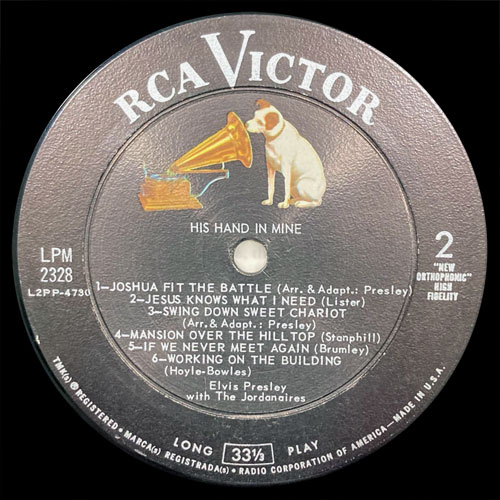
Side 2 of HIS HAND IN MINE (RCA, 1960; from TY’s collection) | Click image for full-color version
Side 2
Joshua Fit The Battle
My first complete read-through of the Bible in 2018 had a secondary and unexpected benefit of filling in details for me on a number of songs. For instance, in the upbeat “Joshua Fit The Battle,” I had always heard the lyrics as, “I know you’ve heard about Joshua, he was the son of none.” Yes, for 25 years I thought Joshua was an orphan until I finally learned that his father’s name was Nun. The song recounts the battle of Jericho, which is featured in chapter 6 of Joshua in the Old Testament. In his later years, Joshua was one of only two adults from Moses’ original followers to make it to the Promised Land.
Jesus Knows What I Need
“Jesus Knows What I Need” is one of those songs that speaks Truth whenever I need comfort. I can imagine Elvis singing this one around the piano with friends. A bit of trivia: In subsequent pressings of His Hand In Mine, this song’s title was corrected to “He Knows Just What I Need.”
Swing Down Sweet Chariot
The humorous “Swing Down Sweet Chariot” takes us back to the Old Testament. Called “Zeke” in the song, the prophet Ezekiel’s encounter with the chariot of God is described in chapter 1 of Ezekiel. Though I love this song, I much prefer the alternate version of Elvis’ 1968 re-recording that features the Blossoms as the backing vocalists.
Mansion Over The Hilltop
Like “In My Father’s House” on Side 1, “Mansion Over the Hilltop” and “If We Never Meet Again” on Side 2 provide beautiful illustrations of the Perfect Place, Heaven. In “Mansion,” a favorite line is, “Someday yonder we will never more wander, but walk on streets that are pure as gold.” I just love the sound of Elvis’ voice as he paints this picture.
If We Never Meet Again
Elvis’ mother, Gladys, passed away in August 1958 at the age of 46, and I’m sure Elvis had her in mind while recording “If We Never Meet Again,” which states: “If we never meet again this side of Heaven, as we struggle through this world and its strife, there’s another meeting place somewhere in Heaven, by the side of the River of Life – where the charming roses bloom forever and ever, and separations come no more.” The “River of Life” is from Revelation 22:1 in the Bible, which describes God’s throne in Heaven. Elvis was only 23 when he lost his mother. At a September 1958 press conference before leaving to be stationed in Germany until his return to the U.S. and civilian life in March 1960, he had this to say about her, captured on the Elvis Sails EP: “My mother, I suppose since I was an only child, that we might have been a little closer. Everyone loves their mother, but I was an only child, and Mother was always right with me, all my life. It wasn’t only like losing a mother, it was like losing a friend, a companion, someone to talk to. I could wake her up any hour of the night, and if I was worried or troubled about something, she’d get up and try to help me.”
Working On The Building
I first heard the energetic “Working On The Building” on the 1988 album Elvis In Nashville and loved it right away. Take 2, released on the 2006 FTD edition of His Hand In Mine, is also a favorite. In the gospel segment of the 1968 ELVIS television special, wheelbarrows can be seen as part of the set decoration – reminding me of this 1960 song, which was unfortunately not performed on the show. “I’m working on the building, it’s a true foundation,” sings Elvis. In Matthew 7:24-27, Jesus talks about the importance of building a strong spiritual foundation. “Working On The Building” serves as a perfect conclusion to His Hand In Mine.
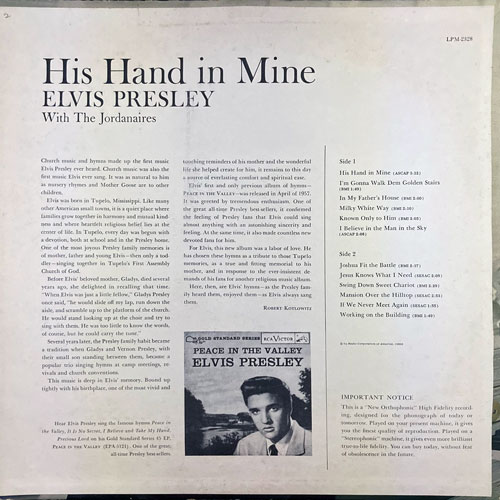
Back cover of HIS HAND IN MINE (RCA, 1960; from TY’s collection) | Click image for color version
I enjoy looking at album covers while playing records. His Hand In Mine includes liner notes on the back by Robert Kotlowitz. He explores Elvis’ early faith through attending the First Assembly Church of God in Tupelo, Mississippi.
An interesting tidbit in the liner notes, which I do not recall reading elsewhere, is, “Gladys and Vernon Presley, with their small son [Elvis] standing between them, became a popular trio singing hymns at camp meetings, revivals and church conventions.” Truth or legend?
The liner notes also include a quote from Elvis’ mother: “When Elvis was just a little fellow, he would slide off my lap, run down the aisle, and scramble up to the platform of the church. He would stand looking up at the choir and try to sing with them. He was too little to know the words, of course, but he could carry the tune.”
Except for a quick session in June 1958, which was a couple of months before his mother’s death, Elvis made no formal recordings while serving in the Army. While Elvis Is Back! and the G.I. Blues soundtrack afforded no such opportunities, I firmly believe His Hand In Mine is a “labor of love” by Elvis in tribute not only to Jesus but, as Kotlowitz states, to Gladys Presley.
Back inner sleeve of HIS HAND IN MINE (RCA, 1960; from TY’s collection) | Click image for color version
“The eyes of the LORD are everywhere, keeping watch on the wicked and the good.” Proverb 15:3
Released as a 2-LP set in 1987, The Top Ten Hits contained all 38 of Elvis’ top 10 hits on Billboard‘s key US charts. Other than a few outliers that failed to make the top 10 and are not on the set (“Blue Suede Shoes,” “Blue Christmas,” “Viva Las Vegas,” “My Way,” and “A Little Less Conversation”), it includes all of his most famous songs for the general public. Indeed, outside of boxed sets, The Top Ten Hits remains one of the most comprehensive Elvis releases to date when it comes to mainstream songs.
Today’s post will feature hits included on Side D of The Top Ten Hits, most of which were studio recordings on the original album.
01. Return To Sender (hit version recorded 1962) Ultimate Live Version: August 1, 1976, Hampton Roads, VA, New Haven ’76
Per request, Elvis performs “Return To Sender” off the top of his head at a concert in Hampton Roads, Virginia. Included as a bonus track on New Haven ’76, this is the only officially released live version of the song. Considering it was recorded in 1976, the nadir of Elvis concert years, it actually isn’t horrible.
02. Devil In Disguise (hit version recorded 1963) Ultimate Live Version: None available
It is unfortunate that Elvis never performed live in the mid-1960s. This song would surely have resulted in a classic rendition at that time.
03. Bossa Nova Baby (hit version recorded 1963) Ultimate Live Version: None available
A medley of “Return To Sender” and “Bossa Nova Baby” might have been fun in his 1969 live shows to acknowledge a couple of hit songs from his 1960s movies.
04. Crying In The Chapel (hit version recorded 1960) Ultimate Live Version: None available
Voice-wise, 1968 probably would have been the best time for Elvis to have performed “Crying In The Chapel” live. I don’t see where it would really fit in any of his four shows captured for the ELVIS special, though. August 1970 probably would have been a good vocal opportunity for it, too. I would love to hear the Blossoms or the Sweet Inspirations backing Elvis on this instead of the Jordanaires.
Elvis Presley performs “The Wonder Of You” at the August 13, 1970, Dinner Show, in Las Vegas, Nevada, captured for the ELVIS: THAT’S THE WAY IT IS documentary film (MGM)
05. In The Ghetto (hit version recorded 1969) Ultimate Live Version: August 26, 1969, Dinner Show, Las Vegas, NV, From Memphis To Vegas/From Vegas To Memphis [Elvis In Person]
Elvis’ live versions of “In The Ghetto” never quite lived up to the studio versions. While he usually performed it strongly, he never seems as “into” the song. A stripped-down version, with just Elvis and an acoustic guitar would have been ideal.
06. Suspicious Minds (hit version recorded 1969) Ultimate Live Version: August 25, 1969, Midnight Show, Hot August Night
An apparent mistake is actually what gives this live version of “Suspicious Minds” an edge over other stellar versions recorded in the same concert series. After James Burton’s opening guitar solo, Elvis fails to begin singing, so Burton continues the solo. Overall, this live version is even better than the studio master.
07. Don’t Cry Daddy (hit version recorded 1969) Ultimate Live Version: February 18, 1970, Dinner Show, Las Vegas, NV, Greatest Hits, Volume One
While I love “Don’t Cry Daddy,” it does not work as well in a live concert setting, and I can understand why Elvis dropped it by 1971. That said, this live version is top-notch.
08. The Wonder Of You (hit version recorded live, February 18, 1970, Midnight Show, Las Vegas, NV, On Stage) Ultimate Live Version (after hit recorded):
August 13, 1970, Dinner Show, Las Vegas, NV, The Way It Was
I have found that time behaves inconsistently in certain situations and for certain people. Elvis’ entire career, for instance, was compressed into about 21 years, yet he left a wealth of material behind that continues to forge his musical legacy. Elvis released his February 1970 live version of “The Wonder Of You” as a single in April 1970, and it peaked at number nine on June 27, 1970. Less than two months later, during one of the concerts captured for the MGM documentary movie Elvis: That’s The Way It Is, he introduces this August 1970 live recording by stating, “I had a record out last year that–-this year . . . this year, wasn’t it?–-that did pretty good for me. I’d like to sing it for you.” In this case, two to four months in “Elvis time” was like a year in normal time.
09. Burning Love (hit version recorded 1972) Ultimate Live Version: April 18, 1972, San Antonio, TX, Close Up
Featured in the documentary movie Elvis On Tour (MGM, 1972), this rockin’ version of “Burning Love” exceeds any other live renditions released thus far. The March 1972 studio master remains the best, however.
Well, that about wraps things up for our look at Elvis’ best officially released live recordings of his hit songs. Over 43 years after his death, Elvis Presley concert recordings continue to surface. With that in mind, we may have to check in on these live hits again in a few years.
Thanks for reading.
Your Conductor,
TY
“Do not let your hearts be troubled. You believe in God; believe also in me.” John 14:1
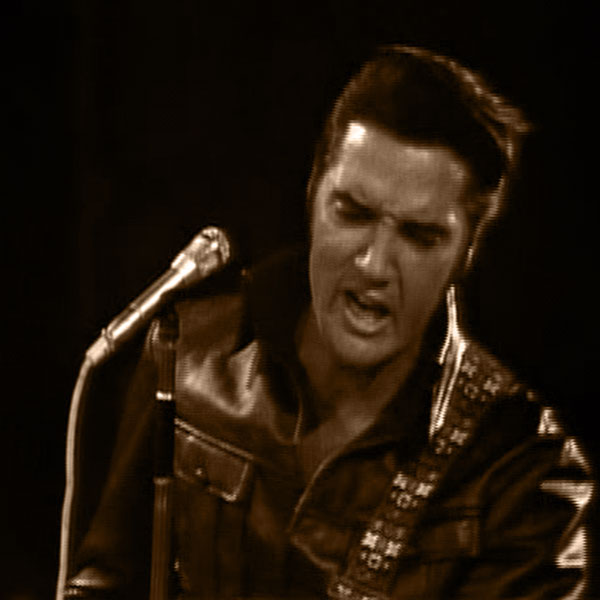
Elvis Presley rocks “Heartbreak Hotel” during taping of 1968’s ELVIS special (NBC)
I was 13 years old during Spring Break of 1988. At that point, I had about a half dozen Elvis Presley albums to my name. At the record store that week, I bought my first 2-record set. The Top Ten Hits was part of an “Elvis Presley Commemorative Issue” series that marked a decade since his 1977 death. I eventually obtained all four of the albums in the series, though I never did mail away for the special bonus album (a future eBay purchase, no doubt).
I had been collecting Elvis records for about a year at that point, and The Top Ten Hits certainly firmed up the foundation of my new obsession by containing all 38 of Elvis’ top 10 hits on Billboard‘s key US charts. These are what I now call mainstream or “general public” Elvis songs in that they are his most famous songs. Back then, these were the ones that various radio stations would still play.
The only two general public Elvis songs that failed to make the US top ten and, thus, this album were “Blue Suede Shoes” (peaked at #20) and “Viva Las Vegas” (peaked at #29). If we include posthumous releases, 1977’s “My Way” (peaked at #22) and 2002’s JXL Radio Edit Remix of “A Little Less Conversation” (peaked at #50) are also general public Elvis songs that are not present on this 1987 release. Except for those few titles and maybe “Blue Christmas,” everything else is here from a mainstream audience perspective. Outside of boxed sets, which really belong in their own category, The Top Ten Hits remains one of the most comprehensive Elvis releases to date when it comes to the general public.
I wore this record out in my 7th and 8th grade years, to the point where many of these songs became boring to me for a time. I will at some point cover this and the other Elvis Presley Commemorative Issue albums as part of my ongoing Vinyl Elvis series. Today, however, I want to use The Top Ten Hits as a jumping off point for a series of four posts covering Elvis’ best live performance of each of his hits. As is the norm here on The Mystery Train, the focus will be on officially released recordings. No bootlegs.
Today’s post will feature hits included on Side A of The Top Ten Hits, all of which were studio recordings on the original album.
01. Heartbreak Hotel (hit version recorded 1956) Ultimate Live Version: June 29, 1968, 6 PM Show, Burbank, CA, ELVIS-TV Special
Recorded in front of small studio audience for Elvis’ 1968 NBC television special, ELVIS, this version of “Heartbreak Hotel” rocks more than any of his other takes on the song. It is unfortunately a shortened version, though, due to being part of a medley with “Hound Dog” and “All Shook Up.” I once created a splice with the June 27, 1968, 6 PM Show version of “Heartbreak Hotel” to partially rectify this (inspired by and in the same vein as the “Blue Suede Shoes” splice on the This Is Elvis album, except starting with the June 29 “stand up” show version and ending with the June 27 “sit down” show version).
02. I Want You, I Need You, I Love You (hit version recorded 1956) Ultimate Live Version: June 5, 1956, Los Angeles, CA, A Golden Celebration
As performed on the Milton Berle Show, following a skit with the host.
03. Hound Dog (hit version recorded 1956) Ultimate Live Version: December 15, 1956, Shreveport, LA, Young Man With The Big Beat: The Complete ’56 Elvis Presley Masters
The finale of one of Elvis’ greatest recorded concerts, this version of “Hound Dog” is not to be missed.
04. Don’t Be Cruel (hit version recorded 1956) Ultimate Live Version: January 6, 1957, New York, NY, A Golden Celebration
After Elvis released “Don’t Be Cruel,” he caught an act in Las Vegas that was doing a number of his songs. The lead singer was Jackie Wilson, and Elvis liked his version of “Don’t Be Cruel” better than his own. When Elvis performed the song on his third Ed Sullivan Show appearance in 1957, he incorporated some of Wilson’s upgrades to the song. What I love about this story is that Elvis inspired Wilson, who, in turn, inspired Elvis. Incidentally, this is the infamous “from the waist up” Sullivan performance where TV cameras were ordered not to show Elvis’ hips and legs – which, of course, only added to his legend. Watch it above or over on YouTube.
05. Love Me Tender (hit version recorded 1956) Ultimate Live Version: June 29, 1968, 8 PM Show, Burbank, CA, ELVIS-TV Special
This live version, recorded for the 1968 ELVIS special, far exceeds Elvis’ original studio recording of the song from 1956. His voice is like velvet.
06. Love Me (hit version recorded 1956) Ultimate Live Version: June 27, 1968, 6 PM Show, Burbank, CA, Memories: The ’68 Comeback Special
This was a close call with the August 12, 1970, Midnight Show, version of “Love Me,” but I slightly prefer the raw sound of the 1968 version.
07. Too Much (hit version recorded 1956) Ultimate Live Version: January 6, 1957, New York, NY, A Golden Celebration
This is the only live version officially released of “Too Much,” to my knowledge, so it wins by default. A decent if sloppy version, performed on the Ed Sullivan Show and broadcast from the waist up.
08. All Shook Up (hit version recorded 1957) Ultimate Live Version: August 26, 1969, Midnight Show, Las Vegas, NV, All Shook Up
The earliest available live version of “All Shook Up,” which is closer to the arrangement of the studio recording, is March 25, 1961, but the performance is tepid compared to his 1968 and 1969 versions.
09. Teddy Bear (hit version recorded 1957) Ultimate Live Version: January 26, 1970, Opening Show, Las Vegas, NV, The On Stage Season: The Opening And Closing Shows 1970
This live version of “Teddy Bear” was a pleasant surprise on one of my favorite FTD releases.
10. Jailhouse Rock (hit version recorded 1957) Ultimate Live Version: June 29, 1968, 8 PM Show, Burbank, CA, ELVIS-TV Special
As with a few of the others on today’s list, this incredible live version of “Jailhouse Rock” was captured for the 1968 ELVIS special. It almost equals the flawless studio recording. Watch it above or over on YouTube.
If only some of Elvis’ 1957 concerts had been recorded. Perhaps ultimate live versions of “Too Much,” “All Shook Up,” and possibly even “Jailhouse Rock” would have been among them. Every now and then, new recordings are unearthed. I maintain hope that a 1957 concert will eventually see the light of day.
I pray all of you are doing well and staying healthy. Drop a note in the comments below about some of your favorite live versions of these Elvis classics.
“Dear brothers and sisters, when troubles of any kind come your way, consider it an opportunity for great joy. For you know that when your faith is tested, your endurance has a chance to grow. So let it grow, for when your endurance is fully developed, you will be perfect and complete, needing nothing.” James 1:2-4
Kicking off his first session of the new year, Elvis Presley recorded “I Believe” on January 12, 1957, at Radio Recorders in Hollywood. It was his first formal recording of a song of faith. The same session also produced the smash hit “All Shook Up,” which ruled atop the Billboard Top 100 chart for eight weeks to become the number one single of 1957.
Ervin Drake, Irvin Graham, Jimmy Shirl, and Al Stillman wrote “I Believe” in 1952 for singer/actress Jane Froman. The most popular version, however, belongs to Frankie Laine‘s 1953 recording.
Elvis’ interpretation of the song did not seem to draw from Laine, however. Elvis named Roy Hamilton among his influences, and he no doubt had Hamilton’s 1955 version of “I Believe” in mind when he recorded it. Check it out on Youtube or below.
What strikes me when listening to Hamilton’s sublime recording is that I can hear not only the influence on Elvis’ “I Believe” in particular, but also on Elvis’ vocals in general. Elvis had many influences, but most of them I do not hear as directly as that of Hamilton.
Now that we have heard two versions of “I Believe,” I want to attempt to interpret a couple lines of the lyrics within a Biblical context. Note that I am not implying the songwriters agree. This is just me thinking about the lyrics from a personal perspective.
“I believe for everyone who goes astray, Someone will come to show the way.”
The truth is, as humans, all of us go astray. Jesus died so that our sins would be forgiven, however, and Heaven would still be available to us. He already paid for all of our sins, but our contribution to the admission ticket to Paradise is belief in Him (see John 3:16), for Jesus is literally the “way” to Heaven.
“Jesus told him, ‘I am the way, the truth, and the life. No one can come to the Father except through me.'” John 14:6 NLT
Early Christians were even called “followers of the Way,” including in Acts of the Apostles in the New Testament.
“I believe above the storm the smallest prayer can still be heard.”
I was surprised to discover in the course of research for this post that there is actually some debate among Biblical scholars about whether God truly hears every prayer. To be clear, I do not claim to be a Bible expert. Though I have read it cover-to-cover four times, and currently working on two more read-throughs, the Bible is a dense work. However, in my humble opinion, there is no debate here. Of course God hears every prayer. He’s God! He’s omniscient. Does he grant every request? Of course not, but that’s a whole other discussion.
[Side Note: An interesting oddity about the Elvis version of “I Believe” is that he sings “the smallest prayer can still be heard” whereas the other half dozen or so versions I listened to by various singers for this post, including Hamilton, sing, “the smallest prayer will still be heard.” As this is The Mystery Train, I naturally used the Elvis version of the lyrics.]
One of the wonderful aspects of prayer is that you need not shout for God to hear you. He does, indeed, hear the quietest voice. In fact, you need not speak your prayer at all. You can think to God at any time, and He hears you. For believers, this is taken even a step further. If we can’t pray or don’t know what to pray, the Holy Spirit even steps in and prays for us (Romans 8:26-27).
In life, all of us encounter many storms. As a follower of Jesus, I now find comfort in Him through any such disturbances. I went through multiple life-changing events last year, for instance, many of which could have turned into tumultuous storms, but I approached each of them with much prayer, and Jesus brought me peace (John 14:27) and calm.
“The ropes of death entangled me; floods of destruction swept over me. The grave wrapped its ropes around me; death laid a trap in my path. But in my distress I cried out to the LORD; yes, I prayed to my God for help. He heard me from his sanctuary; my cry to him reached his ears.” Psalm 18:4-6 NLT
My first exposure to “I Believe” was probably Elvis’ You’ll Never Walk Alone album. When I was a teenager in the 1980s, my family and I were on vacation somewhere or other. Anytime we went to a different place, I would always scour any store we happened to visit for Elvis items not available at home. At a Kmart or similar store, I found a cassette tape version of You’ll Never Walk Alone.
By this time, I had my first Walkman. This was about the third pre-recorded Elvis tape I ever owned. I would go on to acquire less than a dozen total, as my focus was on records and, later, CDs. Tapes were usually either releases I couldn’t find on record or gifts from others. Of course, I probably made well over a hundred Elvis mix tapes for my own use, which was the real appeal of cassette decks.
Anyway, I knew nothing about You’ll Never Walk Alone when I bought it. I just saw it had a lot of song titles I didn’t recognize. It was actually the first Elvis inspirational album I ever owned. I can remember playing it on my Walkman in the car ride home from that vacation. Headphones allow for such an intimate listening experience, and they were perfect for You’ll Never Walk Alone.
I didn’t have any Elvis reference books at the time, so I thought the songs were all recorded around the same time. It sounded like a coherent album. In reality, the compilation included songs from throughout the range of 1957-1969. Elvis’ inspirational and Christmas songs from various decades mix together better than his other music.
“I Believe” kicked off Side 2 of the cassette. As with many other songs on that release, it became a favorite. What I love about Elvis’ version of the song is how his voice eases back and forth effortlessly between gentle innocence and assertive conviction. I should note that I believed in God for as long as I could remember, but I was more skeptical about the Jesus aspect. However, I would explore and encounter Him in different ways over the years, including through Elvis’ many faith-based recordings. It wasn’t until 2018 that all the puzzle pieces came together for me, and I was led to Jesus.
At that point, as a new creation (2 Corinthians 5:17), I began to experience the world in fresh ways. For instance, I was never an “outdoors” person. Now, I am often drawn to it. Walking in parks has become a favorite activity.
Music I had heard for decades began to take on new meanings. Suddenly, Elvis’ catalog of faith-based music was not just a collection of beautifully performed songs, but the most compelling and personal statements of his entire career.
My best friend taught me something she calls, “finding signs of Him.” What she means by that is taking a few minutes to stop, breathe, listen, look, and find God. There are signs of Him everywhere. “I Believe” understands this as well with the lyrics, “Every time I hear a newborn baby cry or touch a leaf or see the sky, then I know why I believe.” Evidence of God literally surrounds us.
To conclude our look at “I Believe” today, I want to sign off with my favorite version. This is Mahalia Jackson, 1953. Listen to her voice, surely evidence of God.
“And it is impossible to please God without faith. Anyone who wants to come to him must believe that God exists and that he rewards those who sincerely seek him.” Hebrews 11:6
ELVIS SINGS HITS FROM HIS MOVIES, VOLUME 1 (Pickwick, 1975/1980) [Photo by the author]
Elvis Sings Hits From His Movies, Volume 1 Label: RCA Camden [Reissue: Pickwick] Catalog Number: CAS-2567 Recorded: 1962-1967 | Hollywood, CA; Nashville, TN Released: 1972 [Reissue: 1975/1980]
A glance by an unknowing fan at the front cover of Elvis Presley’s Elvis Sings Hits From His Movies, Volume 1 (above), might lead her or him to believe that the album contains Elvis singing live versions of various movie songs in the early 1970s. While that might have actually made for an intriguing concept, the reality is this album, first available on RCA’s Camden budget label in 1972, simply re-releases a number of songs as recorded for or during the time of his mid-1960s movies. As with the original soundtracks of that era, the result is a mixed bag – ranging from stellar to awful.
Side 1 of ELVIS SINGS HITS FROM HIS MOVIES, VOLUME 1 (Pickwick, 1975/1980) [Photo by the author]
Side 1
Down By The Riverside and When The Saints Go Marching In (1965)
A pleasant-enough medley, from Frankie And Johnny, opens Side 1. The Dixieland-infused “Down By The Riverside/When The Saints Go Marching In” is fun, but suffers from a chintzy arrangement typical of too many Elvis movie tunes.
They Remind Me Too Much Of You (1962)
From It Happened At The World’s Fair, “They Remind Me Too Much Of You” offers a quiet mood and a simple, effective arrangement. A highlight.
Confidence (1967)
When I first heard “Confidence,” as a teen, I declared it as Elvis’ worst song ever. I can’t say my opinion of this song from Clambake has really evolved since then. If you have never heard this one, you are lucky.
Frankie And Johnny (1965)
Another overblown arrangement detracts from an otherwise nice rendition by Elvis of the title tune of Frankie And Johnny.
Guitar Man (1967) What’s this? A top-notch song to close out Side 1? Unbelievable. Though noted as from the movie Clambake on the label (it neither appeared in the film nor was recorded for it), “Guitar Man” is actually a bonus song, as correctly specified on the back cover. The confusion comes in because it was also a bonus song on the Clambake album. Jerry Reed, writer and original recorder of the song, features on lead guitar. Elvis would return to “Guitar Man” a year later for his 1968 television special, ELVIS.
Side 2
Side 2 of ELVIS SINGS HITS FROM HIS MOVIES, VOLUME 1 (Pickwick, 1975/1980) [Photo by the author]
Long Legged Girl (With The Short Dress On) (1966)
From Double Trouble, “Long Legged Girl” ably represents another staple of the Elvis movie tune catalog, the overblown, pseudo rock & roll song. Enjoyable, but forgettable.
You Don’t Know Me (1967)
And then, out of nowhere, another of Elvis’ best recordings ever – “You Don’t Know Me.” The lyrics of this beautiful song, a different and inferior recording and arrangement of which appeared in the movie Clambake, speak to the sorrow of opportunity lost. I first noticed this song by Ray Charles, in the 1993 movie Groundhog Day – although I must have heard the Elvis version before via this record and missed its significance, probably because an album like this one is so easy to overlook. After loving the Charles version in the movie, I was thrilled when I came across the Elvis version on From Nashville To Memphis just a few months later. It is my completely unbiased opinion as a lifelong Elvis fan that the Elvis version is superior, of course.
How Would You Like To Be (1962)
What is the price for listening to “You Don’t Know Me”? That’s right, the wretched “How Would You Like To Be.” Almost as bad as “Confidence,” this one is from It Happened At The World’s Fair, and it is the stuff of which nightmares are made.
Big Boss Man (1967)
Though not quite up to par with “Guitar Man” or “You Don’t Know Me,” “Big Boss Man” sounds like a comparative masterpiece after “How Would You Like To Be.” Reed again features on guitar. Elvis later re-recorded this one for the ELVIS special as well.
Old MacDonald (1966)
I know, I know, many fans consider this one of Elvis’ worst songs and a nadir in his recording career. I’ve always found it fun, and that opinion has not evolved over the years, either. It remains a guilty pleasure.
Though in fine condition, with no crackles, pops, or skips, the overall sound of Elvis Sings Hits From His Movies, Volume 1 is disappointingly dull. It is simply not as vibrant as most other vintage records I have played in recent years.
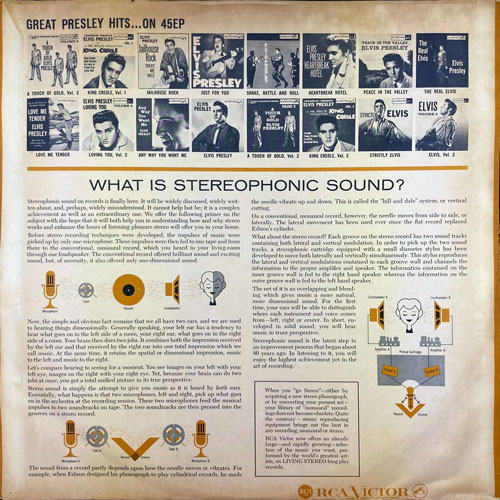
Inner sleeve from ELVIS SINGS HITS FROM HIS MOVIES, VOLUME 1 (Pickwick, 1980) [Photo by the author]
There is some truth in advertising in the album’s back cover (below), which at least features covers of the original 1960s albums from which these recordings were drawn – despite another potentially misleading 1970s live shot.
Back cover of ELVIS SINGS HITS FROM HIS MOVIES, VOLUME 1 (Pickwick, 1975/1980) [Photo by the author]
Misleading covers were typical for the Camden/Pickwick Elvis releases, though. This one appeared on store shelves around the same time as the all-new Elvis As Recorded At Madison Square Garden – in which, ironically, Elvis really did sing live versions of a few of his movie hits (“Can’t Help Falling In Love,” “Love Me Tender,” and “Teddy Bear”) as well as other songs from throughout his career to that point.
As for the muffled sound, if it is a result of the mastering, the material, the budget nature of the label, my setup, my ears, or some other technical factor is beyond my current knowledge. Ultimately, it makes little difference.
Though there is some enjoyment to be found here (it is Elvis, after all), Elvis Sings Hits From His Movies, Volume 1 is not a record I would return to very often even were it in excellent sound quality. The Camden/Pickwick records served their purpose, and I freely admit that Elvis fans, especially this one, are spoiled these days, but even I do not have enough nostalgia to propel this record into something it is not.
Thank you to my brother for giving me the Elvis records that inspired this series of posts.

![ELVIS SINGS HITS FROM HIS MOVIES, VOLUME 1 (Pickwick, 1975/1980) [Photo by the author]](https://themysterytrain.net/wp-content/uploads/2018/03/elvissingshitsfromhismoviesvolume11980_01.jpg?w=676)
![Side 1 of ELVIS SINGS HITS FROM HIS MOVIES, VOLUME 1 (Pickwick, 1975/1980) [Photo by the author]](https://themysterytrain.net/wp-content/uploads/2018/03/elvissingshitsfromhismoviesvolume11980_04.jpg?w=676)
![Side 2 of ELVIS SINGS HITS FROM HIS MOVIES, VOLUME 1 (Pickwick, 1975/1980) [Photo by the author]](https://themysterytrain.net/wp-content/uploads/2018/03/elvissingshitsfromhismoviesvolume11980_05.jpg?w=676)
![Inner sleeve from ELVIS SINGS HITS FROM HIS MOVIES, VOLUME 1 (Pickwick, 1980) [Photo by the author]](https://themysterytrain.net/wp-content/uploads/2018/03/elvissingshitsfromhismoviesvolume11980_03.jpg?w=676)
![Back cover of ELVIS SINGS HITS FROM HIS MOVIES, VOLUME 1 (Pickwick, 1975/1980) [Photo by the author]](https://themysterytrain.net/wp-content/uploads/2018/03/elvissingshitsfromhismoviesvolume11980_02.jpg?w=676)
 The Mystery Train