Pieces of our lives: A look at modern Elvis fans

The Elvis Today Blog (book)
By Thomas Melin
274 pp. Blurb. $9.95
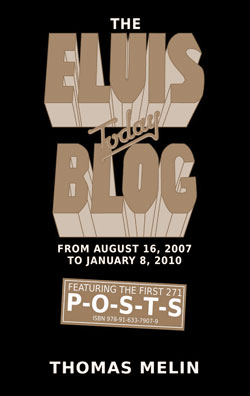
The Elvis Today Blog (2011)

The Elvis Today Blog (2011)

Full Disclosure: I wrote a guest post for the Elvis Today Blog back in 2009, and it appears in this book (p. 224). The last thing I want to do is start reviewing my own material, though, so the following review covers the other 99% of this compilation.

Don’t let the title of this book fool you. The Elvis Today Blog is not a book about an Elvis site. Without a doubt, The Elvis Today Blog is a book about Elvis.

However, it turns out that The Elvis Today Blog is also a book about us – modern Elvis fans.

By relating his personal experiences, author Thomas Melin crafts a unique volume that follows the triumphs and trials of being an Elvis fan in the post-1977 era.

“Sometimes it just hits me how much I love Elvis music and what a great feeling I get from listening to it,” writes Melin in “The Wonder Of Elvis” (p. 56), one of his best entries. “On the highway I put the fourth CD from the Today, Tomorrow & Forever box set in the car stereo and there was ‘See See Rider’ from February 1970 blasting through the speakers. It’s hard to explain what I felt, but I remember thinking ‘Man, I’m gonna listen to Elvis and his music until the very day I die,'” he states.

A major contribution of The Elvis Today Blog is the “Special Moments With FTD” series, Melin’s focus on specific songs released on Sony’s Follow That Dream collectors label for Elvis fans:

  • “Love Me Tender,” Dixieland Rocks (1975) – p. 65
  • “The Sound Of Your Cry,” The Nashville Marathon (1970) – p. 78
  • “You’ll Never Walk Alone,” So High (1967) – p. 92
  • “Mexico,” Out In Hollywood (1963) – p. 107
  • “It’s Easy For You,” The Jungle Room Sessions (1976) – p. 116
  • “Hey Little Girl,” Out In Hollywood (1965) – p. 182
  • “I Just Can’t Help Believin’,” One Night In Vegas (1970) – p. 182
  • “My Boy,” Dixieland Rocks (1975) – p. 183
  • “Young And Beautiful,” Elvis On Tour: The Rehearsals (1972) – p. 238
  • “Suspicious Minds,” Memphis Sessions (1969) – p. 265

Most notable of the above entries are those dealing with “You’ll Never Walk Alone,” “It’s Easy For You,” and “Suspicious Minds,” where the author uses powerful descriptions to take you inside the various studios to watch Elvis at work.

Modern Elvis fans aren’t just listening to records and CDs, though. They also enjoy listening to Elvis on their iPods or other portable music devices. “I too like buying and collecting CD’s, reading the liner notes and listening to the tracks on my stereo. But that doesn’t stop me from downloading the music into my iPod and taking it with me whenever I’m traveling somewhere. To me, that’s the real benefit of owning an iPod, that I always have access to the Elvis Presley catalog, wherever I happen to be,” Melin says (“Ku-u-i-pod,” p. 37).

I don’t normally comment on cover design and page layout of books (unless they are awful), but these elements by Staffan Melin, a brother of the author, warrant special mention. The cover is a creative take-off of the 1975 Elvis Today album cover. The interior page layout makes for easy reading, featuring the Deja Vu Serif Condensed font. Kudos to the designer.

It’s no secret that I’m a huge fan of the web version of the Elvis Today Blog. In fact, I often find inspiration there, and the Mystery Train Elvis Blog would probably not exist in its present form without the Elvis Today Blog’s influence. It has been a joy rediscovering favorite or forgotten posts as I read them in book format.

Needless to say, I’m hoping that Melin releases additional volumes of his Elvis works. One enhancement suggestion I have for the next volume would be to include an index, to make it easier to find all of the references to certain topics. If that could not be done on a large scale, it seems that at least the Labels feature in use on the web version could be converted into a short index for the book version.

Another way to enhance future volumes would be if Melin included supplemental information that was not part of the original blog posts. Using an example from this book, he mentions meeting drummer DJ Fontana (p. 28), who shared some Elvis stories with him. Maybe one or two of those stories could be noted as bonus content.

Those are just minor suggestions, though. The Elvis Today Blog is not only a great book about Elvis, but an essential examination of contemporary Elvis fandom. Highly recommended.
The Elvis Today Blog goes retro!

The “Elvis” of Elvis blogs.

The greatest Elvis blog of all time.

Those are two apt descriptions that immediately come to mind for Thomas Melin’s Elvis Today Blog. Thomas is far too humble to promote his blog with such strong words, so I thought I’d take a moment and do it for him. Some folks out there like to brag, but I suppose when you are already at the top of the mountain, there’s no need for it.

Who says the Internet will be the death of books? On the contrary, Thomas has turned his first 271 Elvis Today posts into a book – now available. I’ve already read every post on his site, but I’m looking forward to reading them all again in this retro format. The book also contains one bonus post that never appeared on the Elvis Today Blog web version.

* * *

Thomas has been kind enough to guest blog for me a couple of times:

  • Elvis Super 8 Film Festival
  • Clambake! (The Mystery Train Elvis blog)

I hope he keep those Elvis Today Blog posts coming. After all, every spectacular book deserves a sequel.

Read Phil Arnold’s foreword to Elvis: The Early Years

ElvisBlog‘s Phil Arnold has released online the full text of his foreword to the latest Alfred Wertheimer photography book, Elvis: The Early Years. The cover of this 120-page hardbound volume from earBOOKS features an iconic 1956 image of Elvis on his Harley.

Phil’s well-written essay for the October 2010 book explores the details behind Wertheimer’s various experiences with Elvis in 1956-1958, illuminating how he was able to gain closer access to the singer than any other photographer.

While other sources have indicated that Wertheimer took nearly 4,000 photographs of Elvis, Phil reveals that this number is exaggerated. “After culling out the unusable shots (too dark, out of focus, etc.), Wertheimer says he has around 2000 commercially viable photos to license for future ventures,” he notes in the foreword. Elvis: The Early Years contains 96 of those images.

The book, available in the United Kingdom, also includes 3 CDs of Elvis music from the same time period.

Read Phil Arnold’s foreword to Elvis: The Early Years over at ElvisBlog.

Elvis lives his dreams in Memphis

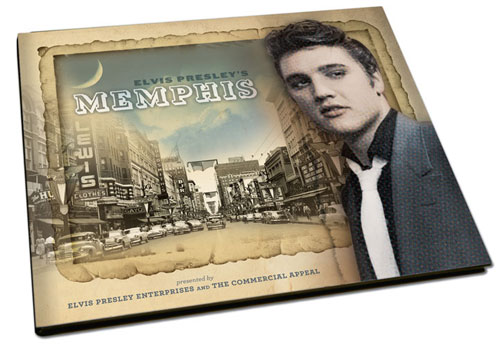
Elvis Presley's Memphis (2010)

Elvis Presley’s Memphis (2010)

Elvis Presley’s Memphis (book)
Presented By Elvis Presley Enterprises and The Commercial Appeal
176 pp. Pediment. $39.95

As I journeyed yet again through the life of Elvis Presley, this literary trip built upon the context of Memphis, I was happy to find some new insights into the man. This is not the average Elvis coffee table book – you know, the ones that shuffle around the same photos and text from last year’s variation.

That Elvis Presley’s Memphis is different is evident right from the start. The cover is hardly typical of those of other Elvis books, which tend to be rush jobs consisting of a common photo of Elvis with a title slapped above it. “It doesn’t matter what it looks like, fans will buy it because its Elvis,” seems to be the mentality.

Instead, this book features a creatively designed, beautiful cover with a lesser-known photo of Elvis superimposed against a vintage 1951 backdrop of Main Street in Memphis. Look carefully at this work of art and you’ll see the Loew’s State Theater is playing Father’s Little Dividend, starring Spencer Tracy, Joan Bennett, and Elizabeth Taylor. Within the book, you’ll find a photo of Elvis at the same theater in 1950, when he worked there as an usher until fired by manager Arthur Groom for getting into a fight with a co-worker.

Elvis apparently held no hard feelings for his former boss, for another photo shows him with Groom several years later for the 1957 Jailhouse Rock premiere – at Loew’s State Theater. His first movie, Love Me Tender, also premiered there in 1956. Business must have been good at Loew’s with that kind of publicity.

Imagine how it must have felt for Elvis to watch himself on screen at the same movie theater he worked at only years before. “When I was a child . . . I was a dreamer. . . . I saw movies, and I was the hero in the movie,” Elvis once said.

“Every dream I ever dreamed has come true a hundred times,” he continued. At its heart, Elvis Presley’s Memphis is about those dreams. The dreams of a 13-year-old as his family moves to Memphis from Tupelo, Mississippi, for a fresh start. The dreams of an 18-year-old as he pays to record a couple of songs at the Memphis Recording Service. The dreams of a 33-year-old as he holds his daughter for the first time.

The bind between Elvis and Memphis is indeed strong, but perhaps no stronger than at Graceland, the home he purchased there on Highway 51 South in 1957 as his rising fame literally chased him out of his previous neighborhood on Audubon Drive. Could the 22-year-old ever have dreamed that Memphis would one day rename the street in front of that mansion in his honor?

Only twenty years later, Elvis would spend his last days at Graceland on Elvis Presley Boulevard. “When the news of Elvis’ death was heard over the police radio, the entire force felt they had lost one of their own,” writes Robert Dye in a section called “Memphis Beat.” You see, Elvis’ renowned collection of police badges was more than just a hobby.

Though they may have indeed been honorary, those badges meant something real not only to him, but also to those who bestowed them – none more so than the Memphis police. While stories of Elvis’ generosity are legendary, there are some here involving the police that are worthy of the spotlight placed on them by this book. Elvis had his flaws, as do we all, but I remain proud to call myself a fan.

From a boy who had little in the way of material possessions to a man who could afford to buy seemingly anything – go-karts, motorcycles, cars, and even airplanes – the life of Elvis in Memphis is detailed in a series of occasionally repetitive articles. Much of this book is about Elvis having fun, for while he sometimes worked in Memphis, it more often served as his playground, a place to unwind and relax.

Some of the stories are new, while others are reprinted from The Commercial Appeal or The Memphis Press Scimitar newspapers. Most are well-written and informative, though a few appear to be excerpts or sidebars from longer pieces and include chopped bits of information that go no deeper than the typical travel brochure for Graceland.

While Elvis is the focus, the book also paints a portrait of Memphis as a whole, including in a running timeline not only significant events in Elvis history, but significant events in Memphis history as well. The two are often intertwined. 1968’s entries include: “April 4: Martin Luther King is assassinated at the Lorraine Hotel in Memphis. Elvis is in California. June 23: Elvis records ‘If I Can Dream.'”

Filled with truly rare documents and photos, including one of Elvis visiting his mother’s grave, Elvis Presley’s Memphis is a standout among the many printed works about this often misunderstood man.

* * *

Cover image courtesy of Pediment Books. Used with permission.

Journey Back in Time to Elvis Presley’s Memphis

When I was 15, my family took a summer vacation to Tennessee. Though we took a detour through Nashville, the main destination, of course, was Graceland in Memphis. One of the things I was unprepared for in the Graceland area was the sheer volume of Elvis merchandise available.

Back then, there were no online stores. While Elvis was certainly available in various places at home, especially in record stores, I had never seen anything like this. For instance, there was an entire record store devoted to Elvis that seemingly had every record he ever released (looking back, probably not).

While I had brought along what I considered a decent amount of spending money (probably the most amount of money I ever had at one time to that point), I quickly realized I was going to have to be very judicious in what I bought. I tried to focus on things that I had never seen before and definitely couldn’t buy back home. Records were out. Though they had records I had never seen, all of them were much more expensive than the prices I was used to paying.

Two of the items I bought were reprints of the two Memphis newspapers’ coverage of Elvis’ death in August 1977, the Memphis Press-Scimitar and the Commercial Appeal. While the articles represented a sad time, I enjoyed reading about Elvis within the context of his times – rather than with years of posthumous baggage.

That’s why I’m looking forward to the July 30, 2010, release of Elvis Presley’s Memphis, a 160-page hardcover book from the archives of The Commercial Appeal and Elvis Presley Enterprises. Along with photographs, the book will include reprints of various articles covering Elvis’ life.

I’ve given EPE a hard time this month over the Mr. Potato Head Elvis Presley fiasco, so it’s only fair for me to point out that the Elvis Presley’s Memphis book may turn out to be one of their best products since the release of the ELVIS: ’68 Comeback Special- Deluxe Edition and Elvis: Aloha From Hawaii-Deluxe Edition DVD sets.

If you happen to be in Memphis during Elvis Week in August, be on the lookout for an exclusive edition of this book that includes a DVD. The rest of us can pre-order the book alone over at Pediment Books.

REVIEW: The Christmas TV Companion book [The Film Frontier blog]

The Christmas TV Companion:
A Guide to Cult Classics, Strange Specials, & Outrageous Oddities
1701 Press, softcover
Release date: November 10, 2009
Author: Joanna Wilson

The Christmas TV CompanionI cover many subjects here on The Film Frontier. Beyond key ones like Star Trek, Star Wars, Superman, and Elvis Presley, I also give love to, among others, The Twilight Zone, Mystery Science Theater 3000, and Charles Schulz’ Peanuts gang from time-to-time. I like to think this is a rather eclectic combination not soon to be found anywhere else.

To some degree, however, all of these topics and more are covered in The Christmas TV Companion by Joanna Wilson. (Fair warning to Superman fans: the associated reference is just an “also appeared in” credit for Margot Kidder on one page.) The book’s main revelation to me is demonstrating a common thread among all of these topics I previously thought were so diverse: Christmas.

The Christmas TV Companion takes readers on a journey through some of pop-culture’s best and worst Christmas moments. Hold on tight for this ride from the traditional to the blasphemous and every point in between.

Core sections of the book are Macabre, Sci-Fi, Variety, Animation, and Dark. With dozens, perhaps hundreds of productions referenced, Wilson is obviously well-versed on her topic. When reading books like this, I fact check by looking at what the writer states about topics on which I am knowledgeable. Wilson’s Elvis, Star Trek, and Star Wars references are all correct – which leads me to trust her on the multitude of other topics covered.

While some shows warrant a line or two, 1978’s infamous Star Wars Holiday Special (is it possible to write the name of that special without including “infamous” in front?) merits five pages of coverage, including a photo of Harvey Korman and Bea Arthur from the show. The special was actually my first exposure to Star Wars, as a three-year-old. I remember very little of it, as I likely fell asleep – which is probably a good thing.

One of my favorite features of this book is the “Make Your Own Marathon” concept. We geeks have been doing this for years, and Wilson’s suggestions add new and creative elements to setting up such marathons. A Star Trek-themed marathon and an Elvis-themed marathon are among the several she provides. She also includes tips on creating your own based on a subject of your choice.

Fellow Trekkies, I can hear you asking, “The only Christmas scene was in Star Trek Generations. How can you have a Star Trek Christmas marathon?” I will not reveal all, but I will throw you a clue as to how these marathons of loose associations work: A certain Star Trek: The Next Generation actor has also appeared as Ebenezer Scrooge.

The Elvis marathon mentions the 1968 ELVIS television special, which aired during the holidays that year, as well as several other Christmas TV shows that have included Elvis in some fashion. An unfortunate omission was Perry White (Lane Smith)’s appearance as “Santa Elvis” in the 1994 “Season’s Greedings” episode of Lois & Clark: The New Adventures of Superman. Superman even pulls Santa Elvis’ sleigh to deliver toys to orphans. Written by series star Dean Cain, it is one of my favorite episodes of the series.

Very little else is left out, though, and the variety that serves as this book’s strength may also leave your head spinning at times. The Christmas TV Companion works best as a fun reference to thumb through, rather than something to read cover-to-cover. You probably want to keep this book near a computer or notepad, too, as you will find yourself wanting to seek out certain specials or look up more about some topics.

For instance, one of my favorite Christmas songs is “Have Yourself A Merry Little Christmas.” I had no idea until reading this book that the song’s original lyrics were actually quite depressing and changed at the last moment for its first appearance in the Judy Garland movie Meet Me In St. Louis. Curious about the original lyrics? You can find them here. You can bet I will start keeping an eye out for Carol for Another Christmas, Rod Serling’s take on A Christmas Carol that aired in 1964, too.

I must give credit to 1701 Press for including an index. A book like this demands one. A couple of recent Elvis books by other publishers lack indexes, and I was beginning to think they were going out of style.

If you are a Christmas special addict like me, you will be glad to know that Wilson’s current project (of which this book is actually derived) is a “comprehensive encyclopedia of Christmas on TV,” due out next year.

With about 135 pages of content outside of the thorough index, it would be easy to underestimate The Christmas TV Companion. Do not let this book’s seemingly short length fool you, though. Each page is full of information. Often Wilson even covers the margins with more trivia on the various productions, performers, or creative types mentioned. Whether by design or fortuitous accident, The Christmas TV Companion appears just small enough to make a perfect stocking stuffer.

The Christmas TV Companion goes on sale Tuesday. It is available for pre-order on Amazon.

Overall Experience: 9 (out of 10)

(1701 Press provided a review copy of this book free-of-charge.)

TRAIN still in station [The Elvis Beat newsletter]

I was 22 when I wrote this piece back in 1997 for The Elvis Beat #16, which turned out to be the final issue of my official Elvis Presley Fan Club newsletter.


Last Train To Memphis, the movie version of Peter Guralnick’s definitive Elvis biography, has been put on hold, according to Elvis World magazine.