One of my favorite pieces ever written about Elvis Presley is “Elvis In The Dark” by Daniel Wolff. I’ve had it linked on The Mystery Train’s Exit page for years. If you’ve never read it or haven’t read it recently, I encourage you to do so while listening to “Are You Lonesome Tonight.”
Wolff’s remarkable essay originally appeared in a 1999 issue of The Threepenny Review, a literary magazine based out of Berkeley, California. While it is ostensibly a review of Peter Guralnick’s Careless Love: The Unmaking Of Elvis Presley, which was released that year, it is much more than that.
I am a firm believer that Elvis’ later work should not be dismissed as easily as it often is. Fortunately, such reactions seem at last to be changing. Wolff’s words capture the essence of post-Army Elvis. He acknowledges Elvis’ personal problems while still recognizing the artistic merits of his work during those times.
That is why it is my fervent hope that one day Wolff writes his own Elvis biography. Guralnick’s works are seminal, especially Last Train To Memphis: The Rise Of Elvis Presley (1994), but there is room for another look.
While Wolff has not yet written a volume dedicated to Elvis, I recently discovered that he devoted an entire chapter to him in his 2012 book How Lincoln Learned To Read: Twelve Great Americans And The Educations That Made Them.
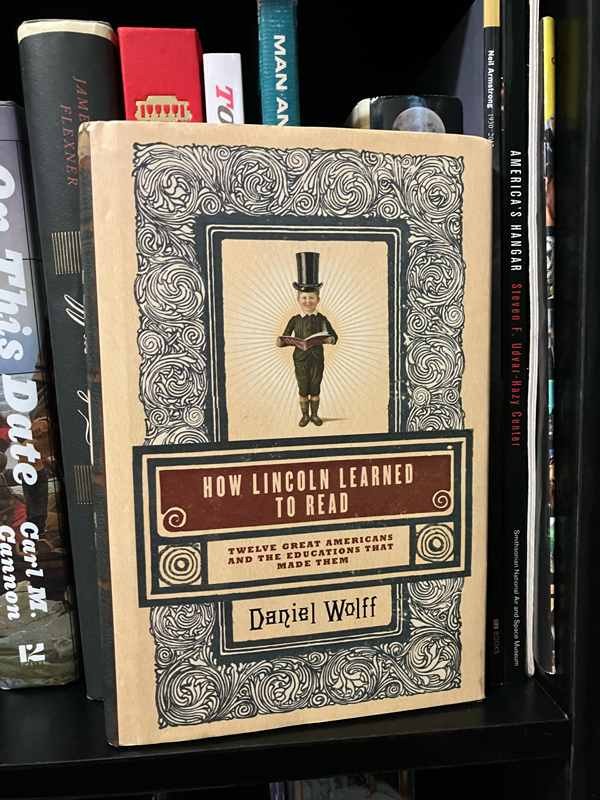
HOW LINCOLN LEARNED TO READ by Daniel Wolff (2012)
The chapter titled “Elvis” includes a fascinating look at the economy of Elvis’ birthplace of Tupelo, Mississippi, during the Great Depression. In the midst of it, Elvis’ father, Vernon, is arrested and convicted for forging a check. During her husband’s 9-month stay in prison, Gladys and their son Elvis survive on government cheese while living with family as she picks up occasional laundry work.
One of their few respites is church, the Assembly of God where Gladys’ uncle is the preacher. Unlike some denominations, the Assembly of God allows guitars, drums, and tambourines, and Elvis’ earliest public singing takes place there.
Wolff also references Elvis’ fifth place win at a state fair talent contest in the mid-1940s, mentioning that it was broadcast over local radio. He adds:
“According to one researcher, over the next two and a half years he was on the radio ten times, singing hymns, show tunes, country-western and patriotic songs.”
Interesting, if true. Per his end notes, Wolff’s source for the multiple radio appearances is 2004’s Elvis: A Musical Inventory – 1939-55 by Richard Boussiron, which I have not read and appears to be difficult to come by these days. Guralnick in Last Train To Memphis alludes to at least one of these appearances in reference to Mississippi Slim’s radio show on WELO.
After the Presley family moves to Memphis, Tennessee, Elvis attends and graduates from Humes High School. During most of his time at Humes, the Presleys live at the Lauderdale Courts government housing project. Much as with Tupelo, Wolff also delves into the socioeconomics of Memphis. All of this serves to portray Elvis’ younger years against his environment and circumstances.
Elvis appears at a school talent show just a couple of months before graduation. Soon thereafter, he cuts a couple of demonstration records at the Memphis Recording Service. When Elvis records his first professional record for Sun at the age of 19, the Elvis chapter ends as his real story begins.
I had high expectations for this 2012 “Elvis” chapter, and it doesn’t quite live up to the peaks of Wolff’s 1999 “Elvis In The Dark” essay. A lot of that, however, is just due to the nature of the work in which it appears.
I continue to hold out hope for that single volume Elvis biography from Daniel Wolff one day. I would love to read how he covers Elvis’ post-Army years in particular, including placing him in the context of the world around him as he does so well in his “Elvis” chapter here. Until then, How Lincoln Learned To Read is certainly worth checking out for what it is, and I’m glad to have added it to my library.
“The LORD doesn’t see things the way you see them. People judge by outward appearance, but the LORD looks at the heart.”
from 1 Samuel 16:7
Discover more from The Mystery Train
Subscribe to get the latest posts sent to your email.
 The Mystery Train
Pingback: Looking At Elvis Presley: A Little Golden Book Biography | Along For The Ride Ep. 1.5 | The Mystery Train