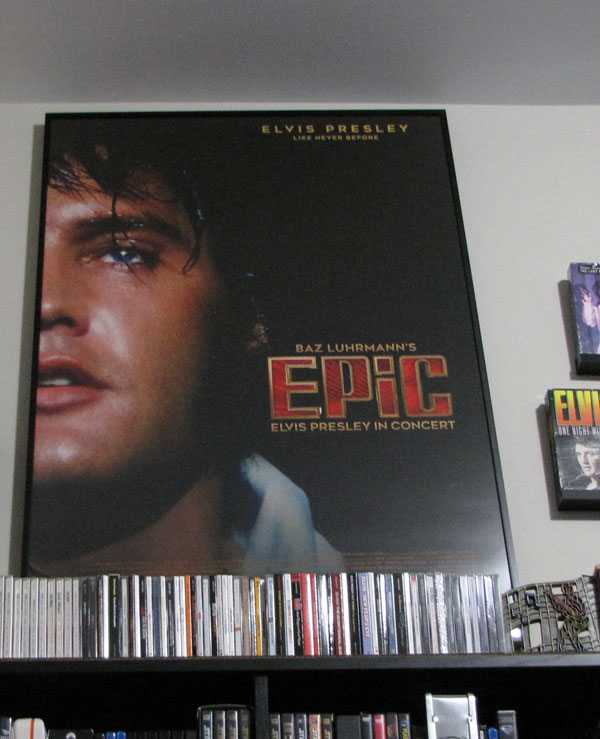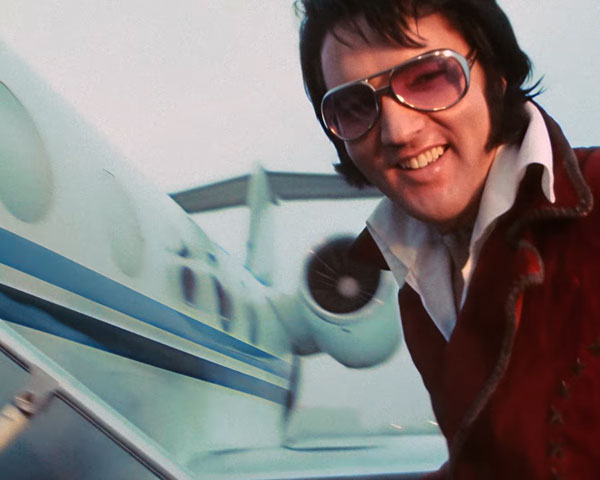
EPiC: Elvis Presley in Concert | An In-Depth Review

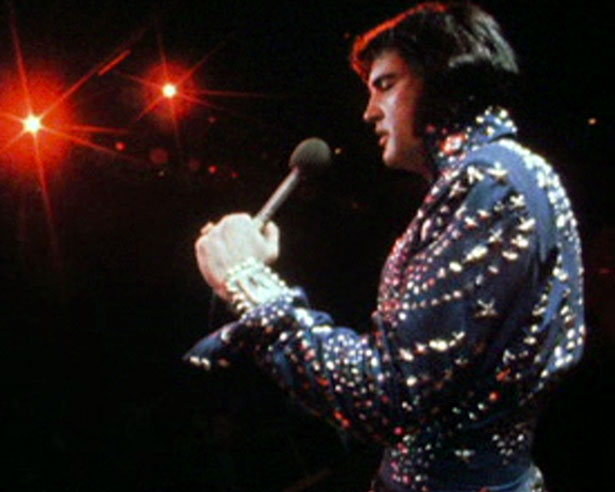
Elvis Presley in EPiC (NEON, 2026)

After nearly wall-to-wall coverage since the movie’s release in February, some of you might be wondering if I’m going to change the name of this site to The EPiC Train. Well, no, but I love Baz Luhrmann’s EPiC: Elvis Presley in Concert so much that I keep finding more to say about it.

My first viewing of EPiC at an IMAX Early Access screening on February 18 was an emotional experience.

Finally, here was a movie that understood and loved Elvis in the same ways I do. Here was a movie that gave Elvis his voice back. Here was a movie that rescued Elvis the man from Elvis the image.

I realized then that I wasn’t ready to dig into the weeds and analyze EPiC just yet. Though I wrote a first reaction piece, I held off on a formal review.

Through multiple rewatches with family and friends, I continued to experience EPiC in an emotional rather than analytical way. Oh, I found ways to write about it, because the movie certainly inspires me in that way. I’m even discussing the movie in detail with my bride on our new radio show (podcast).

Through all that, I tried to stay true to my original thoughts on EPiC, to experience and feel it rather than analyze it. It wasn’t until my final two theatrical rewatches, numbers eight and nine in mid-April, that I began to analyze things, such as how much of the footage was new.

Now that EPiC is available to buy or rent in digital format, I thought this would be a good time fully to let loose my analytical side. What follows will be a collection of observations, criticisms, and even nitpicks. It is part review, part viewer’s companion, and part tribute not only to Elvis but to those who helped him make the music that brings so much comfort to my life.

WARNING: Massive spoilers beyond this point.


NOTE: Footage tags refer only to whether a performance has been previously released in an official project. Previously unseen portions of performances already represented in official releases are not considered new footage for these purposes. However, low-quality bonus material from Elvis: That’s the Way It Is – Special Edition is excluded from consideration.

EPiC begins in perfect fashion, using a variant of one of my favorite Elvis quotes. I even used it to kick off my own Elvis Odyssey series last year.

Elvis: “I’d like to talk to you a little bit, ladies and gentlemen, about how I got in this business. There’s been a lot written and a lot said, but never from my side of the story.” (August 1969)

“The Battle Hymn Of The Republic” (from “An American Trilogy”) | April 9, 1972 Evening Show (ES), Hampton Roads, Virginia | Footage previously released in This Is Elvis

The movie then mirrors the opening of Luhrmann’s ELVIS (2022), with “Also Sprach Zarathustra,” better known as the theme from 2001: A Space Odyssey, segueing into “The Battle Hymn Of The Republic” from “An American Trilogy.” Only this time, a different guy is playing the main character instead of Austin Butler.

That’s right, it’s Elvis himself. As fantastic of a job Butler did in ELVIS, EPiC is all the better film for featuring the genuine article.

Artificially melding the opening “Also Sprach Zarathustra” with the climactic “The Battle Hymn Of The Republic” felt off to me in ELVIS, and it feels off to me again in EPiC. However, this is Elvis’ finest version of “An American Trilogy.”

I love how the EPiC team adds a breathing sound effect as Elvis walks up to the camera while in the process of leaving the stage and the movie proper begins. It is a reminder, as is the rest of the film, that Elvis Presley was a real man. His image as a legend has almost overtaken him, but there was a living and breathing human there.

EPiC now moves into a brief overview of Elvis’ career in the 1950s and 1960s. It is wonderful hearing Elvis narrating his story, sourced from interviews, concerts, and press conferences from 1956 to 1972.

A quibble I have is the use of Elvis’ audio from The Truth About Me, a recording he did as a promotional tie-in for a teen magazine in August 1956. Compared to his more sincere comments throughout EPiC, this audio sounds stilted. Elvis is reading a script, one that he almost certainly did not write, and sounds uncomfortable. Elvis Presley: The Searcher, Thom Zimny’s 2018 documentary, made the same misstep of using this audio. While EPiC relies on many interview sources, it is grating when it falls back on The Truth About Me. Here are just a few examples of The Truth About Me excerpts used in the movie:

Elvis: “Hi, this is Elvis Presley. I guess the first thing people want to know is why I can’t stand still when I’m singing. . . .”

Elvis: “I watch my audience and listen to them, and I know that we’re all getting something out of our system. None of us knows what it is. The important thing is that we’re getting rid of it, and nobody’s getting hurt.”

Elvis: “In a lot of the mail I get, people ask questions about the kind of things I do and all that sort of stuff. Well, I don’t smoke, and I don’t drink, and I love to go to movies.”

Luhrmann does a great job of encapsulating about 15 years of Elvis history into 10 minutes of movie. The editing is phenomenal here, which sets the stage for the visual extravaganza which is to follow.

The preacher complaining about “the beat, the beat, the beat” shows up here, as he does in just about every Elvis documentary covering the 1950s.

“Elvis Presley Arrested”

Luhrmann takes a wrong turn, however, by implying that Elvis is arrested for his stage movements and music. “Elvis Presley Arrested” appears on screen as EPiC covers the controversies surrounding the young singer. Footage is shown of Elvis in court. The problem? The actual incident stems from an October 1956 gas station fight in Memphis, for which he was cleared. This is reminiscent of some of the fictionalized aspects of Luhrmann’s ELVIS biopic. Though I raise an eyebrow at the necessity, I can excuse it in the biopic. False narratives have no place in a documentary.

We get the Elvis “running for his life” to the car footage from 1972 as Elvis’ father, Vernon Presley, talks about Elvis’ wild fans.

Luhrmann also trots out the typical Hy Gardner Calling footage from July 1956, but fortunately doesn’t linger with it too long.

Home movie footage of Elvis and friends in 1961 attempting to right the sign of Tupelo’s Elvis Presley Youth Recreation Center is shown that I don’t personally recall seeing before. Though the audio is not used in EPiC, Elvis references the moment in a February 1961 press conference in Memphis.

“Presley Back Home To Resume Career As Teenage Idol”

After Elvis is drafted and serves in the US Army, Luhrmann uses the singer’s classic “I was in tanks for a long time, you see. They rock and roll quite a bit” reply when a reporter asks if “two years of sobering Army life” had changed Elvis’ mind about rock ‘n’ roll.

“Hollywood”

Luhrmann offers a wonderful review of Elvis’ 1960s films in the “Hollywood” segment. We finally have an alternative to the “Too Much Monkey Business” sequence from This Is Elvis to encapsulate many of his films. EPiC includes clips from a whopping 20 of the 31 narrative films that Elvis appeared in as an actor, many of them in this segment. Some of them are shown, whether intentionally or otherwise, in the wrong aspect ratio. In the fast pace of this portion, it is not very noticeable.

Generally, I can’t stand it when people talk over an Elvis song in documentaries. One of the interesting things I discovered through EPiC is that I don’t mind it if Elvis is the one doing the talking. It really does feel like Elvis is telling you his story. If anyone should be allowed to talk over an Elvis performance, it’s Elvis.

A version of “A Change Of Reality,” a new mashup of multiple songs including “Change Of Habit,” “Edge Of Reality,” and “Charro,” appears here. I mean, wow. The version in the end credits is even better, but I’m getting ahead of myself.

Another strong editing scene of EPiC is when Elvis is shown driving in multiple movies. I realize the point of this segment is to show how repetitive Elvis movies had become, but he looks so cool driving. I mean, who else could have made those movies so watchable?

While I had heard the 1972 audio of Elvis talking about the disappointments of his movie career before, it is really striking to hear his words as visuals from his movies are shown on screen.

“But it did not change. It did not change” Elvis laments. Then we get references to Tom Parker as a gun is held to the head of one of Elvis’ characters, more driving, Vietnam, the Beatles, wrecked cars.

“Did not change” is repeated over and over as the visuals build to a gunshot sound effect when Elvis points his guitar at the camera in 1970 and pretends to fire it like a rifle.

What a sequence. By this point, EPiC had me.

“So, I had to change it, which I did,” says Elvis. We move to Elvis in July 1970, as captured for Elvis: That’s The Way It Is. The often-used scene of Elvis firing his guitar at the camera takes on a new meaning here. “Shoot that Hollywood camera,” Elvis says.

All of the 1970 footage filmed for Elvis: That’s The Way It Is that appears in EPiC is in the wrong aspect ratio – everything is squeezed narrower than it should be. Mistake or dubious artistic choice? You be the judge.

The captions in many places throughout EPiC, as seen in both the Apple and YouTube digital versions, are also laughably wrong. I am not going to point out all of them, but there are a couple I want to mention in the course of this review. One is here. Instead of “Shoot that Hollywood camera,” the caption claims that Elvis says, “Should be all on camera.” Uh, no, that ruins the entire moment that editor Jonathan Redmond and director Baz Luhrmann were building towards.

EPiC makes great use of a remix of “I Got A Feelin’ In My Body” in this and other segments. Recorded in December 1973 at Stax Studios in Memphis, the underlying song is the only post-1972 Elvis performance heard in EPiC.

EPiC makes interesting use of the 1972 audio of Elvis talking about preparing for his Las Vegas shows over the 1970 rehearsals. It works very well! The original Elvis: That’s The Way It Is, as much as I love it, could have benefited from a little more insight like this.

“Stranger In The Crowd” | July 29, 1970, Hollywood, California | Footage previously released in Elvis: That’s The Way It Is

“A Fool Such As I” | July 29, 1970, Hollywood, California | Footage previously unseen

After a familiar “Stranger In The Crowd,” we suddenly get a new snippet of “A Fool Such as I.” Look, I’m not going to count seconds of “new” versus old footage. That’s not my thing. “A Fool Such As I” is not long enough here, true, but I love seeing it nonetheless after first hearing him rehearse it over 25 years ago.

“What’d I Say” | July 29, 1970, Hollywood, California | Footage previously released in Elvis: That’s The Way It Is

“I Was The One” | July 29, 1970, Hollywood, California | Footage previously released in Elvis: The Lost Performances

As I’ve mentioned here many times in the past, 1992’s Elvis: The Lost Performances is one of my favorite Elvis releases ever, so it is wonderful to see aspects of it be preserved in EPiC, including a portion of “I Was The One.”

“You Don’t Have To Say You Love Me” | August 4, 1970, Las Vegas, Nevada | Footage previously unseen

In a jarring moment, EPiC cuts from visuals of a previously unseen 1970 rehearsal of “You Don’t Have To Say You Love Me” to Elvis in 1972 discussing his love of music. Physically, Elvis looks noticeably different due to a little weight gain and a shaggier haircut. He also looks and sounds exhausted or even depressed.

However, I love seeing these interview segments, originally filmed for Elvis On Tour. I have heard this interview for many years, but finally to see it in full color quality like this is really something special, one of the many gifts of EPiC. His words resonate more when you can see him saying them.

This 1972 interview, along with an interview conducted by Lloyd Shearer a decade earlier, represents one of the most introspective interviews of Elvis’ life. If you are interested in digging deeper into Elvis the man, the complete audio of both interviews is worth checking out. You can find them in many places throughout the web, including over at Keith Flynn’s incredible Elvis Presley Pages site.

“Ghost Riders In The Sky” | July 15, 1970, Culver City, California | Footage previously unseen

“Alla En El Rancho Grande” | July 15, 1970, Culver City, California | Footage previously unseen

It is so cool finally to see Elvis singing “Ghost Riders In The Sky”! Again, the snippet is tantalizingly brief, but what a fun moment to see him hamming it up with his band. Even less time is given to “Alla En El Rancho Grande,” which lasts only seconds.

“Runaway” | July 15, 1970, Culver City, California | Footage previously unseen

Wow! All is forgiven because “Alla En El Rancho Grande” cuts to “Runaway.” I’ve been listening to Elvis sing “Runaway” since I was 12-years old and my brother gave me the On Stage album for Christmas. That was a long time ago because I’m 51 now, and it’s wonderful to see at least some of “Runaway” before EPiC cuts the visual away to Elvis and his friend Joe Esposito riding the bicycle built for two.

“Yesterday” | July 15, 1970, Culver City, California | Footage previously unseen

“Something” | July 29, 1970, Hollywood, California | Footage previously unseen

Next, Elvis rehearses a couple of Beatles classics, including “Yesterday,” which also featured on the On Stage album. Though edited, both “Yesterday” and “Something” are given a little more room to breathe than previous rehearsals in EPiC thus far.

As EPiC moves closer to raising the curtain on the Elvis Presley Show, portions of 1964’s “Little Egypt” are used as background music, including “I went and bought myself a ticket and sat down in the very first row,” which is just a cheesy way to incorporate such a poor song. I do enjoy watching the preparations for his Las Vegas shows, though.

Note in the beautiful 1970 marquee shots that the “r” is missing from comedian Sammy Shore’s name, as is the “s” from the name of The Imperials vocal group.

We see the familiar footage of Elvis, other vocalists, and some of his friends walking through the backstage area for opening night on August 10, 1970. This time, we also get to hear Elvis calling for Charlie Hodge, his friend and stage manager, and the two apparently tune his guitar. As Elvis in 1972 talks about stage fright, Elvis in 1970 plays a quick lick and then says something that I can’t quite make out and everyone starts laughing. According to the captions, he says, “That’s bold! That’s bold!” but, as mentioned, they should be taken with a grain of salt.

“That’s All Right” | August 12, 1970 Dinner Show (DS), Las Vegas, Nevada | Footage previously unseen

Finally, Elvis takes the stage and we get a previously unseen version of “That’s All Right,” including a joking start to the show where he begins to sing “Love Me Tender” instead of the intended song.

I get lost in the song, so it’s possible I missed an edit, but I believe “That’s All Right” is the first song in EPiC presented in its entirety. However, Elvis does narrate a bit on top of it. Which I still can’t believe I don’t mind, but I don’t. It’s okay if Elvis does it. I don’t want to hear George Klein (Elvis: The Great Performances), Priscilla Presley (Elvis: The Great Performances, television version), or any other person narrating on top of an Elvis song, though.

“Tiger Man” | August 12, 1970 Midnight Show (MS), Las Vegas, Nevada | Footage previously released in Elvis: That’s The Way It Is

I’ll get my complaint out of the way first for the next song, which is that they edited out the “Mystery Train” portion of the medley with “Tiger Man.” Which, of course, considering this site is The Mystery Train, I must point out. With that out of the way. . . .

“Tiger Man” was AWESOME in the movie theater. This was the moment in EPiC where I first felt I was watching a real concert. I love the strobe light effect as well as Elvis playing air guitar to James Burton’s solos. EPiC shows all of “Tiger Man” and even includes Elvis’ welcome to the audience afterwards and introducing himself as Fats Domino. It unfortunately cuts away before he sings the first four words of “Blueberry Hill,” though.

During the August 10, 1970 Opening Show (OS), Elvis begins to talk about his early years when there is microphone feedback. “Yes, Kirk?” he says in response, a reference to International Hotel owner Kirk Kerkorian. Feedback would plague much of that show. He goes on to talk about the Ed Sullivan Show, and EPiC flashes back to Elvis’ first appearance on that program on September 9, 1956.

“Hound Dog” | August 11, 1970 MS, Las Vegas, Nevada | Footage previously released in Elvis: The Lost Performances

After the brief Sullivan detour, we are back to 1970 with a lightning-fast version of “Hound Dog” from August 11. EPiC then circles back to the August 10 show where Elvis states, “That’s really how I got started,” which feels slightly out of place to me after the August 11 footage.

In that same show, there is a wonderful previously unseen moment where Elvis says, “Catch this, Sam” and then briefly tap dances for Sammy Davis, Jr., who is in the audience for the opening night performance. “That’s it, though. That’s all I can do, man.”

Since first hearing Elvis’ comment over 25 years ago, I have wondered what he meant. EPiC finally reveals what is going on.

“Polk Salad Annie” | Edit of various performances from July and August 1970, California and Nevada | Some footage previously unseen

In a film full of editing highlights, the “Polk Salad Annie” sequence has to rank at or near the top. It is a montage of multiple rehearsal and live performances from July and August 1970. Considering that Elvis’ moves are not choreographed, it all fits together in an amazing fashion.

Things start a bit surprisingly with Elvis at an August 7 rehearsal in Las Vegas singing, “We got a little morphine going on. Give me a little hish hash, baby,” before pretending to smoke a joint and then continuing with, “Polk Salad Annie, where is your fanny at?”

The real song begins, and the sound is so good. We get previously unseen footage from the August 10 OS and the August 11 DS, where Elvis’ distracted marching and vocalizing routine go on a little too long for my taste. Other live footage includes the typical August 12 MS iteration, which was his best version captured for Elvis: That’s The Way It Is and rightly was used in both the theatrical and special edition versions of that movie.

Redmond’s editing work on the “Polk Salad Annie” sequence is so impressive that it is a strong contender for best moment of the film. I might have to watch EPiC a few dozen times more to really say, though.

“You’ve Lost That Lovin Feelin'” | August 11, 1970 MS, Las Vegas, Nevada | Footage previously unseen

I enjoy watching Elvis interacting with the Sweet Inspirations vocal group, how much fun they seem to have together. Here, Elvis playfully echoes one of the Sweets saying, “I’m not doing it tonight” and another prods him to do it again as they all share a laugh. EPiC doesn’t really give us the context of this conversation, nor do we need it to understand that we’re eavesdropping on a moment of family fun.

We also get another brief visual bit of the 1972 interview here, where Elvis talks about how musicians and singers find new sounds that inspire him. Again, this is emphasizing Elvis the man, not the legend. I love those sequences. Only a tiny portion of these interviews were used in the original Elvis On Tour, and EPiC gives us a taste of what might have been.

We are next treated to a portion of a previously unseen version of “You’ve Lost That Lovin’ Feelin'” from the August 11, 1970 MS. Elvis owned this song in August 1970. He never sang it this well again, but it is enough that in this engagement, he provides the definitive versions for all of time.

I know I have mentioned this at least twice already, and I’ll try to make this the last time, but I still marvel at how much I don’t mind the songs being interrupted by Elvis talking. I keep bringing it up because this normally irks me (I’m looking at you, Elvis Lives: The 25th Anniversary Concert).
Elvis Presley in EPiC (NEON, 2026)

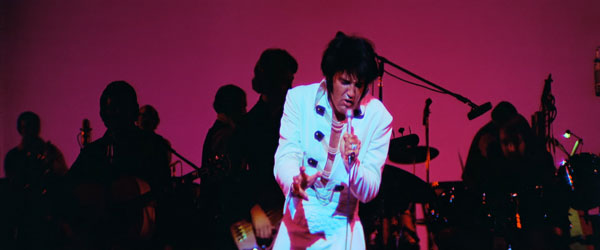
One of the things I’ve always loved about Elvis: That’s The Way It Is and its associated outtakes is the mood lighting behind Elvis, that wall of changing colors, controlled by his friend Lamar Fike. The magenta color during “You’ve Lost That Lovin’ Feelin'” suits the song perfectly.

The “play the hell out of it” scene from the original Elvis: That’s The Way It Is, which unfortunately did not make it into the special edition that has all but replaced it, is up next. Then, we get a kissing and audience walk montage set to the new mashup “Wearin’ That Night Life Look,” which combines “Wearin’ That Loved-On Look” and “Night Life,” among others.

“Little Sister/Get Back” | August 12, 1970 MS, Las Vegas, Nevada | Footage previously unseen

Then, at last, we get the footage of Elvis strapping on his electric guitar at the August 12 MS and singing a medley of “Little Sister” and “Get Back” while sitting on a stool.

I’ll say it right here, it was a mistake for the original director of Elvis: That’s The Way It Is to leave this song on the cutting room floor, and I’ll say the same for the producer of Elvis: That’s The Way It Is – Special Edition, which did at least use a longer edit of the associated rehearsal. Thank you to Luhrmann and Redmond for giving this gem the spotlight it deserves in EPiC.

Near the beginning of the medley, it is unclear who or what Elvis is waving off with a seemingly exasperated look. I have speculated that it was the orchestra, but it also could be Hodge or any number of other things, really.

Speaking of the orchestra, who do not play during the sit-down segment of this show, a few of them appear to be bored in the background. This was a midnight show, after all, so perhaps it was just a long night – their fifth show in three days, plus all of the rehearsals leading up to the engagement. They are also most likely classically trained musicians, and rock ‘n’ roll might not be their thing.

“Little Sister/Get Back” is presented in its entirety.

As Elvis’ 1971 informal studio recording of Bob Dylan’s “I Shall Be Released” plays, EPiC transitions to April 19, 1972, where eight-year-old fan Denise Sanchez, who is battling cancer, meets Elvis before his show in New Mexico in an outtake from Elvis On Tour. Denise, who reportedly met with Elvis again not long before her death, passed away that August.

Denise’s family worked with Parker’s office to arrange the April meeting. It reminds me of the Make-A-Wish program, which did not yet exist in 1972. I would like to encourage interested readers of The Mystery Train to donate to Make-A-Wish or another youth-focused charitable organization in Denise’s name.

As “I Shall Be Released” continues to play, EPiC moves to Elvis apparently on an elevator on the way to a rehearsal and then a light-hearted moment where Elvis successfully ties the largest necktie I’ve ever seen.

We catch the end of a previously unseen rehearsal of “Burning Love,” including Elvis having fun with Bill Baize’s falsetto notes.

“Burning Love” | Edit of various performances from March and April 1972 | Some footage previously unseen

We shift to previously unseen footage of Elvis introducing “Burning Love” in his first-ever live performance of the song during his April 14, 1972, concert in Greensboro, North Carolina. This is just a little over two weeks after he recorded the studio master, and the single is not even out yet.

Before Elvis begins singing, however, EPiC shifts to another rehearsal of “Burning Love” and soon we are into a montage of various rehearsals and the live performance of the song. 1972’s answer to the 1970 “Polk Salad Annie” edit unfortunately doesn’t quite live up to that peak.

The 2015 album If I Can Dream featured Elvis’ vocals with new backing supplied by the Royal Philharmonic Orchestra (RPO). At the time, I enjoyed the concept for what it was, but the use of the RPO version of “Burning Love” as the base for this edit in EPiC is just a poor choice – especially considering that the original studio version is a rock ‘n’ roll classic.

The RPO version is just too much, especially the over-the-top strings at the beginning of the song and at various points throughout. None of it feels right for the mostly unseen footage EPiC is providing.

That aside, we are treated in the montage to multiple different rehearsals of “Burning Love” before picking back up with the Greensboro concert, where he is reading the lyrics. Whether he liked “Burning Love” or not, it was not unusual for Elvis to need a lyric sheet. The proof is in EPiC that he did rehearse the song multiple times.

The 1972 footage captured for Elvis On Tour is presented in the correct aspect ratio. It looks great, but one of the reasons the segment pales compared to “Polk Salad Annie” is because it loses focus. If the edit had stayed with Elvis performing “Burning Love” in rehearsals and in concert, it would have been much stronger. Instead, it replays the footage of him running to the car (why show this again in such a short movie?) and other odd distractions, like:

  • Backstage moments, including Elvis joking around and signing autographs
  • Elvis arriving on stage, multiple times
  • Elvis kneeling and holding his cape up as he prepares to leave the stage, multiple times
  • Elvis greeting fans at an airport

While there are some great shots here, new and old, it just feels too random in such a superbly edited film. A “life on the road” montage just doesn’t fit in the middle of “Burning Love.”

One of the more relevant backstage moments used, however, is Elvis talking about how “they had forgotten the ending” in reference to the Greensboro performance of the song, which was enjoyable to see.

Devil In Disguise

After spending most of his ELVIS biopic pummeling Parker, Luhrmann unfortunately wastes more time in his EPiC documentary taking swipes at Elvis’ manager. The movie takes an unneeded two-minute diversion to remind us that Parker was a “devil in disguise.”

When EPiC promised found footage, I wasn’t expecting it to be of Parker applying suntan oil – a moment that will now live forever in the annals of Elvis history, thanks to EPiC. When I saw someone boast he had watched EPiC 23 times so far, I remembered that means he has watched the Parker suntan oil scene 23 times. As of this writing, I’ve also seen this suntan oil footage 12 times. I’ll probably never catch up.

In all seriousness, those two minutes about Parker could have been put to better use, such as, for example, extending some of those all-too-short rehearsal segments earlier in the film.

I do love seeing the stacks of Elvis records being sold next to all those stuffed hound dogs at the Las Vegas Hilton in 1972, including As Recorded At Madison Square Garden, On Stage, That’s The Way It Is, and both volumes of the Worldwide Gold Award Hits boxed sets.

“Never Been To Spain” | April 9, 1972 ES, Hampton Roads, Virginia | Footage previously unseen

After Elvis talks in a June 1972 press conference about his desire to tour the world, noting that he has never been to Britain or Japan, EPiC moves into a live performance of “Never Been To Spain.” I have no problem with this song in the context of a full Elvis concert, but I feel it drags EPiC down a bit here and that a different song would have been a better choice rather than using “Never Been To Spain” as yet another swipe at Parker, who never did book that world tour Elvis had been talking about since at least 1958. “Before I came in the Army, we were planning a tour of Europe” Elvis told reporters at a press conference marking his departure for Germany in September of that year as part of his military service.

“Love Me” | Edit of various performances from April 1972 and August 1970 | Previously unseen footage

In previously unseen footage, Elvis is shown lying on the floor of the Coliseum in Richmond, Virginia, on April 10, 1972, as he introduces “Love Me.” Unfortunately, EPiC then takes us to another well-known Ed Sullivan Show clip, this time for the opening of his October 28, 1956, performance of “Love Me.”

EPiC then moves to a cool but ultimately unnecessary remix of Elvis’ 1956 studio recording of the song, before finally getting back to the 1970s with previously unseen footage from Hampton Roads, April 9, 1972 ES, where Elvis picks up a bra someone threw on the stage and wears it on his head, and Las Vegas, August 12, 1970 MS, where the edit concludes with Elvis singing a bluesy version of the song during the sit-down segment of that show – the best part of EPiC‘s “Love Me” edit. And again, I love that background wall of color. I’m glad EPiC is making use of the electric guitar segment.

“Twenty Days And Twenty Nights” | August 7, 1970, Las Vegas, Nevada | Footage previously unseen

Near the end of another flashback segment, this one propelled by Elvis’ sublime recording of “Blue Moon” from 1954, Elvis talks about the tragedy of losing his mother, Gladys Presley, who died in August 1958. The “I miss her” ending of “Twenty Days And Twenty Nights” is shown from a Las Vegas rehearsal, effectively using the song to memorialize Gladys. EPiC gets away with it by showing the bit out of context, as the song is actually about a man who is missing his wife after abandoning her.

“I Can’t Stop Loving You” | August 11, 1970 DS, Las Vegas, Nevada | Footage previously released in Elvis: That’s The Way It Is – Special Edition

In the 1972 interview, Elvis talks about how he’ll change up what he’s doing on stage based upon the audience reaction. Appropriately, EPiC then cuts to Elvis telling the band during the August 11, 1970 DS in Las Vegas, “Forget ‘Patch It Up.’ Let’s do ‘Can’t Stop Loving You.'”

As it weakens the moment EPiC is obviously intending to highlight, I will point out that the caption is wrong here, too. The caption states, “We’ll get past it. Let’s do ‘Can’t Stop Loving You.'”

For an artist who is sometimes wrongly portrayed as detached from his art, Elvis is shown in EPiC as truly involved in every aspect of his show, even down to the lighting as demonstrated in a brief scene that I especially appreciate.

In another scene, which appears to be August 11 or 12, 1970, Elvis and his team discuss in his dressing room how the sound has improved since opening night a day or two earlier. In one of the stranger moments of EPiC, Elvis asks Hodge to show the camera his “crystal clear look” and Hodge proceeds to do so. I’ve seen this 12 times, too.

“Are You Lonesome Tonight” | August 12, 1970 MS, Las Vegas, Nevada | Footage previously released in Elvis Lives: The 25th Anniversary Concert

Up next, we get an incredible version of “Are You Lonesome Tonight” from the sit-down segment of the August 12, 1970 MS. This performance is presented in its entirety. Though it is simple compared to many other segments, this is one of EPiC‘s best moments.

“Always On My Mind” | March 30, 1972, Hollywood, California | Footage previously released in This Is Elvis

“Are You Lonesome Tonight” | April 9, 1972 ES, Hampton Roads, Virginia | Footage previously released in Elvis: The Lost Performances

The “Always On My Mind” segment begins next, and there is really some creative editing to the opening as it also mashes with Elvis singing “Are You Lonesome Tonight” in Hampton Roads in 1972, interviews where Elvis discusses loneliness, and various home movies.

“Always On My Mind” is a “breakup” song, so I did find it a little odd that Luhrmann concentrates many of the visuals on Elvis’ daughter, Lisa Marie Presley. Perhaps he was trying to distinguish his use of “Always On My Mind” from how previous Elvis documentaries used it.

It might have also been an attempt to pay tribute to Lisa, who was a vocal supporter of Luhrmann’s ELVIS biopic and passed away in 2023. If so, “All My Trials,” later in the film, might have been a better opportunity:

“So hush little baby, don’t you cry. You know your daddy’s bound to die. But all my trials, Lord, soon be over.”

Every official use thus far of this “Always On My Mind” footage, originally filmed for Elvis On Tour, has included home movies interspersed with Elvis singing the song. Perhaps the raw footage is incomplete. If a complete version exists, however, I would love to see it uninterrupted one day. It is one of my all-time favorite Elvis performances.

“Oh Happy Day” | August 7, 1970, Las Vegas, Nevada | Footage previously unseen

Wow! Elvis wakes us up next with a rousing rendition of “Oh Happy Day.” This is actually a remix, and it works perfectly. So awesome finally to see Elvis singing this song. I first heard his version back in 2000, with fairly low quality sound, so this is another one that has been a long time coming. “Oh Happy Day” serves as a great introduction to the gospel portion of EPiC.

“How Great Thou Art” | April 9, 1972 ES, Hampton Roads, Virginia | Footage previously released in Elvis: The Lost Performances

“How Great Thou Art” from Hampton Roads is used effectively as a framing device for a discussion of gospel music and what it means to Elvis and those around him, including a few more songs shown in rehearsals. I am really glad that EPiC leans so much into gospel, more so than any other Elvis documentary that wasn’t exclusively focused on that topic.
Elvis Presley in EPiC (NEON, 2026)

“I, John” | April 5, 1972, Buffalo, New York | Footage previously released in Elvis On Tour

“Nearer My God To Thee” | March 31, 1972, Hollywood, California | Footage previously unseen

I’ve wondered why Luhrmann includes a bit of “When It’s My Time,” which features Baize and the other members of the Stamps, versus some of the other songs from that gospel jam session that might have had a more pleasing sound. I discovered that Baize apparently sang the same song at Elvis’ private funeral on August 18, 1977, so perhaps that is why Luhrmann chose to use it.

When the segment circles back to “How Great Thou Art,” I love the upbeat ending Elvis used on his live versions. He really was something. One of my favorite moments in Elvis On Tour is watching Elvis listen to the Stamps sing “Sweet, Sweet Spirit” and you can see a similar joy in his face here as he listens to them.

Other than the interlude that splits it, “How Great Thou Art” is presented in its entirety.

“A Big Hunk O’ Love” | Edit of various performances from March and April 1972 | Some footage previously unseen

A previously unseen rehearsal of “A Big Hunk O’ Love” from March 31, 1972, kicks things off next and a previously unseen live version from his April 14, 1972, concert in Greensboro soon takes over. EPiC stays with this one for awhile. I do wish they had used some footage of Glen Hardin on piano during his solo, as it seems off not to show him then–even if they had to grab it from a different concert or a rehearsal. During the James Burton guitar solo, EPiC moves us over to the familiar version from the Hampton concert, as seen in Elvis On Tour.

“Bridge Over Troubled Water” | August 4, 1970, Las Vegas, Nevada | Footage previously released in Elvis: That’s The Way It Is

“Bridge Over Troubled Water” | April 9, 1972 ES, Hampton Roads, Virginia | Footage previously unseen

“Bridge Over Troubled Water” is another song that Elvis owned in 1970. His definitive versions are from that year. EPiC presents only a brief rehearsal snippet of “Bridge Over Troubled Water” from August 4, 1970, before turning to a previously unseen live version from April 9, 1972, in Hampton Roads. It’s a good version, but he did it so much better in 1970. I don’t want to harp on this because the performance for its own sake is perfectly fine. It’s only the comparison to Elvis at his peak that makes it feel disappointing.

“In The Ghetto” | August 13, 1970 DS, Las Vegas, Nevada | Footage previously released in Elvis: The Lost Performances

“Men With Broken Hearts” | August 11, 1970 MS, Las Vegas, Nevada | Footage previously released in Elvis: The Lost Performances

“Walk A Mile In My Shoes” | August 11, 1970 MS, Las Vegas, Nevada | Footage previously released in Elvis: The Lost Performances

One of the most powerful segments of EPiC is up next. It begins with a remix of “In The Ghetto.” The underlying track of the remix is from the RPO version, which uses his 1969 studio audio, so unfortunately it does not sync to his lips in the 1970 live footage as well as it might have. While I do wish they had used Elvis’ actual August 13, 1970 DS vocals as the underlying source for this remix rather than the RPO version, I love the outcome enough to let that go.

EPiC uses the familiar “I’m just an entertainer, and I’d rather not say” comment from Elvis in 1972 at his Madison Square Garden press conference in a brilliant way here by juxtaposing it against “In The Ghetto,” “Men With Broken Hearts,” and “Walk A Mile In My Shoes.” Despite the ever-watchful Parker, Elvis did not always keep his social views to himself. You just had to know where to listen.

“Men With Broken Hearts” serves as a perfect bridge between “In The Ghetto” and “Walk A Mile In My Shoes.” Elvis himself paired “Walk A Mile In My Shoes” in a medley with “In The Ghetto” during his Winter 1970 Vegas engagement, so EPiC honors his instincts here in this segment.

While the August 11, 1970 MS “Walk A Mile In My Shoes” is edited here, it is at least creatively and effectively done. I was actually disappointed they didn’t carry that edit over to the soundtrack, since I already have the full version on other releases.

Watching the incredible “Men With Broken Hearts” and “Walk A Mile In My Shoes” on Elvis: The Lost Performances back in 1992 helped turn me into the obsessive Elvis fan I am today.

“Suspicious Minds” | August 11, 1970 DS, Las Vegas, Nevada | Footage previously released in Elvis: That’s The Way It Is – Special Edition

I will get my gripe out of the way first. In an overzealous attempt to tout more “previously unreleased footage,” one of the mistakes of Elvis: That’s The Way It Is – Special Edition was replacing the greatest version of “Suspicious Minds” ever filmed, the August 12, 1970 MS, with the inferior August 11, 1970 DS version.

I was really hoping EPiC would repair this rip in the Elvis history continuum, but, alas, EPiC also uses the August 11, 1970 DS rather than the superior version from the following night.

That out of the way, this version of “Suspicious Minds” is still fantastic. It is slightly edited, but not in an annoying fashion (unlike, say, the horrible editing of the August 12, 1970 MS version in This Is Elvis). “Suspicious Minds” was wonderful to see in the theater. The drums sound like machine guns, reminiscent of 1956’s “Hound Dog.”

Switching over to primarily using footage from the August 12, 1970 DS, there is then an extended drum solo at the end which evidently combines that audio element from multiple shows or loops it. The solo is about seven seconds longer than the actual solo on the August 12, 1970 DS, which was the longest ending drum solo I found among the five versions of “Suspicious Minds” recorded during that engagement.

This brings up another technical item that I do not want to spend too much time on, but the sound of some of the songs, even those that were not formally remixed, has been sweetened in various ways for EPiC, including the drums. I will just say that the approach works for this film, but my go-to versions as a listener will remain the originals. That said, many of the true mashups and remixes from EPiC have earned permanent spots in my Elvis rotation.

Things are winding up now. We pull away from the stage to a party in Elvis’ dressing room after the August 10, 1970 OS. Most if not all of this footage was previously seen in Elvis: That’s The Way It Is – Special Edition. I enjoy seeing Elvis interacting with Sammy Davis, Jr., and Cary Grant. There is then another montage of Elvis kissing and interacting with fans, both onstage and off.

“All My Trials” (from “An American Trilogy”) | April 9, 1972 ES, Hampton Roads, Virginia | Footage previously released in This Is Elvis

We now circle back to “An American Trilogy” in Hampton Roads with “All My Trials” and just a hint of “Dixie” in the flute solo. This is all part of a beautiful new mashup called “Bring The Curtain Down,” which also contains elements of “I’m Yours” and “Are You Lonesome Tonight.” It gives me chills, even after watching and hearing it multiple times.

“Can’t Help Falling In Love” | August 10, 1970 OS, Las Vegas, Nevada | Footage previously unseen

The concert portion of EPiC ends on a high note with a previously unseen and complete version of “Can’t Help Falling In Love” from the August 10, 1970 OS. Elvis looks absolutely worn out. By the close of the engagement on Labor Day, September 7, he will have performed 57 more shows with no days off.

The Las Vegas curtain coming down as the show ends is always so cool. EPiC again shifts between multiple shows here, but for a quick moment you can see Elvis jumping up from his kneeling position while pumping his fist in the air after the curtain closes on the August 12, 1970 MS, which may well have been the best concert of his life.

We then follow Elvis from a different show to the elevator while he talks in voiceover about performing live.

Exhausted, he smiles as he disappears behind the elevator doors. He is gone.

It gets me every time.

There is something so perfect about that moment. Redmond or Luhrmann or whoever thought of it really deserves credit. How many people before them passed on using this footage?

Elvis’ face as the doors shut actually makes me think of a similar exhausted smile at the end of 1977’s Elvis In Concert. A lot changed for Elvis between 1970 and 1977, but he was still at heart the same man trying his best to entertain us.

EPiC has a perfect landing right here.

Unfortunately, it doesn’t land here.

“American David”

Instead, at the end of a movie that did so much to restore Elvis’ voice such that he could finally tell his own story, we get U2’s Bono reciting a portion of his 1995 poem “American David,” which is apparently intended as a tribute to Elvis.

I won’t include any of it here, but it leaves a stain on EPiC that only the sheer power of what came before is able to overcome.

Bono read a portion of his “American David” at the end of another Elvis documentary, 2002’s Elvis Lives, which aired on NBC the same night that network ran a restored version of Loving You (1957). [Elvis Lives is not to be confused with Elvis Lives: The 25th Anniversary Concert, an entirely different project that was taped in 2002 but not released until 2007.]

After the reading of said poem, Elvis asks us, “Do you miss me?” one more time.

The Credits

I don’t remember ever reviewing credits before, but it has to be done with EPiC. For one thing, the two mashups that play over the credits are spectacular – “A Change Of Reality” and “Don’t Fly Away.” “Don’t Fly Away” was also used in ELVIS, but I failed to recognize its masterpiece status back then.

There’s also a bit more footage shown, including some previously unreleased. That portion ends with Elvis’ dressing room door closing to reveal a “No Smoking” sign, which is quite funny since we have just watched people smoking around Elvis almost constantly for the last 95 minutes.

The credits are fun, but they are lacking acknowledgement not only of the original directors of Elvis: That’s The Way It Is and Elvis On Tour, but of the other performers who supported Elvis during those films.

The RPO gets credited on their songs. The remixers get credited on their songs, but most of the original performers besides Elvis receive nothing. The sole exception is “When It’s My Time,” for which Baize and the Stamps are acknowledged. While the actual movie excludes them, the EPiC soundtrack album at least provides credit for the original performers.

EPiC ends where it began, with Elvis saying, “I’d like to talk to you a little bit, ladies and gentlemen, about how I got in this business. There’s been a lot written and a lot said, but never from my side of the story.” Maybe he heard that Bono poem and felt we needed to listen again?


Despite how much I love EPiC, there are two issues that are worthy of changing in future editions of the film, hopefully including the physical media versions coming out later this year.

The most critical change is that the original performers who backed Elvis during Elvis: That’s The Way It Is and Elvis On Tour and the original directors of those movies should be properly credited or, at the very least, acknowledged by name in the “Special Thanks” section.

I don’t know the legalities or politics involved in movie credits, but I do know that Elvis took the time in every show of that era to introduce his fellow performers. In turn, they even supported Elvis in his later years by playing extra long solos during those introductions such that he could take extensive breaks between numbers. They were also credited in the original movies.

The credits of EPiC should be changed because it’s the right thing to do. Without the original performers and creative teams, there is no EPiC.

The second change that should occur is that all of the 1970 footage that was originally filmed for Elvis: That’s The Way It Is should be revised to its correct aspect ratio. I am not going to belabor this point. You either see it or you don’t. I saw the issue in the initial trailers and during my first viewing of the film. I managed to force myself to ignore it due to how fantastic the film is. But why not show the original footage as it was meant to be seen? If it was an artistic choice, then it was a poor one that should be reconsidered and abandoned. If it was a mistake, then it should be fixed.

EPiC is now an important part of the legacy of Elvis Presley. As such, it also has a responsibility to credit those who shared the stage and screen with him as well as to properly preserve and present the footage it uses.


As of now, EPiC: Elvis Presley in Concert stands as my third favorite film of all time, behind only Star Wars (1977) and The Empire Strikes Back (1980).

Those two have been at or near the top of my list for decades, and recency bias might be helping EPiC.

I’ll let you know in another decade or two if it manages to hold or even gain from that position.


For reference, here is my working breakdown of the 1970 (highlighted in yellow) and 1972 (highlighted in red) performances featured in EPiC.

Song Date Location Footage Status
The Battle Hymn Of The Republic (from “An American Trilogy”) April 9, 1972 ES Hampton Roads Previously released in This Is Elvis
Stranger In The Crowd July 29, 1970 Hollywood Previously released in Elvis: That’s The Way It Is
A Fool Such As I July 29, 1970 Hollywood Previously unseen
What’d I Say July 29, 1970 Hollywood Previously released in Elvis: That’s The Way It Is
I Was The One July 29, 1970 Hollywood Previously released in Elvis: The Lost Performances
You Don’t Have To Say You Love Me August 4, 1970 Las Vegas Previously unseen
Ghost Riders In The Sky July 15, 1970 Culver City Previously unseen
Alla En El Rancho Grande July 15, 1970 Culver City Previously unseen
Runaway July 15, 1970 Culver City Previously unseen
Yesterday July 15, 1970 Culver City Previously unseen
Something July 29, 1970 Hollywood Previously unseen
That’s All Right* August 12, 1970 DS Las Vegas Previously unseen
Tiger Man August 12, 1970 MS Las Vegas Previously released in Elvis: That’s The Way It Is
Hound Dog August 11, 1970 MS Las Vegas Previously released in Elvis: The Lost Performances
Polk Salad Annie July-August 1970 Various Portions previously unseen
You’ve Lost That Lovin Feelin’ August 11, 1970 MS Las Vegas Previously unseen
Little Sister/Get Back* August 12, 1970 MS Las Vegas Previously unseen
Burning Love March-April 1972 Various Portions previously unseen
Never Been To Spain April 9, 1972 ES Hampton Roads Previously unseen
Love Me April 1972 and August 1970 Various Previously unseen
Twenty Days And Twenty Nights August 7, 1970 Las Vegas Previously unseen
I Can’t Stop Loving You August 11, 1970 DS Las Vegas Previously released in Elvis: That’s The Way It Is – Special Edition
Are You Lonesome Tonight* August 12, 1970 MS Las Vegas Previously released in Elvis Lives: The 25th Anniversary Concert
Always On My Mind March 30, 1972 Hollywood Previously released in This Is Elvis
Are You Lonesome Tonight April 9, 1972 ES Hampton Roads Previously released in Elvis: The Lost Performances
Oh Happy Day August 7, 1970 Las Vegas Previously unseen
How Great Thou Art* April 9, 1972 ES Hampton Roads Previously released in Elvis: The Lost Performances
I, John April 5, 1972 Buffalo Previously released in Elvis On Tour
Nearer My God To Thee March 31, 1972 Hollywood Previously unseen
A Big Hunk O’ Love March-April 1972 Various Portions previously unseen
Bridge Over Troubled Water August 4, 1970 Las Vegas Previously released in Elvis: That’s The Way It Is
Bridge Over Troubled Water April 9, 1972 ES Hampton Roads Previously unseen
In The Ghetto August 13, 1970 DS Las Vegas Previously released in Elvis: The Lost Performances
Men With Broken Hearts August 11, 1970 MS Las Vegas Previously released in Elvis: The Lost Performances
Walk A Mile In My Shoes August 11, 1970 MS Las Vegas Previously released in Elvis: The Lost Performances
Suspicious Minds August 11, 1970 DS Las Vegas Previously released in Elvis: That’s The Way It Is – Special Edition
All My Trials (from “An American Trilogy”) April 9, 1972 ES Hampton Roads Previously released in This Is Elvis
Can’t Help Falling In Love* August 10, 1970 OS Las Vegas Previously unseen

* Presented complete in EPiC.
Elvis In The Dawn

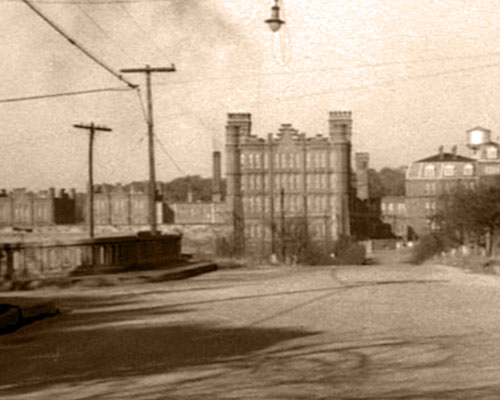
One of my favorite pieces ever written about Elvis Presley is “Elvis In The Dark” by Daniel Wolff. I’ve had it linked on The Mystery Train’s Exit page for years. If you’ve never read it or haven’t read it recently, I encourage you to do so while listening to “Are You Lonesome Tonight.”

Wolff’s remarkable essay originally appeared in a 1999 issue of The Threepenny Review, a literary magazine based out of Berkeley, California. While it is ostensibly a review of Peter Guralnick’s Careless Love: The Unmaking Of Elvis Presley, which was released that year, it is much more than that.

I am a firm believer that Elvis’ later work should not be dismissed as easily as it often is. Fortunately, such reactions seem at last to be changing. Wolff’s words capture the essence of post-Army Elvis. He acknowledges Elvis’ personal problems while still recognizing the artistic merits of his work during those times.

That is why it is my fervent hope that one day Wolff writes his own Elvis biography. Guralnick’s works are seminal, especially Last Train To Memphis: The Rise Of Elvis Presley (1994), but there is room for another look.

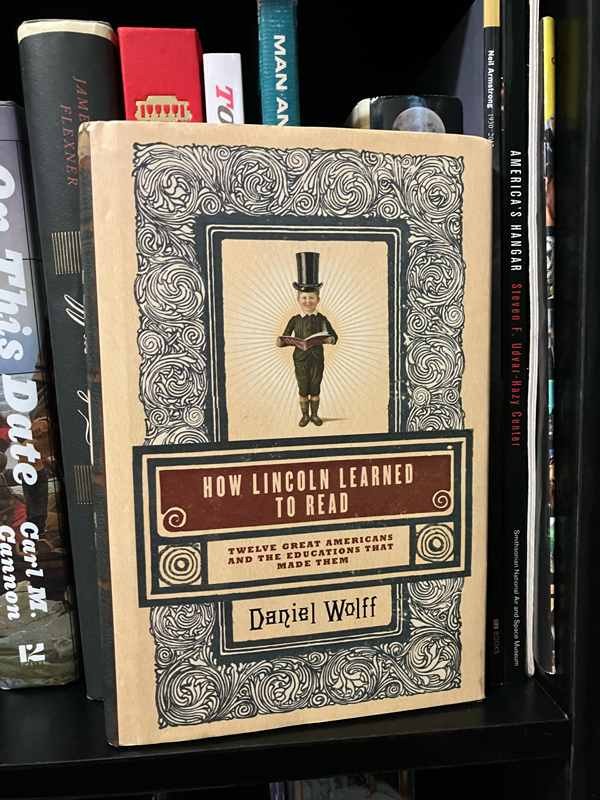
While Wolff has not yet written a volume dedicated to Elvis, I recently discovered that he devoted an entire chapter to him in his 2012 book How Lincoln Learned To Read: Twelve Great Americans And The Educations That Made Them.

HOW LINCOLN LEARNED TO READ by Daniel Wolff (2012)

The chapter titled “Elvis” includes a fascinating look at the economy of Elvis’ birthplace of Tupelo, Mississippi, during the Great Depression. In the midst of it, Elvis’ father, Vernon, is arrested and convicted for forging a check. During her husband’s 9-month stay in prison, Gladys and their son Elvis survive on government cheese while living with family as she picks up occasional laundry work.

One of their few respites is church, the Assembly of God where Gladys’ uncle is the preacher. Unlike some denominations, the Assembly of God allows guitars, drums, and tambourines, and Elvis’ earliest public singing takes place there.

Wolff also references Elvis’ fifth place win at a state fair talent contest in the mid-1940s, mentioning that it was broadcast over local radio. He adds:

“According to one researcher, over the next two and a half years he was on the radio ten times, singing hymns, show tunes, country-western and patriotic songs.”

Interesting, if true. Per his end notes, Wolff’s source for the multiple radio appearances is 2004’s Elvis: A Musical Inventory – 1939-55 by Richard Boussiron, which I have not read and appears to be difficult to come by these days. Guralnick in Last Train To Memphis alludes to at least one of these appearances in reference to Mississippi Slim’s radio show on WELO.

After the Presley family moves to Memphis, Tennessee, Elvis attends and graduates from Humes High School. During most of his time at Humes, the Presleys live at the Lauderdale Courts government housing project. Much as with Tupelo, Wolff also delves into the socioeconomics of Memphis. All of this serves to portray Elvis’ younger years against his environment and circumstances.

Elvis appears at a school talent show just a couple of months before graduation. Soon thereafter, he cuts a couple of demonstration records at the Memphis Recording Service. When Elvis records his first professional record for Sun at the age of 19, the Elvis chapter ends as his real story begins.

I had high expectations for this 2012 “Elvis” chapter, and it doesn’t quite live up to the peaks of Wolff’s 1999 “Elvis In The Dark” essay. A lot of that, however, is just due to the nature of the work in which it appears.

I continue to hold out hope for that single volume Elvis biography from Daniel Wolff one day. I would love to read how he covers Elvis’ post-Army years in particular, including placing him in the context of the world around him as he does so well in his “Elvis” chapter here. Until then, How Lincoln Learned To Read is certainly worth checking out for what it is, and I’m glad to have added it to my library.


“The LORD doesn’t see things the way you see them. People judge by outward appearance, but the LORD looks at the heart.”
from 1 Samuel 16:7

EPiC: A Soundtrack That Shouldn’t Stand Alone

I originally was going to do my standard song-by-song review of the soundtrack for Baz Luhrmann’s EPiC: Elvis Presley in Concert. However, I soon realized this would essentially turn into a review of the actual film, which I want to avoid analyzing for now.

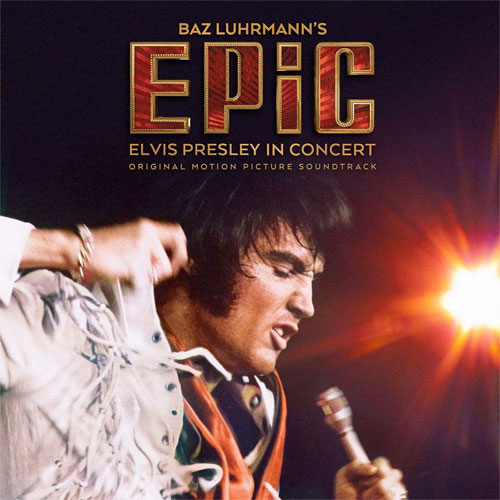
Cover of the EPiC soundtrack (2026, Sony)

Cover of the EPiC soundtrack (2026, Sony)

The soundtrack is inextricably intertwined with the movie, which isn’t to say they just laid down the exact audio of the documentary onto this CD. Some songs, mostly ambiance material from the non-concert portions, are missing, while some of the other songs are expanded or slightly different edits.

You should not listen to the soundtrack until you first see the movie. Unlike some soundtracks, this one really does not stand alone. It is a companion piece to the best Elvis Presley project ever made. Some choices that might sound odd at first on the soundtrack make much more sense in the context of EPiC as a film.

Listening to the soundtrack would also provide massive spoilers for EPiC as an experience. If you have not already, see it in a theater as soon as possible. No one has asked me to post these kinds of comments about the movie. I don’t get anything out of any of this, other than personal enjoyment. This is just me talking, one Elvis fan to another. EPiC is special, and you don’t want to miss seeing it.

You see? Even without song-by-song, I find myself drifting into a review of the movie.

Back to the soundtrack, there are a number of highlights that will live on in my main Elvis rotation for years if not decades to come. “Oh Happy Day” is breathtaking to hear. All we ever had was the rehearsal track of this, which left me wondering “what if?” This remix finally provides the answer.

“Wearin’ That Night Life Look” is a mashup of 1969’s “Wearin’ That Loved-On Look” and 1964’s “Night Life.” You don’t combine a highlight of the American Sound sessions with a movie tune! Oh, and then you’re going to throw in snippets of “Let Yourself Go” and “I, John”? It makes no sense. It can’t possibly work.

But it does! Somehow it does! What a wonderful “new” Elvis song “Wearin’ That Night Life Look” turns out to be. Along the same lines is the even more stellar “A Change Of Reality (Do You Miss Me?),” which I won’t even describe for you. See. The. Movie. I never thought an “invented” song like “A Change Of Reality” could be so incredible, but here we are. It’s probably my favorite new track.

The track “Bring The Curtain Down (EPiC Outro)” is brilliant as well. “Don’t Fly Away” is another mashup that I previously enjoyed on the 2022 ELVIS soundtrack, and it earns its encore here.

Plus there are tons of Elvis songs that we already know and love.

A minor quibble is that one of the interior artwork pieces (not pictured) frames Elvis in radiating, halo-style imagery that feels a little too saint-like for my taste. It pushes him toward deification rather than humanity. It doesn’t really fit with EPiC‘s mostly grounded portrait of Elvis. I find Elvis’ “King” image far less interesting than the real human being, which is one of the reasons I love EPiC and why that graphic doesn’t work for me.

That said, packaging is secondary to what matters most for Elvis releases, which is, as it always has been, the music. There’ll be plenty of time to analyze both the film and the soundtrack in the future.

Until then, enjoy this rare moment and see and feel Elvis like never before in EPiC.
The EPiC soundtrack is available on CD and digital now. The vinyl edition drops on April 24.

Elvis Live at His Las Vegas Peak

This is Part 8 of an occasional series reviewing Elvis: The Complete Masters Collection.

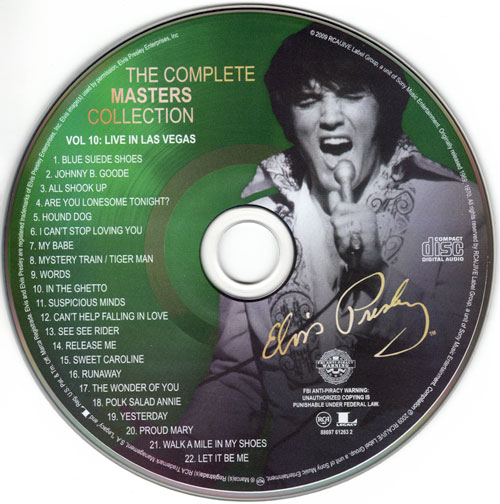
Well, as I was saying, volume 10 of Elvis: The Complete Masters Collection is called Live In Las Vegas and compiles Elvis In Person and On Stage, two of Elvis Presley’s best albums.

When Elvis made his debut at the International Hotel in Las Vegas on July 31, 1969, it had been 3,050 days since his last public concert. With that in mind, the 1,935 days that have elapsed since my last entry in this review of Elvis: The Complete Masters Collection don’t sound so bad, do they?

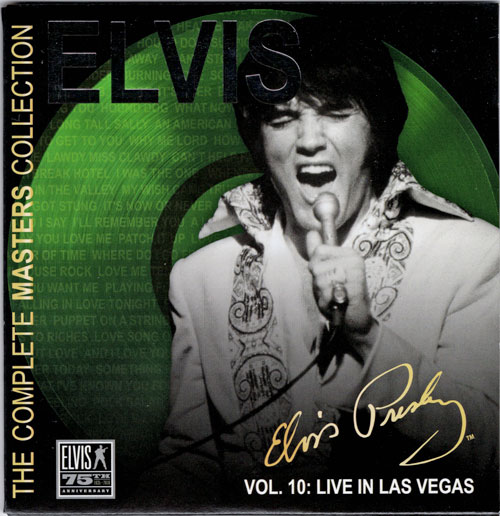
ELVIS: THE COMPLETE MASTERS COLLECTION – VOLUME 10 CD front sleeve - 2009, from TY's collection

ELVIS: THE COMPLETE MASTERS COLLECTION – VOLUME 10 CD front sleeve (2009, from TY’s collection)

CD Vol. 10: Live In Las Vegas

As I’ll talk about later, the compilers had an opportunity to do something really creative with the sequencing of this CD, but they took the easy route instead.

The first 12 tracks are the 1970 album Elvis In Person At The International Hotel, Las Vegas, Nevada, which was actually first released as record 1 of From Memphis To Vegas/From Vegas To Memphis in 1969. Do you think the RCA folks got paid by the character for their album titles back then?

The final 10 tracks are the album On Stage – February, 1970. One of my favorite little tidbits about that album, besides the unnecessary comma in the title, is that Elvis’ name does not appear anywhere on the front or back cover.

Elvis In Person pulls together recordings from Elvis’ August 1969 engagement at the International, whereas On Stage primarily assembles songs from his February 1970 return engagement but tosses in a couple more highlights from August 1969.

01. Blue Suede Shoes (August 25, 1969 Midnight Show [MS]): Trumpets blare, the rhythm group springs into action, and then Elvis takes the stage as Elvis In Person begins with a rocking rendition of Carl Perkins’ “Blue Suede Shoes.”

02. Johnny B. Goode (August 24, 1969 MS): From one rock ‘n’ roll anthem to the next, Elvis rips into Chuck Berry’s “Johnny B. Goode,” with his strongest version of the song from a vocals perspective released to date. James Burton on lead electric guitar is killing it in the right channel. The Sweet Inspirations sound great, too!

03. All Shook Up (August 25, 1969 MS): Elvis next launches into “All Shook Up,” certainly one of his finest performances of the 1957 classic. Ronnie Tutt on drums really drives this one. After the song, Elvis mentions that this is his first live appearance in nine years.

04. Are You Lonesome Tonight? (August 24, 1969 MS): Elvis sings a compelling version of his 1960 hit “Are You Lonesome Tonight,” with Sweet Inspiration Cissy Houston’s vocals soaring throughout. At the end of the track, in an excerpt from the August 24, 1969 Dinner Show (DS), Elvis introduces his “message song” for the night, which turns out to be . . .

05. Hound Dog (August 25, 1969 MS): Elvis attacks the opening of this song so forcefully that I’m just now getting up from the floor to try to type my thoughts as Burton completes his mid-song guitar solo. Best version from the 1968-1977 era.

06. I Can’t Stop Loving You (August 25, 1969 MS): This is a pretty enough version of Don Gibson’s “I Can’t Stop Loving You,” but Elvis would do it better from August 1970 through 1972 when he put a little more oomph into it. Bizarrely dubbed-in from another moment, an audience member screaming incoherently near the end doesn’t help this version, either. Elvis’ voice is gorgeous here, though, don’t get me wrong.

Listening closely to Elvis In Person as an album for the first time in awhile, it also becomes apparent that this is really a showcase for the incredible Sweet Inspirations as well.

If I play this performance of “I Can’t Stop Loving You,” I grab the one from disc 9 of 2019’s ELVIS LIVE 1969: International Hotel, Las Vegas, Nevada. Note that the tradition has carried on and that the Sony folks must get paid by the character for their titles, too. Anyway, the August 25, 1969 MS is one of Elvis’ greatest recorded concerts and the one that provided most of the masters for Elvis In Person.

07. My Babe (August 25, 1969 MS): Elvis rocks “My Babe,” his best version of Willie Dixon’s blues number. I love the extra guitar flourish by Burton at the end, too.

08. Mystery Train/Tiger Man (August 25, 1969 MS): The problem with a review of a fantastic album like Elvis In Person is that you run out of superlatives. Here is a no-holds-barred take on the “Mystery Train/Tiger Man” medley – possibly the best version of this combination ever recorded.

Elvis’ 1955 Sun master of “Mystery Train” is surely among his top five recordings ever. No live version has a chance of beating it, but the song still works perfectly here in tandem with “Tiger Man.” As always, this medley also spotlights Burton and Tutt. The best track on this CD.

09. Words (August 25, 1969 MS): Now, Elvis slows things way down with “Words,” a 1968 Bee Gees song. This is a great version, though I do prefer Elvis’ August 1970 take on the song.

This CD sounds fantastic, by the way. If I close my eyes I can pretend, just for a moment, that I’m in the showroom. At the end of the track, in a moment from the August 26, 1969 DS, Elvis introduces the next number as, “A record that just did very well for me recently, ladies and gentlemen.”

10. In The Ghetto (August 26, 1969 DS): That record, of course, is “In The Ghetto,” which made it to number 3 on the charts. This is a solid live version that remains true to the studio version, outside of being a tad faster. This, of course, was the true message song for the night.

11. Suspicious Minds (August 26, 1969 DS): It’s not that this is a bad version of “Suspicious Minds,” but there are a few others from the August 1969 engagement that I would have chosen ahead of this iteration. Really, any Midnight Show version probably would have been better than this Dinner Show version.

When Elvis’ producer Felton Jarvis witnessed the live version of “Suspicious Minds” earlier in this engagement, he went back and added similar horns and a fading down/up/down effect to the January 1969 studio master to attempt to replicate the feel. Backed with “You’ll Think Of Me” from the same sessions, the “Suspicious Minds” studio single hit the streets on August 26, literally the day of this Elvis In Person live recording, and made its way to number one.

12. Can’t Help Falling In Love (August 26, 1969 DS): After the two versions recorded in front of the small studio audiences of the 1968 ELVIS special, this is the next greatest live version of “Can’t Help Falling In Love.” Similar to “Are You Lonesome Tonight,” Houston’s vocals are near-operatic. This would be a fantastic end to a CD, except our CD doesn’t end here.

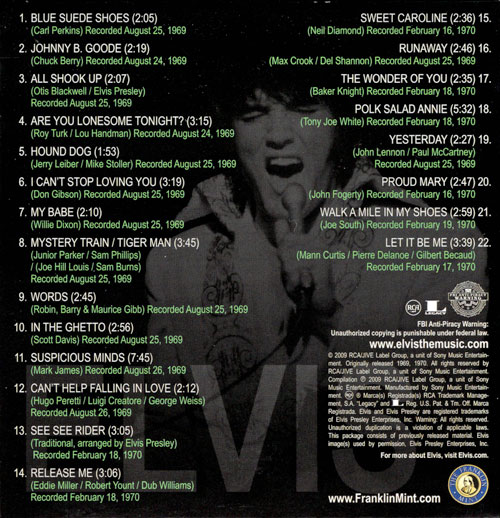
ELVIS: THE COMPLETE MASTERS COLLECTION – VOLUME 10 CD (2009, from TY’s collection)

13. See See Rider (February 18, 1970 MS): On Stage kicks off with “See See Rider,” which Elvis actually wouldn’t begin using as an opening song in his concerts for another couple of years. Did he get the idea from the sequencing of this album? This is one of my favorite Burton guitar solos. It is also Elvis’ best version of “See See Rider,” though the one on 2002’s Today, Tomorrow & Forever from this same engagement comes pretty close.

14. Release Me (February 18, 1970 MS): Elvis sings a committed version of “Release Me” and everyone does a great job backing him up. Despite all of that, this well-worn classic is just not a song I often enjoy very much.

15. Sweet Caroline (February 16, 1970 DS): Up next, Elvis takes on Neil Diamond’s 1969 hit “Sweet Caroline.” I actually like Elvis’ version of “Sweet Caroline” better than Diamond’s, and it’s pretty cool to watch him sing it in Elvis: That’s The Way It Is, too. Elvis sounds like he’s having fun, so that makes it enjoyable as well. This is Elvis’ best version of “Sweet Caroline.”

16. Runaway (August 25, 1969 DS): Elvis has a solid take on Del Shannon’s 1961 classic.

17. The Wonder Of You (February 18, 1970 MS): I love Elvis’ version of “The Wonder Of You,” a song first released by Ray Peterson in 1959. This live version was released as a single by Elvis and peaked at number nine. I love Elvis’ vocal interplay with Burton’s guitar solo on this.

18. Polk Salad Annie (February 18, 1970 MS): The only real competition for best track on this CD versus “Mystery Train/Tiger Man” is right here – “Polk Salad Annie.” Elvis begins the song with his “little story” that explains the lyrics. Tony Joe White’s 1969 classic is a perfect choice for Elvis’ live show. Jerry Scheff owns this song on electric bass. A similar rendition filmed a few months later for Elvis: That’s The Way It Is should not be missed, though this February version is superior.

19. Yesterday (August 25, 1969 DS): And now, Elvis sings The Beatles with a solid version of their 1965 hit “Yesterday.” This live version is actually one half of a medley that concluded with “Hey Jude,” but the original compiler of On Stage wisely left it off. Elvis’ “Yesterday” is stronger without it.

20. Proud Mary (February 16, 1970 DS): Next, Elvis sings Creedence Clearwater Revival by taking on their 1969 hit “Proud Mary.” While I prefer Elvis’ 1972 versions of “Proud Mary,” this is certainly a spirited and worthy take.

21. Walk A Mile In My Shoes (February 19, 1970 MS): Joe South first released the incredible “Walk A Mile In My Shoes” on his 1969 album Don’t It Make You Want To Go Home? and the single came out just a few weeks before Elvis’ live version was captured.

When Elvis sang “Walk A Mile In My Shoes” in this engagement, it was the first half of a medley with “In The Ghetto,” which was an inspired combination. For On Stage, the original compiler unfortunately excised the “In The Ghetto” portion. Nevertheless, “Walk A Mile In My Shoes” is another of my favorite songs on this CD.

Elvis notes at the end of this track that the next song had been released by a few different people.

22. Let It Be Me (February 17, 1970 MS): Elvis does a phenomenal job on this song, but so do the Sweet Inspirations – who were actually one of the groups that had released “Let It Be Me” prior to Elvis taking a turn at the song. Their 1967 version, which can be heard on their self-titled album, is not to be missed.

In terms of song selection and sequencing, this Franklin Mint set of Elvis’ complete masters does not strictly adhere to a session or album chronology. Those two approaches were later covered by re-releases of this material by Sony/RCA.

With that in mind, I think it would have been a much more interesting listening experience to put the first side of Elvis In Person, tracks 1-7, at the beginning, then both sides of On Stage, tracks 13-22, followed by the second side of Elvis In Person, tracks 8-12. This essentially would give you the feel of one incredible concert covering both seasons rather than two separate albums thrown together.

No matter how you sequence it, though, if you want to hear the Elvis Presley Show at its peak in Las Vegas, this CD just about covers it. The August 1970 engagement would begin at this same level, broadening the setlist to include new material from his June 1970 sessions.

I’ve been listening to the live recordings from this disc for 15 years now, and Vic Anesini’s mastering work continues to hold up as a stellar representation of the original releases of Elvis In Person and On Stage.

I hope to see you in 1,935 days or less for our next installment.

ELVIS: THE COMPLETE MASTERS COLLECTION – VOLUME 10 CD back sleeve (2009, from TY’s collection)


“We can make our plans, but the LORD determines our steps.”
Proverb 16:9 NLT

Elvis Movies: JAILHOUSE ROCK

Hey folks, I didn’t expect it to be this long between posts but here I am. It’s been over a year since the last entry in my random rewatch of Elvis Presley movies. It sure doesn’t feel that long ago. As a great philosopher once asked, “Ain’t it funny how time slips away?”

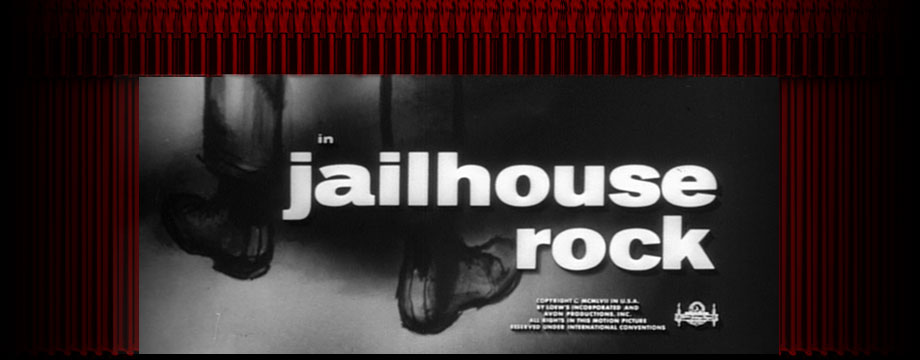
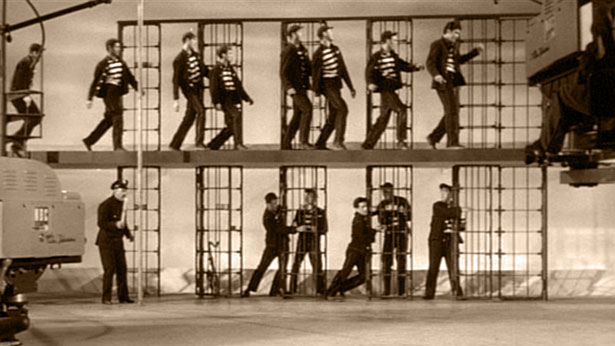
Elvis’ 3rd movie was called Jailhouse Rock. It is the 2nd of 3 Elvis movies shot in black & white, which certainly adds to the gritty tone.


“Elvis in Action as Never Before!”

Jailhouse Rock, now playing at a train near you

Jailhouse Rock (MGM)
Wide Release: November 8, 1957 (United States)
Starring: Elvis Presley, Judy Tyler, Mickey Shaughnessy
Screen Play By: Guy Trosper
Story By: Ned Young
Music Supervised By: Jeff Alexander
Produced By: Pandro S. Berman
Directed By: Richard Thorpe
Running Time: 96 Minutes


Elvis Presley stars in 1957's JAILHOUSE ROCK (MGM)

Elvis Presley stars in 1957’s JAILHOUSE ROCK (MGM)

Elvis stars in Jailhouse Rock as Vince Everett, a tractor driver who has just received his weekly paycheck. As is his custom, he cashes the check at the neighborhood bar and then arm wrestles the proprietor. After losing, Vince good-naturedly buys a round of drinks for everyone at the bar. The film soon takes a dark turn when another patron roughs up a woman for talking to Vince. Vince tells him to leave her alone.

“Look, buster, you want some teeth knocked out? Just keep it up,” warns the man.

“You scare me,” says Vince. “Woman-beaters always scare me.”

This being an Elvis movie, a fistfight of course ensues.

Much like in Loving You, released earlier in 1957, the fight concludes with the Elvis character punching his opponent into a jukebox. In Loving You, the Presley Maneuver causes the jukebox to turn on. In Jailhouse Rock, it turns the jukebox off.

Unlike most Elvis movies, though, this fight turns out to have lethal consequences. When the woman-beater dies, Vince is convicted of manslaughter and sentenced to 1 to 10 years in the state penitentiary. If only he had cashed his check at a bank instead of a bar.

Before we go much further, I want to jump back for a moment to the credits. I love the opening theme of Jailhouse Rock, an overture of sorts that includes instrumental renditions of portions of “Baby, I Don’t Care,” “Jailhouse Rock,” and “Young And Beautiful.”

This jazzy version of “Jailhouse Rock” is quite a treat. I played trumpet in our middle school jazz band, and when I first saw the movie on TV as a teenager back then, the “Jailhouse Rock” instrumental reminded me of the arrangement we were using for the same song.

Mickey Shaughnessy is Hunk Houghton in 1957's JAILHOUSE ROCK (MGM)

Mickey Shaughnessy is Hunk Houghton in 1957’s JAILHOUSE ROCK (MGM)

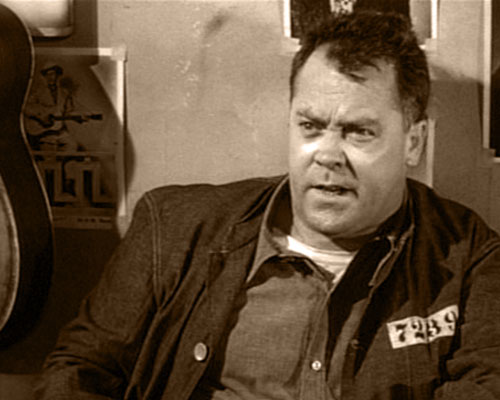
Anyway, Vince shares a cell with Hunk Houghton (Mickey Shaughnessy), a washed-up country singer. Hunk is near the end of an 18-year term for robbing a bank. Despite some of the variances, Jailhouse Rock is still an Elvis movie, so Hunk of course has a guitar hanging on the prison cell wall that draws Vince’s attention. Though Hunk is annoyed at first, he softens and teaches Vince some chords. When Hunk tells him about his 10-year career, Vince says, “I never heard of anybody paying money to hear a guitar player” and Elvis seems barely able to hold a straight face delivering the line. He is, after all, the highest paid “guitar player” in the world by this point.

Elvis performs Vince’s early songs in Jailhouse Rock as intentionally flat and tentative, reflecting the character’s inexperience with singing. However, Hunk hears something in the young man and offers him a spot in Breath of a Nation, a nationwide television special he is producing for the warden. You see, a state inspection committee is coming to review prison conditions, and the warden wants the prisoners to put on a show as a smokescreen. Conditions at this prison must be pretty rough to require a national television special to cover things up.

Vince sings “I Want To Be Free” in his segment, and, unlike Hunk or anyone else, he receives a large bag full of fan mail from all over the country. Hunk sees to it that Vince does not learn of the mail, saving face with the mailroom workers by saying he made a mistake by giving Vince the best spot in the show. He soon offers Vince a partnership contract for the pair to perform together and split everything 50/50. Great shades of Colonel Parker!

“Alone, son, you’d be like a lamb in a pack of wolves,” Hunk tells him. Vince signs the contract, thinking that the deal is in his favor since Hunk is the established “star.”

The State Pen in 1957's JAILHOUSE ROCK (MGM)

The State Pen in 1957’s JAILHOUSE ROCK (MGM)

Soon thereafter, a food fight turned riot breaks out in the prison over the poor conditions. Hunk tries to get Vince back to their cell, but a guard roughly handles Vince. Having apparently not yet learned his lesson from the barroom brawl, Vince swings his fists. He is caught and whipped. Outtakes of this scene surfaced on the 1993 VHS Elvis In Hollywood: The 50s. The original Jailhouse Rock film trailer also shows a clip that did not make it to the final film where Vince lunges at the warden when the guards untie his hands after the whipping.

Back in their cell, Hunk states that he tried to pay off the guards to prevent Vince’s whipping but he didn’t have enough money. He emphasizes the importance of having money to Vince and also teaches him his twisted version of the Golden Rule: “Do unto others as they would do unto you, only do it first.”

Hunk still has 10 months to go, but Vince is released from prison after serving 14 months – including 2 extra months for the riot incident. The warden gives Vince his remaining pay from the state. He also gives him the large bag of fan mail from the television special 8 months earlier. Vince realizes that Hunk helped keep the letters secret.

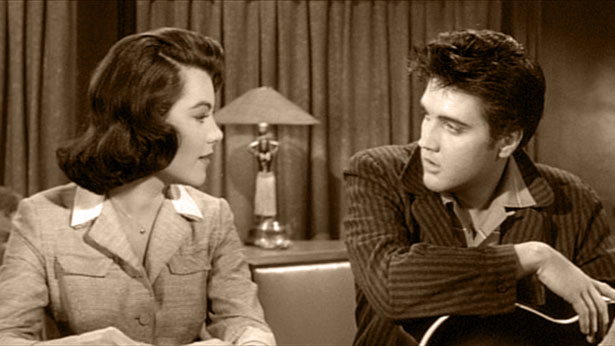
Vince buys a guitar from a pawnshop and goes to a bar where Hunk has arranged a job for him with an old contact. There, he meets Peggy Van Alden (Judy Tyler), who looks at some indicators inside of a jukebox and makes notes. He is curious what she is up to, but she is not impressed at all that Vince is a singer. However, she does say she’ll tell him more about her job if he buys her a fresh drink.

“Buy your own drink,” Vince says, wryly – no doubt remembering that the last time he bought a woman a drink in a bar he ended up in prison.

Judy Tyler is Peggy Van Alden and Elvis Presley is Vince Everett in 1957's JAILHOUSE ROCK (MGM)

Judy Tyler is Peggy Van Alden and Elvis Presley is Vince Everett in 1957’s JAILHOUSE ROCK (MGM)

“Is yours the approved manner with ladies in the backwoods?” Peggy fires back at him, but then goes on to explain that she is an “exploitation man” in the record business. “I work for Mickey Alba, you’ve heard of him?”

“Word sometimes gets to the backwoods,” says Vince. Alba (Don Burnett with vocals by Bill Lee) is a popular singer along the lines of Pat Boone.

Vince meets the bar’s owner, thinking he is going to be hired on as a singer. However, it turns out the job Hunk secured for him is as a barboy, essentially a bartender’s helper (“make setups, bring ice”). Vince is disappointed and forces his way on stage. Hey, it’s Scotty Moore, Bill Black, and DJ Fontana! Elvis’ real band! And Mike Stoller (composer of “Jailhouse Rock” and many other Elvis classics) on piano. Vince sings, “Young And Beautiful.” The owner actually seems to like the song, but a guy keeps laughing and carrying on in the audience, distracting both him and Vince.

Finally, Vince jumps from the stage and smashes his guitar into the obnoxious patron’s table. However, he refrains from killing him. That’s called character development.

Vince storms out, with Peggy trailing. “Hey, you forgot something,” she calls.

“What?”

“Me!”

So, before this re-watch, it had been over a decade since I last saw Jailhouse Rock. While I’ve always liked it, in fact it’s one of my favorite Elvis movies, I never really saw much chemistry between Vince and Peggy. Watching it through this time, though, I disagree with my past self. Now I see it.

Anyway, Peggy suggests Vince make a recording of himself to discover what’s wrong with his singing. This is not as simple a task as it is these days. Vince rents out a recording studio for $20 to make a demonstration recording. Peggy supplies a borrowed guitar and the background musicians. It’s Scotty, Bill, DJ, and Mike again! I guess Peggy knew them from the bar.

Vince records a faltering version of “Don’t Leave Me Now.” However, Peggy loosens him up a bit, and he also decides to ditch the guitar. He tries again, and they decide the resulting demo is good enough to shop around to the record labels. Jack Lease (Peter Adams), Peggy’s contact at Geneva Records, which is Mickey Alba’s label, seems unimpressed, but he decides to borrow the tape to play over the phone to someone else in New York later.

After it turns out to be a rejection anyway, Vince shows up disgruntled and late for a dinner meeting with Peggy. Even when she tells him the good news that she has gotten them a deal with another label, Deltona Records, he is still rude to her. He just wants to brood. “When the money starts rolling in, then I’ll say I’m happy,” he says.

After a celebratory steak dinner, they head out to meet Peggy’s parents, who are having a party. They seem to know all about Vince, including that he sold his first record that day. However, Peggy has not told them about his stay in the state penitentiary. He expects this information to shock them, but it does not phase them. Instead, they start the record player and a technical discussion begins about jazz.

Another guest tries to involve Vince. “I say atonality is just a passing phase in jazz music. What do you think, Mr. Everett?”

Vince’s response is classic and one that I’ve had to bite my tongue not to use in various situations over the years: “Lady, I don’t know what the hell you talking about.”

Judy Tyler is Peggy Van Alden and Elvis Presley is Vince Everett in 1957's JAILHOUSE ROCK (MGM)

Judy Tyler is Peggy Van Alden and Elvis Presley is Vince Everett in 1957’s JAILHOUSE ROCK (MGM)

He storms out, and Peggy chases after him again. She is angry and embarrassed by his behavior – noting they were only trying to draw him into the conversation.

“They can shove their conversation,” he retorts. “I’m not even sure they were talking English!”

When Vince decides to walk home after their bickering, Peggy says, “I think I’m gonna just hate you.”

“You ain’t gonna hate me. I ain’t gonna let you hate me.” He grabs and kisses her.

“How dare you think such cheap tactics would work with me,” she exclaims. He kisses her again.

“That ain’t tactics, honey. That’s just the beast in me.”

On paper, the scene sounds creepy, but it is extremely well-executed by both performers – one of the best acted scenes in any Elvis movie.

Vince half-heartedly apologizes to Peggy on the way into the record store on the release day of “Don’t Leave Me Now.”

The girl at the cash register states that the record is flying off the shelves. Vince asks for a half dozen copies. Peggy looks alarmed when she sees the stack of records, and Vince looks over one curiously, reading aloud, “‘Don’t Leave Me Now’ by Mickey Alba? Geneva Record Company.” It turns out that Lease, the Geneva executive, only borrowed the tape so Alba could copy Vince’s arrangement and style. Vince’s record is gone – somehow squashed by Geneva.

Vince makes an unscheduled visit to Lease. “You’re a thievin’ rat” Vince exclaims and goes to punch him. However, seeing as how no jukebox is available to land the body on, he just slaps him a couple of times instead. “Go back under your rock, you snake!”

Later, he speaks of his time in prison to Peggy: “On the inside, they’re cub scouts compared to Jack Lease. If you make something, they might steal it from you, but they’d be too honorable to say they made it themselves.”

Vince suggests they start their own record company, and they form Laurel Records – splitting things 60/40. “I’m the artist, don’t forget,” Vince explains when Peggy at first objects to holding only 40%. After Peggy agrees to the deal, they have the following conversation – illustrating how they are both on different pages.

“This really calls for a celebration, Vince.”

“Do you know a lawyer? We need a good one. . .”

“Do you know how to dance?” asks Peggy.

“. . .A guy with an eye for a buck. Do you know a lawyer?”

Peggy is disappointed. “Yeah, I know a lawyer. Mr. Shores. . .”

After Vince makes it clear he is only interested in money, they form the record company. Vince records “Treat Me Nice,” which becomes a big hit. Vince makes reservations at a fancy restaurant to celebrate with Peggy but is disappointed when she points out that he failed to make reservations with her. She has a date, and states, “Vince, I will not be subject to your beck and call.” Go, Peggy! That’s a bold stance in 1957, especially in the male-dominated world of Jailhouse Rock.

Despite emotional setbacks, Vince’s career continues to skyrocket, including appearances in Las Vegas. After Vince agrees to do an NBC television special, Peggy shows up to ask him to record more records. Vince is rude to her, but reaches out right as she is leaving, almost like he wants to apologize or say something else – but his heart is still too hardened to get the words out. As Peggy exits, Hunk returns – fresh out of prison and looking for his spot in the TV special.

Elvis Presley is Vince Everett in 1957's JAILHOUSE ROCK (MGM)

Elvis Presley is Vince Everett in 1957’s JAILHOUSE ROCK (MGM)

The character of Vince is an unusual one in the Elvis cinematic universe. For most of the film, as many have pointed out over the years, Vince is a conceited jerk seemingly obsessed with money. Most of Elvis’ characters are likable guys cut from the same cloth. Vince is different, primarily due to his stay in prison, and offers a refreshing change of pace from the run-of-the-mill Elvis character. Vince should not be dismissed as a complete jerk, however. In several scenes, Elvis convincingly displays the emotional turmoil going on inside the man. He outwardly says he is all about the money, but you can also see that he loves Peggy and even Hunk.

In the music department, Jailhouse Rock is more than solid. The title song is a bonafide Elvis masterpiece. While the single version, one of Elvis’ greatest recordings, is used as the underlying track here in the film, the guitar riff opening of the song is unnecessarily hacked off. The screen version of the song is also hampered by awful overdubs of instruments and backing male vocals. Only the strength of Elvis’ underlying performance and the stellar production number save the tune. What were they thinking?

“Baby, I Don’t Care” and “Treat Me Nice” are also fantastic renditions. While “Young And Beautiful” is not quite up to the same par established by those three songs, it is still a lovely performance. “I Want To Be Free” and “Don’t Leave Me Now” serve their purposes well in the context of the film as does Mickey Shaughnessy’s “One More Day” — which is reminiscent of the classic folk song “Sixteen Tons.”

Vince Everett (Elvis Presley) sings "Baby, I Don't Care" at a pool party as a guitarist (Scotty Moore) plays along in the background in 1957's JAILHOUSE ROCK (MGM)

Vince Everett (Elvis Presley) sings “Baby, I Don’t Care” at a pool party as a guitarist (Scotty Moore) plays along in the background in 1957’s JAILHOUSE ROCK (MGM)

There is an oft-noted continuity error in Jailhouse Rock. During the “Baby, I Don’t Care” scene, guitarist Scotty Moore is shown wearing sunglasses in the wide shots but no eyewear in the closeups.

Vince Everett (Elvis Presley) sings "Baby, I Don't Care" at a pool party as a band (Bill Black, DJ Fontana, Scotty Moore, Mike Stoller) plays along in the background in 1957's JAILHOUSE ROCK (MGM)

Vince Everett (Elvis Presley) sings “Baby, I Don’t Care” at a pool party as a band (Bill Black, DJ Fontana, Scotty Moore, Mike Stoller) plays along in the background in 1957’s JAILHOUSE ROCK (MGM)

Another error is one I just noticed for the first time – a 1957 calendar is shown on the wall during a strikethrough sequence when Vince is in prison. When the calendar page is ripped down to show the next year, it is a 1957 calendar again. Talk about a life sentence! For the purposes of the Action File at the end of this post for Vince Everett, my conjecture is that the initial calendar was supposed to represent 1956 and that he was released in 1957.

One supposed error that is sometimes referenced with this film is that the prison ID number stamped on Vince’s shirt changes. Vince’s number is consistent during the penitentiary portions of the movie, however. Later, during the “Jailhouse Rock” production number, well after he has been released from actual prison, Vince wears a costume with a different number stamped on it. One was the character’s actual prison garb, the other was simply a costume. So calling it an error is . . . an error.

When Vince makes it to Hollywood, he takes his leading lady (played by Jennifer Holden) to Knott’s Berry Farm – a real amusement park in California that is still open to the public, including the “Old West” town represented in Jailhouse Rock.

A photographer prepares to take a souvenir picture of Vince Everett (Elvis Presley) and Sherry Wilson (Jennifer Holden) at Knott's Berry Farm in 1957's JAILHOUSE ROCK (MGM)

A photographer prepares to take a souvenir picture of Vince Everett (Elvis Presley) and Sherry Wilson (Jennifer Holden) at Knott’s Berry Farm in 1957’s JAILHOUSE ROCK (MGM)

Elvis released 33 movies during his lifetime, but Jailhouse Rock is one of only a small handful that is a serious contender as his very best. It was inducted into the US Library of Congress’ National Film Registry in 2004, the only Elvis movie to achieve this honor.

Just a few days after filming wrapped on Jailhouse Rock, actress Judy Tyler (Peggy) was killed at the age of 24 in a horrific car accident on July 3, 1957. Tyler’s husband and a passenger in another vehicle were also killed in the crash.

Elvis was devastated and according to many sources never watched the completed movie. Peter Guralnick & Ernst Jorgensen’s Elvis: Day By Day – The Definitive Record Of His Life And Music, however, notes that Elvis watched a special screening of the film with his parents on October 2, 1957. The book provides no further details, nor does Guralnick’s Last Train To Memphis: The Rise Of Elvis Presley, but perhaps Elvis was unable to finish the screening — thus validating both versions of the story.

Judy Tyler is Peggy Van Alden in 1957's JAILHOUSE ROCK (MGM)

Judy Tyler is Peggy Van Alden in 1957’s JAILHOUSE ROCK (MGM)

Jaihouse Rock was Tyler’s second and final movie. Her first, Bop Girl Goes Calypso, hit theaters only a couple of weeks after her death. While Jailhouse Rock, released in November 1957, carries no dedication to Tyler – I am not even sure that kind of thing was done back then – there is a moment in the closing scene during “Young And Beautiful” where the edit seems to linger on her more than it perhaps otherwise would have. In the magic of the movies, she will indeed remain forever young and beautiful.


Boldly Go

Multiple uncredited cast members from Jailhouse Rock went on to play roles in Star Trek.

K.L. Smith appears in the opening bar scene in Jailhouse Rock and appears as a Klingon in the Star Trek episode “Elaan Of Troyius” in 1968. Eagle-eyed readers will note that I also referenced Smith in a previous “Boldly Go” installment for his appearance in 1964’s Roustabout. Speaking of eagle eyes, thank you once again to Elvis movie superfan Gary Wells for pointing out where Smith shows up in Jailhouse Rock for me.

Elvis Presley and K.L. Smith in 1957's JAILHOUSE ROCK (MGM)

Elvis Presley and K.L. Smith in 1957’s JAILHOUSE ROCK (MGM)

K.L. Smith is a Klingon captain in the 1968 STAR TREK episode "Elaan Of Troyius" (Paramount)

K.L. Smith is a Klingon captain in the 1968 STAR TREK episode “Elaan Of Troyius” (Paramount)

Other cross-overs include:

  • Buzz Barbee [Jailhouse Rock: Apartment party guest | Star Trek: Ambassador Fox’s aide in “A Taste Of Armageddon” (1967) and maiden voyage official in Star Trek Generations (1994)]
  • Albert Cavens [Jailhouse Rock: Nightclub patron | Star Trek: Klingon crewmember in “Day Of The Dove” (1968) and fop 2 in “All Our Yesterdays” (1969)]
  • Noble “Kid” Chissell [Jailhouse Rock: Convict | Star Trek: Server in “The City On The Edge Of Forever” (1967)]
  • Richard Dial [Jailhouse Rock: Minor role | Star Trek: Sam in “The Devil In The Dark” (1967), Kaplan in “The Apple” (1967), security guard in “And The Children Shall Lead” (1968) and Fabrini guard in “For The World Is Hollow And I Have Touched The Sky” (1968)]
  • Shep Houghton [Jailhouse Rock: Nightclub patron | Star Trek: Cameraman in “Bread And Circuses” (1968)]
  • Arthur Tovey [Jailhouse Rock: Record shop owner in montage | Star Trek: Vulcan citizen in Star Trek: The Motion Picture (1979)]

Elvis Presley is Vince Everett and Mickey Shaughnessy is Hunk Houghton in 1957's JAILHOUSE ROCK (MGM)

Elvis Presley is Vince Everett and Mickey Shaughnessy is Hunk Houghton in 1957’s JAILHOUSE ROCK (MGM)

Jailhouse Rock Tote Board

  • Punches: 23
  • Songs: 15
  • Kisses: 12
  • Storm-Outs: 4
  • Slaps: 2

Songs In Jailhouse Rock

  1. Mickey Shaughnessy: “One More Day” (1957) [performed twice], written by Sid Tepper & Roy C. Bennett
  2. Elvis Presley: “Young And Beautiful” (1957) [performed 3 times], written by Abner Silver & Aaron Schroeder
  3. Elvis Presley: “I Want To Be Free” (1957), written by Jerry Leiber & Mike Stoller
  4. “Don’t Leave Me Now” (1957) [performed three times by Elvis Presley and once by Bill Lee], written by Aaron Schroeder & Ben Weisman
  5. Elvis Presley: “Treat Me Nice” (1957) [performed three times], written by Jerry Leiber & Mike Stoller
  6. Elvis Presley: “Jailhouse Rock” (1957), written by Jerry Leiber & Mike Stoller
  7. Elvis Presley: “Baby, I Don’t Care” (1957), written by Jerry Leiber & Mike Stoller

The Mystery Train’s Jailhouse Rock Scorecard

  • Story: 8 (out of 10)
  • Acting: 10
  • Entertainment Value: 8
  • Songs: 9
  • Overall: 9 (Must See)

Jailhouse Rock Around The Web


Click image for larger, color version


“But to you who are willing to listen, I say, love your enemies! Do good to those who hate you. Bless those who curse you. Pray for those who hurt you. If someone slaps you on one cheek, offer the other cheek also. If someone demands your coat, offer your shirt also. Give to anyone who asks; and when things are taken away from you, don’t try to get them back. Do to others as you would like them to do to you.”
Luke 6:27-31 NLT

Elvis Movies: EASY COME, EASY GO

Up next in my rewatch of Elvis Presley movies is Easy Come, Easy Go – his 23rd movie to be released.


“Excitement! Adventure under the sea! Skin-diving for treasure, adventure and fun!”

Easy Come, Easy Go (Paramount)
Wide Release: March 22, 1967 (United States)
Starring: Elvis Presley, Dodie Marshall, Pat Priest
Screenplay By: Allan Weiss, Anthony Lawrence
Music Score By: Joseph J. Lilley
Produced By: Hal B. Wallis
Directed By: John Rich
Running Time: 95 Minutes


1967’s EASY COME, EASY GO features multiple underwater scenes (Paramount)

Easy Come, Easy Go premiered only two weeks before Double Trouble, which was actually filmed first.

Elvis stars as Lieutenant Ted Jackson, a US Naval officer who serves aboard the USS Gallant, an Aggressive Class minesweeper. Ted is nearing the end of his military service and during his final Explosive Ordnance Disposal (EOD) mission, he discovers a sunken treasure chest. Wealthy Dina Bishop (Pat Priest) skippers a civilian boat in the area and deploys her boy-toy Gil Carey (Skip Ward) to obtain a photo of the Naval officer, interfering with Ted’s work.

Elvis Presley is Ted Jackson and Dodie Marshall is Jo Symington in 1967’s EASY COME, EASY GO (Paramount)

Once he leaves the Navy, Ted is determined to raise the treasure chest. He enlists help from Judd Whitman (Pat Harrington) and Jo Symington (Dodie Marshall). Ted was former partners with Judd in a nightclub business, while Jo is a free spirit looking to open an art center with her share of the pending fortune. Both Marshall and Harrington are strong in their roles. Marshall, in particular, brightens the movie whenever she appears.

A 1967 Dodge Dart becomes a work of modern art in EASY COME, EASY GO (Paramount)

Dina and Gil find out about the treasure, too, and begin trying to thwart Ted’s plans in order to get the treasure for themselves. Gil’s motivation is that if he becomes wealthy through the treasure, Dina might begin treating him as an equal.

Jo and Ted are usually friendly to one another through most of Easy Come, Easy Go, but a romance between the two late in the film seems to happen only out of obligation to the Elvis movie formula rather than as a natural result of the story.

Elvis Presley is Ted Jackson in 1967’s EASY COME, EASY GO (Paramount)

Easy Come, Easy Go makes a good second movie in a double feature with Spinout, for Marshall appears briefly near the end of the latter (as a different character, for Elvis never made a sequel to one of his narrative films). In fact, Spinout was the Elvis movie released just prior to Easy Come, Easy Go, so her appearance almost acts as a kind of advertisement for the next movie in the Elvis Cinematic Universe.

Easy Come, Easy Go reflects the culture of its time by the mostly sexist ways it portrays women – the worst of which is exemplified by a dreadful musical number, “The Love Machine.” Navy men spin a wheel of fortune where the “prizes” are available ladies, complete with photos, measurements, and phone numbers.

Elvis Presley is Ted Jackson and Dodie Marshall is Jo Symington in 1967’s EASY COME, EASY GO (Paramount)

The movie includes a number of well-filmed underwater scenes, though they often drag on too long by modern standards – especially considering that the underwater version of “Ted Jackson” is not portrayed by Elvis. Though Elvis often did many of his own stunts in his movies, scuba-diving was not among his skillsets. At one point, Gil even attempts to kill Ted underwater – pretty intense for an Elvis movie.

Elsa Lanchester and Elvis Presley in 1967’s EASY COME, EASY GO (Paramount)

As for the music, there are no real stand-out numbers – at least not for the right reasons. The legendary Elsa Lanchester (Bride Of Frankenstein) appears briefly as a yoga instructor – just long enough to become one of the few people ever to sing a duet with Elvis. Unfortunately, “Yoga Is As Yoga Does” is a disservice to both stars, and I’ll just leave it at that.

Ted performs “Easy Come, Easy Go” during the opening credits on a small Navy boat – even using a paddle to play air guitar along to an unseen background music source (Elvis movies had long ago given up trying to make such scenes make logical sense).

Ted Jackson (Elvis Presley) tries to part the waters of a crowded party in 1967’s EASY COME, EASY GO (Paramount)

Faring better in the music department are “Sing You Children,” an inspirational number that Ted uses to “part the waters” of a crowd and “I’ll Take Love,” which serves as the film’s finale.

Easy Come, Easy Go is a good example of an average Elvis movie. It is not very ambitious, but it manages to entertain.

Elvis Presley is Ted Jackson in 1967’s EASY COME, EASY GO (Paramount)


Boldly Go

Shari Nims, who played Mary, one of Dina’s friends, in 1967’s Easy Come, Easy Go, appeared as Sayana, a Vaalian, later that same year in the Star Trek episode “The Apple.”

I knew where Nims was in Star Trek, but I sure couldn’t find her in Easy Come, Easy Go. Instead, my friend and Elvis movie superfan Gary Wells over at SoulRide Blog tracked down one of her scenes for me. Thanks, Gary!

Shari Nims is Mary in 1967’s EASY COME, EASY GO (Paramount)

William Shatner is James T. Kirk, Shari Nims is Sayana, and Leonard Nimoy is Spock in the 1967 STAR TREK episode “The Apple” (Paramount)


Easy Come, Easy Go Tote Board

  • Punches: 11
  • Songs: 6
  • Kisses: 5

Songs In Easy Come, Easy Go

  1. Elvis Presley: “Easy Come, Easy Go” (1966), written by Sid Wayne & Ben Weisman
  2. Elvis Presley: “The Love Machine” (1966), written by Gerald Nelson, Fred Burch, & Chuck Taylor
  3. Elvis Presley & Elsa Lanchester: “Yoga Is As Yoga Does” (1966), written by Gerald Nelson & Fred Burch
  4. Elvis Presley: “You Gotta Stop” (1966), written by Bill Giant, Bernie Baum, and Florence Kay
  5. Elvis Presley: “Sing You Children” (1966), written by Gerald Nelson & Fred Burch
  6. Elvis Presley: “I’ll Take Love” (1966), written by Dolores Fuller & Mark Barkan

The Mystery Train’s Easy Come, Easy Go Scorecard

  • Story: 4 (out of 10)
  • Acting: 5
  • Fun: 7
  • Songs: 5
  • Overall: 5 (For Elvis Fans Only)

Easy Come, Easy Go Around The Web


Click image for larger, full-color version


“Then Moses raised his hand over the sea, and the LORD opened up a path through the water with a strong east wind. The wind blew all that night, turning the seabed into dry land. So the people of Israel walked through the middle of the sea on dry ground, with walls of water on each side!”
Exodus 14:21-22 NLT

As Recorded At Greensboro Coliseum: ELVIS ON TOUR – First (or Second) Reactions

I really struggled during my first run-through of CD 3 of Elvis On Tour, as I initially found it disappointing. I decided to give it another try about a week later, so this consolidated review actually represents impressions from both my first and second listens of the show.


I’ve been enjoying the new Elvis On Tour boxed set, so I’m continuing my informal, off-the-cuff reviews. This time, I’ll be listening to CD 3, which captures Elvis Presley’s concert on Friday, April 14, 1972, at the Greensboro Coliseum in North Carolina. Though this show is previously unreleased, it does have 3 songs that appear in the actual movie.

Elvis Presley performing at the Greensboro Coliseum on Friday, April 14, 1972 (MGM)

Also Sprach Zarathustra (Theme from 2001: A Space Odyssey)

See See Rider: Though nothing really distinguishes it, this is a fine 1972 version of “See See Rider.”

Proud Mary: This is a rockin’ version but, much like “See See Rider,” nothing really distinguishes this one from other fine performances of this tune in 1972.

Never Been To Spain: This is an okay version of this song on Elvis’ part, with nothing standing out. “We’ll get the ending right one day,” he notes after completing it.

I must admit, I’m disappointed in this concert so far. I’d been looking forward to it. Hopefully things will pick up. I’m also hoping for a surprise or two in terms of the setlist (I have not read the accompanying booklet yet, which includes the track listing).

You Gave Me A Mountain: I’ve mentioned in previous reviews that this is a poor spot in the setlist to downshift to slow songs. “Polk Salad Annie” right here would be so much better. I love slow songs, but this should be a little later in the show. This is not an especially good version of “You Gave Me A Mountain,” either.

Until It’s Time For You To Go

Polk Salad Annie: The Greensboro crowd reacts loudly as “Polk Salad Annie” begins. I love the wild Jerry Scheff bass guitar solos on the 1972 versions of the song, and this one is no exception.

Love Me: The crowd is definitely enthusiastic in Greensboro. Way to go, North Carolina!

All Shook Up: Elvis offers up a surprisingly spirited version. At least he doesn’t seem bored like he often does on this song.

Teddy Bear/Don’t Be Cruel: I usually don’t enjoy the “oldies” section of the show in 1972, but Elvis again seems enthusiastic on this medley.

Hound Dog: Well, that all just went out the window. Elvis really should have retired “Hound Dog” after 1970. This is a rather poor version.

Heartbreak Hotel: I normally like 1972 versions of “Heartbreak Hotel.” This one is good, though he gets distracted.

A Big Hunk O’ Love: Here we go! “A Big Hunk O’ Love” really takes off! Elvis says, “It’s your big chance, man” during Glen Hardin’s piano solo. I love how this song has two instrumental breaks, one for Glen and the other for James Burton on lead guitar. This should have happened more often. I love this song! So awesome!

Bridge Over Troubled Water: This version of “Bridge Over Troubled Water” appeared in the Elvis On Tour movie. I know some fans consider it Elvis’ best version ever, but I can’t grasp how they can think that when 1970 exists. In any event, it’s fun to hear a 1972 version of this song. As a teen, I remember being surprised to see this in Elvis On Tour when I watched it for the first time. I associated the song with 1970, for it was such a climactic moment in Elvis: That’s The Way It Is, and I didn’t realize he continued performing it after that year.

Suspicious Minds: All right, let’s do it right, Elvis! The start is fairly strong, for 1972. Overall, a decent version. It’s probably the best version of the three I’ve heard so far on this set – which isn’t necessarily a huge compliment. Why did Elvis allow his most recent #1 hit to become almost a throwaway?

As the band begins “Comin’ Home Baby” for the introductions portion of the show, Elvis says, “My first movie, ladies and gentlemen, was Love Me Tender. I’d like to sing that for you,” and the band quickly shifts into “Love Me Tender” instead.

Love Me Tender: A short but fine version. Includes the ad-lib, “You have made my suit turn blue, and I love you so.”

Elvis Presley performing at the Greensboro Coliseum on Friday, April 14, 1972 (MGM)

Comin’ Home Baby/Introductions By Elvis

For The Good Times: I really enjoyed the multiple attempts of “For The Good Times” on the Hollywood Studio CDs of this set. While I prefer studio versions of this song, this live version is still good. Possibly my favorite live version of this song.

An American Trilogy: Dixie/Battle Hymn Of The Republic/All My Trials – This appeared in the Elvis On Tour movie. It’s a great version. I like the Hampton Roads version better, but I can see why they went with this one for the movie – it’s visually better than Hampton. This makes me want to watch the movie again. It’s been a few years.

Burning Love: Oh, cool! Elvis debuts his soon to be hit song, recorded only a couple of weeks earlier. You’ve gotta crank the sound up on this one. Go Elvis! Who cares if some of the words are wrong? It’s the feel of the song. That’s always been the case when listening to Elvis. This Greensboro version of “Burning Love” is possibly my second favorite live version, after San Antonio.

Release Me: This one appeared in the excellent Elvis: The Lost Performances VHS video in 1992. It’s a good version of “Release Me,” but certainly anticlimactic after “Burning Love.”

Funny How Time Slips Away: This is a good 1972 version of “Funny How Time Slips Away.” It will probably be my go-to version for that year. This performance appears in Elvis On Tour. I love finally hearing these songs in context of the full shows. When multiple police officers pull a fan away after trying to reach Elvis on the stage, he says “Let her have that, let her have that, man,” to one of them, handing the officer a scarf to give to the overzealous fan. How cool.

Generally, this song indicates the show is almost over (because time is slipping away). I am hoping he squeezes in at least one more song before the “Can’t Help Falling In Love” finale, though. “Let me drink a little Gatorade, and I’ll sing another song for you,” he says. Maybe!

Can’t Help Falling In Love: Well, darn. The show is just about over. 1972 versions of “Can’t Help Falling In Love” are way too fast, but he does sound good here.

I really wish the show was a bit longer. Most Elvis concerts are around 60 minutes. This one clocks in at 62 minutes. For some reason, it feels shorter than that. The overall Greensboro experience feels unsatisfying compared to Hampton and San Antonio.

Well, 51 years later, I guess I shouldn’t complain since at least I get to hear this show at all. The first listen was definitely disappointing, but I enjoyed it more the second time through, including multiple highlights noted above.


“May the mountains yield prosperity for all, and may the hills be fruitful.”
Psalm 72:3