Education, Elvis Style (Part 1)

At this time of year in the United States, high school and university graduations are taking place. It is customary to send friends and family members gifts once they reach this milestone. Particularly for high school grads, these gifts often come in the form of money – intended for use in further education.

I graduated from high school in the early 1990s and sure enough, in the last few months of my senior year, checks from various friends and family members arrived in the mail. At the time, I was still working on obtaining my first summer job. When it came to money, I basically had none.

That had never stopped me from spending time browsing record stores, though. I can remember drooling over two Elvis CD releases in particular that had been out for about a year by that time: ELVIS: The King of Rock ‘n’ Roll – The Complete 50s Masters and Elvis Today.

The King of Rock ‘n’ Roll, of course, was the groundbreaking and critically acclaimed 5-CD boxed set that collected his 1950s material together in a coherent fashion for the first time. I can remember just staring at the track listings on the back of the box, marveling over the song titles.

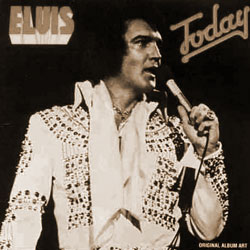
Cover of 1992 Elvis Today CD

Elvis Today was the CD debut of a 1975 album previously available only on vinyl. Since RCA had inexplicably deleted the original album from its catalog, I had been trying to track it down for years before the CD release. I only had three of the songs on it and wanted desperately to hear the others.

Both releases were part of RCA/BMG’s “Elvis In The 90s” series, which had the mission of bringing all of his master recordings to the CD format.

As I dutifully wrote out thank you notes for the gracious graduation gifts people had sent me, a plan began formulating in my head. Sure, I was starting university classes in a few months, but what did I need for that right now? I had a better idea.

Soon enough, I was at the record store and spent most of my graduation money on The King of Rock ‘n’ Roll and Elvis Today. I had just enough left over to buy a reference book I had also been eyeing up for some time: ELVIS: His Life From A to Z by Fred L. Worth and Steve D. Tamerius.

People had sent money for me to further my education, and that was exactly what I intended to do.

To be continued. . . .

Elvis On Tour: The Official Audio Releases

Elvis On Tour (1972)

Elvis On Tour (1972)

This is an updated re-posting of an item I first placed on my sci fi/pop culture blog back in January – prior to rolling out The Mystery Train Elvis Blog.

Warner Home Video is releasing Elvis On Tour on Blu-ray and DVD on August 3. The MGM movie features Elvis on the road and in rehearsals in the spring of 1972.

Sandwiched between 1970’s colossal That’s The Way It Is and 1973’s Aloha From Hawaii, the Golden-Globe-winning documentary often seems to be overlooked among Elvis events.

At the time, Elvis On Tour ultimately did not even garner a soundtrack album release – trumped by the As Recorded At Madison Square Garden and Aloha live albums.

Nevertheless, Elvis On Tour shows Elvis in good form, with the effects of his marriage problems with Priscilla only beginning to show their toll. It is a well-assembled film, capturing an important moment in the entertainer’s life. The second documentary produced about him, Elvis On Tour also represents Elvis’ 33rd and final completed movie.

When Warner Home Video remade That’s The Way It Is in 2000, RCA/BMG released a corresponding boxed set of audio material recorded during the filming of the movie. There have since been a number of other That’s The Way It Is themed audio releases.

Since the record label also recorded many of the rehearsals and concerts during the filming of Elvis On Tour, it seems likely that this Blu-ray release will open the floodgates for related audio material.

To celebrate the Blu-ray release, this is one of a series of Elvis On Tour related posts this year. Today, I want to take a look back at what has been officially released to this point on audio from the material recorded for this movie.

Most of these performances were not used in the actual film, though some were. Believe it or not, this is only the tip of the iceberg when it comes to the audio recordings made for Elvis On Tour. 2010 may turn out to be a very good year indeed for Elvis fans.

This Is Elvis (1981)
Always On My Mind (Rehearsal)
An American Trilogy (Live-April 9, 1972, Hampton Roads, Virginia)

Amazing Grace (1994)
Bosom of Abraham (Rehearsal)
I, John (Rehearsal)
Lead Me, Guide Me (Rehearsal)
Turn Your Eyes Upon Jesus/Nearer My God To Thee (Rehearsal)
You Better Run (Rehearsal)

From The Heart (1998)
Separate Ways (Rehearsal)

6363 Sunset (2001)
A Big Hunk O’ Love (Rehearsal)
All Shook Up (Rehearsal)
Heartbreak Hotel (Rehearsal)
See See Rider (Rehearsal)
Teddy Bear/Don’t Be Cruel (Rehearsal)
Until It’s Time For You To Go (Rehearsal)

Close Up: Live In Texas 1972 (2002)
(Live-April 18, 1972, San Antonio, Texas)
All Shook Up
An American Trilogy
Burning Love
Can’t Help Falling In Love
For The Good Times
Funny How Time Slips Away
Heartbreak Hotel
Hound Dog
How Great Thou Art
I Can’t Stop Loving You
Love Me
Love Me Tender
Never Been To Spain
Polk Salad Annie
Proud Mary
See See Rider
Suspicious Minds
Teddy Bear/Don’t Be Cruel
Until It’s Time For You To Go
You Gave Me A Mountain

Elvis On Tour: The Rehearsals (2005)
A Big Hunk O’ Love
Burning Love
For The Good Times
Funny How Time Slips Away
Help Me Make It Through The Night
Hound Dog
Johnny B. Goode
Lawdy, Miss Clawdy
Love Me
Never Been To Spain
Polk Salad Annie
Proud Mary
Release Me
See See Rider
Separate Ways
The First Time Ever I Saw Your Face
Young And Beautiful

(The Elvis Session Notes by Oven Egeland site was a valuable resource in compiling this information.)

Could 50,000,000 Elvis Fans Have Been Wrong?

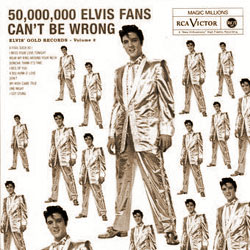
Cover of 50,000,000 Elvis Fans Can't Be Wrong

Cover of 50,000,000 Elvis Fans Can’t Be Wrong

When I order a new Elvis CD on Sony’s Follow That Dream Records collectors label, I usually pick up one of their older releases as well. This month’s release was an upgraded Classic Albums edition of 1972’s Elvis Now. If you haven’t already done so, be sure to check out Thomas’ great review of Elvis Now over on Elvis Today.

My backfill purchase this time to go along with Elvis Now was a 2007 entry in FTD’s Classic Album series, 50,000,000 Elvis Fans Can’t Be Wrong: Elvis’ Gold Records – Volume 2. RCA released the original LP album version in December 1959, near the end of Elvis’ stint in the US Army. The original consisted of the following songs:

Side A
I Need Your Love Tonight (1958)
Don’t (1957)
Wear My Ring Around Your Neck (1958)
My Wish Came True (1957)
I Got Stung (1958)

Side B
One Night (1957)
A Big Hunk O’ Love (1958)
I Beg Of You (1957)
A Fool Such As I (1958)
Doncha’ Think It’s Time (1958)

I’ve actually never bought this specific album in any form until now. When I bought The King of Rock ‘n’ Roll: The Complete 50s Masters set in 1993, I assumed it contained all of the tracks from this album.

Turns out, I was wrong. When I researched the albums for my recent marathon of Elvis songs released during his lifetime, I found that RCA released two slightly different versions of “Doncha’ Think It’s Time” back then.

The first version was the actual single (a splice of takes 47, 40, and 48), and it’s the one I had on The Complete 50s Masters. For whatever reason, they released a second version (a splice of takes 40 and 39) on the 50,000,000 Elvis Fans Can’t Be Wrong album. The second version was the one I was missing.

I don’t try to keep up with each of the thousands of song variations released since Elvis’ death – I pick and choose on those – but I do feel it is important to have all of the ones released while he was alive. I still have variants of four other songs to track down, including one on an FTD release that is no longer available (I waited too long to backfill that one).

The original 50,000,000 Elvis Fans Can’t Be Wrong album is a strong follow-up to 1958’s Elvis’ Golden Records. It contains several classic performances, including “One Night,” one of the best recordings of his career. Other highlights include “Don’t,” “A Big Hunk O’ Love,” and “A Fool Such As I.” The only weak spots are “My Wish Came True” (which needs a Jordanaires & Millie Kirkham mute button) and the lightweight “I Got Stung.”

Outtakes

The FTD edition of 50,000,000 Elvis Fans Can’t Be Wrong contains 88 tracks on two CDs. Compared to other Classic Albums releases I’ve bought, I have to say that I love the way FTD presents the outtakes on this release.

Instead of in the somewhat random fashion of other releases, FTD instead presents each one chronologically in order of recording. Each take, even false starts, gets its own track. That means you get to hear the same song several times in a row, which to me is the entire point of this kind of collectors label release.

Okay, so it’s not always a good thing. In the case of “I Got Stung,” you get to hear it 23 times in a row, which is about 22 times too many. For most songs, though, this is usually a great way to hear how Elvis and the band worked until it was just right. To be fair, even “I Got Stung” is better on the last take.

Unfortunately, they were apparently a lot faster to turn off the tape when recording Elvis in the 1950s versus the 1960s and 1970s. When a take is blown, someone usually cuts the tape quickly, so missing for the most part is a lot of the in between song banter that makes this kind of release so much fun.

Incidentally, most of the outtakes presented here are from Elvis’ June 1958 session in Nashville, which took place only three months after his induction in the Army. The weekend session was the only time he formally recorded while in the service.

Bonus Tracks

FTD adds “Ain’t That Loving You, Baby” and “Your Cheatin’ Heart” to the album for this release. “Ain’t That Loving You, Baby” gets 11 takes, including some versions at superspeed.

Beyond the masters, the best tracks for me on this album were actually the three that made up the 1958 Elvis Sails Extended Play album. This was a “talking album only” that consisted of three interviews conducted with Elvis while he was in the Army, shortly before leaving for Germany. It reached #2 on the EP charts.

It contains one of my all-time favorite Elvis quotes. A reporter asks the probing, in-depth question of, “Elvis, what’s your idea of the ideal girl?”

Elvis doesn’t miss a beat, answering, “Female, sir.” The press members erupt in laughter.

In a more serious segment, Elvis talks about his mother, who had passed away only weeks before:

My mother, I suppose since I was an only child that we might have been a little closer […] and Mother was always right with me all my life. And it wasn’t only like losing a mother, it was like losing a friend, a companion, someone to talk to. I could wake her up any hour of the night, and if I was worried or troubled about something, she’d get up and try to help me.”

Though the outtakes are occasionally interesting, it was Elvis Sails and the LP variant of “Doncha’ Think It’s Time” that made this release worthwhile for me.

So, were 50,000,000 Elvis fans wrong? Of course not. This is a great album, whether you bought it in 1959, 2007, 2010, or any other year.

Admitting a Guilty Pleasure

Today, I want to make a startling admission that may cause you to never want to read any of my Elvis reviews ever again.

In fact, it may forever change the way you read The Mystery Train Elvis Blog, if you come back here at all.

It’s not fair for me to keep posting here without letting you know the full truth, though. I can no longer hide this secret.

So, here it is. Prepare yourself. I’m even placing a random Elvis photo in between, in case you want to stop reading now and avoid the shock and horror of what I have to say below. Don’t say I didn’t warn you.

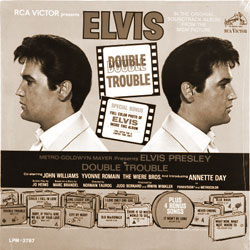
Cover of Double Trouble (1967)

Cover of Double Trouble (1967)

Here is my confession:

I love Elvis’ version of “Old MacDonald.”

There, I said it. I have finally admitted it.

I know the 1966 recording for the movie Double Trouble is considered a career low point for Elvis. By most accounts, recording the song was an extreme embarrassment for him – which is an accomplishment considering how embarrassing it must have been to record many of his other 1960s movie tunes, too.

Yet, despite all of that, I still can’t help but love “Old MacDonald.” I want to sing along every time it comes on. Maybe that’s the power of Elvis, or maybe that’s just the power of my own insanity.

I also enjoy the dark humor of the song, which was adapted by Randy Starr from the children’s tune for use in the movie. Stuff like, “…if those animals get out of line, we’ll have a mulligan stew…” Being an animal lover, I probably shouldn’t find that funny. But I do.

I have now admitted being a fan of a “bad” Elvis song. How about you? Are there any universally panned Elvis performances that you secretly enjoy? Make your confession in the comments below.

REVIEW: Elvis Now CD Set (2010 FTD Edition)

Elvis Now CD set (Follow That Dream Records, 2010)

Elvis Now: What’s in a name?

Apparently, we Elvis fans are not supposed to like Elvis Now. Even the new liner notes provided by Follow That Dream Records in this Classic Albums version of the release seem on the verge of being apologetic.

“With three older recordings, and precious few songs in the folk genre, neither the title of the album nor the original intent is of any importance anymore it seems,” the notes state in an entry about the album’s release in February 1972.

I think some people, including the unnamed author of FTD’s liner notes, get too hung up on the title. Three of the four Elvis releases in the seven months leading up to Elvis Now contained much older recordings, some dating all the way back to the 1950s.

Due to similar cover art featuring Elvis in concert in the early 1970s, the “Now” in Elvis Now simply distinguishes the album from the likes of C’Mon Everybody and I Got Lucky as containing current, post-Comeback Special material.

Additionally, “Elvis Now” was one of the marketing slogans used during his Vegas engagements. To complain about one song out of ten being three years old, and two others being nearly two years old, is to miss the point.

Compared to some of his other efforts at the time, Elvis Now is certainly a mellow album. The closest thing to a rocker is probably the gospel-infused “Put Your Hand In The Hand,” and that is a stretch.

In 1970, Elvis pointed out that he hated to be labeled a “strictly country” singer. The corollary to this is that he also should not be labeled as “strictly rock ‘n’ roll,” “strictly gospel,” or “strictly rhythm & blues.”

Elvis resisted such labels right from the start. “I don’t sound like nobody,” a much younger Elvis told Marion Keisker at the Memphis Recording Service in 1953.

You see, that is the real secret to the appeal of Elvis’ body of work as an artist. Those who judge his career based solely on various rock ‘n’ roll milestones do Elvis a disservice by overlooking his multi-faceted approach to music.

While rock ‘n’ roll mostly takes a back seat in Elvis Now, the album offers slices of some of the other kinds of music that he enjoyed creating. If you are willing to listen in new ways, the album can even be interpreted to include an emotional and thematic journey.

“I don’t want to be alone”

In “Sylvia,” love has been lost – although the hero-singer is in denial. (Side note: Elvis sings, “…here I am on the phone, wondering when she will call.” Uh, Elvis, maybe Sylvia was trying to call you all along but could not get through because you were on the phone!)

Bruce Springsteen once said that Elvis took away people’s loneliness, yet ended up so alone. You can feel this loneliness in the compelling “Help Me Make It Through The Night,” where the hero-singer begs to a lost love – maybe Sylvia, maybe someone before her – to remain by his side just one more night.

With apologies to Kris Kristofferson, had Elvis been a writer, “Help Me Make It Through The Night” sure sounds like a song he might have written to fight some of his own demons.

Though not as strong of a composition, “Until It’s Time For You To Go” shows the hero-singer later that night still wanting to hold on to this doomed romance for as long as possible. “I’m not a king, I’m just a man,” he intones, pleading for understanding.

In “We Can Make The Morning,” the hero-singer continues to fight the darkness, singing, “It’s a long, long lonely night, we can make the morning if we try.” This stunning performance is an often-overlooked gem.

When the couple finally makes it to a new day, “Early Morning Rain,” the album’s best song, reveals that it is not as bright as the hero-singer expected. It is the same as the day before, and he is still down. “I’m stuck here on the ground,” he sings, for as it always does, night will come again – and with it the loneliness.

“Take a sad song and make it better”

Finding no consolation with his lost love, the hero-singer now seeks another cure to his loneliness in “Put Your Hand In The Hand” and “Miracle Of The Rosary.” He places faith in God, seeking the same comfort in music as he sought in life.

Faith leads to hope in “Hey Jude” and the tides begin to change. Much underrated, Elvis recorded this entertaining jam only months after the original release of the Beatles classic. Yes, Elvis mixes up some of the lyrics, but that is all part of the fun. This is another highlight of the album.

The hero-singer realizes his hope by falling in love yet again in “Fools Rush In,” the weakest song here. The mood is vibrant yet cautionary: “When we met, I felt my life begin, so open up your heart and let this fool rush in.”

He has fallen for someone new, but we are left to wonder if she returns this love. Otherwise, this new interest may go the way of Sylvia and lead to yet another long, lonely night.

Were it not for the strength of the other songs on Elvis Country, “I Was Born About Ten Thousand Years Ago” could very well have ruined that album due to the senseless decision to edit it in between each tune. On Elvis Now, the complete song works much better – tying everything up.

“I Was Born About Ten Thousand Years Ago” is a song about mankind and the human experience. In the end, the human experience is what Elvis Now is about, too: loneliness, despair, faith, hope, and love. An exciting album? No. A worthwhile album? Very much so.

Outtakes

Unfortunately, there are not a lot of revelations this time around with the outtakes. The best of the outtakes are takes 7 and 15 of “Help Me Make It Through The Night” (tracks 9 and 17, respectively, on disc 2). Outtakes of “Fools Rush In” prove as mundane as the master version. The outtakes of “Early Morning Rain” are disappointing in their mediocrity – considering the brilliance of the master take.

Bonus Songs

While it’s always great to hear the top-notch songs “I’m Leavin’,” “It’s Only Love,” and “The First Time Ever I Saw Your Face,” the real stand-out among the bonus songs is the unedited master of the “Don’t Think Twice, It’s All Right” jam, clocking in at over nine minutes.

You are there as Elvis and the band take this Bob Dylan song through its paces. Like “Hey Jude,” he does not know all of the words – and, again, that is not the point here. This is Elvis making music with a joy that is noticeably absent from many of the other tracks on this release.

Though the same words are repeated over and over, the nine minutes goes by before you know it. I love this kind of thing, so I must have listened to it four or five times in a row. The edited version of this song (shortened to under three minutes) first appeared on 1973’s Elvis (“Fool”) album, so my hope is that the full-length version is presented on Elvis Now because the FTD upgrade of the Elvis album will have too many other outtakes to accommodate it.

Also of note are impromptu versions of the Beatles’ “Lady Madonna” and Dylan’s “I Shall Be Released,” both of which were first released on Walk A Mile In My Shoes. “Lady Madonna” is slightly longer here.

Final verdict

Perhaps the best part of FTD’s Elvis Now is that every song sounds better than it ever has before. If you love Elvis in the 1969 – 1971 era represented by this album and care about audio quality, you will be thrilled with these sound upgrades – particularly on the master takes. Kudos to FTD for much improvement in this area over the years.

Elvis Now is a different kind of listening experience than that of From Elvis In Memphis or That’s The Way It Is. While those two albums are monumental, their greatness should not take away from the understated achievement that Elvis Now represents.
Experience Elvis in Lake Tahoe with High Sierra

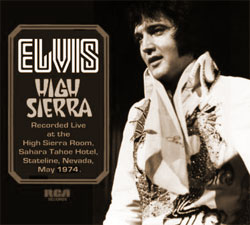
High Sierra cover (concept art)

High Sierra cover (concept art)

In May, Follow That Dream (FTD) Records is releasing High Sierra, a new CD containing Elvis’ May 21, 1974, show at the Sahara Tahoe Hotel (now the Horizon Casino Resort). Rounding out the set are six bonus songs from the same engagement, as well as an 8-page booklet. The track listing certainly has my attention:

01 See See Rider
02 I Got A Woman/Amen
03 Love Me
04 Trying To Get To You
05 All Shook Up
06 Love Me Tender
07 You Don’t Have To Say You Love Me
08 Hound Dog
09 Fever
10 Polk Salad Annie
11 Why Me Lord
12 Suspicious Minds
13 Introductions
14 I Can’t Stop Loving You
15 Help Me
16 Bridge Over Troubled Water
17 Let Me Be There
18 The First Time Ever I Saw Your Face
19 Big Boss Man
20 Can’t Help Falling In Love
21 Closing Vamp
Bonus Tracks
22 Johnny B. Goode
23 Steamroller Blues
24 Spanish Eyes
25 How Great Thou Art
26 It’s Now Or Never
27 I’m Leavin’
28 Introducing Billy Eckstine

What a great and varied collection of songs! I don’t collect every FTD CD, but this one looks like a potential must-have to me. I’m especially looking forward to hearing “I’m Leavin’,” “The First Time Ever I Saw Your Face,” “It’s Now Or Never,” “Spanish Eyes,” “Bridge Over Troubled Water,” and “You Don’t Have To Say You Love Me.”

FTD is Sony’s Elvis collectors label, aimed directly at fans rather than the general public. FTD releases are like official versions of bootlegs. The Elvis bootleg industry is huge, but FTD provides a legal alternative with releases focusing on alternate takes and live performances. While the mainstream is listening to yet another greatest hits compilation, the hardcore fans are listening to FTD releases. The FTD releases are available from ShopElvis.com and other online Elvis retailers.

Also coming in May is Showtime! Birmingham/Dallas ’76, a two CD set containing Elvis’ December 28 (Dallas) and December 29 (Birmingham), 1976, concerts.

For those of us in the United States, FTD releases (which are imports) are normally about one month behind. So, we can expect to see these two titles in June.

From Elvis Presley to Moody Blue in 21 Days

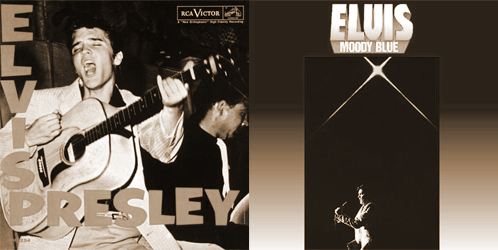
The covers of Elvis Presley's first and last albums

The covers of Elvis Presley’s first and last albums

Though I’m a huge Elvis fan, I don’t listen to my favorite singer exclusively. Variety is the spice of life, and I enjoy all kinds of music. Back on Saint Patrick’s Day, though, before I even created The Mystery Train, I began a marathon of sorts where I’ve been spending all of my music time listening to Elvis.

Starting with 1956’s Elvis Presley, I listened in order to every album that Elvis released during his lifetime. I skipped previously released tracks on compilation albums, meaning I only listened to each individual recording once. Between albums, I sprinkled in the few unique singles that never appeared on albums while he was alive (e.g., “The First Time Ever I Saw Your Face”).

My Elvis odyssey ended earlier this week when I reached the conclusion of 1977’s Moody Blue. In 21 days, I had listened to just about every Elvis track released during his lifetime, over 700 in all (more than 30 hours of music). It turns out I am missing five song variants, which I have started tracking down.

Going from beginning to end with Elvis was quite an experience. Other than the doldrums of the worst of his 1960s movie soundtracks, the quality of his album output was actually a lot better than some folks would have you believe.

Starting with two or three tracks on 1966’s Spinout, though, you can feel the approaching storm and revitalization of his 1968 comeback. Finally, when “Tiger Man” closes out the surprisingly great Singer Presents Elvis Singing Flaming Star And Others, the anticipation for the very next album, the milestone ELVIS-TV Special, reaches its height.

From that point on, everything is different, and Elvis begins releasing the best music of his life. Despite what people will try to tell you, that holds true all the way to the end – with the stunning and heartfelt From Elvis Presley Boulevard and Moody Blue albums, both recorded at Graceland.

I’m not sure if I’ll ever listen to Elvis’ album output in sequence again, but it was an amazing experience.