REVIEW: Boston Garden CD (FTD)

Elvis As Recorded At Boston Garden ‘71 CD (Follow That Dream Records, 2010)

Yesterday’s dream

You have been an Elvis fan for 15 years, through the ups and downs since 1956. When the Beatles came to Boston seven years ago, you stayed home. Now, finally, the one you were really waiting for is here.

You forget about the borrowed camera you are clutching as Elvis appears, as if out of magic.

Fans erupt in screams. You do not even realize that you are yelling, too, as Elvis grabs the microphone.

“Well, that’s all right little mama, that’s all right with you. That’s all right little mama, just any way you do,” he sings. Are you dreaming? Is this really happening?

By the middle of the show, you suddenly remember the camera. You only make it a little closer before the police and security guards push you back. You have never used this camera before, but you snap away, hoping it is close enough to preserve this moment, this feeling, forever.

Then, all too soon, it comes to an end.

Before you know it, Elvis is gone, and 39 years have passed by.

You would have never believed back then that photos you snapped in 1971 would appear in an official release of the Elvis concert you witnessed that day at Boston Garden. You even write the liner notes, filling them with your memories of this unforgettable event.

Like the idle daydream of an Elvis fan, it sounds too good to be true. Yet, this is exactly what happened for Cathi Avenell, who supplied photographs and liner notes for FTD’s latest release, Elvis As Recorded At Boston Garden ’71.

Bridging the gap

While the best concerts of the 1969-1977 Elvis era undoubtedly took place in the hot Vegas summers of 1969 and 1970, this November 1971 show stands out among the others. For this time period, it represents the earliest recording yet released of Elvis on the road in the 1970s—rather than in a Las Vegas showroom. It also serves to bridge the gap between his 1970 and 1972 live recordings.

Though this show only precedes his 1972 Vegas engagement by three months, the difference is sometimes striking. This late 1971 Elvis still has some of the 1969 and 1970 fire in him, as opposed to the subdued performances of the early 1972 engagement.

This late 1971 Elvis interacts with the crowd and still apparently enjoys himself, while the early 1972 Elvis seems to do little of either.

If anything, the Boston show often feels like a bizarre crossbreed of August 1970’s That’s The Way It Is concerts and June 1972’s Madison Square Garden shows.

Quick tour of the tracks

Track 01 “Also Sprach Zarathustra”/Track 02 “That’s All Right”: Elvis experimented with various show openers over the years, but the ultimate was “Also Sprach Zarathustra” (theme from 2001: A Space Odyssey) segueing into “That’s All Right,” his first record. Elvis really rocks “That’s All Right” here, the first sign that this will be a great show.

Track 03 “I Got A Woman/Amen”: What sometimes feels like a throwaway version of “I Got A Woman” early on eventually tightens up. “Amen” here is relatively short, not the endless repeats of later years.

Track 04 “Proud Mary”: Though it sometimes has more energy, this sounds like Elvis’ 1972 versions.

Track 05 “You Don’t Have To Say You Love Me”: I have still yet to hear a worthwhile version after 1970.

Track 06 “You’ve Lost That Lovin’ Feelin’”: Disappointing. Elvis sounds distracted throughout.

Track 07 “Polk Salad Annie”: Here is a perfect example of why As Recorded At Boston Garden ’71 is so cool, a hybrid between the 1970 and 1972 variations of “Polk Salad Annie.” While the overall vibe matches 1972, the talking portion is still present at the beginning. Elvis jokes his way through the “little story” though, perhaps an indicator of boredom that resulted in its eventual removal. After the jokes, this is a strong version of the song.

Track 08 Instrumental: You’ll recognize this one as “Comin’ Home Baby,” the instrumental often played while Elvis introduced his band and other stage performers. No introductions on this track, though, making it a rare stand-alone version of the song.

Track 09 “Love Me”: Already sounding like 1972 and beyond throwaway versions, this “Love Me” lacks the spark of the 1970 versions.

Track 10 “Heartbreak Hotel”: Speaking of throwaways, one of the worst versions of this song I have heard by Elvis. I like the bluesy take on it he first introduced in 1969, but Elvis fools around too much on this one for my taste. Maybe it was a ‘You had to be there’ moment.

Track 11 “Blue Suede Shoes”: Rushed, 1972-style. Better than “Heartbreak Hotel,” at least.

Track 12 “One Night”: Right after he sings, “Just call my name. . .,” someone with an irritating voice yells out “ELVIS!” and spoils an otherwise great version, reminiscent of 1970.

Track 13 “Hound Dog”: The typical bluesy slow start into a fast rocking ending, 1972-style. I never cared for this arrangement.

Track 14 “How Great Thou Art” (incomplete): We get about two-thirds of the song here before an artificial fade. Hard to judge without the big ending, but it probably would have been a contender for best song on the album had the performance been intact.

Track 15 Introductions (incomplete): “Comin’ Home Baby” plays again as Elvis introduces the band (joined in progress).

Track 16 “I’m Leavin’”: A true highlight, the best live version released so far. This was only six months after he recorded the song in RCA’s Nashville studio.

Track 17 “Bridge Over Troubled Water”: A stunning performance, especially considering that it sounds average at the beginning. Do not miss this one, best track on As Recorded At Boston Garden ’71.

Track 18 “I Can’t Stop Loving You”: A tad slower, but otherwise sounds like a 1972 version. Enjoyable.

Track 19 “Love Me Tender”: Annoying that this becomes a throwaway with ad-libbed lyrics, because Elvis sounds in such good voice.

Track 20 “Suspicious Minds”: By far, the biggest disappointment of the album. Perhaps the worst live version I have heard, due to jokes and distractions. Arrangement is 1972-style.

Track 21 Elvis Talks: For the third time, “Comin’ Home Baby” plays. Elvis does his traditional request to turn the house lights up so that he can better see the audience. It is fun hearing Elvis thanking the crowd in a mellow kind of way as the music goes on behind him. It almost sounds like he is about to leave on the spot but instead he launches into. . . .

Track 22 “Funny How Time Slips Away”: Like “Polk Salad Annie,” this version is interesting as a previously missing evolutionary step for the song. The softened lyric “In time, it’s all gonn’ be okay” has already replaced the original “In time, you’re gonna pay,” but the finale is still “Ain’t it surprising how time slips away.” Probably the best post-1970 version.

Track 23 “Can’t Help Falling In Love”/Track 24 Closing Vamp: “Let’s take it home,” Elvis announces, then launches into a decent 1972-style version of “Can’t Help Falling In Love,” and the show is soon over.

Final verdict

Taken as a whole, Elvis As Recorded At Boston Garden ’71 is a strong release. Concerts probably should not be picked apart song-by-song as I have done here, as it is the overall experience that counts. Elvis more than delivers a fantastic show. This is one of many concerts where I find myself wishing that I could have somehow been there.

Sound quality is impressive, considering that it is a soundboard recording. I love how FTD tied in the album art with the Elvis As Recorded At Madison Square Garden album. The liner notes and photos by Avenell give this release a personal feel and warmth.

A must-have for fellow fans of the era.
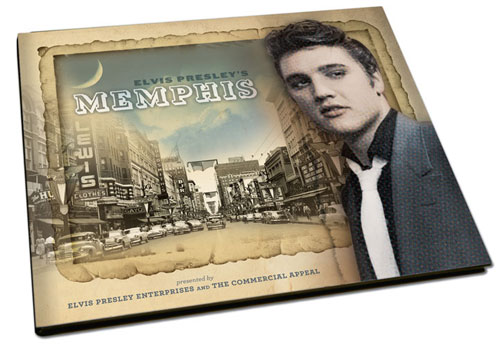
Elvis lives his dreams in Memphis

Elvis Presley's Memphis (2010)

Elvis Presley’s Memphis (2010)

Elvis Presley’s Memphis (book)
Presented By Elvis Presley Enterprises and The Commercial Appeal
176 pp. Pediment. $39.95

As I journeyed yet again through the life of Elvis Presley, this literary trip built upon the context of Memphis, I was happy to find some new insights into the man. This is not the average Elvis coffee table book – you know, the ones that shuffle around the same photos and text from last year’s variation.

That Elvis Presley’s Memphis is different is evident right from the start. The cover is hardly typical of those of other Elvis books, which tend to be rush jobs consisting of a common photo of Elvis with a title slapped above it. “It doesn’t matter what it looks like, fans will buy it because its Elvis,” seems to be the mentality.

Instead, this book features a creatively designed, beautiful cover with a lesser-known photo of Elvis superimposed against a vintage 1951 backdrop of Main Street in Memphis. Look carefully at this work of art and you’ll see the Loew’s State Theater is playing Father’s Little Dividend, starring Spencer Tracy, Joan Bennett, and Elizabeth Taylor. Within the book, you’ll find a photo of Elvis at the same theater in 1950, when he worked there as an usher until fired by manager Arthur Groom for getting into a fight with a co-worker.

Elvis apparently held no hard feelings for his former boss, for another photo shows him with Groom several years later for the 1957 Jailhouse Rock premiere – at Loew’s State Theater. His first movie, Love Me Tender, also premiered there in 1956. Business must have been good at Loew’s with that kind of publicity.

Imagine how it must have felt for Elvis to watch himself on screen at the same movie theater he worked at only years before. “When I was a child . . . I was a dreamer. . . . I saw movies, and I was the hero in the movie,” Elvis once said.

“Every dream I ever dreamed has come true a hundred times,” he continued. At its heart, Elvis Presley’s Memphis is about those dreams. The dreams of a 13-year-old as his family moves to Memphis from Tupelo, Mississippi, for a fresh start. The dreams of an 18-year-old as he pays to record a couple of songs at the Memphis Recording Service. The dreams of a 33-year-old as he holds his daughter for the first time.

The bind between Elvis and Memphis is indeed strong, but perhaps no stronger than at Graceland, the home he purchased there on Highway 51 South in 1957 as his rising fame literally chased him out of his previous neighborhood on Audubon Drive. Could the 22-year-old ever have dreamed that Memphis would one day rename the street in front of that mansion in his honor?

Only twenty years later, Elvis would spend his last days at Graceland on Elvis Presley Boulevard. “When the news of Elvis’ death was heard over the police radio, the entire force felt they had lost one of their own,” writes Robert Dye in a section called “Memphis Beat.” You see, Elvis’ renowned collection of police badges was more than just a hobby.

Though they may have indeed been honorary, those badges meant something real not only to him, but also to those who bestowed them – none more so than the Memphis police. While stories of Elvis’ generosity are legendary, there are some here involving the police that are worthy of the spotlight placed on them by this book. Elvis had his flaws, as do we all, but I remain proud to call myself a fan.

From a boy who had little in the way of material possessions to a man who could afford to buy seemingly anything – go-karts, motorcycles, cars, and even airplanes – the life of Elvis in Memphis is detailed in a series of occasionally repetitive articles. Much of this book is about Elvis having fun, for while he sometimes worked in Memphis, it more often served as his playground, a place to unwind and relax.

Some of the stories are new, while others are reprinted from The Commercial Appeal or The Memphis Press Scimitar newspapers. Most are well-written and informative, though a few appear to be excerpts or sidebars from longer pieces and include chopped bits of information that go no deeper than the typical travel brochure for Graceland.

While Elvis is the focus, the book also paints a portrait of Memphis as a whole, including in a running timeline not only significant events in Elvis history, but significant events in Memphis history as well. The two are often intertwined. 1968’s entries include: “April 4: Martin Luther King is assassinated at the Lorraine Hotel in Memphis. Elvis is in California. June 23: Elvis records ‘If I Can Dream.'”

Filled with truly rare documents and photos, including one of Elvis visiting his mother’s grave, Elvis Presley’s Memphis is a standout among the many printed works about this often misunderstood man.

* * *

Cover image courtesy of Pediment Books. Used with permission.

Looking Back at Elvis’ Benefit Concert in Hawaii

Elvis was nervous at the start of the show, but the screaming audience has since calmed his fears. Truth is, he learned to use his nervous energy to his advantage on stage years ago. Despite all that has changed in his life, the fuel that powers him continues to be his fans.

This concert is a little different from most of the others, though. This time, he is in Hawaii to raise money for a cause that is very important to him. Colonel has worked out most of the details, of course, including talks with NBC to have the concert aired on TV.

A few songs in now, Elvis glances at his hastily scribbled list to see what is up next. It turns out to be one of his favorites, one sure to get a reaction from the crowd. “Treat me like a fool,” he begins and is met with more yells of approval. He still knows his audience, no matter what anybody says.

After introducing the band and backup singers, it is time for another song. He first heard this Drifters number back in 1954, but didn’t get to record it until he was out of the Army. “It was a night, ooh what a night it was, it really was such a night,” he sings into the microphone.

This time, the audience is a little quiet at first. They don’t know this one as well. No problem, Elvis throws a little leg into it and is instantly rewarded with more cheers. Secretly, he is glad Colonel’s deal fell through and those NBC cameras aren’t here after all. No need to tone this show down.

The year is 1961, and Elvis is in Hawaii to help raise money for the USS Arizona memorial. Just over seven months from now will mark the twentieth anniversary of the December 7, 1941, Japanese sneak attack on Pearl Harbor that plunged the United States into the middle of World War II.

That attack sunk the mighty Arizona, forever entombing over 1,000 officers and crew below the water in the battleship. Yet, a memorial commission established in 1949 is still having trouble finding the money to start construction on a proper tribute to the fallen.

* * *

Though NBC ended up not filming the show, fortunately at least the audio was captured and preserved for us to still hear today. It appears on the 1980 “Silver” boxed set Elvis Aron Presley, which received a CD release in 1998. The sound quality is not great, but it is certainly listenable.

I pulled this set out for the first time in years yesterday and loved hearing this top-notch and exciting concert. It also reminded me that quite some time ago I had set aside a related book for later reading. As is often the case, by the time “later” came, I had forgotten about it.

Elvis In Hawaii by Jerry Hopkins (author of Elvis: A Biography and Elvis: The Final Years) is an oversized book filled with text and photos about Elvis’ various excursions to Hawaii, including this 1961 concert. One of the cool pieces of memorabilia in the book is Elvis’ handwritten set list for the show, which helped inspire today’s post. Interestingly, he originally planned to sing “Doin’ The Best I Can,” a 1960 album cut from G.I. Blues, before scratching it out and replacing it with his 1956 hit “Don’t Be Cruel.”

Of course, Elvis would return to Hawaii a number of times after this show, including the 1973 cancer fund benefit for which the television cameras of NBC and the world were present, Aloha From Hawaii. Only two songs appear in both his 1961 and 1973 benefit concerts in Hawaii. Can you name them?

USS Arizona Memorial in 2006

USS Arizona Memorial in 2006

The 1961 USS Arizona benefit raised over $50,000 for the memorial as well as turned a spotlight on the issue to encourage contributions from others, including the US Congress. On Memorial Day 1962, the memorial was finally dedicated.

Though no one knew it at the time, the show also marked Elvis’ last live appearance for over seven years until the studio audience tapings of the 1968 ELVIS television special and his full-fledged 1969 Las Vegas shows. Instead, for better or worse, most of the rest of his 1960s career would focus on making movies.

* * *

Elvis knows he could stay on all night and they would stay, but the show is winding down now. He won’t be leaving Hawaii yet, though.

In just a couple of days, he has to start filming a new movie, Blue Hawaii. Though Mr. Wallis once told him it was to be a “drama,” Elvis is no longer so sure of that after reading the script and recording over a dozen songs for the soundtrack back in Hollywood just a few days ago.

Being on stage in Hawaii is a lot better than that stuffy recording studio. “We’d like to do a spiritual song for you, ladies and gentlemen, from our religious album called His Hand In Mine,” he says. “It goes something like this.”

He launches into “Swing Down, Sweet Chariot.” For that moment on stage, all is right in his world.

REVIEW: Elvis Now CD Set (2010 FTD Edition)

Elvis Now CD set (Follow That Dream Records, 2010)

Elvis Now: What’s in a name?

Apparently, we Elvis fans are not supposed to like Elvis Now. Even the new liner notes provided by Follow That Dream Records in this Classic Albums version of the release seem on the verge of being apologetic.

“With three older recordings, and precious few songs in the folk genre, neither the title of the album nor the original intent is of any importance anymore it seems,” the notes state in an entry about the album’s release in February 1972.

I think some people, including the unnamed author of FTD’s liner notes, get too hung up on the title. Three of the four Elvis releases in the seven months leading up to Elvis Now contained much older recordings, some dating all the way back to the 1950s.

Due to similar cover art featuring Elvis in concert in the early 1970s, the “Now” in Elvis Now simply distinguishes the album from the likes of C’Mon Everybody and I Got Lucky as containing current, post-Comeback Special material.

Additionally, “Elvis Now” was one of the marketing slogans used during his Vegas engagements. To complain about one song out of ten being three years old, and two others being nearly two years old, is to miss the point.

Compared to some of his other efforts at the time, Elvis Now is certainly a mellow album. The closest thing to a rocker is probably the gospel-infused “Put Your Hand In The Hand,” and that is a stretch.

In 1970, Elvis pointed out that he hated to be labeled a “strictly country” singer. The corollary to this is that he also should not be labeled as “strictly rock ‘n’ roll,” “strictly gospel,” or “strictly rhythm & blues.”

Elvis resisted such labels right from the start. “I don’t sound like nobody,” a much younger Elvis told Marion Keisker at the Memphis Recording Service in 1953.

You see, that is the real secret to the appeal of Elvis’ body of work as an artist. Those who judge his career based solely on various rock ‘n’ roll milestones do Elvis a disservice by overlooking his multi-faceted approach to music.

While rock ‘n’ roll mostly takes a back seat in Elvis Now, the album offers slices of some of the other kinds of music that he enjoyed creating. If you are willing to listen in new ways, the album can even be interpreted to include an emotional and thematic journey.

“I don’t want to be alone”

In “Sylvia,” love has been lost – although the hero-singer is in denial. (Side note: Elvis sings, “…here I am on the phone, wondering when she will call.” Uh, Elvis, maybe Sylvia was trying to call you all along but could not get through because you were on the phone!)

Bruce Springsteen once said that Elvis took away people’s loneliness, yet ended up so alone. You can feel this loneliness in the compelling “Help Me Make It Through The Night,” where the hero-singer begs to a lost love – maybe Sylvia, maybe someone before her – to remain by his side just one more night.

With apologies to Kris Kristofferson, had Elvis been a writer, “Help Me Make It Through The Night” sure sounds like a song he might have written to fight some of his own demons.

Though not as strong of a composition, “Until It’s Time For You To Go” shows the hero-singer later that night still wanting to hold on to this doomed romance for as long as possible. “I’m not a king, I’m just a man,” he intones, pleading for understanding.

In “We Can Make The Morning,” the hero-singer continues to fight the darkness, singing, “It’s a long, long lonely night, we can make the morning if we try.” This stunning performance is an often-overlooked gem.

When the couple finally makes it to a new day, “Early Morning Rain,” the album’s best song, reveals that it is not as bright as the hero-singer expected. It is the same as the day before, and he is still down. “I’m stuck here on the ground,” he sings, for as it always does, night will come again – and with it the loneliness.

“Take a sad song and make it better”

Finding no consolation with his lost love, the hero-singer now seeks another cure to his loneliness in “Put Your Hand In The Hand” and “Miracle Of The Rosary.” He places faith in God, seeking the same comfort in music as he sought in life.

Faith leads to hope in “Hey Jude” and the tides begin to change. Much underrated, Elvis recorded this entertaining jam only months after the original release of the Beatles classic. Yes, Elvis mixes up some of the lyrics, but that is all part of the fun. This is another highlight of the album.

The hero-singer realizes his hope by falling in love yet again in “Fools Rush In,” the weakest song here. The mood is vibrant yet cautionary: “When we met, I felt my life begin, so open up your heart and let this fool rush in.”

He has fallen for someone new, but we are left to wonder if she returns this love. Otherwise, this new interest may go the way of Sylvia and lead to yet another long, lonely night.

Were it not for the strength of the other songs on Elvis Country, “I Was Born About Ten Thousand Years Ago” could very well have ruined that album due to the senseless decision to edit it in between each tune. On Elvis Now, the complete song works much better – tying everything up.

“I Was Born About Ten Thousand Years Ago” is a song about mankind and the human experience. In the end, the human experience is what Elvis Now is about, too: loneliness, despair, faith, hope, and love. An exciting album? No. A worthwhile album? Very much so.

Outtakes

Unfortunately, there are not a lot of revelations this time around with the outtakes. The best of the outtakes are takes 7 and 15 of “Help Me Make It Through The Night” (tracks 9 and 17, respectively, on disc 2). Outtakes of “Fools Rush In” prove as mundane as the master version. The outtakes of “Early Morning Rain” are disappointing in their mediocrity – considering the brilliance of the master take.

Bonus Songs

While it’s always great to hear the top-notch songs “I’m Leavin’,” “It’s Only Love,” and “The First Time Ever I Saw Your Face,” the real stand-out among the bonus songs is the unedited master of the “Don’t Think Twice, It’s All Right” jam, clocking in at over nine minutes.

You are there as Elvis and the band take this Bob Dylan song through its paces. Like “Hey Jude,” he does not know all of the words – and, again, that is not the point here. This is Elvis making music with a joy that is noticeably absent from many of the other tracks on this release.

Though the same words are repeated over and over, the nine minutes goes by before you know it. I love this kind of thing, so I must have listened to it four or five times in a row. The edited version of this song (shortened to under three minutes) first appeared on 1973’s Elvis (“Fool”) album, so my hope is that the full-length version is presented on Elvis Now because the FTD upgrade of the Elvis album will have too many other outtakes to accommodate it.

Also of note are impromptu versions of the Beatles’ “Lady Madonna” and Dylan’s “I Shall Be Released,” both of which were first released on Walk A Mile In My Shoes. “Lady Madonna” is slightly longer here.

Final verdict

Perhaps the best part of FTD’s Elvis Now is that every song sounds better than it ever has before. If you love Elvis in the 1969 – 1971 era represented by this album and care about audio quality, you will be thrilled with these sound upgrades – particularly on the master takes. Kudos to FTD for much improvement in this area over the years.

Elvis Now is a different kind of listening experience than that of From Elvis In Memphis or That’s The Way It Is. While those two albums are monumental, their greatness should not take away from the understated achievement that Elvis Now represents.

What Might Have Been: The Home Recording Studio

On the edge of reality. . . .

The rest of the world is asleep, but Elvis Presley is on a mission. As he bursts through the door, his friends Red and Charlie are already in the studio, setting up microphones. The small facility is just big enough for a piano, a few stools, and two or three of his favorite guitars.

Ignoring the piano for now, he grabs his trusty Gibson J200 and begins picking out the song that would not leave his head. “We’re rolling,” says Red, his hands moving over the control board with ease. The year is 1964, and Elvis is about to make his third album at his Graceland studio.

* * *

At least, that’s how I like to imagine what might have been.

Little moments in time can change history. Leave a few seconds early and avoid a car crash, leave a few seconds later and never make it back home.

At least one such potential life-altering moment in Elvis’ life jumped out at me when I first read a couple of key books about him.

It took me awhile to find the passage just now in Peter Guralnick’s Careless Love: The Unmaking of Elvis Presley (1999), which covers Elvis’ life from 1958 to 1977. I thought it occurred closer to the late 1960s. Turns out, it is about 1960. Here’s the moment:

RCA [. . .] even offered to build Elvis a studio in his home so he could record whenever the inspiration took him – but the Colonel wisely urged him to turn the company down, seeing their generosity for what it was, a desperate attempt to generate more product and thereby undercut the Colonel’s unassailable bargaining position” (p. 84).

Could this have changed everything? Prior to Elvis’ June 1961 Nashville session, the home recording studio receives another mention:

The idea of a home studio had been broached again a number of months earlier; this time Elvis actually indicated his interest in building a recording facility at Graceland, and initial plans were drawn up […]” (p. 112).

Ernst Jorgensen also mentions the fate of the studio project in 1998’s Elvis Presley: A Life In Music:

After initially promoting the idea, the label realized it would be a mistake to single one of its artists out above all others; eventually, the Colonel worked out a compromise in which Elvis received, among other considerations, some up-to-date RCA stereo equipment – and RCA got to keep Nashville’s Studio B as Elvis’s recording home base” (p. 150).

Considering that Elvis Presley was RCA’s most successful recording artist, the company should have made an exception in this case and built Elvis his studio. If other artists complained, they should have just been told that they could have their own studios, too – as soon as they sold as many records as Elvis.

Another huge recording artist of the 1960s, Ray Charles, had his own studio. What if, like Charles, Elvis had been able to record whenever the mood struck him, rather than being forced to create on demand at pre-determined studio times?

What kinds of music would he have produced if left to his own devices at Graceland? Sure, we have scratchy, home recordings made by Elvis on tape recorders, but what if he had been able to professionally record in his home?

Of course, Elvis eventually did record at Graceland –  in 1976 – but under markedly different circumstances. As Guralnick describes:

So desperate was RCA to lure Elvis back into the studio that they revived the old dream of recording him at home. This time, however, both the nature and the reason for the plan were a far cry from its original conception fifteen years before. […] And far from building him a new state-of-the-art plaything, they now proposed simply to install temporary equipment in the den behind the kitchen […]” (p. 593).

While the Graceland sessions that produced From Elvis Presley Boulevard and most of Moody Blue turned out to be special, I still can’t help but wonder what might have been if plans for building a true recording studio at Graceland had come to pass?

Would it have just been another intense but soon forgotten hobby – like slot cars or the Circle G?

Or would Elvis the artist have finally been able to fully realize his dreams?

* * *

After three takes, he puts down his guitar. He wants to focus only on the vocals. He nods to his friend, who kills the lights in the studio. The year is 2010. At home, Elvis begins to sing. . . .

REVIEW: Good Times CD Set (2009 FTD Edition)

Good Times CD set (Follow That Dream Records, 2009)

A perfect presentation for an imperfect album

Good Times marked the second album released from Elvis’ 1973 sessions at Stax studio in Memphis. This version from the Follow That Dream collectors label includes all ten tracks from the original album and thirty-seven additional tracks of alternate takes and undubbed masters. FTD’s Classic Album series serves as the best possible format for this album, with sound quality in most cases as good or better than previous releases.

Take Good Care Of Her

  • Disc 1, Track 01, Master—Take 6: You have to give Elvis credit. Musically, he openly dealt with his relationship issues from just about every angle imaginable. In “Always On My Mind,” the singer begged forgiveness and asked for another chance from his wife. In “Separate Ways,” he accepted the split as inevitable. In “Take Good Care Of Her,” Elvis even directed a surprisingly benign message at his soon-to-be ex-wife’s new love interest. Whether his real-life actions measured up to his song choices is a debate for another time, but certainly, Elvis found creative sparks in his relationship problems that fueled many of his later recordings. Though many could be labeled as “dark” or “depressing,” these deeply personal recordings also may be the best insight into how Elvis was feeling during the last few years of his life. Though “Take Good Care Of Her” is not a great song by itself, it is Elvis’ personal conviction and passion that somehow make it more than it really should be.
  • Disc 1, Track 11, Rehearsal & Take 1: Here, we get a short rehearsal segment, followed by Elvis’ first attempt to record the song. Elvis almost sings to himself during the rehearsal, an interesting listen just for the “fly on the wall” aspect. Absent from the master take, you can hear a hint of bitterness in Elvis’ voice as he goes through Take 1. “Just to be around her was my greatest pleasure, she was everything my future held in store,” he sings sadly.
  • Disc 2, Track 06, Takes 2, 3: Take 2 falls apart just seconds into the song. Take 3 is complete, but unremarkable.
  • Disc 1, Track 23, Take 4: Nothing special here, either, though you can still hear more bitterness than on the master.
  • Disc 2, Track 17, Take 5: Producer Felton Jarvis apparently brings this take to an early close, causing Elvis to curse and comment, “Now I know how Jesus felt with that thorn in his side.”
  • Disc 2, Track 18, Take 6 (Undubbed Master): One of the best services that FTD provides us Elvis fanatics is supplying the undubbed versions of many of his master recordings. These stripped-down versions are often revelations, sometimes sounding better than the released recordings. For this song, though, I actually slightly prefer it with the overdubs. It is nice to have both options for this and the other songs on this album, though – a real selling point for this release and many others in the Classic Album series.

Loving Arms

  • Disc 1, Track 02, Master—Take 3: “Loving Arms” is one of Elvis’ best country songs – ranking right up there with just about anything on Elvis Country. This is a superb performance, one of the highlights of Good Times. This FTD release is the best this song has ever sounded, as if you are standing in the studio with Elvis as he pleads, “If you could only hear me now. . . .”
  • Disc 1, Track 12, Take 1 & Rehearsal: Elvis plays around with the tempo of “Loving Arms” during Take 1, obviously trying to find the “sweet spot.” By the end, you can hear the confidence in his voice as he begins to get it just right. After the take, Elvis and the other musicians work out a new ending for the song.
  • Disc 2, Track 02, Take 2: This is another faster take on the song. It’s probably too fast, but the power of his voice still makes it a worthwhile listen.
  • Disc 2, Track 12, Take 3 (Undubbed Master): I must note again that sound quality here is simply amazing, especially considering these recordings are over 35 years old. I prefer the dubbed version, mostly because the ending of the song is improved by removing the obnoxiously loud chorus on the last note.

I Got A Feelin’ In My Body

  • Disc 1, Track 03, Master—Take 3: There are three songs that drag Good Times down from being a real contender for one of the top albums of his career. Unfortunately, they all come right in a row. First up among the losers is “I Got A Feelin’ In My Body,” a fast-paced gospel number on which Elvis sounds like he is trying too hard. The song is not very good, and Elvis is unable to save it this time.
  • Disc 1, Track 13, Take 1: By the end of Take 1, Elvis begins playing around with the words, yet keeps the song from completely falling apart.
  • Disc 2, Track 03, Take 2: This sounds more like a rehearsal than an actual attempt, particularly at the beginning. Elvis obviously knows it’s not quite there yet as well, for he laughs near the end.
  • Disc 2, Track 13, Rehearsal & Take 3 (Undubbed Master): Even this master take does not sound like they have quite worked the song out, probably the source of some my issues with this recording. This is marginally better than the dubbed version, though. Outside of the context of playing this album in its entirety, I would still rarely, if ever, play this song.
  • Disc 1, Track 21, Take 4: A take beyond the master, which is actually somewhat rare at an Elvis session. Perhaps evidence that they were not completely satisfied with Take 3, either. Still not something I would choose to hear often, but I do like it better than Take 3. Elvis sounds more comfortable with the song than on previous takes.
  • Disc 2, Track 19, Take 7: Elvis sounds tired on Take 7. The pace is a little slower, but not a real improvement. By the end, I was hoping they would speed up to just get the thing over.

If That Isn’t Love

  • Disc 1, Track 04, Master—Take 4: It is evident on Disc 4 of the Live In Las Vegas boxed set when Elvis introduces Dottie Rambo, writer of “If That Isn’t Love,” that he thinks a lot of her. That is why it pains me to criticize this song. Elvis recorded many great gospel numbers in his career, but unfortunately, this is not one of them. As is often the case, Elvis puts a lot of effort into the song, but it is just sub-par material.
  • Disc 1, Track 14, Take 1: This take was a surprise for me. I actually liked it, certainly better than the master. It turns out this was first released on Rhythm & Country, but it did not stand out to me back then.
  • Disc 2, Track 07, Take 4 (Undubbed Master): This undubbed take is better than the released master, but not as good as Take 1.
  • Disc 1, Track 24, Splice of Takes 5 (LFS) & 7: Referring to Take 4, Elvis tells Jarvis to “save that last one” before beginning Take 5. This splice of Take 5 (a long false start) and the end of Take 7 is also better than the master Take 4. The song is still lacking, but at least is more listenable.
  • Disc 2, Track 14, Takes 6, 7: A mistake on piano ends Take 6 just seconds in. Next, is Take 7, complete but forgettable.

She Wears My Ring

  • Disc 1, Track 05, Master—Take 10: “She Wears My Ring” is the worst song on Good Times, and one of the worst from Elvis’ mostly stellar 1970s studio work.
  • Disc 2, Track 09, Takes 1-7: Elvis and the band get a case of the laughs in these early takes, which go by rather quickly. Much like some of the 1960s movie tunes, studio chatter and laughter is far more interesting than the actual song in question.
  • Disc 1, Track 15, Take 8: Elvis and company manage to cool the laughter and make a decent take, better than the master.
  • Disc 2, Track 15, Take 10 (Undubbed Master): Elvis sounds bored to me but Jarvis declares, “That’s a gas!” at the end.

I’ve Got A Thing About You Baby

  • Disc 1, Track 06, Master—Take 15: The payoff for making it through the last three songs begins with “I’ve Got A Thing About You, Baby.” This one is from Tony Joe White, familiar to Elvis fans as the writer and original performer of “Polk Salad Annie.” While Elvis’ early versions of “Polk Salad” more or less followed White’s original, Elvis’ take on “I’ve Got a Thing About You, Baby” is faster and funkier than White’s. This mostly positive, upbeat song is exactly what this album needs. Elvis only briefly falls into more jaded territory with the “Ain’t it just like a woman” verse. This one deserved to be a big hit.
  • Disc 1, Track 16, Take 1: Fourteen takes would separate this take from the master, and it shows. Elvis sings it slightly differently, and stumbles over a few of the words in this fast-paced version.
  • Disc 2, Track 8, Take 5: This is a fun song, so listening to take after take is no problem. Enjoyable but unremarkable take.
  • Disc 2, Track 16, Takes 6, 8, 10, 11: Multiple takes on a single FTD track can mean only one thing: lots of false starts. These takes are slower than 1 and 5, about the speed of the released version. Elvis flubs the lyrics on the otherwise promising 6 and 8, then calls for a “big, huge idiot board” to show the words. He flubs Take 10 as well. “I’m too crazy to be serious,” Elvis notes and then pulls off a longer Take 11, flubbing some of the lines near the close and finally ending the song slightly early.
  • Disc 1, Track 22, Take 14: Elvis makes it all the way through this spirited take of the song. With the overly complicated lyrics, it’s no wonder this song did not become a mainstay of his concert repertoire.
  • Disc 2, Track 1, Takes 15 (Rough Mix of Master): This rough mix is pretty close to the released version.

My Boy

  • Disc 1, Track 07, Master—Take 3: On “My Boy,” Elvis worries about the effects of a potential breakup on a child. My impression is that Elvis fans either love or hate this song. I’ll take this soul-searching performance over “Hound Dog” or “Teddy Bear” any day.
  • Disc 1, Track 17, Take 1: Elvis approaches “My Boy” seriously from the start, making it obvious that the song is important to him. I love this take, which is a little slower and has a simpler sound than the released version. Though Elvis misses a note near the end, this one is nevertheless as great as the master.
  • Disc 2, Track 5, Take 2: Another serious attempt. Elvis stutters a bit about halfway through, but marches on through the song anyway. An okay take, but the lesser of the three. “I can’t sing it no more,” Elvis jokes when Jarvis calls for another take.
  • Disc 2, Track 20, Take 3 (Undubbed Master): Despite his joke, Elvis delivers on Take 3. An interesting listen here without the overdubs.

Spanish Eyes

  • Disc 1, Track 08, Master—Take 4: “Spanish Eyes” is a good example of “standard fare” for Elvis’ studio work in the 1970s – not his best, and not his worst. According to the liner notes, he recorded this one at the request of girlfriend Linda Thompson. Enjoyable as much for the acoustic guitar work as Elvis’ vocals. Sound quality is a huge improvement over the prior CD release of this album.
  • Disc 1, Track 18, Takes 1, 2: Elvis flubs Take 1 early, and then delivers a decent second take. Again, be sure to listen out for the beautiful acoustic guitar on this one.
  • Disc 2, Track 21, Take 3: Pianist David Briggs hits a sour note, so Elvis’ portion of this short take consists only of him singing the first word, “Blue.” Some fun studio chatter starts this track out, though. Briggs also spoils a first attempt at Take 4. “He’s gettin’ crazy!” Elvis says. With no new take called, the track ends just in time for the official Take 4 on the next track.
  • Disc 2, Track 22, Take 4 (Undubbed Master): Nice to have, but I prefer the dubbed version.

Talk About The Good Times

  • Disc 1, Track 09, Master—Take 4: Elvis’ version of “Talk About the Good Times” just doesn’t work as well as two of his other Jerry Reed covers, “Guitar Man” and “US Male.” Perhaps it’s because Reed is not present in the studio to provide guitar accompaniment this time. The underlying song and its associated message are strong. Lyrics like “Most folks couldn’t tell you who their neighbors are. All the guns are loaded, front doors are bolted,” are even more relevant now than in the 1970s. However, Elvis could have done so much better than just the okay version he delivered of this song. Instead, the finished product just sounds like a frantic rush job.
  • Disc 2, Track 10, Takes 1, 2: Take 1 starts out promisingly enough, guitar driven in the vein of “Promised Land” with less of the often annoying piano of the released version. Elvis stumbles over the lyrics, though, and curses the take to an early close. Take 2 is even shorter. Elvis looks away from the lyrics and misses them again. He then recites part of the Lord’s Prayer in a mock serious tone. Odd stuff.
  • Disc 1, Track 19, Take 3: Other than the master, this is apparently the only other complete take Elvis did of this song. Piano is unfortunately more prominent than on the first take. By the next take, it really takes over.
  • Disc 2, Track 11, Take 4 (Undubbed Master): They obviously took a “good enough” approach on this song. A real missed opportunity.

Good Time Charlie’s Got The Blues

  • Disc 1, Track 10, Master—Take 9: The album’s best song is saved for last. Like “Loving Arms,” “Good Time Charlie’s Got The Blues,” is one of Elvis’ greatest country performances – as good or better than anything on Elvis Country. Sound quality is the best it has ever been. You are there.
  • Disc 2, Track 4, Takes 1, 4, 6: “Just keep it down to Earth,” Elvis reminds the band as they start Take 1 of “Good Time Charlie’s Got The Blues.” Elvis starts cursing about his cord before he can even sing, though. On Take 4, Elvis makes it through about the first third of the song before he gets distracted and thinks they’re at the end of the song. He jokingly blames it on his pal Charlie Hodge. Take 6 is complete, but Elvis still sounds distracted. The song is not quite together yet.
  • Disc 1, Track 20, Takes 7, 8: Elvis flubs the lyrics in the first verse, and then does an impromptu parody of the song as only Elvis can. A must-listen. When Jarvis notes that this is now Take 8, Elvis is surprised. “It is? Damn, these takes are going by fast.” “Some of them have been very short,” Jarvis points out, getting a chuckle out of Elvis. Take 8 is just about as good as the released version.
  • Disc 2, Track 23, Take 9 (Unedited, Undubbed Master): The expanded FTD version of Good Times closes out with a surprise, an unedited, undubbed version of the “Good Time Charlie’s Got The Blues” master that is even better than the released version. This track alone makes the FTD Good Times an essential release.

* * *

FTD does a fine job on the accompanying booklet this time out. One of the things that has always bothered me about Good Times is that Elvis doesn’t look quite right on the cover, particularly his lips. I won’t give it away here, but the booklet finally reveals why this is so.

FTD’s version of Good Times turns out to be a fine upgrade of the original album, truly capturing the spirit of a collectors label by bringing the original cuts together in pristine sound quality along with tons of additional takes. Ten years in, FTD seems to have hit its stride, and its Classic Album series has become essential.

Songs: 6 (out of 10)

Audio Quality: 10

Liner Notes/Booklet: 7

Original Album Cover Art: 6

Overall Experience: 9


REVIEW: From Elvis In Memphis CD Set (2009 Legacy Edition)

From Elvis In Memphis CD set (Sony Legacy, 2009)

Elvis takes it home

“Take it home, son, take it home,” Elvis proclaims near the end of his 1968 Comeback Special. Just a few weeks after the special aired, Elvis did just that. He had not formally recorded in his adopted hometown of Memphis since his last session for Sun in 1955.

By January 1969, the musical landscape had changed, the entire world had changed, and even Elvis had changed. The 20-year-old kid who last recorded in Memphis as he was on the verge of becoming an unrivaled superstar was now a 34-year-old husband and father looking to continue pounding his way out of a creative slump.

Was the success of the ’68 Special a fluke, or was Elvis truly back on the track? His January and February 1969 sessions at the American Sound Studio in Memphis would help answer that question.

Outside of the hit singles, I first heard most of these songs when my brother gave me The Memphis Record double LP set as a Christmas gift back in 1988. It collects 23 of the best tracks from the sessions, including all of the songs from the original From Elvis In Memphis album.

As an Elvis fan, The Memphis Record changed my life. As I said, I was already familiar with “Suspicious Minds,” “In The Ghetto,” and the other hits, but I remember being blown away right off the bat by “Stranger In My Own Home Town,” “Power Of My Love,” “Any Day Now,” and “After Loving You,” to name just a few.

How had I not heard these songs before? Why wasn’t the radio playing these constantly? Unlike most of the kids my age back then and their favorite music fads, I knew at that moment I was going to be an Elvis fan for the rest of my life.

As I typed those words, I have just realized that I am now 34-years-old, like Elvis during these Memphis sessions. Since I first played The Memphis Record back in 1988, the musical landscape has changed, the entire world has changed, and I have changed. I hear the words to some of these songs differently than I did as a 13-year-old. Yet, here I am, still listening to Elvis. Despite all the change, Elvis is still here.

In the early 1990s, I switched over to the CD format and eventually picked up The Memphis Record on CD and complimented it with Back In Memphis to get some of the remaining songs from the session—which I found I didn’t like as much. Even the Back In Memphis songs I was familiar with sounded “muffled” to me.

In 1993, RCA treated the Elvis world to From Nashville To Memphis: The Complete 60s Masters I, a five-disc set that included all of his non-movie and non-gospel studio master recordings from the 1960s, including the complete 1969 Memphis sessions. While this was probably the most authentic sound to date at the time (I only found out later that the mixes on The Memphis Record were slightly altered to sound more contemporary), I remember being just a touch disappointed by the 1969 Memphis sound again for some of the tracks.

For the thirtieth anniversary of the Memphis sessions, RCA released Suspicious Minds: The 1969 Memphis Anthology in 1999. The sound was improved over 1994, but still muffled and lacking to me at times. I figured that it was the best we were ever going to have, though, and I was content with it.

When I first heard about the Legacy Edition of From Elvis In Memphis, now upgraded to include Back In Memphis and all of the other songs from the sessions, I was not planning to buy it. As much as I loved them, I had bought these songs countless times over. Then, a new press release announced that From Elvis In Memphis—Legacy Edition was going to include the original mono versions of all of the singles.

There, Sony/RCA had hooked me. At first, I planned only to purchase the ten individual mono singles online as legal downloads. However, I realized that just for three or four dollars more, I could buy the entire set of 36 songs by just purchasing the CD in a store (buying Elvis music in an actual store: “it’s been a long time, baby”). I probably wouldn’t need all of those other songs, but at least the packaging looked nice.

I played the mono singles first on Disc 2, and once I heard the quality of their sound, I could hardly wait to go back to Disc 1 and play From Elvis In Memphis proper. I don’t know what Sony/RCA did differently this time, but they finally got rid of that sort of muffled sound some of the Memphis tracks had before. Crystal clear. I’m loving this release! What a great surprise!

Yet, I’m sure this won’t be the last time I buy these songs. Sony’s Follow That Dream Elvis collectors label will undoubtedly release both From Elvis In Memphis and Back In Memphis as part of their Classic Album series in the coming years. The whole world will probably have changed by then, but I’ll still be listening to Elvis.

Songs: 10 (out of 10)

Audio & Mix Quality: 10

Liner Notes: 5

Cover Art: 10

Packaging: 10

Overall Experience: 10