Elvis embarks on THE RETURN TO VEGAS

Forty-five years ago tonight, only eleven days after astronaut Neil Armstrong took his famous “one small step” on the moon, Elvis Presley took his own giant leap.

On that July 31st night in 1969, the singer stepped onto the stage of the International Hotel in Las Vegas and firmly reestablished himself as one of the world’s most dynamic performers.

His comeback after years of making movies had already revved into high gear back in December, with NBC’s broadcast of the highly-rated and critically-acclaimed ELVIS TV special.

He rode the tide of that success into his first Memphis recording sessions in nearly 15 years, resulting in smash hits “Suspicious Minds,” “In The Ghetto,” and “Don’t Cry, Daddy.”

Elvis was on fire again, and his Vegas engagement was another crown jewel in his comeback. With two shows a night, seven days a week, for four weeks, the concerts represented his first live appearances in nearly nine years – outside of four studio audience shows for his TV special.

RCA started recording the Vegas shows on August 21, capturing eleven complete concerts in all that summer. At that time, some of the best tracks were selected for an album, From Memphis To Vegas/From Vegas To Memphis (Elvis In Person). More recently, several of the shows have been released in full:

  • August 21 Midnight Show (MS) on Elvis: Viva Las Vegas (2007 Limited Edition)
  • August 22 Dinner Show (DS) on Elvis In Person (2008 FTD Edition)
  • August 23 MS on Elvis At The International
  • August 24 DS on Live In Las Vegas
  • August 25 MS on Hot August Night
  • August 26 DS on Live In Vegas
  • August 26 MS on All Shook Up

To commemorate the forty-fifth anniversary of this engagement, Sony’s collectors label for Elvis fans recently released on CD The Return To Vegas, the earliest known recording from this concert series.

The shows listed above are all multitrack recordings, meaning they were professionally captured for potential commercial release and can be properly mixed after the fact for optimum sound quality.

By contrast, Follow That Dream’s The Return To Vegas is a soundboard recording – an informal reference tape made in-line from the showroom’s soundboard console – never intended for release.

While the sound quality can be improved in certain ways, soundboard mixes are pretty much stuck as to how they were originally recorded. Some bootlegs are copies of copies, though, so sometimes there can be improved sound quality versus previous releases if an earlier generation source is used.

The Return To Vegas is actually one of the better-sounding soundboard CDs I have purchased.
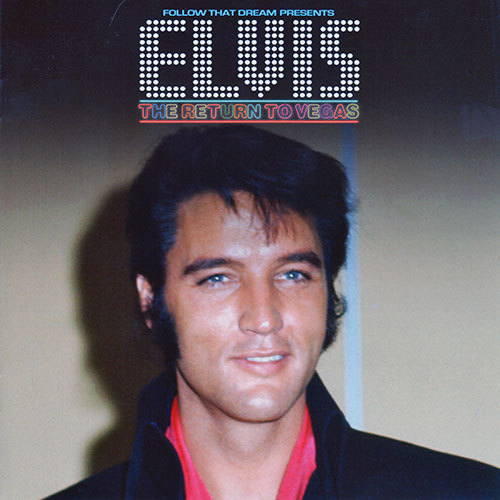
THE RETURN TO VEGAS booklet cover

THE RETURN TO VEGAS booklet cover

I must admit, however, that I am surprised. I was expecting to be blown away by The Return To Vegas. After all, this recording from an unconfirmed date in August is probably the closest we will ever come to hearing the legendary July 31 show that opened the engagement.

To be clear, like all 1969 Elvis shows released thus far, The Return To Vegas represents one of his best concerts. Yet, I found it slightly disappointing.

With that being said, The Return To Vegas does have many strong points. “Mystery Train/Tiger Man” is inspired, for instance, with the guitar portion of the lead-off song sounding closer to the 1955 SUN version than it ever would again on later recordings. I wish James Burton had kept playing it this way. An overbearing train whistle effect ruins some of that for me, though, and the performances on Hot August Night and Live In Vegas will remain my go-to versions.

The versions of “Love Me Tender” and “Can’t Help Falling In Love” are strong enough to contend for best of the season, at least out of what has been released thus far. “Don’t Be Cruel” is also strong.

During this engagement, Elvis took several minutes out of each show to talk about his career. This is, by far, my favorite of these “monologues.” It is actually the only previously released track on this CD, though, having been released in an edited form way back in 1974 for the infamous Having Fun With Elvis On Stage “talking” album. While the concept behind that particular album may have been poor, this monologue was actually pretty funny and gave some credibility to the Having Fun title.

“Are You Lonesome Tonight” features a slightly different arrangement than later versions, with strings instead of Sweet Inspiration Cissy Houston’s soaring vocals. It makes for a nice alternative, but I much prefer the versions with Houston. In addition, Elvis sounds uncomfortable during the spoken portions.

On “Blue Suedes Shoes,” Elvis also seems unsure of himself, plodding through it with slow and deliberate vocals. “All Shook Up” starts in fine form but degrades near the end due to Elvis going into a, dare I say, imitator-style quality on his vocals.

While I normally enjoy the bluesy arrangement of “Heartbreak Hotel” that made its debut at this engagement, the version here is lacking. It sounds off from the start and never really gains momentum. He sounds nearly manic on “Hound Dog,” and this version becomes tiresome on repeat listens. “Suspicious Minds” is decent, but not particularly memorable.

All-in-all, The Return To Vegas is a mixed bag. Audio quality aside, it certainly cannot compete as the strongest overall 1969 show released thus far.

So, when exactly did the show (or shows) presented on this CD take place? The accompanying booklet is sparse on information, focusing instead on photos of Elvis from the time.

Though FTD’s press release indicated this was originally prepared for release as a double album by RCA in the late 1970s before being cancelled, no associated paperwork is included in the booklet.

A brief essay by Ken Sharp (author of Elvis: Vegas ’69) fails to even mention this particular performance, speaking only in generalities about the overall engagement.

We do know that it is not the July 31 Opening Show as previously thought both by RCA and a subsequent bootlegger. They apparently keyed in on the line, “This is my first live appearance in nine years,” which Elvis actually stated at every full show thus far released at this engagement, while skipping his “It’s hard to get going on these dinner shows” comment that makes it clear some fatigue is already setting in for Elvis in Vegas.

Certainly he would not have said this at his first-ever Dinner Show on August 1, nor was he likely even to say it at the August 2 Dinner Show. Assuming this is not a splice of two shows, the August 3 Dinner Show seems to be the prevailing hypothesis among many fans. That still seems too early to me.

Since I refrain from bootlegs, I am no expert on the unofficial recordings available from this era. Certainly the arrangement of “Are You Lonesome Tonight” is a clue here, since it differs from the later versions. That may indicate an upper end to the range of possible dates, but I do not know exactly when that arrangement changed.

There is another clue. When introducing “Suspicious Minds,” Elvis states that it “should be out in a week or 10 days or so.” RCA released “Suspicious Minds” on August 26. Though Elvis was probably not speaking literally, a week to 10 days before the release would put us in the range of August 16 to 19. If it turned out that this concert took place closer to those dates and farther from August 3, it would not surprise me at all.

No matter the date, this is an enjoyable release, and it is definitely of historic value to Elvis fans. If you already have the multitrack shows, then you should purchase this CD. If not, I recommend you buy the professional multitrack shows from this engagement first. Each of these concerts has provided me hours of enjoyment, and I have no doubt that The Return To Vegas will ultimately do the same.

While the 1969 concerts are incredible, my favorite Vegas engagement took place a year later. With a more varied set list, Elvis seemed more relaxed in August 1970. For me, the shows captured for That’s The Way It Is are somehow even better than 1969. The Dinner Show presented on The Return To Vegas is actually but an appetizer for what is to come next week. I am ready for the main course!

Tracks

01. Blue Suede Shoes
02. I Got A Woman
03. All Shook Up
04. Love Me Tender
05. Jailhouse Rock/Don’t Be Cruel
06. Heartbreak Hotel
07. Hound Dog
08. Memories
09. Mystery Train/Tiger Man
10. Monologue *
11. Baby, What You Want Me To Do
12. Are You Lonesome Tonight
13. Yesterday/Hey Jude
14. Introductions
15. In The Ghetto
16. Suspicious Minds
17. What’d I Say
18. Can’t Help Falling In Love

* Previously released
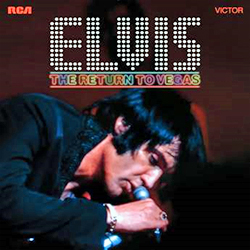
Elvis conquers Vegas in 1969 with FTD

Cover concept art for THE RETURN TO VEGAS CD

Cover concept art for THE RETURN TO VEGAS CD. One hopes this amateurish effort will be replaced by time of release.

Follow That Dream will soon release the earliest known recording from the 1969 Las Vegas engagement that helped reignite Elvis Presley’s career. Add this news to Sony’s 10-disc That’s The Way It Is: Deluxe Edition set (track listing for that coming in my next post) and Warner Home Video’s That’s The Way It Is: Special Edition Blu-ray set coming in August, and 2014 is truly the return of the “Elvis Summer Festival.”

The Return To Vegas features an undated soundboard recording from early August 1969. RCA’s formal recordings of the concert series did not begin until later that month. FTD, Sony’s collectors label for Elvis fans, plans to release the show in late June – meaning it probably will not reach most consumers until sometime in July.

Though it has made the rounds on bootleg, this marks the first official release of the show – other than an entertaining monologue track previously included on the notorious 1974 album Having Fun With Elvis On Stage.

This early August soundboard recording is probably the closest we will ever come to hearing the legendary July 31, 1969, show that opened the engagement, so this has been one of my most anticipated concert releases. What a summer this will be.

Below is the press release from FTD, as well as the track listing.

[The Return To Vegas] is the official release of the soundboard recording that Joan Deary planned as a double album release back in the late seventies. It’s the earliest known professional recording from Elvis’ 1969 engagement in Las Vegas. The original tape box has “opening night” written on the back, but that’s not the real date. Some experts believe it’s from August 3, but we have no information whatsoever to suggest a certain date.

However, the arrangements seem to suggest that this show is definitely several days earlier than the shows RCA recorded from August 20 and onwards. Why Joan Deary edited and mastered this for release is another mystery, since she of course had all the shows RCA recorded on 8-track tape with audio in substantially better quality. This release comes in a 7″ digi-pack with a 12-page booklet, featuring great photos from the collections of Steve Barile & Jim Patino, and a foreword by Ken Sharp.

Tracks

01. Blue Suede Shoes
02. I Got A Woman
03. All Shook Up
04. Love Me Tender
05. Jailhouse Rock/Don’t Be Cruel
06. Heartbreak Hotel
07. Hound Dog
08. Memories
09. Mystery Train/Tiger Man
10. Monologue *
11. Baby, What You Want Me To Do
12. Are You Lonesome Tonight
13. Yesterday/Hey Jude
14. Introductions
15. In The Ghetto
16. Suspicious Minds
17. What’d I Say
18. Can’t Help Falling In Love

* Previously released

ELVIS RECORDED LIVE ON STAGE IN MEMPHIS Legacy Edition out today, with bonus Richmond concert

Before we begin, a reminder that there are less than 13 hours left to lock in your predictions bracket for Elvis Mania 2014. The person with the highest score will receive a Sony Legacy Edition CD of an Elvis title, courtesy of The Mystery Train. See yesterday’s post for more details. [Update: Predictions are now locked.]

* * *

Forty years ago today, on March 18, 1974, Elvis Presley rocked the Richmond Coliseum in Virginia. A live recording of the concert features on the second CD of a new Legacy Edition of Elvis Recorded Live On Stage In Memphis, in stores today from Sony.

The first CD features a complete version of the March 20 Memphis concert at the Mid-South Coliseum that RCA first released in an edited form in 1974. Elvis earned his third and final Grammy Award for his performance of “How Great Thou Art” in Memphis on that original 1974 album.

The Follow That Dream collectors label for Elvis fans restored the missing tracks from the Memphis concert and removed unnecessary audience overdubs in a 2004 Classic Albums CD release of the title, including a new mix. The same label also issued the expanded show in vinyl format as a 2-record set last year. This new 2014 Legacy Edition features yet another new mix of the Memphis concert.

The Richmond concert made its debut in 2011’s Forty-Eight Hours To Memphis on the FTD label. This new release features the same mix of the Richmond show as on the 2011 collectors CD.

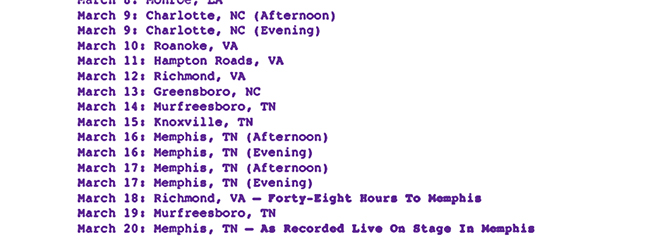
The Elvis Presley Show crisscrossed back and forth from Virginia to Tennessee on that leg of his tour. Tickets for a March 12 appearance at the Richmond Coliseum sold out so quickly that Elvis’s management re-routed the tour to accommodate a second show there on March 18. Elvis performed four shows in Memphis on March 16 and 17, hit Richmond, Virginia, again on March 18, and then returned to Tennessee for concerts in Murfreesboro and Memphis on March 19 and 20, respectively.

RCA professionally recorded the March 20 Memphis concert for the album project. It is a 16-track recording (audio elements recorded on separate channels) that can be tweaked for optimum sound quality. The Memphis show is presented in stereo.

Though the background story remains mysterious, the March 18 Richmond concert was supposedly captured as a 16-track recording, too. If so, it remains missing from the Sony vaults – lost, stolen, or erased.

The Richmond concert audio source on both the 2011 and 2014 releases is a tape copy of a mono mix-down of the 16-track recording, with artificial reverb applied. In other words, no further changes can be made to the Richmond mix or reverb since the 16-track original is unavailable.

While Elvis’s sound engineers often made informal reference tapes of his shows from the soundboard mixing console, the Forty-Eight Hours To Memphis liner notes in 2011 only speculated about why RCA apparently recorded the Richmond concert in multitrack. The 2014 Legacy Edition refers to the Richmond show as a “test run concert” for the subsequent Memphis recording.

Five selections from an August 16, 1974, rehearsal at RCA Hollywood for an upcoming Las Vegas engagement round out the second CD of the release. Captured on a personal cassette recorder, the rehearsals are in comparatively poor sound quality. The five tracks were among twenty from the rehearsal included as part of the 2009 FTD release From Sunset To Las Vegas.

In addition to participating retail stores, the 2014 Legacy Edition of Elvis Recorded Live On Stage In Memphis is also available from Amazon and other online outlets.

ELVIS RECORDED LIVE ON STAGE IN MEMPHIS (2014 Legacy Edition)

ELVIS RECORDED LIVE ON STAGE IN MEMPHIS (2014 Legacy Edition)

Tracks

Disc One

Elvis Recorded Live On Stage In Memphis, March 20, 1974
01. Also Sprach Zarathustra/
02. See See Rider
03. I Got A Woman/Amen
04. Love Me
05. Tryin’ To Get To You
06. All Shook Up
07. Steamroller Blues
08. Teddy Bear/Don’t Be Cruel
09. Love Me Tender
10. Long Tall Sally/Whole Lotta Shakin’ Goin’ On/Your Mama Don’t Dance/Flip, Flop & Fly/Jailhouse Rock/Hound Dog
11. Fever
12. Polk Salad Annie
13. Why Me Lord
14. How Great Thou Art
15. Suspicious Minds
16. Introductions By Elvis
17. Blueberry Hill/I Can’t Stop Loving You
18. Help Me
19. An American Trilogy
20. Let Me Be There
21. My Baby Left Me
22. Lawdy, Miss Clawdy
23. Funny How Time Slips Away
24. Can’t Help Falling In Love/
25. Closing Vamp

Disc Two

Recorded Live At The Coliseum, Richmond, March 18, 1974
01. Also Sprach Zarathustra/
02. See See Rider
03. I Got A Woman/Amen [edited with Memphis, March 20, 1974]
04. Love Me
05. Tryin’ To Get To You
06. All Shook Up
07. Steamroller Blues
08. Teddy Bear/Don’t Be Cruel
09. Love Me Tender
10. Long Tall Sally/Whole Lotta Shakin’ Goin’ On/Your Mama Don’t Dance/Flip, Flop & Fly/Jailhouse Rock/Hound Dog
11. Fever
12. Polk Salad Annie
13. Why Me Lord
14. Suspicious Minds
15. Introductions By Elvis
16. I Can’t Stop Loving You
17. Help Me
18. An American Trilogy
19. Let Me Be There
20. Funny How Time Slips Away
21. Can’t Help Falling In Love/
22. Closing Vamp

The August 1974 RCA Rehearsals
23. Down In The Alley
24. Good Time Charlie’s Got The Blues
25. Softly, As I Leave You
26. The First Time Ever I Saw Your Face
27. The Twelfth Of Never

ELVIS RECORDED LIVE ON STAGE IN MEMPHIS Legacy Edition to include Richmond, Virginia concert

ELVIS RECORDED LIVE ON STAGE IN MEMPHIS (2014 Legacy Edition)

ELVIS RECORDED LIVE ON STAGE IN MEMPHIS (2014 Legacy Edition)

One of my favorite CD releases on the Follow That Dream collectors label for Elvis Presley fans is 2011’s Forty-Eight Hours To Memphis, which captures a March 18, 1974, concert that Elvis performed at the Richmond Coliseum in Virginia.

The confusing album title reflects that Elvis closed out his tour two days after the Richmond concert with a show in Memphis at the Mid-South Coliseum, portions of which became the 1974 album Elvis Recorded Live On Stage In Memphis. Elvis earned his third and final Grammy Award for his stellar performance of “How Great Thou Art” in Memphis on the original 1974 album.

The link between the two shows continues, for Sony announced last week that it will reissue the Richmond concert on the second disc of a Legacy Edition of Elvis Recorded Live On Stage In Memphis. While the FTD collectors label has very limited distribution, this new 2-CD release on the main Sony label hits mainstream retail stores on March 18, the 40th anniversary of the Richmond concert. Amazon and other outlets are accepting pre-orders now.

The Elvis Presley Show crisscrossed back and forth from Virginia to Tennessee on that leg of his tour. Tickets for his March 12 appearance at the Richmond Coliseum sold out so quickly that the tour was re-routed to accommodate a second show there on March 18. Elvis performed four shows in Memphis on March 16 and 17, hit Richmond, Virginia, again on March 18, and then returned to Tennessee for concerts in Murfreesboro and Memphis on March 19 and 20, respectively.

Elvis Presley's March 1974 tour schedule (partial)

Elvis Presley’s March 1974 tour schedule (partial)

For space considerations on the original LP, RCA edited several songs out of the March 20 Memphis concert for the 1-record release in July 1974. The album also featured overdubbed audience reactions that detracted from the sound quality. FTD restored the missing tracks and removed the unnecessary overdubs in a 2004 Classic Albums CD release of the concert, including a new mix. The same label also issued the expanded show in vinyl format as a 2-record set last year.

It turned out that RCA chose well in 1974 which performances to use on the original record, though. The performance quality of many of the excised songs was underwhelming, with the exception of a fine rendition of “Steamroller Blues,” first released on Platinum: A Life In Music over two decades later. The energetic Memphis version was superior to his live recording of the song in Hawaii that served as a single in 1973.

This new Elvis Recorded Live On Stage In Memphis Legacy Edition will also include the previously omitted songs, but whether a new or an existing mix will be featured is unclear.

In fact, Sony’s press release for this album is riddled with errors, an issue far too common these days in the marketing of Elvis music releases, so it is difficult to trust any of its statements. For that reason, I am not even including Sony’s alleged track listing at this point. Suffice it for now to say that Disc 1 will contain the Memphis show, while Disc 2 will contain the Richmond show and some low-fidelity bonus tracks recorded on a personal cassette player of Elvis rehearsing a few months later for yet another Las Vegas stint.

RCA professionally recorded the March 20 Memphis concert for the album project. It is a 16-track recording (audio elements recorded on separate channels) that can be tweaked for optimum sound quality. Though I enjoyed the 2004 FTD mix over the original 1974 version, another new mix could be revealing. The Memphis show is presented in stereo.

Though the background story remains mysterious, the March 18 Richmond concert was supposedly captured as a 16-track recording, too. If so, it remains missing from the Sony vaults – lost, stolen, or erased.

The Richmond concert audio source on both the 2011 and 2014 releases is a tape copy of a mono mix-down of the 16-track recording, with artificial reverb applied. In other words, no further changes can be made to the Richmond mix or reverb since the 16-track original is unavailable. The Richmond concert is not likely to sound very different from Forty-Eight Hours To Memphis on this reissue, if at all.

While Elvis’s sound engineers often made informal reference tapes of his shows from the soundboard mixing console, the Forty-Eight Hours To Memphis liner notes in 2011 only speculated about why RCA apparently recorded the Richmond concert in multitrack.

However, the 2014 Sony press release refers to the Richmond show as a “test run concert” for the subsequent Memphis recording. Some have theorized that the test copy is in mono due to Elvis’s preference for that format over stereo, though his previous live albums had been stereo releases. Perhaps the accompanying Legacy Edition booklet will reveal new information.

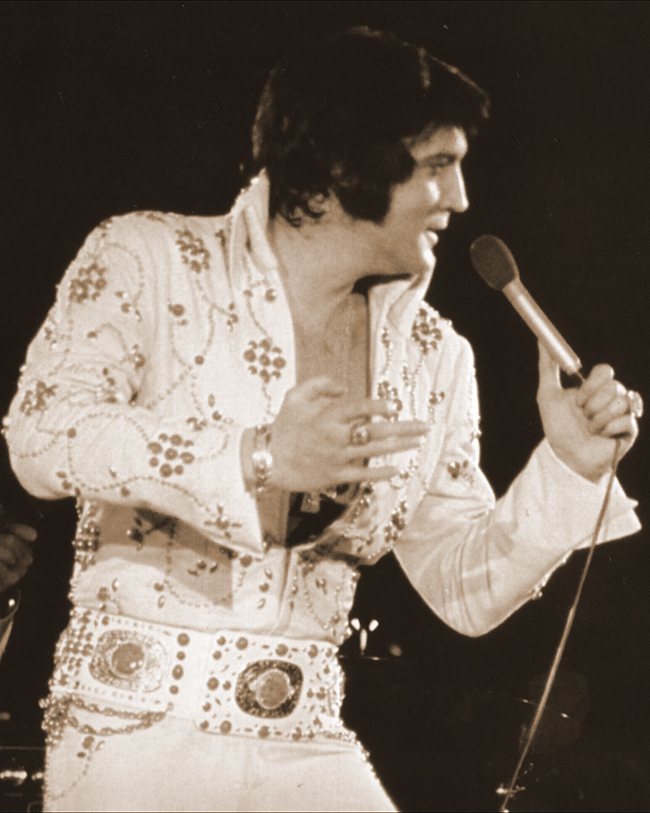
Elvis at the Richmond Coliseum, March 18, 1974 (FTD)

Elvis at the Richmond Coliseum, March 18, 1974 (FTD)

In the years leading up to 1974, many of Elvis’s concerts were superior to this particular show in Richmond. However, as with the Memphis show, the fun concert features Elvis in a fantastic mood interacting with fans. Music highlights in Richmond include “Steamroller Blues,” “Polk Salad Annie,” and “Suspicious Minds.”

Over the course of 21 years, Elvis performed 15 concerts in Richmond. The 14th of these shows was captured on Forty-Eight Hours To Memphis and, from what I have read, this was Elvis’s last great concert in Richmond. He performed in Richmond one final time in 1976, but, by that point, his rising prescription drug addiction and abuse had diminished the power of his shows. Therefore, I consider the March 18, 1974, appearance to be Elvis’s true “last hurrah” in Richmond.

Legacy Questions

I am looking forward to the reissues of both the Richmond and Memphis concerts. Despite my personal enthusiasm as an Elvis fan, I find myself wondering whether these two concerts are appropriate choices for mainstream release in 2014.

I fear that the repetitive nature of these shows compared to other recent Sony releases will use up some of the goodwill shown by music critics in reviews of Elvis At Stax, Prince From Another Planet, and certain other titles released in the last few years.

Will mainstream critics and listeners understand Elvis’s sense of humor? For instance, will some misinterpret his joke in Richmond about it being a pleasure to be back in Hampton Roads as an out-of-it singer not knowing which town he was playing?

By following up 2012’s As Recorded At Madison Square Garden reissue with 2013’s Aloha From Hawaii via Satellite reissue and now 2014’s Elvis Recorded Live On Stage In Memphis reissue, is Sony simply committing the same release blunders in the 2010s that RCA made in the 1970s? Has locking into an “anniversary” theme for release choices doomed them to repeat history’s mistakes going forward?

Keep in mind that the 40th anniversary of Having Fun With Elvis On Stage is later this year as well.

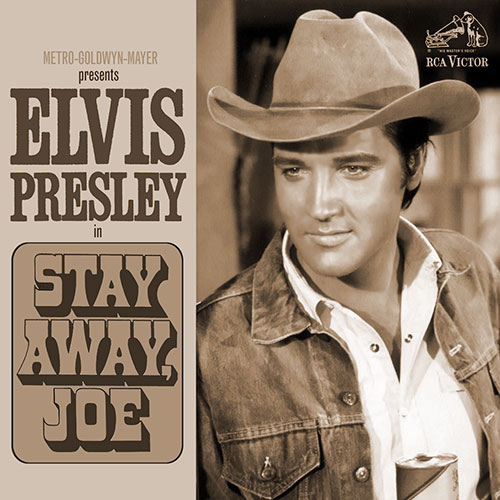
REVIEW: Stay Away, Joe CD (FTD)

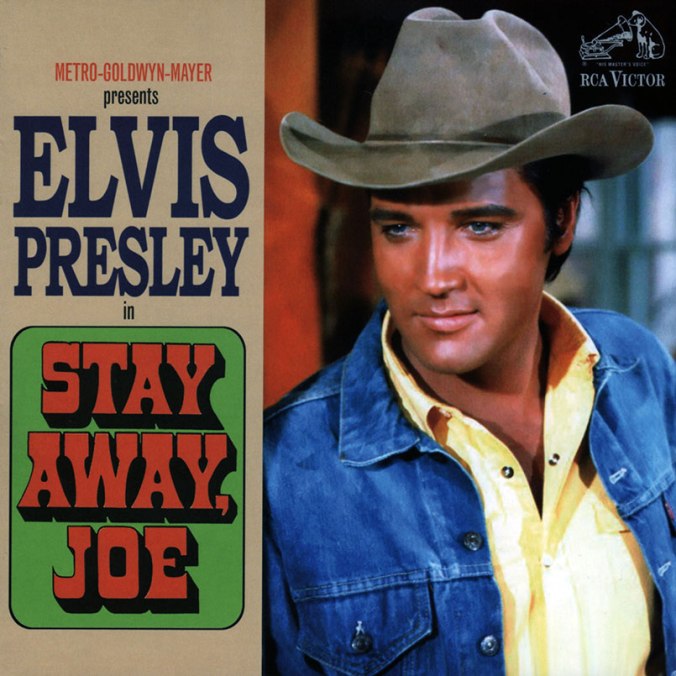
SAJ_cover

Stay Away, Joe CD (Follow That Dream Records, 2013)

I never quite know what to make of Stay Away, Joe. The first time I tried to watch the movie as a teenager in the early 1990s, I couldn’t get past the non-stop party scene near the beginning. The whole thing just seemed so unbearable.

Yet, over the years, I have come to love most of the five songs Elvis recorded for this film. While Elvis performed many country songs in his career, he rarely delved into “outdoor” country songs that celebrate nature like “Stay Away” (“Greensleeves”) and “Goin’ Home” do. Elvis infuses a passion into these numbers that makes them stronger than the lyrics might otherwise suggest.

“All I Needed Was The Rain” is much the same, but this time with Elvis making the most of an otherwise lesser blues number.

The rollicking “Stay Away, Joe” is a song that had to grow on me. Somewhere, I’ve seen it accurately described as a “campfire song.” Taken in that spirit, “Stay Away, Joe” is just as much fun as it needs to be.

The outlier is the awful “Dominic,” which Elvis recorded against his better judgment after securing a promise from producer Felton Jarvis that it would never be released on record. Though it appeared in the movie, RCA did not release the song until the Double Features series in 1994 – long after the deaths of both Elvis and Jarvis.

I’m torn about whether “Dominic” should have ever been released. On one hand, Elvis lost the right to decide what should and should not be released once he passed away. Surely, had he lived, he would have been against quite a few of the releases that have kept us Elvis fans going over the years. Of course, had he lived, many of those releases would not have been necessary. On the other hand, “Dominic” is such a wretched song, even among the already low standards of Elvis movies, that maybe his music label’s current Elvis team should have respected his wishes in this one instance. Releasing it served no purpose other than to please completists.

FTD’s Classic Albums series edition of the Stay Away, Joe soundtrack supplements the movie tunes with two far more commercial recordings made during the same period, “Too Much Monkey Business” and “U.S. Male.” My first exposure to “Too Much Monkey Business” was watching the 1981 documentary This Is Elvis on TV in the early 1990s. Though “Too Much Monkey Business” is not heard in any of Elvis’ real movies, I’ll always associate it with them due to its perfect use in the montage sequence of his Hollywood years. Elvis’ take on the Chuck Berry hit certainly fits within the spirit of many of his better movie songs, anyway.

Penned and first recorded by Jerry Reed, “U.S. Male acts as a natural follow-up to Elvis’ 1967 recordings of Reed’s “Guitar Man” and Jimmy Reed’s “Big Boss Man” – the evolution of which are chronicled in the essential FTD release Elvis Sings Guitar Man. With tongue planted firmly in cheek, Elvis plays up Southern “country boy” stereotypes in “U.S. Male,” including his wonderful ad-libbed clarification at the song’s conclusion: ‘. . . the American U.S. male.’ As with “Guitar Man,” Jerry Reed provides guitar support on Elvis’ cover of his song, making it far more authentic than it otherwise would have been.

Unlike Elvis Sings Guitar Man, which felt like a true album, albeit imaginary, the master recordings portion of the FTD Stay Away, Joe feels disjointed. Seven songs do not an album make, and the listener is never treated to the illusion that this is an album that “might have been.”

While it would have padded the “album” out to a more plausible length, adding in the Live A Little, Love A Little soundtrack session would have only made for an even more disjointed experience, given the entirely different themes of those recordings. FTD has done the right thing by sticking to the October 1967 and January 1968 sessions that make up this release.

I should clarify that the label does not even try to pass this off as an imaginary album anyway, forgoing the usual “Side One” and “Side Two” divisions in the track listing. Given this, I believe the ideal sequencing of these particular sessions would simply have been to present all of the songs and takes in the order recorded, rather than front-loading the masters. There is a definite “party” atmosphere to these sessions, particularly in the studio chatter, which is lost by FTD holding firm to its routine, scattershot approach. Though normally intended to create a better listening experience, it fails in this case.

The FTD release, of course, adds a multitude of alternate takes and false starts. However, beyond the false starts, there are not many completely new takes here. Whether this is due to unavailability of additional tapes or a budget-saving maneuver to avoid a second disc and requisite work on previously unreleased tracks remains to be seen.

Take 13 of “Stay Away, Joe” is a spirited version, with lots of hootin’ and hollerin’. As with the master, the acoustic guitar and Charlie McCoy’s harmonica drive the song.

An “alternate mastering” of “All I Needed Was The Rain” features some studio chatter and a false start. The song also fades later and includes Elvis joking at the end. Other than that, any other differences compared to the standard master are beyond my technical abilities to detect.

Take 3 of “Too Much Monkey Business” is a long false start, but notable due to the prominence of slightly different sounding guitar work reminiscent of what would later be heard on the master of “Burning Love” in 1972. As fans probably expect from a song with this many words, Elvis confuses some of the lyrics along the way, including an “…Army chow, Army clothes, Army jeep, Army car!” line that made me laugh.

The various false starts of “Goin’ Home” reveal that there was audio trickery involved in the studio chatter that appeared on the Collectors Gold release. The snippets heard on that 1991 boxed set are actually edited together from a few different moments. I’ve heard it that way for so long that it’s hard to get used to these snippets within their proper contexts.

Be sure to listen out for Elvis singing the line “You belong to my heart…” before the Take 11 false start of “Stay Away.” Elvis sang a tiny bit more of this while jamming with Carl Perkins and Jerry Lee Lewis at SUN Studios in December 1956, as first heard on The Million Dollar Quartet.

The most interesting parts of the accompanying booklet are reproductions of advertisements and other vintage memorabilia. The modern text is perfunctory and exhibits the same awkwardness all too often associated with FTD. Even if a professional proofreader were outside of the budget, it would still be a good idea to have someone else read these items before printing and selling them.

FTD’s Stay Away, Joe is a decent release buffeted in no small part by Jerry Reed’s guitar work on the 1968 tracks. While most of the tracks have appeared before on various releases, this CD offers the opportunity to obtain them all in one package. While not essential, Stay Away, Joe is certainly recommended to fans of these songs who might not have already collected key alternate takes.

About a year ago, I finally revisited Stay Away, Joe as a film. The majestic, opening title visuals, accompanied by “Stay Away,” are unlike anything else I’ve ever seen in an Elvis movie. That dreaded party scene follows shortly thereafter, but the rest of the movie proves watchable and, at times, entertaining. Elvis looks terrific and, as evidenced by this soundtrack release, most of the songs are more than worthwhile. Too bad “Goin’ Home” fails to make the cut (as with “Stay Away,” it was actually recorded after filming completed), while “Dominic” is there to remind us that “Old MacDonald” wasn’t such a bad song after all.

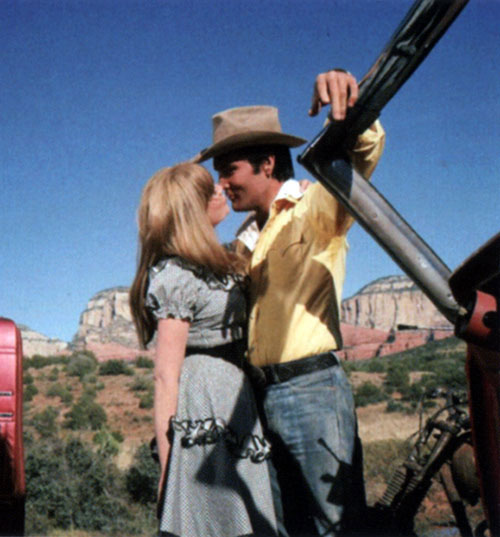
SAJ_booklet07

New and upcoming Elvis releases focus on slices of a diverse career

Get those sound systems (and wallets) ready, folks, new Elvis releases are on the way.

Stay Away, Joe

Stay Away, Joe (concept cover art)

May 2013

Follow That Dream Records, Sony’s collectors label for Elvis fans, is releasing this month:

  • From Elvis In Memphis (2-CD): One of Elvis’ best albums finally receives the FTD Classic Album treatment. This should make an excellent companion to the recent Back In Memphis release. Surely an “imaginary album” will be in the works at some point to feature the rest of the recordings from the 1969 American Sound Studio sessions.
  • Stay Away, Joe (CD): Speaking of imaginary albums, here is one that compiles October 1967 and January 1968 sessions. In addition to the Stay Away, Joe soundtrack, it includes “Too Much Monkey Business” and “US Male.” The January session features Jerry Reed on guitar, which is why I consider this a follow-up of sorts to the fantastic Elvis Sings Guitar Man.
  • On Stage-February 1970 (2-LP): This vinyl release includes the original On Stage-February 1970 album, recorded live in 1969 and 1970, as well as additional material Elvis recorded during his early 1970 Las Vegas engagement.
  • Summer of ’61 (Book & CD): In conjunction with Flaming Star publications, this book primarily focuses on the making of the movie Follow That Dream. A brief CD containing previously released Elvis tracks and two demos for “What A Wonderful Life” is also included.

June 2013

FTD has scheduled the following for release in June:

  • Sold Out! (2-CD): The ambiguous title of this one could refer to almost any Elvis concert from 1956 and beyond. [May 19, 2013, Update: The concerts on this release will be March 1, 1974, Tulsa, Oklahoma and June 21, 1974, Cleveland, Ohio.] This one is from the creative team behind Forty-Eight Hours To Memphis: Recorded Live On Stage In Richmond, Virginia – March 18, 1974 and 3000 South Paradise Road, so a quality presentation is expected.
  • Hot August Night (CD): This one features the August 25, 1969, Midnight Show in Las Vegas. The 1969 shows are all must-haves. Portions of this one contributed to the From Memphis To Vegas/From Vegas To Memphis (Elvis In Person) release in 1969. Many tracks are previously unreleased, however.
  • Elvis Recorded Live On Stage In Memphis (2-LP): This vinyl release features the complete March 20, 1974, Memphis concert, from which selections made up the original 1974 version of this album. I have to admit, I enjoy the truncated version of this show more than the full version. Other than “Steamroller Blues,” the songs edited out of the 1974 1-LP release featured some disappointing performances by Elvis.
  • Best of British: The HMV Years (Book): This is a reprint of the popular book exploring Elvis’ 1956-1958 releases on the HMV label in Great Britain, which sold out upon release in February. Though not noted in the press release, presumably the two CDs of previously released Elvis material from the original printing are also included.

The only physical store in the US authorized to sell FTD releases is Good Rockin’ Tonight, a Graceland gift shop in Memphis. However, FTD products may be obtained online from a variety of other Elvis stores, including Graceland’s ShopElvis.com.

August 2013

Sony has scheduled Elvis At Stax: Deluxe Edition, a 3-CD boxed set, as a main label, wide release in August. The set will include all of the masters Elvis recorded in Memphis at Stax Recording Studio in July and December of 1973. It will also include alternate takes of many of the songs. Here is the track listing:

DISC 1: The R&B and Country Sessions – The Outtakes

1. I Got A Feelin’ In My Body – take 1
2. Find Out What’s Happening – take 8/7
3. Promised Land – take 4
4. For Ol’ Times Sake – take 4
5. I’ve Got A Thing About You, Baby – take 14
6. It’s Midnight – take 7
7. If You Talk In Your Sleep – take 5
8. Loving Arms – take 2
9. You Asked Me To – take 3A
10. Good Time Charlie’s Got The Blues – take 8
11. Talk About The Good Times – take 3
12. There’s A Honky Tonk Angel – take 1
13. She Wears My Ring – take 8
14. Three Corn Patches – take 14
15. I Got A Feelin’ In My Body – take 4
16. If You Don’t Come Back – take 3
17. Promised Land – take 5

DISC 2

Part 1 – The Pop Sessions – The Outtakes

1. Mr. Songman – take 2
2. Your Love’s Been A Long Time Coming – take 4
3. Spanish Eyes – take 2
4. Take Good Care Of Her – takes 1,2,3
5. It’s Diff’rent Now (unfinished recording)
6. Thinking About You – take 4
7. My Boy – take 1
8. Girl Of Mine – take 9
9. Love Song Of The Year – take 1
10. If That Isn’t Love – take 1

Part 2 – The July 1973 Masters

11. Raised On Rock
12. For Ol’ Time Sake
13. I’ve Got A Thing About You, Baby
14. Take Good Care Of Her
15. If You Don’t Come Back
16. Three Corn Patches
17. Girl Of Mine
18. Just A Little Bit
19. Find Out What’s Happening
20. Sweet Angeline

DISC 3: The December 1973 Masters

1. Promised Land
2. It’s Midnight
3. If You Talk In Your Sleep
4. Help Me
5. My Boy
6. Thinking About You
7. Mr. Songman
8. I Got A Feelin’ In My Body
9. Loving Arms
10. Good Time Charlie’s Got The Blues
11. You Asked Me To
12. There’s A Honky Tonk Angel
13. Talk About The Good Times
14. She Wears My Ring
15. Your Love’s Been A Long Time Coming
16. Love Song Of The Year
17. Spanish Eyes
18. If That Isn’t Love

I have mixed feelings on this release. I think it is wonderful for the main label to focus on an overlooked period in the recording career of Elvis Presley. For those fans who do not already have the corresponding FTD Classic Album 2-CD sets (Raised On Rock, Good Times, and Promised Land), this is an excellent, budget-conscious alternative to hear highlights of this material.

However, the first thing I noticed is that Sony really blew the sequencing of these tracks. Why, oh, why would the compiler of this collection choose to kick things off with the dreadful “I Got A Feelin’ In My Body”? Especially when “Promised Land” is sitting there, practically begging to begin this set in the right manner?

Short of starting from scratch, one simple alternative that I can suggest would be the following:

  • Swap Disc 1 with Disc 3
  • Swap Disc 2 – Part 1 with Disc 2 – Part 2

Just making the simple changes above would result in a much better listening experience from start to finish. Again, it is great to see a release focusing on 1973, but it should not just be grudgingly thrown together. While Sony’s Elvis team may disagree, some of us love this material. Treat it right.

Sony is also releasing in August a 1-CD version and a 2-LP version collecting some of the above Stax material.

Elvis Live Wire: Ernst Jorgensen acquires “I Forgot To Remember To Forget”

Silvertone wire recording of Elvis Presley

Silvertone wire recording of Elvis singing “I Forgot To Remember To Forget”

One of the feel-good Elvis stories of 2012 will have an encore after all. Audio collector amberola1b, who discovered a 1955 live recording of Elvis singing “I Forgot To Remember To Forget” on the Louisiana Hayride radio program, recently remarked that he has sold the recording to Ernst Jorgensen. Jorgensen heads up Sony Music’s Elvis team and helms their Follow That Dream collectors label. This means, at some point, there will undoubtedly be an official release of this incredible find.

Last July, amberola1b caused a sensation among Elvis fans when he briefly posted the recording on YouTube, without being aware that it was so unique. Sourced from a Silvertone wire recording, the performance had never been heard by the public since the original broadcast.

Elvis appeared on the Hayride about fifty times from 1954 to 1956. Though similar to Nashville’s Grand Ole Opry, the show was more receptive to new talent – including Elvis’ groundbreaking style. Compared to most of the other Hayride recordings released in the past, the audio quality on “I Forgot To Remember To Forget” was stunning.

The discovery made headlines on the eve of the release of the Elvis masterpiece A Boy From Tupelo: The Complete 1953-1955 Recordings, Ernst Jorgensen’s book and music project covering the SUN years. A Boy From Tupelo included several other recordings from the Louisiana Hayride, but “I Forgot To Remember To Forget” was found too late for consideration. “Wow – it’s unbelievably beautiful. I’m still trying to recover from the shock,” Jorgensen said at the time.

Audio grabs of amberola1b’s YouTube video have appeared on a couple of “gray market” releases, but a professional transfer from the wire, properly mastered, should yield much more impressive sound quality.

On January 12, amberola1b posted the following comments on YouTube about his interaction with Jorgensen:

“I did sell the rights to him but the way it went was that I didn’t even know Ernst and was directed to him thru other utubers that were Elvis fans. I didn’t even know there was a big anniversary album or book being put together about The King, I just merely decided at that moment in time to do the utube video, and just happen to post it during the summer. If luck had been on my side and I had known about what was being planned […] I would have made the video months before, and it would have been included in the album that was included in the book ‘A Boy From Tupelo’. But as it turned out he sent me a copy of the book and it just blew my mind to see all the wonderful pictures that had been compiled of Elvis and the stories written about him.”

[Thank you to Greg1995 on the For Elvis CD Collectors Forum, who first posted about amberola1b’s recent confirmation of the sale.]


I only listened to the live “I Forgot To Remember To Forget” once. It was so incredible, I knew I wanted to wait for an official release. Out of respect for amberola1b, I also never posted links to the multiple copies of this video that showed up after his original post (I made an exception for the copied version in the story linked above, since that is where he chose to post his comments).

I’m thrilled that Jorgensen has acquired this fantastic discovery. So, to amberola1b: Thank you for making a deal that will allow Elvis fans to hear this recording in the best sound quality possible for generations to come.

So, the question is, what should Jorgensen do with this recording now that he has it?

Ideally, this would be a terrific opportunity for Sony to release a mainstream version of A Boy From Tupelo, which was a limited run on the FTD collectors label. Every Elvis and rock ‘n’ roll fan should have the opportunity to own A Boy From Tupelo – one of the most important Elvis releases since his death in 1977. Scooting the two interviews over to the end of Disc 2 would free up enough space for “I Forgot To Remember To Forget” to join the other Hayride performances on Disc 3.

If a full-blown re-release of A Boy From Tupelo is not possible for some reason, I think 2013 or 2014 would be the perfect time for a 2-CD set on the main Sony label covering 1953-1955. After all, 2013 marks the 60th anniversary of Elvis paying to record his first demo (“My Happiness” b/w “That’s When Your Heartaches Begin”), while 2014 marks the 60th anniversary of his first professional release (“That’s All Right” b/w “Blue Moon Of Kentucky”).

For fun, here’s how I would approach such a 2-CD set.

Elvis Begins: The 1953-1955 Recordings

Disc 1

  1. That’s All Right (45 RPM SUN single version)
  2. Blue Moon Of Kentucky (45 RPM SUN single version)
  3. Good Rockin’ Tonight
  4. I Don’t Care If The Sun Don’t Shine
  5. Milkcow Blues Boogie (78 RPM SUN single version)
  6. You’re A Heartbreaker (78 RPM SUN single version)
  7. Baby, Let’s Play House
  8. I’m Left, You’re Right, She’s Gone
  9. I Forgot To Remember To Forget
  10. Mystery Train
  11. Harbor Lights
  12. I Love You Because
  13. Blue Moon
  14. I’ll Never Let You Go
  15. Just Because
  16. Tryin’ To Get To You
  17. My Happiness (Demo)
  18. That’s When Your Heartaches Begin (Demo)
  19. I’ll Never Stand In Your Way (Demo)
  20. It Wouldn’t Be The Same Without You (Demo)
  21. Harbor Lights (Take 7)
  22. I Love You Because (Take 3)
  23. I Love You Because (Take 5)
  24. That’s All Right (Takes 1, 2)
  25. That’s All Right (Take 3)
  26. Blue Moon Of Kentucky (Take 3)
  27. Blue Moon (Take 4)
  28. Blue Moon (Take 5)
  29. Blue Moon (Take 8)
  30. Tomorrow Night (Undubbed/unedited version)
  31. That’s All Right (Live-Shreveport, LA-October 16, 1954)
  32. Blue Moon Of Kentucky (Live-Shreveport, LA-October 16, 1954)

Disc 2

  1. I’m Left, You’re Right, She’s Gone (Slow version, Take 1)
  2. I’m Left, You’re Right, She’s Gone (Slow version, Take 2)
  3. I’m Left, You’re Right, She’s Gone (Slow version, Take 3)
  4. I’m Left, You’re Right, She’s Gone (Slow version, Take 5)
  5. I’m Left, You’re Right, She’s Gone (Slow version, Take 6)
  6. Shake, Rattle & Roll (Demo-Lubbock, TX-January 6, 1955)
  7. Fool, Fool, Fool (Demo-Lubbock, TX-January 6, 1955)
  8. Hearts Of Stone (Live-Shreveport, LA-January 15, 1955)
  9. That’s All Right (Live-Shreveport, LA-January 15, 1955)
  10. Tweedlee Dee (Live-Shreveport, LA-January 15, 1955)
  11. Money Honey (Live-Shreveport, LA-January 22, 1955)
  12. Blue Moon Of Kentucky (Live-Shreveport, LA-January 22, 1955)
  13. I Don’t Care If The Sun Don’t Shine (Live-Shreveport, LA-January 22, 1955)
  14. That’s All Right (Live-Shreveport, LA-January 22, 1955)
  15. Tweedlee Dee (Live-Shreveport, LA-March 5, 1955)
  16. Money Honey (Live-Shreveport, LA-March 5, 1955)
  17. Hearts Of Stone (Live-Shreveport, LA-March 5, 1955)
  18. Shake, Rattle & Roll (Live-Shreveport, LA-March 5, 1955)
  19. Little Mama (Live-Shreveport, LA-March 5, 1955)
  20. You’re A Heartbreaker (Live-Shreveport, LA-March 5, 1955)
  21. Good Rockin’ Tonight (Live-Houston, TX-March 19, 1955)
  22. Baby, Let’s Play House (Live-Houston, TX-March 19, 1955)
  23. Blue Moon Of Kentucky (Live-Houston, TX-March 19, 1955)
  24. I Got A Woman (Live-Houston, TX-March 19, 1955)
  25. That’s All Right (Live-Houston, TX-March 19, 1955)
  26. How Do You Think I Feel (1955 version, Take 1)
  27. Tweedlee Dee (Live-Gladewater, TX-April 30, 1955)
  28. That’s All Right (Live-Meridian, MS-May 26, 1955)
  29. I’m Left, You’re Right, She’s Gone (Live-Shreveport, LA-July 2, 1955)
  30. Baby, Let’s Play House (Live-Shreveport, LA-August 20, 1955)
  31. Maybellene (Live-Shreveport, LA-August 20, 1955)
  32. That’s All Right (Live-Shreveport, LA-August 20, 1955)
  33. I Forgot To Remember To Forget (Live-Shreveport, LA-October 1, 1955)
  34. When It Rains, It Really Pours (1955 version, Take 5)
  35. When It Rains, It Really Pours (1955 version, Take 8)