Elvis lives his dreams in Memphis

Elvis Presley's Memphis (2010)

Elvis Presley’s Memphis (2010)

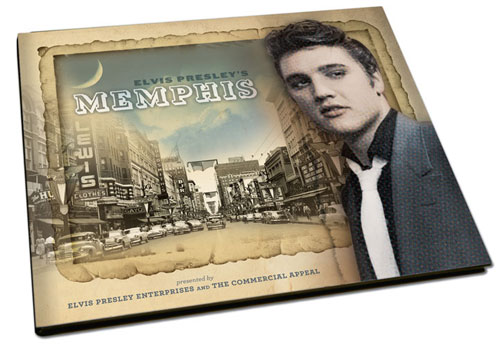
Elvis Presley’s Memphis (book)
Presented By Elvis Presley Enterprises and The Commercial Appeal
176 pp. Pediment. $39.95

As I journeyed yet again through the life of Elvis Presley, this literary trip built upon the context of Memphis, I was happy to find some new insights into the man. This is not the average Elvis coffee table book – you know, the ones that shuffle around the same photos and text from last year’s variation.

That Elvis Presley’s Memphis is different is evident right from the start. The cover is hardly typical of those of other Elvis books, which tend to be rush jobs consisting of a common photo of Elvis with a title slapped above it. “It doesn’t matter what it looks like, fans will buy it because its Elvis,” seems to be the mentality.

Instead, this book features a creatively designed, beautiful cover with a lesser-known photo of Elvis superimposed against a vintage 1951 backdrop of Main Street in Memphis. Look carefully at this work of art and you’ll see the Loew’s State Theater is playing Father’s Little Dividend, starring Spencer Tracy, Joan Bennett, and Elizabeth Taylor. Within the book, you’ll find a photo of Elvis at the same theater in 1950, when he worked there as an usher until fired by manager Arthur Groom for getting into a fight with a co-worker.

Elvis apparently held no hard feelings for his former boss, for another photo shows him with Groom several years later for the 1957 Jailhouse Rock premiere – at Loew’s State Theater. His first movie, Love Me Tender, also premiered there in 1956. Business must have been good at Loew’s with that kind of publicity.

Imagine how it must have felt for Elvis to watch himself on screen at the same movie theater he worked at only years before. “When I was a child . . . I was a dreamer. . . . I saw movies, and I was the hero in the movie,” Elvis once said.

“Every dream I ever dreamed has come true a hundred times,” he continued. At its heart, Elvis Presley’s Memphis is about those dreams. The dreams of a 13-year-old as his family moves to Memphis from Tupelo, Mississippi, for a fresh start. The dreams of an 18-year-old as he pays to record a couple of songs at the Memphis Recording Service. The dreams of a 33-year-old as he holds his daughter for the first time.

The bind between Elvis and Memphis is indeed strong, but perhaps no stronger than at Graceland, the home he purchased there on Highway 51 South in 1957 as his rising fame literally chased him out of his previous neighborhood on Audubon Drive. Could the 22-year-old ever have dreamed that Memphis would one day rename the street in front of that mansion in his honor?

Only twenty years later, Elvis would spend his last days at Graceland on Elvis Presley Boulevard. “When the news of Elvis’ death was heard over the police radio, the entire force felt they had lost one of their own,” writes Robert Dye in a section called “Memphis Beat.” You see, Elvis’ renowned collection of police badges was more than just a hobby.

Though they may have indeed been honorary, those badges meant something real not only to him, but also to those who bestowed them – none more so than the Memphis police. While stories of Elvis’ generosity are legendary, there are some here involving the police that are worthy of the spotlight placed on them by this book. Elvis had his flaws, as do we all, but I remain proud to call myself a fan.

From a boy who had little in the way of material possessions to a man who could afford to buy seemingly anything – go-karts, motorcycles, cars, and even airplanes – the life of Elvis in Memphis is detailed in a series of occasionally repetitive articles. Much of this book is about Elvis having fun, for while he sometimes worked in Memphis, it more often served as his playground, a place to unwind and relax.

Some of the stories are new, while others are reprinted from The Commercial Appeal or The Memphis Press Scimitar newspapers. Most are well-written and informative, though a few appear to be excerpts or sidebars from longer pieces and include chopped bits of information that go no deeper than the typical travel brochure for Graceland.

While Elvis is the focus, the book also paints a portrait of Memphis as a whole, including in a running timeline not only significant events in Elvis history, but significant events in Memphis history as well. The two are often intertwined. 1968’s entries include: “April 4: Martin Luther King is assassinated at the Lorraine Hotel in Memphis. Elvis is in California. June 23: Elvis records ‘If I Can Dream.'”

Filled with truly rare documents and photos, including one of Elvis visiting his mother’s grave, Elvis Presley’s Memphis is a standout among the many printed works about this often misunderstood man.

* * *

Cover image courtesy of Pediment Books. Used with permission.
Journey Back in Time to Elvis Presley’s Memphis

When I was 15, my family took a summer vacation to Tennessee. Though we took a detour through Nashville, the main destination, of course, was Graceland in Memphis. One of the things I was unprepared for in the Graceland area was the sheer volume of Elvis merchandise available.

Back then, there were no online stores. While Elvis was certainly available in various places at home, especially in record stores, I had never seen anything like this. For instance, there was an entire record store devoted to Elvis that seemingly had every record he ever released (looking back, probably not).

While I had brought along what I considered a decent amount of spending money (probably the most amount of money I ever had at one time to that point), I quickly realized I was going to have to be very judicious in what I bought. I tried to focus on things that I had never seen before and definitely couldn’t buy back home. Records were out. Though they had records I had never seen, all of them were much more expensive than the prices I was used to paying.

Two of the items I bought were reprints of the two Memphis newspapers’ coverage of Elvis’ death in August 1977, the Memphis Press-Scimitar and the Commercial Appeal. While the articles represented a sad time, I enjoyed reading about Elvis within the context of his times – rather than with years of posthumous baggage.

That’s why I’m looking forward to the July 30, 2010, release of Elvis Presley’s Memphis, a 160-page hardcover book from the archives of The Commercial Appeal and Elvis Presley Enterprises. Along with photographs, the book will include reprints of various articles covering Elvis’ life.

I’ve given EPE a hard time this month over the Mr. Potato Head Elvis Presley fiasco, so it’s only fair for me to point out that the Elvis Presley’s Memphis book may turn out to be one of their best products since the release of the ELVIS: ’68 Comeback Special- Deluxe Edition and Elvis: Aloha From Hawaii-Deluxe Edition DVD sets.

If you happen to be in Memphis during Elvis Week in August, be on the lookout for an exclusive edition of this book that includes a DVD. The rest of us can pre-order the book alone over at Pediment Books.

“Together all alone”

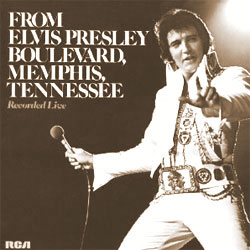
I’ve recently been playing Elvis’ last couple of non-compilation albums, From Elvis Presley Boulevard and Moody Blue, as well as associated outtakes on The Jungle Room Sessions and other releases. He recorded many of these songs in the den at Graceland in February and October of 1976.

I’ve also been listening to songs from Elvis In Concert, the first album released after he passed away, containing songs from his last concert tour in June 1977.

From Elvis Presley Boulevard (1976)

From Elvis Presley Boulevard (1976)

These recordings represent the last audio documentation we have of Elvis Presley the artist. From Elvis Presley Boulevard and Moody Blue are two of his finest albums. By this time, Elvis was apparently reluctant to record, so it is only through the efforts of people like producer Felton Jarvis that we have these recordings at all.

Boulevard has a thematically dark tone, established right from the beginning. If your Elvis experience is limited to the likes of “Blue Suede Shoes” and “Hound Dog,” it can make for some revealing and, at times, difficult listening.

I’m so hurt to think that you lied to me. I’m hurt way down deep inside of me. You said our love was true, and we’d never part. Now you want someone new, and it breaks my heart.” –From “Hurt,” Elvis Presley song, 1976 (written by Crane/Jacobs)

The pain is so evident in his voice as he pours out what is left of that broken heart. Reluctant or not, the results are some of the most honest music of his life.

What will become of me when you’re no longer here? If I can’t stop loving you, what am I to do? You’ll be free, but where will I be?” –From “Never Again,” Elvis Presley song, 1976 (written by Wheeler/Chesnut)

Let there be no doubt that Elvis could still rock, though. In the midst of Boulevard‘s otherwise slow songs suddenly appears “For The Heart,” and Elvis tears it up.

Though a gloomy tone is still present, Moody Blue lightens things up a bit compared to Boulevard. Rockers “Way Down,” “Moody Blue,” and a fun 1977 live version of “Little Darlin'” help in this regard, as does a 1974 live recording of “Let Me Be There” – first released on Elvis Recorded Live On Stage In Memphis.

I can still remember the first time I played Moody Blue. It was an album I borrowed from the local library, before I had any Elvis records of my own. I was fascinated by the fact that the record was blue rather than black. It began with a beautiful, haunting version of “Unchained Melody.” That song, as well as “Little Darlin'” and “Way Down” caught my attention, though I remember listening to the whole record over and over. What a perfect Elvis album.

You don’t have to face the music. You don’t have to face the crowd. Just go back where you came from. You ain’t even proud.” –From “It’s Easy For You,” Elvis Presley song, 1976 (written by Webber/Rice)

This turned into a longer post than I first planned. All I really wanted to say was how much joy listening to these songs has brought me in the last couple of days. Sometimes, you can listen to something in a whole new way. A song you’ve heard a hundred times can suddenly sound new.

That’s the great thing about being an Elvis fan, there is so much music out there to explore. I’ll never stop listening.

What Graceland’s broken gates reveal about us

Over the weekend, I was happy to see a portion of one of Thomas’ Elvis Today blog posts picked up by no less than Elvis Information Network and ElvisNews.com.

While at ElvisNews.com, another story also caught my eye: Graceland Gates Damaged.

In the middle of the night on Friday, a motorist apparently crashed through Graceland’s famous music gates, shouted something to a security guard, and then fled the scene.

Appalling behavior, of course, but what I found even more appalling were the views of some of the Elvis fans that posted reactions on ElvisNews.com.

Attention immediately focused on the suspect’s race, while some called Graceland’s surroundings a “ghetto” and a “hood” and suggested that the whole area be bulldozed and its occupants evicted. To top it off, insults were hurled at the entire city of Memphis.

I have a simple question. How can people who spend so much time listening to Elvis manage never to hear his message?

There was a guy who said one time, he said, ‘You never stood in that man’s shoes, or saw things through his eyes. Or stood and watched with helpless hands while the heart inside you dies. So help your brother along the way, no matter where he starts. For the same God that made you, made him, too – these men with broken hearts.'” –Elvis Presley, 1970, quoting Hank Williams, Sr.

Though often associated with extravagant wealth, Elvis rose out of a poor background. From his early days of fame all the way through to the end, he often gave to his community. Though he eventually had everything, he obviously remembered what it was like to have nothing.

People don’t you understand? A child needs a helping hand, or he’ll grow to be an angry young man some day. Take a look at you and me, are we too blind to see, or do we simply turn our heads and look the other way?” –From “In The Ghetto,” Elvis Presley song, 1969 (written by Mac Davis)

The answer is not to extend Graceland’s walls out and create an antiseptic Disneyland for Elvis fans. The answer is not to kick out Graceland’s neighbors in the name of “improvement,” but rather to help those same neighbors improve their community.

Yes, there is crime in Shelby County. Yes, there is crime in Memphis. Don’t look too far out of your own backdoor, though, because you might find out that crime is closer than you think.

Graceland is a part of Memphis, just like Elvis once was a part of Memphis. To ignore Memphis, to ignore the context of Graceland – whether in the past when Elvis lived there or in the present day when thousands of fans spend money to visit there – is to turn visiting Graceland into something no more real than visiting the Magic Kingdom. Sure, it’s a lot of fun, but at the end of the day, it’s all meaningless illusions.

Is that really what Elvis fans want for Graceland? I think we can do better.

If I can dream of a better land, where all my brothers walk hand-in-hand, tell me why can’t my dream come true?” –From “If I Can Dream,” Elvis Presley song, 1968 (written by W. Earl Brown)

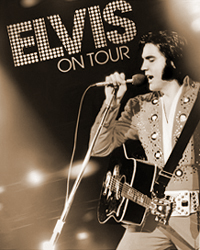
Elvis On Tour Blu-ray/DVD coming August 3

Elvis On Tour (1972)

Elvis On Tour (1972)

This week, Warner Home Video and Elvis Presley Enterprises announced the Elvis On Tour Blu-ray and DVD release date as August 3. There will also be a special screening of the movie on August 14 in Memphis during Elvis Week.

You read that right, we’re only four months away from the Elvis On Tour release!

Elvis On Tour features Elvis on the road and in rehearsals in the spring of 1972. Sandwiched between 1970’s colossal That’s The Way It Is and 1973’s Aloha From Hawaii, MGM’s Golden-Globe-winning documentary often seems to be overlooked among Elvis events. The second documentary produced about him, Elvis On Tour also represents Elvis’ 33rd and final movie.

Previously available in wide release only on VHS, Elvis On Tour is finally making its debut on Blu-ray and DVD. So, it is a little late to the DVD party, but just in time for the high-definition Blu-ray party!

While there will apparently not be any previously unreleased footage in this release, the press release does mention a number of songs that were featured only in the 1992 home video Elvis: The Lost Performances.

My hope is that the 1972 songs from The Lost Performances will be available as fully restored bonus features, along with the original theatrical version of the film. Blu-ray movies also allow for the possibility of “branching” — where you can choose between variations of a movie.

As we count down the months to the Elvis On Tour release, The Mystery Train will have more articles celebrating this event. Keep checking back, folks.

This is a great time to be an Elvis fan!

“Elvis On Beale” restored to glory [The Elvis Beat newsletter]

I was 20 when I wrote this article back in 1995 for The Elvis Beat #12, my official Elvis Presley Fan Club newsletter.


The restoration of the statue formerly known as “Elvis On Beale” has been completed. Although the awesome Memphis statue, created by Eric Parks, once had an outside home on Beale Street, it will now be displayed inside a new Tennessee welcome center, scheduled to be opened in Memphis by early next year.

The 10-foot-tall bronze statue was originally unveiled in 1979 but fell prey to erosion and other deterioration.

A new, weather-proof statue of Elvis is being designed to fill the vacancy on Beale Street. There will also be a better plan for the care of the statue and the surrounding Elvis Presley Plaza.

Elvis statue to move [The Elvis Beat newsletter]

I was 19 when I wrote this article back in 1994 for The Elvis Beat #9, my official Elvis Presley Fan Club newsletter.


The Elvis statue on Beale Street in Memphis will soon be moving. Eric Parks’ 1979 bronze statue has fallen prey to erosion and other deterioration in its current location, which is outside at Elvis Presley Plaza. The 10-foot statue, which is a stunning likeness of Elvis, will be completely restored before being moved inside to a new multi-million dollar welcome center being built in downtown Memphis.

Todd Morgan, Director of Communications for Graceland, said, “The center’s lobby is expected to feature imagery celebrating Memphis music, with the Elvis statue dominating the area as its centerpiece.”

Morgan reports that Graceland is planning to place a weather-proof statue or tribute at the old Beale Street location.

The new Memphis welcome center is scheduled to open by the end of this year.