Elvis In The Dawn

One of my favorite pieces ever written about Elvis Presley is “Elvis In The Dark” by Daniel Wolff. I’ve had it linked on The Mystery Train’s Exit page for years. If you’ve never read it or haven’t read it recently, I encourage you to do so while listening to “Are You Lonesome Tonight.”

Wolff’s remarkable essay originally appeared in a 1999 issue of The Threepenny Review, a literary magazine based out of Berkeley, California. While it is ostensibly a review of Peter Guralnick’s Careless Love: The Unmaking Of Elvis Presley, which was released that year, it is much more than that.

I am a firm believer that Elvis’ later work should not be dismissed as easily as it often is. Fortunately, such reactions seem at last to be changing. Wolff’s words capture the essence of post-Army Elvis. He acknowledges Elvis’ personal problems while still recognizing the artistic merits of his work during those times.

That is why it is my fervent hope that one day Wolff writes his own Elvis biography. Guralnick’s works are seminal, especially Last Train To Memphis: The Rise Of Elvis Presley (1994), but there is room for another look.

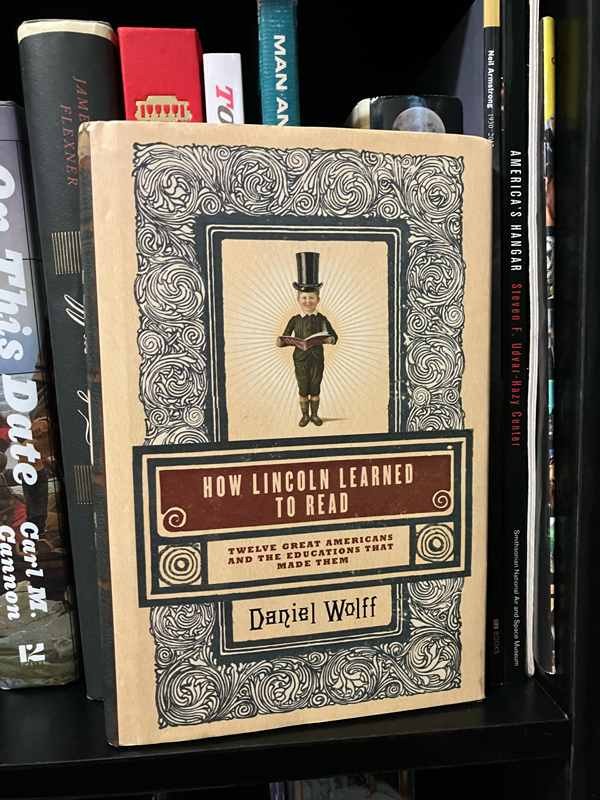
While Wolff has not yet written a volume dedicated to Elvis, I recently discovered that he devoted an entire chapter to him in his 2012 book How Lincoln Learned To Read: Twelve Great Americans And The Educations That Made Them.

HOW LINCOLN LEARNED TO READ by Daniel Wolff (2012)

The chapter titled “Elvis” includes a fascinating look at the economy of Elvis’ birthplace of Tupelo, Mississippi, during the Great Depression. In the midst of it, Elvis’ father, Vernon, is arrested and convicted for forging a check. During her husband’s 9-month stay in prison, Gladys and their son Elvis survive on government cheese while living with family as she picks up occasional laundry work.

One of their few respites is church, the Assembly of God where Gladys’ uncle is the preacher. Unlike some denominations, the Assembly of God allows guitars, drums, and tambourines, and Elvis’ earliest public singing takes place there.

Wolff also references Elvis’ fifth place win at a state fair talent contest in the mid-1940s, mentioning that it was broadcast over local radio. He adds:

“According to one researcher, over the next two and a half years he was on the radio ten times, singing hymns, show tunes, country-western and patriotic songs.”

Interesting, if true. Per his end notes, Wolff’s source for the multiple radio appearances is 2004’s Elvis: A Musical Inventory – 1939-55 by Richard Boussiron, which I have not read and appears to be difficult to come by these days. Guralnick in Last Train To Memphis alludes to at least one of these appearances in reference to Mississippi Slim’s radio show on WELO.

After the Presley family moves to Memphis, Tennessee, Elvis attends and graduates from Humes High School. During most of his time at Humes, the Presleys live at the Lauderdale Courts government housing project. Much as with Tupelo, Wolff also delves into the socioeconomics of Memphis. All of this serves to portray Elvis’ younger years against his environment and circumstances.

Elvis appears at a school talent show just a couple of months before graduation. Soon thereafter, he cuts a couple of demonstration records at the Memphis Recording Service. When Elvis records his first professional record for Sun at the age of 19, the Elvis chapter ends as his real story begins.

I had high expectations for this 2012 “Elvis” chapter, and it doesn’t quite live up to the peaks of Wolff’s 1999 “Elvis In The Dark” essay. A lot of that, however, is just due to the nature of the work in which it appears.

I continue to hold out hope for that single volume Elvis biography from Daniel Wolff one day. I would love to read how he covers Elvis’ post-Army years in particular, including placing him in the context of the world around him as he does so well in his “Elvis” chapter here. Until then, How Lincoln Learned To Read is certainly worth checking out for what it is, and I’m glad to have added it to my library.


“The LORD doesn’t see things the way you see them. People judge by outward appearance, but the LORD looks at the heart.”
from 1 Samuel 16:7

EPiC: Through Elvis’ Voice | Along For The Ride Ep. 1.2

ALONG FOR THE RIDE episode 2 is now available from The Mystery Train (underlying radio image created by generative AI)

In episode 2 of the Along For The Ride radio show, our discussion of Baz Luhrmann’s EPiC: Elvis Presley in Concert continues with topics including:

  • Elvis’ Onstage Humor
  • “Polk Salad Annie”
  • “I Like Elvis” & “I Hate Elvis” Buttons
  • The Strange Dog Scene
  • Elvis’ Jumpsuits & Capes
  • The TCB Band
  • Elvis’ Compassion

The second episode is embedded below or you can jump directly to YouTube.

Exclusive bonus for readers of The Mystery Train

Listen to an outtake from episode 2 below, where Elvis takes over as producer.

The Mystery Train Presents: Along For The Ride

ALONG FOR THE RIDE episode 1 is now available from The Mystery Train (underlying radio image created by generative AI)

We’ve been working on something here at The Mystery Train for the last six weeks, and I’m excited finally to be able to share it with you.

Not long after we saw Baz Luhrmann’s EPiC: Elvis Presley in Concert back in February, my bride came up with the idea for an online radio show or podcast that we would co-host on The Mystery Train. The concept grew directly out of real conversations we were already having after the film. Neither of us had ever done anything like this, so much research ensued.

The underlying idea of Along For The Ride is simple: My bride is literally along for the ride with a lifelong Elvis fan as her husband. She has now seen EPiC in theaters with me twice, and projects like that naturally spark questions for her. Along For The Ride gives you a chance to listen in on those unscripted conversations.

I am not an “Elvis expert.” However, I have been listening to his music, watching his performances and movies, and reading about him for just about my entire life. Her fresh perspective often helps me see Elvis and his world in new ways.

The first episode is embedded below or you can jump directly to YouTube.

Exclusive bonus for readers of The Mystery Train

All I had to say was, “. . . . Baz Luhrmann used audio from Bono of the band U2. . . .” That doesn’t sound so difficult, does it? Play my attempt below.

Elvis 1967: Season’s Greetings From Elvis

As part of The Mystery Train’s year-long celebration of 1967, below is a repost of a feature I wrote last year about Elvis’ first Christmas special.


While Elvis’ 1968 Christmas special is legendary, nearly lost to time is Elvis’ Christmas special from the previous year. His 1967 Christmas special no doubt inspired the original concept of the ELVIS (’68 Comeback) special.

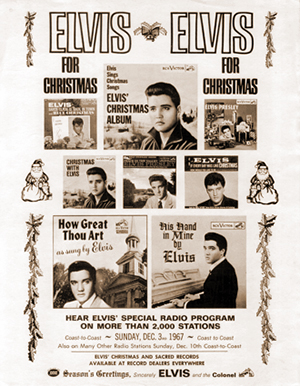
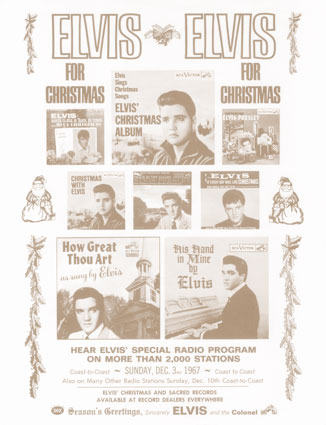
Exactly 44 years ago today, on Sunday, December 3, 1967, a special called Season’s Greetings From Elvis aired on over 2,000 stations across the United States. Why is it mostly forgotten? Season’s Greetings From Elvis was a radio special.

Season's Greetings From Elvis flyer (1967)

Season's Greetings From Elvis flyer (1967)

The special contained no new numbers by Elvis, but instead featured previously released Christmas and religious music. The songs in the half-hour show included:

  • Here Comes Santa Claus (1957)
  • Blue Christmas (1957)
  • O Little Town Of Bethlehem (1957)
  • Silent Night (1957)
  • I’ll Be Home For Christmas (1957)
  • I Believe (1957)
  • If Every Day Was Like Christmas (1966)
  • How Great Thou Art (1966)
  • His Hand In Mine (1960)
  • I’ll Be Home For Christmas (1957)

The special’s finale, “I’ll Be Home For Christmas,” contained a new voice-over by Elvis: “Thank you for listening. I’d like to wish you a merry Christmas and a wonderful New Year.” Oddly, this 1967 audio was later placed on top of “Silent Night” on 1982’s Memories Of Christmas and re-released on 1994’s If Every Day Was Like Christmas. However, the beginning music of “I’ll Be Home For Christmas” and not “Silent Night” can still be heard in the background on those releases as Elvis speaks the lines.

Exactly one year later, on December 3, 1968, the more famous Elvis Christmas special aired for the first time. Colonel Tom Parker’s original concept for the ’68 special sounded like little more than a TV version of Season’s Greetings From Elvis. The eventual show turned out much different, of course, and changed everything.


Image Source
Thank you to Holger Bock at Rare Elvis for providing the original image of an RCA promotional flyer for the 1967 radio special. Please do not reproduce this image without obtaining permission of Holger at Rare Elvis.

Research Sources

  • Careless Love: The Unmaking Of Elvis Presley by Peter Guralnick, Little, Brown And Company, Boston, 1999 (page 282).
  • Season’s Greetings From Elvis, Elvis In Norway, 2010.
  • Elvis: Word For Word by Jerry Osborne, Harmony Books, New York, 2000 (page 204).
  • Elvis: The Biography by Jerry Hopkins, Plexus, London, 2007 (page 205).
  • ELVIS: His Life From A To Z by Fred Worth and Steve Tamerius, Wings Books, New York, 1992 (page 560).

Throughout 2011, The Mystery Train has been commemorating the 44th anniversary of 1967. Find out why here. Surf in again next week for the exciting conclusion to this series.

Elvis’ Christmas special

For today’s Christmas edition of The Mystery Train Elvis Blog, I originally planned to write a short retrospective of the 1982 album Memories Of Christmas. Last week, I browsed over to the Elvis Today blog and found that Thomas had just written almost the exact same “Memories Of Christmas” post I had planned (even down to beginning with a reference to 1994’s If Every Day Was Like Christmas album). Hey Thomas, get out of my head, man!

In all seriousness, Thomas and I have very similar views and approaches when it comes to Elvis, so these things happen to us from time-to-time. There was one small element of Memories Of Christmas that he did not mention in that particular post, however, so I decided to use that as a springboard to a new idea. This time, I ran it past him first to make sure he did not already have it in the works for this week.

Thomas gave me the all clear, so today I’m going to talk about Elvis’ 1967 Christmas special.

Wait, wait, wait. Don’t fire off a correction message to me just yet.

Yes, I said 1967 Christmas special. That was not a typo.

While Elvis’ 1968 Christmas special is legendary, nearly lost to time is Elvis’ Christmas special from the previous year. His 1967 Christmas special no doubt inspired the original concept of the ELVIS (’68 Comeback) special.

Season's Greetings From Elvis flyer (1967)

Season’s Greetings From Elvis flyer (1967)

On Sunday, December 3, 1967, a special called Season’s Greetings From Elvis aired on over 2,000 stations across the United States. Why is it mostly forgotten? Season’s Greetings From Elvis was a radio special.

The special contained no new numbers by Elvis, but instead featured previously released Christmas and religious music. The songs in the half-hour show included:

  • Here Comes Santa Claus (1957)
  • Blue Christmas (1957)
  • O Little Town Of Bethlehem (1957)
  • Silent Night (1957)
  • I’ll Be Home For Christmas (1957)
  • I Believe (1957)
  • If Every Day Was Like Christmas (1966)
  • How Great Thou Art (1966)
  • His Hand In Mine (1960)
  • I’ll Be Home For Christmas (1957)

The special’s finale, “I’ll Be Home For Christmas,” contained a new voice-over by Elvis: “Thank you for listening. I’d like to wish you a merry Christmas and a wonderful New Year.” Oddly, this 1967 audio was later placed on top of “Silent Night” on Memories Of Christmas (and re-released on 1994’s If Every Day Was Like Christmas). However, the beginning music of “I’ll Be Home For Christmas” and not “Silent Night” can still be heard in the background on those releases as Elvis speaks the lines.

Exactly one year later, on December 3, 1968, the more famous Elvis Christmas special aired for the first time. Colonel Tom Parker’s original concept for the ’68 special sounded like little more than a TV version of Season’s Greetings From Elvis. The eventual show turned out much different, of course, and changed everything.

To fellow Elvis fans across the world, I’d like to wish you and your families a wonderful Christmas.

* * *

Image Source
Thank you to Holger Bock at Rare Elvis for providing the original image of an RCA promotional flyer for the 1967 radio special. Please do not reproduce this image without obtaining permission of Holger at Rare Elvis.

Research Sources

  • Careless Love: The Unmaking Of Elvis Presley by Peter Guralnick, Little, Brown And Company, Boston, 1999 (page 282).
  • Season’s Greetings From Elvis, Elvis In Norway, 2010.
  • Elvis: Word For Word by Jerry Osborne, Harmony Books, New York, 2000 (page 204).
  • Elvis: The Biography by Jerry Hopkins, Plexus, London, 2007 (page 205).
  • ELVIS: His Life From A To Z by Fred Worth and Steve Tamerius, Wings Books, New York, 1992 (page 560).

Return of the Rocker Starts an Obsession

Close-up of Return of the Rocker (1986)

Close-up of Return of the Rocker (1986)

In my childhood, I mostly listened to Elvis through borrowing records from my Mom and brother.

That all changed in 1987. Back then, you could still hear music on AM radio, and Oldies stations still played more than the same 200 songs they recycle today.

A local AM radio station was playing the live version of “I’ve Lost You” by Elvis that very morning as I waited anxiously on the phone. I was 11-years-old and on a strange winning streak. It seemed just about any contest I entered at that time, I won.

This radio call-in contest was for the prize to end all prizes, though. The winner of this contest would receive an Elvis LP record album, Return of the Rocker.

I had been trying for a week or two to win this one. To win, you simply had to be the tenth caller once they announced the contest each weekday morning. They had been giving away the album for some time, as my brother had won it over a month before. I was determined to win as well.

Usually such call-in contests went like this for me:

  1. Dial the number.
  2. Hear busy signal.
  3. Hang up.
  4. Hit re-dial.
  5. Hear busy signal.
  6. Go back to 3 until it finally rings, someone answers, states there has already been a winner, and hangs up.

The phone was ringing, and sooner than normal this time. The DJ, “Large” Larry, answered by simply saying the name of the station. I paused, as this had never happened before. “Am I a winner?” I asked sheepishly.

“Yes, you are!” He said. Realizing (and, looking back, probably surprised by) my age, the DJ asked me a few questions about what grade I was in and whether or not I thought my teacher was good-looking.

I didn’t care about the DJ’s shenanigans, though. I had just won my first-ever Elvis album! A week or two later, a certificate arrived in the mail that could be redeemed at the now defunct Peaches Music for a free copy of Return of the Rocker.

I would eventually spend a lot of time browsing the Elvis Presley section in Peaches, but I believe this was my first time in the store. I didn’t browse too long that day, just grabbed Return of the Rocker, checked out without problems, and hurried my Mom on the car ride home so I could finally play this record.

The record player I had back then was a hand-me-down from my older sister. It was vintage 1970s, I think, and kind of folded up to be carried around – though it was really too heavy to do that since it had a couple of bookshelf speakers as well.

I gently placed the needle on Side A of Return of the Rocker and was instantly rewarded with a rousing saxophone intro to an Elvis song I had never heard before, “King of the Whole Wide World.”

“The poor man wants the oyster,” Elvis sang, “The rich man wants the pearl, but the man who can sing but he hasn’t got a thing, he’s the king . . . of the whole wide world. Come on and sing! Sing, brother, sing!”

I was blown away. My life was never the same after that moment. Over the next few weeks, while pondering the incredible front and back cover art by Mark Chickinelli (I would love to find a print of his full cover art painting someday), I must have played the record dozens and dozens of times.

The rest of it was just as good as the opener, and it was full of songs that were new to me.

Side A
King of the Whole Wide World (1961)
(Marie’s The Name) His Latest Flame (1961)
Little Sister (1961)
A Mess Of Blues (1960)
Like A Baby (1960)
I Want You With Me (1961)

Side B
Stuck On You (1960)
Return To Sender (1962)
Make Me Know It (1960)
Witchcraft (1963)
I’m Comin’ Home (1961)
Follow That Dream (1961)

Return of the Rocker may have just been a compilation record of previously released songs, but that record was everything to me.