Elvis Movies: DOUBLE TROUBLE

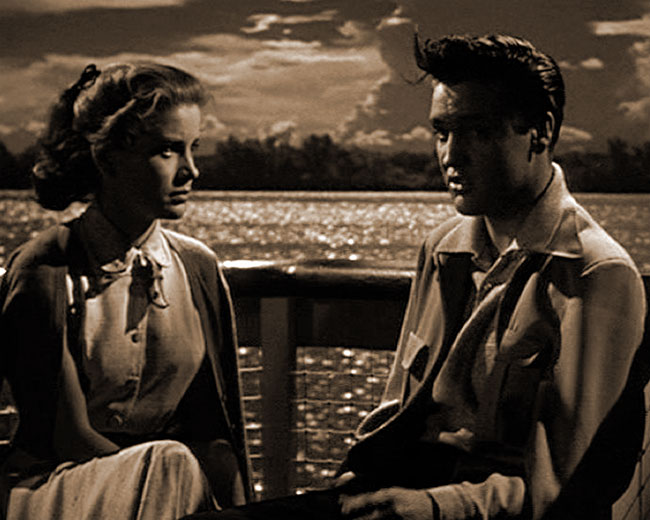
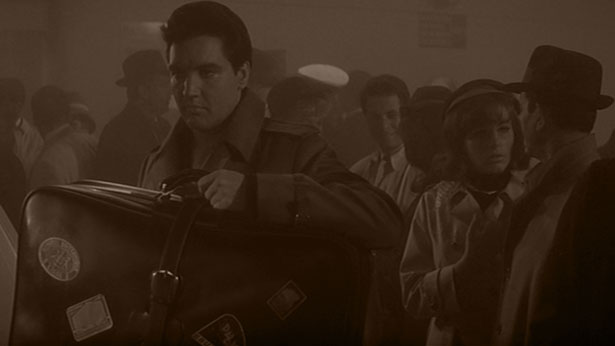
Guy Lambert (Elvis Presley) departs for Belgium in 1967's DOUBLE TROUBLE (MGM)

Guy Lambert (Elvis Presley) departs for Belgium in 1967’s DOUBLE TROUBLE (MGM)

“[F]or the most part, Elvis movies take place in Elvis Land, a time outside of time, a time where Elvis is King, there is no outside world, there is no larger context – because when you have Elvis, that’s all the context you need. He justified films merely by being in them. You can imagine how that could be a disheartening experience for someone so competitive as Elvis, someone so determined to do well, but it is just one of the elements that make him fascinating as a performer.”
-Sheila O’Malley, 2012, The Sheila Variations

In his lifetime, Elvis Presley released 31 narrative movies and 2 documentaries. At the height of his film career in the 1960s, he was cranking out 3 movies a year.

When I was a teen, the local video rental store had dedicated sections for Action, Drama, Romance, Musicals, Horror, Science Fiction, and the like. It also had an entire section called Elvis Movies, with shelves full of VHS tapes of many of his films and concerts. Like Monster Movies or Superhero Movies, Elvis Movies really are their own genre. As writer Sheila O’Malley aptly notes above, they also occur in their own little reality.

As a second generation Elvis fan, and a child of the late 1970s and 1980s, my first exposure to Elvis Movies was not in the theater or even on VHS, but on broadcast television. A local, independent UHF channel would show a mini-marathon of themed movies on Saturday afternoons. On some Saturdays, for instance, I watched a double or triple feature of Monster Movies like King Kong vs. Godzilla (1963). On other Saturdays, I watched two or three Elvis Movies on this station. I can still hear the announcer excitedly proclaiming, “Up next, more Elvis in Harum Scarum!”

Though there are occasional exceptions, Elvis Movies are usually not remarkable achievements from an artistic perspective. Near the end of his film career, Elvis admitted that his movies made him “physically ill.” Though I cannot confirm the authenticity of this next quote, Elvis is also purported to have once said, “The only thing worse than watching a bad movie is being in one.”

As a child, though, I loved watching Elvis Movies with my family. They were fun, and Elvis played any number of characters of interest to an 8-year old: A racecar driver, a cowboy, a boxer, an Army man, etc. Elvis was the ultimate action hero, destined to win every fight and every girl. Elvis had a natural comedic flair, and there were also action scenes, often involving karate, that kept me interested as well. Of course, music was ever-present. The quality of many of his movie tunes were subpar, to say the least, but I didn’t really notice this back then, either. Elvis Movies were complete fantasy packages, as entertaining to young me as watching Godzilla and King Kong duke it out.

At some point, I suppose in my early adulthood, I began to see Elvis Movies in a different light. Maybe it was slogging through those dreadful movie tunes as I began exploring his entire catalog of music. Maybe it was reading about how much he disliked making them. Maybe it was the constant re-running of his movies on cable stations every January and August. At some point, I began to find it harder to sit through Elvis Movies. The completist in me has collected all of them on DVD, and I have watched each at least once. I don’t return to most of them too often, though. I love movies almost as much as I love music. I watched nearly 100 movies last year, but only one Elvis Movie.

In the spirit of that 8-year-old who watched a string of Elvis Movies on Saturday afternoons so long ago, I’ve decided to rewatch Elvis Movies over the next few years. I’m going to approach this in a random fashion, for that is how I first watched them. Along the way, I plan to blog about them. While I won’t go as deep into the details of these movies as someone like Gary Wells over at the Soul Ride blog might, I’ll hit what I consider the highlights as well as quirky tidbits that jump out at me, often on a personal level. Up first is Double Trouble.


“Elvis takes mad mod Europe by song as he swings into a brand new adventure filled with dames, diamonds, discotheques, and danger!!”

Double Trouble

Double Trouble (MGM)
Wide Release: April 5, 1967 (United States)
Starring: Elvis Presley, John Williams, Yvonne Romain, Annette Day
Screenplay By: Jo Heims
Story By: Marc Brandel
Music Score By: Jeff Alexander
Produced By: Judd Bernard and Irwin Winkler
Directed By: Norman Taurog
Running Time: 92 Minutes


You would be forgiven if, based on the movie’s title or the fact that he appears twice on its poster, you expected Elvis Presley to play dual roles in Double Trouble, his 24th film to be released. Alas, this is not the case, for he had already performed that schtick a few years earlier in Kissin’ Cousins (1964). The double in the trouble represents our hero, singer Guy Lambert (Elvis), being torn between two love interests – the innocent but zany Jill (Annette Day) and the seductive Claire (Yvonne Romain). The movie isn’t really about any of that, though. While Guy seems intrigued by Claire, his heart is obviously with Jill – despite his own misgivings, including a subplot involving Jill’s age that is cringe-worthy by today’s standards.

Instead, Double Trouble tries to be a madcap comedy/thriller. Most of the comedy external to Elvis doesn’t really work (I’m looking at you, Wiere Brothers).
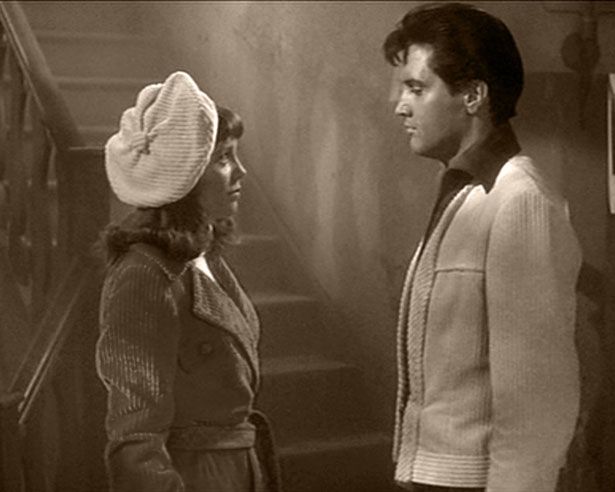
Annette Day is Jill Conway and Elvis Presley is Guy Lambert in 1967's DOUBLE TROUBLE (MGM)

Annette Day is Jill Conway and Elvis Presley is Guy Lambert in 1967’s DOUBLE TROUBLE (MGM)

Double Trouble doesn’t really work as a thriller, either. Someone wants Guy and/or Jill dead. Though the ultimate mastermind of the murder plot might come as a surprise, this revelation comes about through the hackneyed explanation of a hired killer right before he is going to off his victim. Guy, of course, saves the day, and the would-be killer ends up succumbing to the very trap he had planned for his target. Death is rare in Elvis Movies, but it does happen.
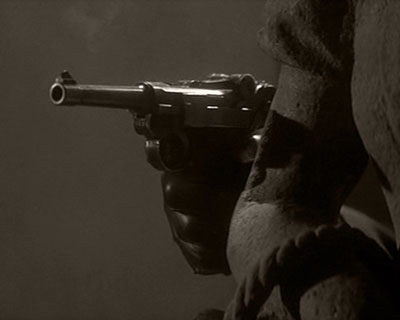
1967’s DOUBLE TROUBLE includes multiple murder attempts (MGM)

Double Trouble is also rare among Elvis Movies in that it takes place in Europe. The film opens in London, England, and then takes us to Belgium. Not really, though, as Double Trouble was filmed in Culver City, California.

In Double Trouble, the Belgian police drive Volkswagen Beetles. The interesting thing about this, for me, is that, as a child, I was obsessed with wanting a red VW Beetle. I drew pictures of one throughout my elementary school years, often including a police siren on top and other special devices, like spotlights and ejection seats. Though I have no memory of picking up this particular fascination from an Elvis Movie, sure enough, a red VW Beetle police car appears during a chase sequence.
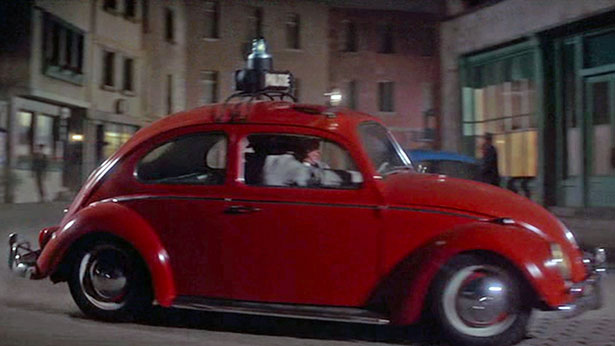
A Volkswagen Beetle police car appears in 1967’s DOUBLE TROUBLE (MGM)

Double Trouble marks the acting debut of Annette Day (Jill). You wouldn’t know it from the film, as she does a commendable job in both comedic and dramatic scenes. I love watching her observe and then mimic Elvis’ movements as he sings “Old MacDonald” to her. Unfortunately, this is Day’s only movie.
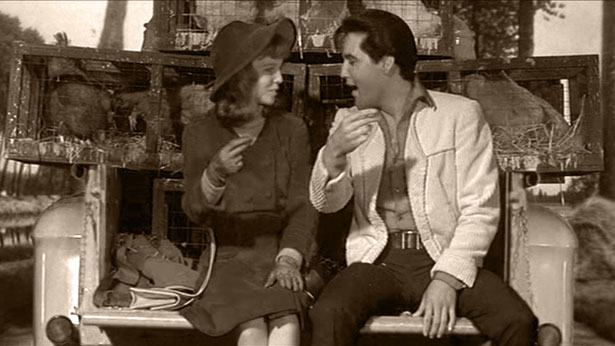
Jill Conway (Annette Day) snaps along as Guy Lambert (Elvis Presley) sings "Old MacDonald" in 1967's DOUBLE TROUBLE (MGM)

Jill Conway (Annette Day) snaps along as Guy Lambert (Elvis Presley) sings “Old MacDonald” in 1967’s DOUBLE TROUBLE (MGM)

I enjoyed watching many of the songs in the context of this film far more than I do listening to the soundtrack album in isolation. Elvis does appear quite stiff at times, though, particularly during his opening number, the title song. Incidentally, I really enjoyed the funky instrumental opening to the film and wish that ambience had been present on the actual Elvis music.

I admitted long ago that I’m a fan of Elvis’ version of “Old MacDonald” but the beautiful “City By Night” and “Could I Fall In Love” are Double Trouble‘s musical highlights.
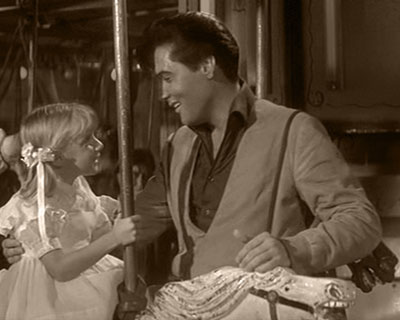
A child (portrayed by Laurie Lambert) and Guy Lambert (Elvis Presley) ride a carousel as he sings “I Love Only One Girl” in 1967’s DOUBLE TROUBLE (MGM)

If you go with the flow, as is necessary with most Elvis Movies, Double Trouble is entertaining.


Boldly Go

Stanley Adams plays Captain Roach in Double Trouble. Adams is known to fellow Trekkies for his portrayal of Cyrano Jones in the Star Trek episode “The Trouble With Tribbles” (1967) and the animated Star Trek follow-up episode “More Tribbles, More Troubles” (1973).
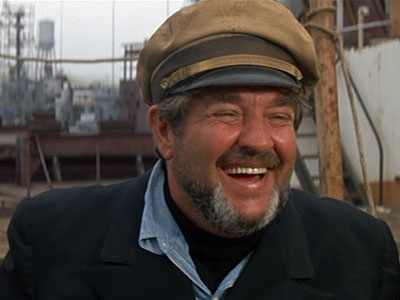
Stanley Adams is Captain Roach in 1967's DOUBLE TROUBLE (MGM)

Stanley Adams is Captain Roach in 1967’s DOUBLE TROUBLE (MGM)
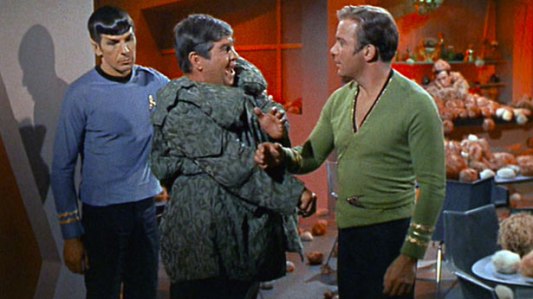
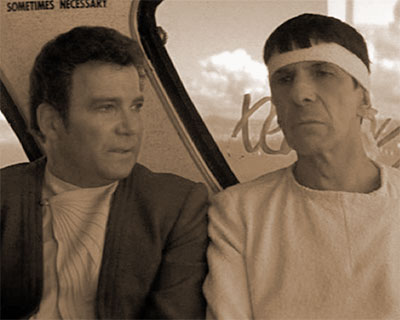
Leonard Nimoy is Mister Spock, Stanley Adams is Cyrano Jones, and William Shatner is Captain James T. Kirk in the 1967 STAR TREK episode "The Trouble With Tribbles" (Desilu)

Leonard Nimoy is Mister Spock, Stanley Adams is Cyrano Jones, and William Shatner is Captain James T. Kirk in the 1967 STAR TREK episode “The Trouble With Tribbles” (Desilu)


Double Trouble Tote Board

  • Kisses: 13
  • Karate Chops: 9
  • Songs: 8
  • Karate Kicks: 4
  • Broken Windows: 2
Elvis Presley is Guy Lambert in 1967's DOUBLE TROUBLE (MGM)

Elvis Presley is Guy Lambert in 1967’s DOUBLE TROUBLE (MGM)

Songs In Double Trouble

  1. “Double Trouble” (1966), written by Doc Pomus & Mort Shuman
  2. “Baby, If You’ll Give Me All Of Your Love” (1966), written by Joy Byers
  3. “Could I Fall In Love” (1966), written by Randy Starr
  4. “Long Legged Girl” (1966), written by J. Leslie McFarland & Winfield Scott
  5. “City By Night” (1966), written by Bill Giant, Bernie Baum, & Florence Kay
  6. “Old MacDonald” (1966), written by Randy Starr, based on the traditional composition
  7. “I Love Only One Girl” (1966), written by Sid Tepper & Roy C. Bennett, based on the traditional composition “Auprès de ma blonde“
  8. “There Is So Much World To See” (1966), written by Sid Tepper & Ben Weisman

The Mystery Train’s Double Trouble Scorecard

  • Story: 2 (out of 10)
  • Acting: 5
  • Fun: 6
  • Songs: 5
  • Overall: 4 (For Elvis Fans Only)

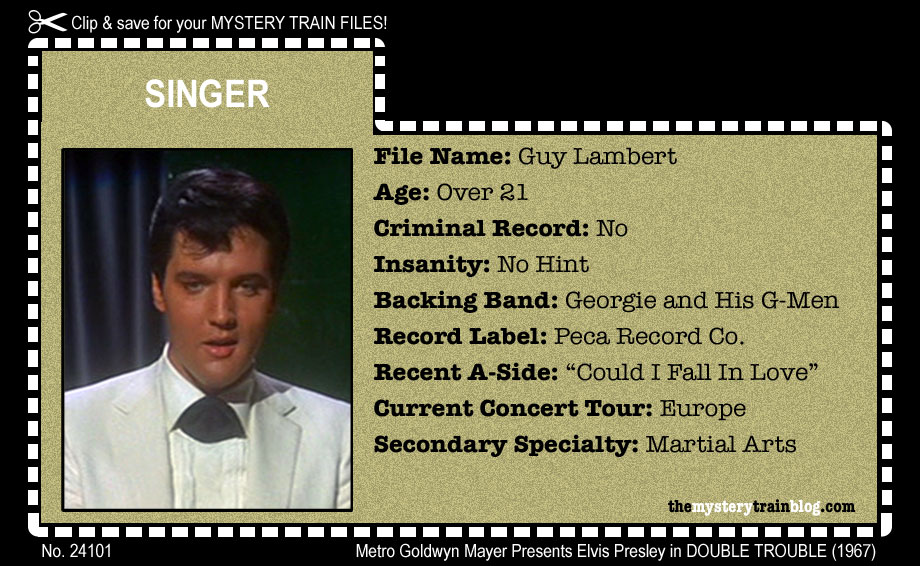
TMT Files: Guy Lambert

Click image for larger, full-color version


“And whatever you do or say, do it as a representative of the Lord Jesus, giving thanks through him to God the Father.”
Colossians 3:17
Music of the Year for 2015 [Pastimescapes blog]

One of the things I enjoy doing at the end of each year is looking back on the music I have played, mostly from a number-crunching standpoint.

According to iTunes, out of 9,554 unique music tracks in my collection, the one I played most often in 2015 was “Always On My Mind” by Elvis Presley, as presented on the 1981 soundtrack This Is Elvis. I played the song 22 times.

This came as no surprise to me, for the track is one of my favorite recordings of all time. Earlier this year, Sony’s Follow That Dream collectors label for Elvis fans released the soundtrack on CD for the first time. It was previously available only on vintage vinyl and cassette, neither of which I had backed up to iTunes.

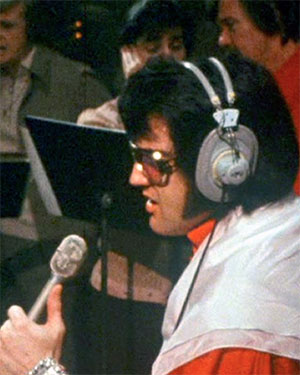
This version of “Always On My Mind” is unique in that Elvis recorded it as part of a “mock” studio session with MGM cameras rolling in March 1972 for the Elvis On Tour documentary, one day after his actual master recording.

Though that film ultimately did not include the footage, portions of it later wound up in This Is Elvis almost a decade later. The This Is Elvis soundtrack version also includes instrumental overdubs created in 1981.

Elvis records "Always On My Mind" in March 1972

Elvis records “Always On My Mind” in March 1972

A “clean” version of the song without the posthumous overdubs is available on the CDs Elvis: The Great Performances and Elvis On Tour: The Rehearsals, but I much prefer the This Is Elvis version.

I listened to 3,862 Elvis songs using iTunes or my iPods in 2015 (including duplicates). That is an average of almost 11 Elvis songs a day. I listened to 1,819 different Elvis tracks during the year, out of 3,981 unique Elvis recordings in my collection.

Out of 5,573 non-Elvis tracks in my collection, my most played piece in 2015 was Alexander Courage’s “Beyond The Pale/Main Title” (1965) from Star Trek‘s second pilot episode, “Where No Man Has Gone Before.” I played that one 21 times, so Elvis only narrowly edged out the competition.

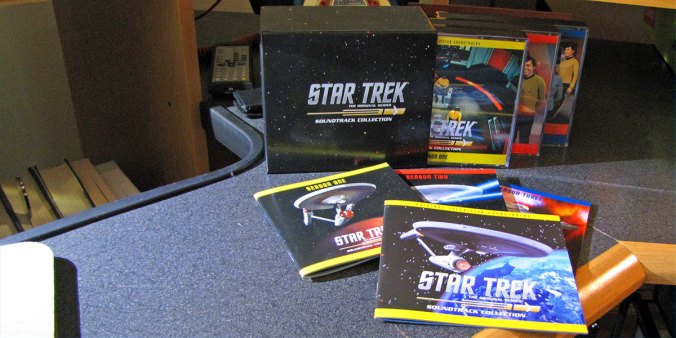
STAR TREK: THE ORIGINAL SERIES SOUNDTRACK COLLECTION (La-La Land Records, 2012)

STAR TREK: THE ORIGINAL SERIES SOUNDTRACK COLLECTION (La-La Land Records, 2012)

Earlier this year, I obtained the 15-CD Star Trek: The Original Series Soundtrack Collection from La-La Land Records.

In many ways, this set was the centerpiece of my music listening in 2015. It is a stunning collection that lives up to the many accolades bestowed upon it by folks more knowledgeable in this area than me.

If you are a fan of the original Star Trek and have room in your budget, I cannot recommend this premium set enough. Courage’s “Beyond The Pale/Main Title” might very well be my favorite track from the collection, if the numbers are to be believed. His work on the pilots and season 1 helped define the series.

Overall, I listened to 10,538 music tracks using iTunes or my iPods this year. That works out to almost 29 recordings a day. These counts, of course, exclude the additional time I spent listening to CDs and records. I love music and cannot imagine life without it.


I hope you have a healthy and rewarding 2016! Thank you for reading my little blog.

“Elvis Song Of The Year” for 2013

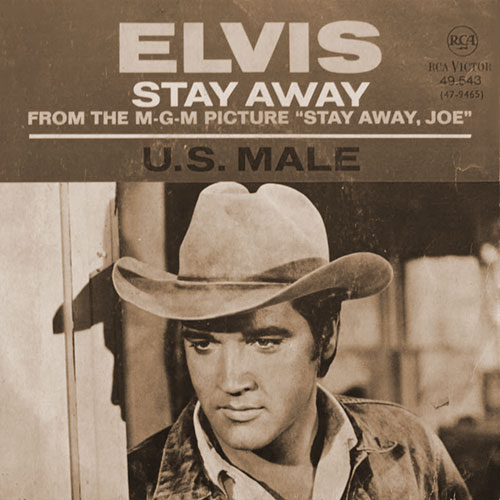
According to iTunes, out of 3,572 unique Elvis tracks in my collection, the one I played most often in 2013 was “Stay Away,” the flip side of “U.S. Male” in 1968. I played the track 22 times.

Based on the traditional melody of “Greensleeves,” which also inspired the 19th century Christmas classic “What Child Is This,” “Stay Away” played over the opening titles of Stay Away, Joe, Elvis’ 26th movie.

Considering how little time I have had for this blog lately, “Stay Away” indeed seems like the perfect Elvis song to represent 2013 for me.

Stay Away (1968)

Stay Away (1968)

I listened to 8,499 Elvis songs using iTunes or my iPods in 2013 (including duplicates). That is an average of 23 Elvis songs a day. I listened to 2,353 different Elvis tracks during the year.

Out of 3,700 non-Elvis tracks in my collection, my most played piece in 2013 was Michael Giacchino’s “Spock Drops, Kirk Jumps,” from his 2013 Star Trek Into Darkness film score. I played that one 26 times.

Among vocal performances, the non-Elvis track I played most was 2008’s “All I Want” by Darius Rucker (20 plays), from his Learn To Live album.

Overall, I listened to 12,629 songs using iTunes or my iPods this year. That works out to 35 songs a day.

* * *

Thank you for reading. May 2014 be your best year yet!

King Creole: A Stone For Danny Fisher

A Stone For Danny Fisher: Now A Major Motion Picture From Paramount

Herbert Baker and Michael Vincent Gazzo based the King Creole screenplay on the 1952 novel A Stone For Danny Fisher by Harold Robbins. Until I read the book, my knowledge of the author was limited to the following exchange between Jim Kirk and Spock in 1986’s Star Trek IV: The Voyage Home.

Jim Kirk and Spock discuss language on 20th century Earth in STAR TREK IV

Jim Kirk (William Shatner) and Spock (Leonard Nimoy) discuss language on 20th century Earth in STAR TREK IV: THE VOYAGE HOME (1986).

In the film, the Enterprise crew has journeyed back in time 300 years to 20th century Earth. Kirk has been trying to fit in with the natives.

Spock: Your use of language has altered since our arrival. It is currently laced with, shall I say, more colorful metaphors….
Kirk: You mean the profanity?
Spock: Yes.
Kirk: That’s simply the way they talk here. Nobody pays any attention to you unless you swear every other word. You’ll find it in all the literature of the period.
Spock: For example?
Kirk: Well, the collected works of Jacqueline Susann, the novels of Harold Robbins.
Spock: Ah. The giants.

With Vulcan sarcasm in mind, I was not quite sure what to expect from Robbins’ novel.

While I feel the acting potential of Elvis Presley was never fully realized, even I acknowledge that he probably would have been less than convincing in 1958 playing a Jewish boxer from Brooklyn. Who am I to say, though? Maybe he would have pulled it off.

While Danny Fisher morphs into a religiously-ambiguous singer from New Orleans in King Creole, the interesting thing about reading the novel is that it does feel like the same character. The book, then, acts as an excellent back story for the film. According to biographer Peter Guralnick, Elvis even read the novel as part of his preparations for the movie (Last Train To Memphis, page 450).

Guralnick’s claim is backed up by the sheer strength of Elvis’ performance in the role. The character seems more than what is on the page of the film script, and I believe Elvis reading the novel beforehand is part of what makes Danny so believable. This is a character who has already lived, already has a history, before the events of the movie begin. Compare that with Vince Everett of Jailhouse Rock, who seems to fade into existence just to serve the purpose of the movie.

A Stone For Danny Fisher is written in first person perspective, meaning in this case that Danny is actually the one telling his story. I could not help but imagine much of the book with Elvis as Danny.

As one would expect, the novel captures a much broader story than the film does. While the movie focuses on Danny at 19-years-old in 1958, the book covers his life from 8-years-old in 1925 up until 27-years-old in 1944.

Only touched upon in the film, one of the recurring elements of the novel is Danny’s house. Danny’s family moves from a tight apartment into a more spacious home. Moving day is his eighth birthday, and his father tells him the house is his present.

I turned and pressed my lips to the cool floor. “I love you, house,” I whispered. “You’re the most beautiful house in the whole world, and you’re mine and I love you.”

Danny’s father loses the house during the depths of the Great Depression in 1932, and they are forced to move again. From that point on, his relationship with his father is different.

That was the night when for the first time I admitted to myself that it was not my house, that it really belonged to someone else, and there was no heart left in me for tears.

As in the movie, Danny takes Nellie to see his old house, vowing to someday buy it back.

Nellie listens to Danny talk about his house in KING CREOLE

Nellie (Dolores Hart) listens to Danny (Elvis Presley) talk about his house in KING CREOLE (1958).

The movie version of the scene is illustrative of the issues in the relationship between Danny and Nellie. More so than any other point in the movie, Danny is being open with Nellie and sharing something that is extremely important to him. She misses this entirely, barely reacting at all. It is a telling moment, as the two characters appear to be in the middle of completely different conversations.

Danny: You see that house over there? Way over there. See it? That used to be our house. Pa bought it when I was about 8-years-old. It was kind of my birthday present. We sure had a lot of happy times there. I’m gonna buy that house back someday or one just like it. And I guarantee nobody’s gonna take it away from me. Nobody.
Nellie: I told my mother about you. I told her I met a million-dollar boyfriend in a five and ten cents store.

In the novel, Nellie is much more present in the scene. It draws them closer together, while the film version seems to distance them.

We were standing on a dark empty corner, almost ten o’clock at night, in a neighborhood in Brooklyn she had never even known about. I raised my hand and pointed across the street. “See it?” I asked. […] “It’s my house. I used to live there. Maybe soon we’ll be able to move back.”

A sudden light came into her eyes. She glanced quickly at the house, then back at me. Her mouth softened gently. “It is a beautiful house, Danny,” she said in an understanding voice.

My hand tightened on her arm. “Papa gave it to me for my birthday when I was eight years old,” I explained to her. […]

“And now you will move back here,” she whispered softly, pressing her face against my shoulder. “Oh, Danny, I’m so happy for you!”

As told through Danny’s eyes, the writing of the novel varies from crude to eloquent. Even the movie shows some of this dichotomy of character. Think of the crudeness of Danny propositioning the innocent Nellie outside of Room 205 versus the eloquence of him singing “As Long As I Have You,” for instance. While the overall tone is often gritty, I was surprised at the beauty of certain passages of the novel. Though a boxer and later a business man of questionable virtue, Danny has a poet’s soul.

I find Danny in King Creole to be a frustrating character because he seems to have a good heart, yet keeps taking the wrong steps or simply getting bad breaks. The novel version of Danny has many of the same qualities. Like his house, true happiness often seems just within his reach, before it is ripped away from him. Seeing this pattern, Nellie eventually becomes afraid of the house, afraid of what will happen when Danny finally obtains what he has sought for so long.

Reading the book made me realize that Baker and Gazzo’s screen adaptation represents a masterpiece of writing in its own right. It pulls bits and pieces from the novel and carves out a new, yet familiar story. To reference more recent Star Trek movies, King Creole feels like an alternate universe version of the Danny Fisher story.

It was almost as if I were watching this from a seat in the movies. I wasn’t really a part of it. It was another guy named Danny Fisher, and he had gone away two years ago and never really come back.

Though the fates of certain characters differ from the film, the book also offers the rare opportunity to find out “what happens next.”

While a departure from what I normally read, A Stone For Danny Fisher is a worthwhile, well-written novel that sheds more light on the story behind King Creole and the material that inspired how Elvis portrayed his character.


My grandmother worked in the ticket booth of a theater for decades. I dedicate this series of movie posts to her, who would have turned 103 this year. I often remember her when I watch movies.

Steve Brogdon sets new record conquering Elvis Trivialities #5

The Mystery Train’s Night Riders have a new member. Setting a new record, Steve Brogdon correctly answered Elvis Trivialities #5 in only 17 minutes. In recognition of this outstanding achievement, Steve now has a brand-new set of bragging rights.

And the answer is…

The Mystery Train Elvis Trivia 5

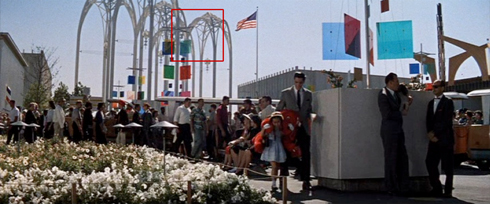
The above image slice is from the Elvis movie It Happened At The World’s Fair.

It Happened At The World's Fair (1963)

The real question should have been, what exactly happened at the world’s fair?

The 1963 film also starred Joan O’Brien and Gary Lockwood. Kurt Russell had a bit part in the movie as the boy who kicks Elvis. Russell went on to portray the singer in 1979’s Elvis, directed by John Carpenter. An homage to the scene appears in 2001’s 3,000 Miles To Graceland, which also starred Russell.

The 1979 Elvis movie was produced by Dick Clark. Now, stay with me, here’s some even stranger trivia for you. John Carpenter (best known for directing Halloween) shares his name with the character Elvis played in 1969’s Change Of Habit. Change Of Habit was directed by William A. Graham. Graham directed 1993’s Elvis & The Colonel: The Untold Story (one of the worst movies about Elvis, and that’s an accomplishment), which, get this, was also produced by Dick Clark! Confused yet?

Whew! Meanwhile, Gary Lockwood from It Happened At The World’s Fair went on to play Gary Mitchell in “Where No Man Has Gone Before,” the Star Trek pilot that sold the series. Yesterday, Star Trek celebrated its 45th anniversary. Lockwood is most known, however, for playing Dr. Frank Poole in 1968’s 2001: A Space Odyssey. Elvis, of course, went on to use “Also Sprach Zarathustra” as his opening theme in most of his 1971-1977 concerts. Richard Strauss’ 1896 composition was also used as the theme to 2001.

If you’re lookin’ for trivia, you came to the right place.

Meanwhile, you never know when I’ll post the next question. The best way to have a chance to win is to subscribe to The Mystery Train Elvis Blog using the feature in the menu bar to the right. Then, you’ll be notified by email whenever there is a new post.

Congratulations again to Steve!


The Mystery Train’s Night Riders

  • September 9, 2011: Steve Brogdon (0:17) <— Record time
  • August 6, 2011: Thomas (2:26)
  • July 9, 2011: Thomas (5:26)
  • June 23, 2011: Fred Wolfe (0:18)
  • June 22, 2011: [Ty stumps the train]

Thomas claims victory in Elvis Trivialities #4, becomes first back-to-back winner

Thomas has once again triumphed over Elvis Trivialities by being the first person to correctly answer the fourth installment.

With a response time of two hours and twenty-six minutes, he becomes the first member of The Mystery Train’s Night Riders to score not only a repeat victory, but a back-to-back one at that. Thomas now receives even more bragging rights.

And the answer is…

Brett Reno in Love Me Tender was played by an actor who later had two different roles on Star Trek.

Veteran character actor William Campbell portrayed Brett Reno, a brother to Clint (Elvis). Among many other television roles, he went on to appear as Trelane in the first season Star Trek episode “The Squire of Gothos” (1967) and Koloth, a Klingon captain, in the second season episode “The Trouble With Tribbles” (1967). Both installments consistently rate among Trek’s best.

He reprised the role of Koloth in “Blood Oath,” a 1994 episode of Star Trek: Deep Space Nine. Campbell passed away earlier this year.

Congratulations again to Thomas!


The Mystery Train’s Night Riders

  • August 6, 2011: Thomas (2:26)
  • July 9, 2011: Thomas (5:26)
  • June 23, 2011: Fred Wolfe (0:18) <— Record time
  • June 22, 2011: [Ty stumps the train]

Elvis Trivialities #4

Welcome to Elvis Trivialities. Your question is:

Which character in Love Me Tender was played by an actor who later had two different roles on Star Trek?

Bragging rights to the first person to post the correct answer in the comments below.

Will we have our first repeat winner? Or will a new winner join their ranks? Can anyone break Fred Wolfe’s speed record? Check in next time to find out.