ELVIS RECORDED LIVE ON STAGE IN MEMPHIS Legacy Edition to include Richmond, Virginia concert

ELVIS RECORDED LIVE ON STAGE IN MEMPHIS (2014 Legacy Edition)

ELVIS RECORDED LIVE ON STAGE IN MEMPHIS (2014 Legacy Edition)

One of my favorite CD releases on the Follow That Dream collectors label for Elvis Presley fans is 2011’s Forty-Eight Hours To Memphis, which captures a March 18, 1974, concert that Elvis performed at the Richmond Coliseum in Virginia.

The confusing album title reflects that Elvis closed out his tour two days after the Richmond concert with a show in Memphis at the Mid-South Coliseum, portions of which became the 1974 album Elvis Recorded Live On Stage In Memphis. Elvis earned his third and final Grammy Award for his stellar performance of “How Great Thou Art” in Memphis on the original 1974 album.

The link between the two shows continues, for Sony announced last week that it will reissue the Richmond concert on the second disc of a Legacy Edition of Elvis Recorded Live On Stage In Memphis. While the FTD collectors label has very limited distribution, this new 2-CD release on the main Sony label hits mainstream retail stores on March 18, the 40th anniversary of the Richmond concert. Amazon and other outlets are accepting pre-orders now.

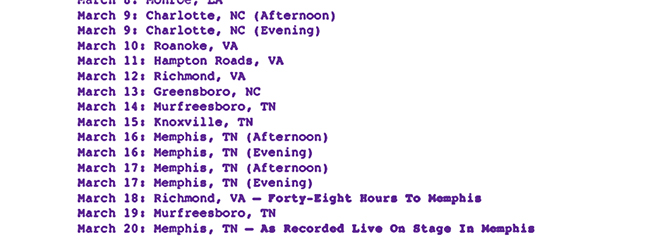
The Elvis Presley Show crisscrossed back and forth from Virginia to Tennessee on that leg of his tour. Tickets for his March 12 appearance at the Richmond Coliseum sold out so quickly that the tour was re-routed to accommodate a second show there on March 18. Elvis performed four shows in Memphis on March 16 and 17, hit Richmond, Virginia, again on March 18, and then returned to Tennessee for concerts in Murfreesboro and Memphis on March 19 and 20, respectively.

Elvis Presley's March 1974 tour schedule (partial)

Elvis Presley’s March 1974 tour schedule (partial)

For space considerations on the original LP, RCA edited several songs out of the March 20 Memphis concert for the 1-record release in July 1974. The album also featured overdubbed audience reactions that detracted from the sound quality. FTD restored the missing tracks and removed the unnecessary overdubs in a 2004 Classic Albums CD release of the concert, including a new mix. The same label also issued the expanded show in vinyl format as a 2-record set last year.

It turned out that RCA chose well in 1974 which performances to use on the original record, though. The performance quality of many of the excised songs was underwhelming, with the exception of a fine rendition of “Steamroller Blues,” first released on Platinum: A Life In Music over two decades later. The energetic Memphis version was superior to his live recording of the song in Hawaii that served as a single in 1973.

This new Elvis Recorded Live On Stage In Memphis Legacy Edition will also include the previously omitted songs, but whether a new or an existing mix will be featured is unclear.

In fact, Sony’s press release for this album is riddled with errors, an issue far too common these days in the marketing of Elvis music releases, so it is difficult to trust any of its statements. For that reason, I am not even including Sony’s alleged track listing at this point. Suffice it for now to say that Disc 1 will contain the Memphis show, while Disc 2 will contain the Richmond show and some low-fidelity bonus tracks recorded on a personal cassette player of Elvis rehearsing a few months later for yet another Las Vegas stint.

RCA professionally recorded the March 20 Memphis concert for the album project. It is a 16-track recording (audio elements recorded on separate channels) that can be tweaked for optimum sound quality. Though I enjoyed the 2004 FTD mix over the original 1974 version, another new mix could be revealing. The Memphis show is presented in stereo.

Though the background story remains mysterious, the March 18 Richmond concert was supposedly captured as a 16-track recording, too. If so, it remains missing from the Sony vaults – lost, stolen, or erased.

The Richmond concert audio source on both the 2011 and 2014 releases is a tape copy of a mono mix-down of the 16-track recording, with artificial reverb applied. In other words, no further changes can be made to the Richmond mix or reverb since the 16-track original is unavailable. The Richmond concert is not likely to sound very different from Forty-Eight Hours To Memphis on this reissue, if at all.

While Elvis’s sound engineers often made informal reference tapes of his shows from the soundboard mixing console, the Forty-Eight Hours To Memphis liner notes in 2011 only speculated about why RCA apparently recorded the Richmond concert in multitrack.

However, the 2014 Sony press release refers to the Richmond show as a “test run concert” for the subsequent Memphis recording. Some have theorized that the test copy is in mono due to Elvis’s preference for that format over stereo, though his previous live albums had been stereo releases. Perhaps the accompanying Legacy Edition booklet will reveal new information.

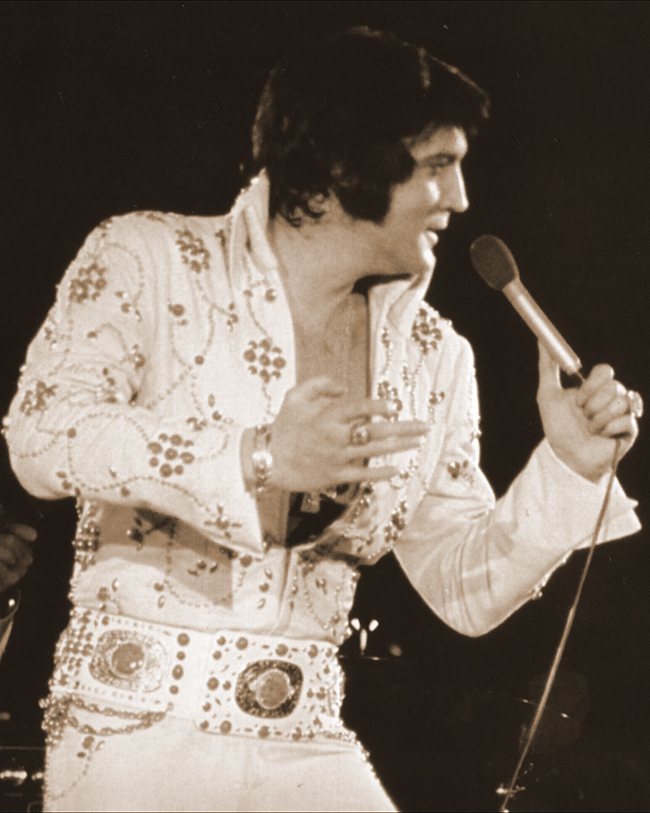
Elvis at the Richmond Coliseum, March 18, 1974 (FTD)

Elvis at the Richmond Coliseum, March 18, 1974 (FTD)

In the years leading up to 1974, many of Elvis’s concerts were superior to this particular show in Richmond. However, as with the Memphis show, the fun concert features Elvis in a fantastic mood interacting with fans. Music highlights in Richmond include “Steamroller Blues,” “Polk Salad Annie,” and “Suspicious Minds.”

Over the course of 21 years, Elvis performed 15 concerts in Richmond. The 14th of these shows was captured on Forty-Eight Hours To Memphis and, from what I have read, this was Elvis’s last great concert in Richmond. He performed in Richmond one final time in 1976, but, by that point, his rising prescription drug addiction and abuse had diminished the power of his shows. Therefore, I consider the March 18, 1974, appearance to be Elvis’s true “last hurrah” in Richmond.

Legacy Questions

I am looking forward to the reissues of both the Richmond and Memphis concerts. Despite my personal enthusiasm as an Elvis fan, I find myself wondering whether these two concerts are appropriate choices for mainstream release in 2014.

I fear that the repetitive nature of these shows compared to other recent Sony releases will use up some of the goodwill shown by music critics in reviews of Elvis At Stax, Prince From Another Planet, and certain other titles released in the last few years.

Will mainstream critics and listeners understand Elvis’s sense of humor? For instance, will some misinterpret his joke in Richmond about it being a pleasure to be back in Hampton Roads as an out-of-it singer not knowing which town he was playing?

By following up 2012’s As Recorded At Madison Square Garden reissue with 2013’s Aloha From Hawaii via Satellite reissue and now 2014’s Elvis Recorded Live On Stage In Memphis reissue, is Sony simply committing the same release blunders in the 2010s that RCA made in the 1970s? Has locking into an “anniversary” theme for release choices doomed them to repeat history’s mistakes going forward?

Keep in mind that the 40th anniversary of Having Fun With Elvis On Stage is later this year as well.

From 1956 to 2012: Follow Elvis’ journey through Richmond

Despite his enduring popularity, Elvis Presley is rarely given his due as an artist. Though this has improved considerably over the last ten to twenty years, the general public still tends to latch on to things like wacky souvenirs, bad impersonators, and “alive” hoaxes.

My favorite Elvis writer of late has been Sheila O’Malley of the Sheila Variations blog. With a fresh voice, she presents new perspectives on Elvis the artist. Rarely fluff pieces like you might see on other blogs (including this one), Sheila’s posts tend to be demanding reads. Invest the time and there are always insightful payoffs.

I discovered the Sheila Variations not through Elvis but through baseball. A few years ago, I was writing a post about baseball movies for my now-extinct pop culture blog. One of my favorites is Field Of Dreams, adapted from W.P. Kinsella’s Shoeless Joe. While researching the film, I came across Sheila’s blog and a number of extremely helpful posts.

When I find a new blog I love, I tend to search it for other topics of interest. Though it was only one post, I was delighted to find a reference to Elvis there as well. The 2005 post promised of more to come, eventually. “I’ll know when I’m ready,” she said at the time.

I bookmarked the blog and checked it every now and then. Always finding something to enjoy while patiently waiting for the topic of Elvis to return. It took over six years for Sheila to know she was ready to write about Elvis, but when she was, the resulting series of Elvis Essays that began last August 16 and continue to this day have been nothing short of astounding. I’m hoping that she will eventually compile her observations into a book, a documentary, a multi-media experience, or all of the above.

I was quite happy, therefore, when Sheila last month posted a short preview of a future Elvis post centered around Richmond, Virginia. Inspired by the excellent “In Search Of Elvis In Richmond, VA” posts on the Smithsonian’s Elvis At Twenty One blog, Sheila took a road trip from New Jersey to visit some of Richmond’s Elvis sites in person – as well as take in the Elvis At 21 exhibition at the Virginia Museum of Fine Arts. This turned out not to result in just one post, but four.

The Sheila Variations: The Richmond Saga

Part I June 30, 1956: Elvis Presley in Richmond, Virginia – Moment By Moment

Part II The Jefferson Hotel

Part III The Mosque and The Monuments

Part IV The Train Station, the Water Tower, and “Elvis at 21″ at VMFA

Sometimes, I’ll read something and think, “I wish I had written that.” This is definitely one of those times.
The Sheila Variations
My favorite random moments:

  • “I showed the really nice guy at the front desk the things I wanted to see. […] I asked him if it was ‘walkable’. He said, ‘Oh, no. It’s about two miles.’ Just one of the many cultural differences between living in NYC and living somewhere else which is more of a car culture.” (from Richmond Snapshots)
  • “Peter Guralnick, in his introduction to his second volume of Elvis’ biography, says that the years from 1958 until 1977 were all about ‘the disappearance’ of Elvis Presley, a sentiment I disagree with entirely. He did not disappear. He was always there. It’s just we didn’t get to see him anymore, unless we went to the movies, or, in the 70s, saw him in concert. […] I know Guralnick means “disappeared” on another level, but I disagree with THAT level as well. How you can say that someone who put out the two gospel albums he did in the 60s […] disappeared is a mystery to me. How you can feel he disappeared when you consider his record-breaking appearances in Vegas [and] at Madison Square Garden, the albums from the 70s, especially Promised Land […] the continued innovation in his music, the continued personal aspect of it […] The nerve of that Elvis guy to follow his own path.” (from Part I) [This segment, which should be read in context in its entirety in the original post for full effect, literally left me wanting to cheer. –Ty]
  • “The Jefferson Hotel certainly isn’t hurting for customers, but they do say on their website: ‘Stay where Elvis stayed!'” (from Part II)
  • “New York often doesn’t honor its history, architecturally anyway. I never even saw the original Penn Station, but it is like a wound in my soul to think of what was torn down. […] But there the Mosque stands, now called The Landmark, with a giant Lion King banner, and the ghosts of Duke Ellington and Ethel Barrymore and Frank Sinatra and Elvis Presley literally shimmering in the foreground.” (from Part III)
  • “What would Elvis at 21, strolling down that hallway, have thought if he knew that one day an entire exhibit devoted to his time in Richmond would be on display at the Museum there? It’s all so strange. And beautiful. And perfect. Elvis couldn’t know, he couldn’t predict. He could just believe in himself, and keep launching himself out there into the spotlight. That is what he did.” (from Part IV)

* * *

Today was the final day of the Elvis At 21 exhibition here in Richmond. Though I regret not being able to make it out to see photographer Alfred Wertheimer when he visited the museum for an Elvis panel discussion in January, I did at least have the opportunity to take in the exhibition one more time a couple weekends back.

For my return visit, I brought along my Mom, who became an Elvis fan in 1956. It was nice to walk through the exhibit without having to worry about writing a review this time. We followed the museum visit up by watching Elvis ’56 and my Mom’s all-time favorite, Aloha From Hawaii. It was a perfect day.

Elvis At 21 is not over, though. The tour continues at the Dwight D. Eisenhower Presidential Library and Museum in Abilene, Kansas, starting April 7 (more info here).

From an art museum to a Presidential library . . . maybe Elvis really is starting to get his due.

Presley wins clash of cultures in Elvis At 21

There are over 23,000 works of art in the Virginia Museum of Fine Arts, spanning some 5,000 years. There is so much to see there, in fact, that it cannot be adequately covered in a single day.

Yesterday, though, my mission was to explore only 56 of those works, all created just over 55 years ago. In VMFA time, 55 years is but a second.

The traveling Elvis At 21: Photographs by Alfred Wertheimer exhibition covers March 17, 1956, and June 30 through July 4, 1956, in the life of Elvis Presley. The images capture the young singer on the brink of fame, in the midst of a nation on the brink of change.

By March 17, “Heartbreak Hotel” is at number 15 and still rising on Billboard‘s sales chart. That evening, Elvis is to make his fifth of six appearances on Jackie Gleason’s Stage Show – a CBS variety program hosted by Tommy and Jimmy Dorsey. Initially hired by RCA to take publicity photos, Alfred Wertheimer is along with Elvis in New York City.

Entering The Warwick shows Elvis in a moment of freedom between rehearsals and the actual show. On the sidewalk, he is alone, unrecognized, unbothered – making it one of the exhibition’s most striking photographs.

Later, in his hotel room, Elvis reads fan mail and then rips it to shreds, according to one of the exhibition notes accompanying the photos. Wertheimer asks him why. “I’m not going to carry them with me. I’ve read them and seen what’s in them. It’s nobody else’s business,” Elvis tells him.

With Scotty Moore, Bill Black, and DJ Fontana behind him, he performs “Blue Suede Shoes” and “Heartbreak Hotel” on television that night. Though Wertheimer’s images are stills, there is no doubt that Elvis is very much in motion. In Jump, his feet are not even touching the ground.

When Elvis arrives in Richmond, Virginia, 15 weeks later for two concerts at the Mosque Theater (now the Landmark Theater) on June 30, his life is already changing.

He has made a final appearance on Stage Show and appeared twice on The Milton Berle Show. The second Berle appearance has proven controversial, due to his exaggerated hip movements on “Hound Dog” – a song only recently added to his stage act. In that brief time, he has also given over 85 concerts in tours criss-crossing the country (including two other shows at the Mosque on March 22). He has even cut a new record, “I Want You, I Need You, I Love You.” “Heartbreak Hotel” has now sold a million copies and hit number one. After a series of screen tests in Hollywood, he has been signed to a multi-movie deal. Production has not yet begun on his first film. Elvis does not plan to sing in his movies.

Most Elvis fans have seen Wertheimer’s images at least a dozen times over. It is striking, though, to see them within the context of an art museum. Who in 1956 would have ever believed Elvis would end up here? The prints vary in size, are framed in black, and fill two small halls. The exhibition is crowded with people, but there is plenty of time to examine each picture. Visitors talk softly to each other. In the background, though, I can hear that unmistakable voice:

“Welll, since my baby left me…well, I found a new place to dwell…well, it’s down at the end of Lonely Street…”

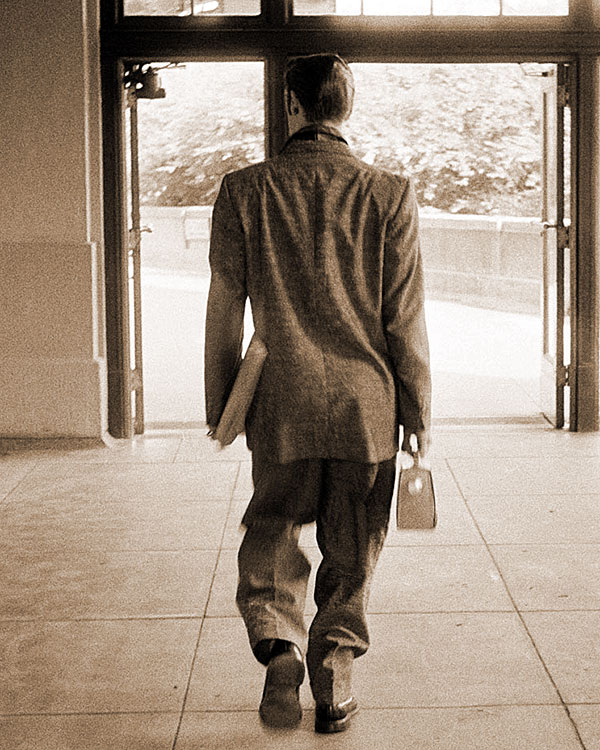
It’s true that I have seen these pictures before, but there is always something new. For instance, until this exhibition pointed it out, I never noticed in the image Elvis Leaving Richmond Train Station (AKA Elvis Did Have A Pelvis) that he is actually carrying and playing a portable radio as he walks out of Richmond’s Broad Street Station (now the Science Museum of Virginia).

Elvis Leaving Richmond Train Station (Detail)

Elvis Leaving Richmond Train Station (Detail): Elvis went to Richmond for two shows at the Mosque Theater. Getting off the train, he turned on his RCA portable radio. Richmond, Virginia, June 30, 1956 © Alfred Wertheimer. All rights reserved. Original image courtesy of the Virginia Museum of Fine Arts. Used with permission.

Several other Richmond images are included, including two at the Jefferson Hotel and six backstage at the Mosque. Of the Richmond images presented, one stands out among the rest. It is Elvis on stage in the magnificent Kneeling At The Mosque – used as the (unfortunately colorized) cover for the Close Up boxed set, among other projects.

After the welcome detour to Richmond, it is back to New York, this time for the Steve Allen Show. Wertheimer captures rehearsals for Elvis’ July 1 appearance.

“I went to the Steve Allen Show,” Elvis recalled in 1969. “They were going to tame me down, so they told me to stand still. They had me dressed in a tuxedo and singing to a dog on a stool.”

Much worse than singing to a dog, though, Elvis is also forced to perform with Allen in a “Range Round-up” skit. Andy Griffith and Imogene Coco also appear during the nearly unwatchable Western parody. “Allen signified his own importance by wearing the biggest white hat,” states Wertheimer in a note accompanying one of the rehearsal photos.

Allen’s attempts to embarrass Elvis and put the singer in his place, of course, have the opposite effects. The legend of Elvis only grows.

The next day, July 2, he records 31 grueling takes of “Hound Dog” and 28 more of “Don’t Be Cruel” at RCA’s New York studio. The single would prove to be one of his most popular. Included in the exhibition is RCA Victor Studio I, a shot of Elvis rehearsing “Hound Dog” with his band and the Jordanaires. It is literally history in the making.

Elvis Screams is a Wertheimer photo that has always jumped out at me. I’m pretty sure the first time I saw it was back in the 1980s on the old Cinemax documentary Elvis ’56. The shot goes by quickly, as part of a montage. At the time, I thought the documentary producers had made a glaring error.

To me, the photo looks for all the world like an image of Elvis singing in the 1970-1973 era. It is not often that a 1956 image of Elvis can be confused with one from 1973, yet the only mistake was, of course, mine. According to Wertheimer, the image captures the moment that Elvis accepted take 31 of “Hound Dog.” I still find it fascinating, because my eyes still see the “Aloha” Elvis in this image, despite what my brain tells me.

Another series of images are striking. Elvis returns to Memphis after the “Hound Dog” recording session and departs the train on July 4. He walks alone through a field and then down a sidewalk. No bodyguards, no hanger-ons, no fans. Just Elvis.

The impression is not completely “normal,” however, He has just left the train from a multiple-day trip. He holds only his acetates of “Hound Dog,” “Don’t Be Cruel,” and “Any Way You Want Me” from the recording session. No bags or other luggage in sight.

Next, we see Elvis with his father (Vernon looks positively annoyed with Wertheimer, with a “back off” look) and then with his mother. He has just moved them into a new home. Not Graceland, which is still a year away.

One of the largest images in the exhibition, Elvis plays the rebel on his Harley in No Gas In The Tank – an image which inspired one of my favorite album covers, Return of the Rocker. Surely, there is a best-selling poster to be made here.

Finally, the photo exhibition concludes with images of Elvis on stage that same night at Russwood Park in Memphis. The image that stands out most to me from the entire exhibition, perhaps because it is one I do not recall seeing before, is Elvis Onstage: Russwood. As far as the eye can see are fans. Scotty Moore is picking away on guitar, and Elvis is turning around with a look of intense joy back at the crowd behind them. You can hear the screams. You can hear the music.

“He would listen respectfully backstage to criticism from agents that wanted him to contain his movements on stage. But once Elvis got on stage, he always did it his way. He really did it his way,” states Wertheimer. His text narrative throughout the exhibition is interesting, for it reveals what the photographer thought of his subject and those around him.

It could be argued that Wertheimer spent more time with and was allowed greater access to Elvis than any other “outsider.” For all of their spectacular moments, for instance, the 1970s documentaries That’s The Way It Is and Elvis On Tour are but illusions in terms of revelations about Elvis beyond his music.

Here, in 1956, Wertheimer is able to capture everything with his lens. No one would ever get this close to the real man again. That is what makes the Elvis At 21 collection and Wertheimer’s many other Elvis photographs significant.

* * *

Feeling almost like an afterthought, though at least providing an appropriate soundtrack that can be heard throughout the experience, there is a little television and bench in the exit alcove at the end of the exhibition. The short video, licensed by Jackie Gleason Enterprises for Elvis At 21, features three complete performances of Elvis on Stage Show:

  • “I Got A Woman” (January 28, 1956)
  • “Blue Suede Shoes” (February 11, 1956)
  • “Heartbreak Hotel” (February 11, 1956)

The audio and video of the performances breathe additional life into the Wertheimer photos just witnessed.

Elvis At 21 is a simple exhibition, and that is all that is required. The works and the subject stand alone. The short video, though, leads me to wonder about the possibilities of future Elvis exhibitions benefitting from complete audio-visual integration.

* * *

I am an American, so I must admit that I looked forward to seeing what Elvis items would be available in VMFA’s gift shop almost as much as I did seeing the exhibition itself.

As we all know, Elvis merchandise can range from the sublime to the chintzy. Fortunately, most of what VMFA had to offer was closer to the former category. No Elvis potato heads, thankfully. I picked up Elvis 1956: Photographs by Alfred Wertheimer (2009), a terrific hardcover that presents all of the photos and information from the exhibition.

I also splurged on Elvis At 21: New York To Memphis by Alfred Wertheimer (2006), a massive, coffee-table sized volume that explores even more of his photographs.

Jerry Hopkins’ consolidated Elvis biography and Sonny West’s Still Taking Care Of Business were available there as well, as were some lesser titles. Anachronistic considering the theme of the exhibition, the omnipresent aviator-style Elvis sunglasses that he wore in the 1970s were also available – in both gold and silver plastic, of course. There was even a stuffed “Steve Allen” style hound dog. For this occasion, I stuck with the Wertheimer books.

* * *

For anyone who is ever near Richmond, Virginia, I can always recommend the Virginia Museum of Fine Arts. If you are an Elvis fan, though, then you really should try to make it out while this exhibition is still there. Elvis At 21 will be available through March 18, 2012. Museum admission is always free, while tickets for the exhibition are $8 for adults and $6 for seniors, students, and youths. There is no charge for museum members.

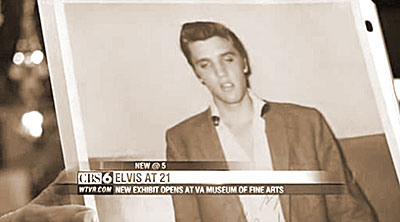
Richmond TV station debuts unseen Elvis photo from 1955

Greg McQuade at CBS 6 News in Richmond, Virginia, has helped unearth a previously unseen photo of Elvis.

“Sylvia Brendle was a high school junior when she snapped a never-before-seen picture of Elvis at the Mosque in May of 1955,” McQuade states (“Elvis fan shares unseen photo as new exhibit opens at VMFA” — wtvr.com).

The photo is significant to Richmond fans in particular because the May 16, 1955, concert at the Mosque was the first time Elvis appeared here in Richmond. The singer was still on the SUN Records label at the time. Just six months later, he would sign with RCA Records and soon go from being a regional star to an international one.

CBS 6: Elvis At The Mosque, Richmond, Virginia, 1955

Also covered in McQuade’s story is the Elvis At 21 exhibition at the Virginia Museum of Fine Arts. The exhibition features legendary photos of Elvis snapped by photographer Alfred Wertheimer, including several of Elvis in Richmond in June 1956.

Elvis eventually did 15 shows in Richmond, the last one in 1976.

Elvis arrives in Richmond, Virginia

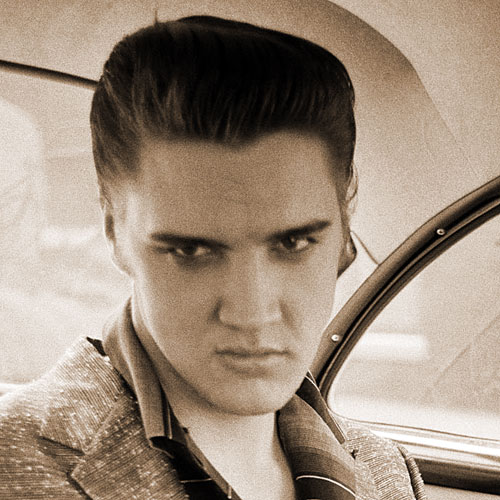
Elvis Inside Taxi (Detail)

Inside Taxi (Detail): In the back of a local cab, Elvis is about to leave for the Jefferson Hotel. He has two performances at the Mosque Theater that afternoon and evening. Richmond, Virginia, June 30, 1956 © Alfred Wertheimer. All rights reserved.

Elvis is back in Richmond, Virginia. This time, he’s not staying at the Jefferson Hotel or the John Marshall Hotel. Instead, he’s checked in at the Virginia Museum of Fine Arts.

The Elvis At 21 exhibition, featuring 56 legendary photographs of Elvis by Alfred Wertheimer opened today at the VMFA in a special sneak preview for members-only. The exhibition opens tomorrow to the general public and remains at the museum through March 18, 2012.

While museum admission is always free, tickets for the exhibition are $8 for adults and $6 for seniors, students, and youths. There is no charge for museum members.

On Christmas Day only, entry to the Elvis At 21 exhibition will be free to everyone, states Alex Nyerges, museum director, in the latest issue of My VMFA magazine. “(This) is our gift to those who come here on Christmas,” he says.

Check out Elvis.com’s “Virginia Museum of Fine Arts to Host Elvis at 21 Exhibit” article for more information.

* * *

Original image courtesy of the Virginia Museum of Fine Arts. Used with permission.

Virginia Museum of Fine Arts decks the halls with Elvis December 24

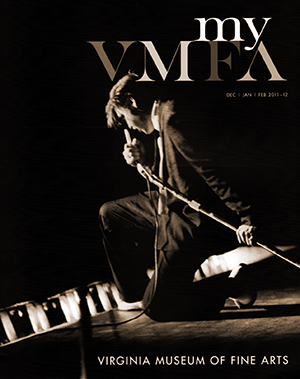
My VMFA Magazine - Elvis Kneeling At The MosqueAlfred Wertheimer’s Elvis Kneeling At The Mosque, taken in Richmond, Virginia, on June 30, 1956, graces the cover of the latest issue of My VMFA magazine. Distributed to Virginia Museum of Fine Arts members, this issue of the magazine promotes the upcoming Elvis At 21 exhibition.

The exhibition, featuring 56 of Wertheimer’s photos, will appear at the VMFA in Richmond December 24, 2011, through March 18, 2012.

In January, the museum will hold three special Elvis events, including a panel discussion with Wertheimer and local Elvis experts on January 20.

From Sweden To Richmond/From Richmond To Sweden: A Little More Conversation

Welcome to the first ever simultaneous post of Elvis Today Blog and The Mystery Train. We’re going to try something a little different and present a discussion of Forty-Eight Hours To Memphis: Recorded Live On Stage In Richmond, Virginia – March 18, 1974, one of the latest CDs from Sony’s Follow That Dream Records collectors label for Elvis fans.

The Forty-Eight Hours To Memphis title reflects that Elvis closed out his tour two days after the Richmond concert with a show in Memphis – portions of which became the 1974 album Elvis Recorded Live On Stage In Memphis.
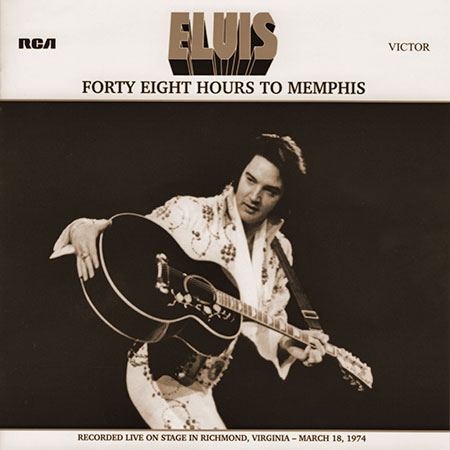
Forty-Eight Hours To Memphis (2011 FTD, booklet cover)

Forty-Eight Hours To Memphis (2011 FTD, booklet cover)

TY [The Mystery Train]
I’m glad you thought of this idea, Thomas.

Thomas [Elvis Today Blog]
Yeah, well, it must have been exciting when you heard of this release. What was your first impression when you listened to it?

TY
That this was obviously the best Elvis Presley release in history, as I’m sure you’ll agree! Just kidding… The first time I played it, I just tried to imagine being there, in the Richmond Coliseum that night.

Thomas
I would’ve loved to be there, that’s for sure. The atmosphere during that particular tour in the southern states obviously was an indescribably electric one, and the shows were of high quality. Have you noticed the joyful laughter from one person in the audience when “Also Sprach Zarathustra” begins? A safe bet is he’s one excited man.

TY
That almost nervous laughter was the first thing I noticed. My other first impression, I was really happy to hear Elvis make Richmond-related references not once, not twice, but three times during the show. I think you’ve heard more Elvis concerts than I have, Thomas, but I believe it is rare for him to mention what city he is in – outside of Las Vegas, that is.

Thomas
And multiple times at that! Also, I was pleased that he mentioned Sweden as well!

TY
This is probably the only concert where he mentions both Richmond and Sweden. Now that I think about it, I suppose he very well could have mentioned both during the March 12 show in Richmond, too. This March 18 Richmond show was added because the March 12 one sold out so quickly. So there might be two concerts where he mentions both Richmond and Sweden

Thomas
The reason Elvis mentioned my country is because Sweden’s Per-Erik “Pete” Hallin was playing piano for the group Voice at the time. I actually interviewed him once, but that’s another story.

TY
He was a second piano player on the stage at the same time as Glen Hardin? Or just when Voice was opening?

Thomas
I think he was just playing the piano when Voice was opening, and then sang together with them on stage while Elvis was on. Elvis actually mentions Pete at the end of this concert, during “Can’t Help Falling In Love,” when he sings “… some things, you know, Pete, are meant to be…” He did this two days later in Memphis as well, where he also introduced Pete and the other members of Voice individually.

TY
I had always wondered who “Pete” was on the Memphis show, so that clears it up. Funny that he gets the exact same mention here on the Richmond concert. As far as I could tell, it is just Elvis doing the same joke, not an audio repair or anything where they pulled it from the Memphis show.

Thomas
I agree, it’s the same joke. Elvis obviously liked to recycle his jokes, like the “I saw J.D., with baldheaded Sally” that was used both in Richmond and in Memphis during the “Rock Medley.”

TY
I’m also pretty sure, outside of Vegas, I’ve never heard Elvis reference the hotel where he stayed. After the introductions on Forty-Eight Hours To Memphis, he thanks Richmond’s John Marshall Hotel.

Thomas
Yes, I was actually surprised to hear him mention the hotel. That is unusual.

TY
So, that first time through, I was really happy with this CD. I was all kinds of worried that I would be disappointed with either the sound or the show itself.

Thomas
Glad you liked the show as well as the sound. Now there’s been a lot written about the sound, this being a newly discovered 2-track copy of a 16-track tape.

TY
Right, we should address the sound controversy. I was already excited about this release when it was first announced. This represents the first official release of an Elvis concert in Richmond, after all. However, when the news later came out that the source of this concert was a 16-track professional recording, rather than the expected soundboard, I think that brought the rest of the Elvis World to where I already was in anticipating this CD.

Thomas
Yes, I was excited when I heard of this, also. A newly discovered 16-track professional recording, where did that one come from?

TY
That’s right. All the fans were excited until FTD essentially said, “Oops, did we mention this was mono?” Then, I think FTD took a lot of heat for that. Some of it deserved, for poor communication. At the same time, I think the reaction by some fans was way overblown. But, hey, I guess that’s what Elvis fans do. How did you feel when you found out Forty-Eight Hours To Memphis would actually be in mono?

Thomas
At first, a little disappointed, maybe, but I was looking forward to the album anyway, and I have to say I was pleasantly surprised when I listened to the show for the first time. I think the sound is great!

TY
I agree, the sound is incredible, especially considering that it is from a mono tape. I was glad to be able to put that concern to rest. I’m not someone who hates mono recordings, though. After all, Elvis has quite a few more mono songs that maybe a few of the complainers should try hearing someday. Such “unknowns” as “Mystery Train,” “Jailhouse Rock,” “One Night,” “Baby, Let’s Play House,” “Love Me,” “Santa Claus Is Back In Town,” and “Don’t Be Cruel” – to name but a few. There are also some 1960s movie soundtrack songs that I think sound better in mono than their stereo counterparts. “Viva Las Vegas” is one that immediately comes to mind. You can never please everyone, though.

Thomas
Yes, they should give them a spin. I remember when RCA made “electronically created stereo” out of a lot of the mono albums – they sounded terrible!

TY
I’m glad they didn’t try that here.

Thomas
Yeah, me too. Thinking about it, it’s really incredible that a show in this sound quality surfaces so many years after it was recorded.

TY
That is the real mystery here, and the liner notes really do nothing to clear that one up. Just the same kinds of speculation all of us were doing when we first heard.

Thomas
So, what about the actual show, TY? No doubt Elvis is in good spirits and enjoying his work, wouldn’t you agree? He sounds happy and close to laughter on many occasions. “Fever” is probably as close to a laughing version as it gets. “That’s a fun song to do!” he says. At the same time, he delivers good, solid renditions of many of the songs. “Steamroller Blues” is one of the highlights to me, as is “Polk Salad Annie” and “An American Trilogy.” Not to mention “Trying To Get To You,” where he really uses his voice to the fullest.

TY
Well, jumping right into “Fever,” I’ve never been a big fan of the “I light up when you call my name… ELVIS!” versions of this song, for some reason. So, that is my least favorite track on the album.

Thomas
In a way I agree, but I think the version two days later in Memphis is even worse.

TY
I agree that the Richmond Fever is better than the Memphis Fever, but it’s a bad bug, either way. At times, “Let Me Be There” also grates on my nerves, and don’t even get me started on J.D. Sumner’s “Amen” dive-bomb routine. However, those are just about the only negatives I ultimately found about this show.

Thomas
Maybe that was a song that was more fun to watch than only hear.

TY
I was also worried about “Suspicious Minds” – a favorite of mine.  I was really disappointed by the Memphis live version of that one when it finally came out a few years ago. So, I was worried that I wouldn’t like the Richmond version, either. But it’s great, very energetic. It would’ve been great to see.

Thomas
Yes, by this time he’d performed “Suspicious Minds” for five years or something, and I always thought he was tired of it, when I heard the version from Memphis. But in Richmond he does sound happier with it, that’s true, TY!
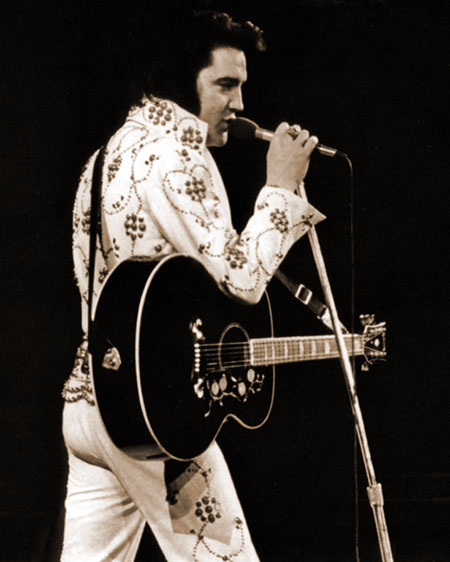
Elvis at the Richmond Coliseum, March 18, 1974 (FTD)

Elvis at the Richmond Coliseum, March 18, 1974 (FTD)

TY
The other highlights for me were “Also Sprach Zarathustra”/”See See Rider,” for the excitement of imagining Elvis taking the Richmond Coliseum stage by storm. “Steamroller Blues,” which I might like even better than Memphis version, my favorite rendition until this point.

Thomas
I just love the way he shouts “Aargh!” at the intro of “Steamroller Blues,” and what then follows really lives up to the song’s name.

TY
Let’s see, I also enjoyed the “Rock Medley” – what a great idea for Elvis to link together all those songs. Rather than just do the typical “Hound Dog” throwaway, I think it worked somewhat better like this, at the tail end of the medley. It’s still too fast, but not as disappointing as most of the other post-1970 Hound Dogs.

Thomas
For some reason I thought the “Rock Medley” rocked even more than it did in Memphis, and I love the tail end too!

TY
Yes, the “Rock Medley” was another one that Elvis performed better than its Memphis counterpart.
“Polk Salad Annie” was one I didn’t care for on Memphis, but loved it in Richmond.

Thomas
I always enjoy hearing Elvis saying things I’ve never heard in songs before, like during the guitar solo in “Polk Salad Annie” by James Burton where he says something like “Sneak up on him, Ronnie!” I can just imagine him casting a glance in Tutt’s direction while saying this.

TY
Yeah! I guess because we’ve heard so many of his shows, that’s the kind of stuff that stands out to us. While the general public would say, “Why do I need another ‘Polk Salad Annie’?”

Thomas
The two songs that got the most serious renditions were the gospel songs, “Why Me, Lord” and “Help Me.”

TY
I was relieved that “Why Me” wasn’t a laughing/joking version. Not that I mind some joking, but it seems ill-suited for a gospel song. I think I like the Memphis version of “Why Me” better, though.

Thomas
Elvis cared deeply for that kind of music.

TY
You know, that’s one of the terrific things about his show, especially from this time period, the way it brings together so many kinds of music – gospel, country, blues, rock ‘n’ roll. What other so-called “rock star” could do that?

Thomas
That’s true, TY, Elvis sang “Something for Everybody.” Speaking of the gospel stuff, I did miss “How Great Thou Art.” But hey, that’s a minor complaint.

TY
Funny, I was just about to say the same thing about “How Great Thou Art,” which of course featured prominently on the Memphis concert album. I had a slight twinge of disappointment when I saw the Richmond track listing and it wasn’t there.

Thomas
I just love it when he sings the ending one more time in Memphis. And his voice, so powerful, it gives me goose bumps!

TY
At least the Grammys got that one right. So, what did you think about the bonus songs, recorded in Tulsa and Memphis? I thought it was cool to hear “Sweet Caroline” in 1974. I don’t remember hearing that one outside of 1970 before. Also, “Johnny B. Goode” is always welcome.

Thomas
I think the most important thing was that they showed what a difference there is in sound quality between a soundboard and the professionally recorded Richmond concert. And once again I was reminded how very similar “My Baby Left Me” and “That’s All Right” sound.

TY
It was really awesome to hear a 1974 version of “That’s All Right” in Memphis. That live performance was just a few months shy of the 20th anniversary of Elvis first recording it at Sun Studio there – the record that started it all.

Thomas
I hadn’t thought of that. That is indeed awesome!

TY
What do you think about Forty-Eight Hours To Memphis being presented in the oversized, 7-inch digipack format usually reserved for FTD’s Classic Albums series?

Thomas
I thought it was great that it was presented this way. I’m a bit tired of the live material not getting treated as serious as the classic album series.

TY
Agreed. If I remember correctly, they originally planned this treatment for As Recorded At Boston Garden last year, but a production issue or something caused them to put it in the standard, smaller format.

Thomas
Or was it the latest 1969 concert, I don’t remember.

TY
That’s right, it was actually the Live In Vegas release they originally planned for the larger format. Maybe, FTD now intends to use that format more often? Perhaps, at least on “special” releases of live material where the sound and/or show is of a high quality.

Thomas
Here’s hoping the last couple of August 1969 and 1970 concerts will get this treatment.

TY
That would be great. I hope that’s the case as well.

Thomas
Hopefully the 1972 concert in Richmond will also get an official release soon, together with the other shows recorded for Elvis On Tour.

TY
Yes, that is the Richmond show that has the best chance of also getting an official release at some point.  I just hope it’s sooner, rather than later. Do you think the release of this 1974 show will mean that there will be less of a chance of the 1972 Richmond show coming soon?

Thomas
I hope not, TY. I’ve heard that Ernst Jorgensen is waiting for Turner/Warner Home Video to make a move with the unreleased footage, to do a combo of sorts, but that won’t happen anytime soon, I’m afraid. I just hope he realizes this and releases the shows from Elvis On Tour anyway. For now I’m really pleased with FTD for releasing this Richmond show, it’s not an album that’s going to collect a lot of dust on the shelf for a long time yet.

TY
I’m definitely happy about this release as well. This is a special CD that I’ll be playing often for the rest of my life. What are your final thoughts on this CD? What are you going to remember most about it?

Thomas
You know what I thought halfway into listening to it the first time? It hit me how happy I am being an Elvis fan, and what a pleasure it gives me to listen to a great concert like the one from Richmond. Also, that Elvis was in great shape during the March 1974 tour, delivering the goods in style! But I guess, I’m gonna remember the most how incredible it is that a professionally Elvis concert like this can suddenly make an appearance out of the blue. It was almost as exciting waiting for it as listening to it. Well, not really, but hopefully you see my point.

TY
Yes . . . it shows hope that there is still more out there, waiting to be discovered. Things not even rumored to exist.
For me, it was really something to finally hear an Elvis concert recorded here in Richmond, where he appeared 15 times. This is number 14, yet he still sounds engaged, like he’s having a great time. Obviously, the audience was, too. It was a fantastic show. Though he came back to Richmond once more in 1976, my understanding is that this 1974 concert was his last great show in Richmond.
Thanks again, Thomas. This has been a fun little experiment, but I wonder if people will enjoy reading this kind of post?

Thomas
I sure hope so. At least it was enjoyable to write, so thank you, TY!


As with other FTD releases, the only physical store in the US authorized to sell the Forty-Eight Hours To Memphis CD is Good Rockin’ Tonight, a Graceland gift shop in Memphis. However, the CD may be obtained online from a variety of other Elvis stores – including Graceland’s ShopElvis.com.

Forty-Eight Hours To Memphis

Live At The Richmond Coliseum, March 18, 1974
01) Also Sprach Zarathustra/
02) See See Rider
03) I Got A Woman/Amen [edited with Memphis, March 20, 1974]
04) Love Me
05) Tryin’ To Get To You
06) All Shook Up
07) Steamroller Blues
08) Teddy Bear/Don’t Be Cruel
09) Love Me Tender
10) Long Tall Sally/Whole Lotta Shakin’ Goin’ On/Your Mama Don’t Dance/Flip, Flop & Fly/Jailhouse Rock/Hound Dog
11) Fever
12) Polk Salad Annie
13) Why Me
14) Suspicious Minds
15) Introductions By Elvis
16) I Can’t Stop Loving You
17) Help Me
18) An American Trilogy
19) Let Me Be There
20) Funny How Time Slips Away
21) Can’t Help Falling In Love/
22) Closing Vamp
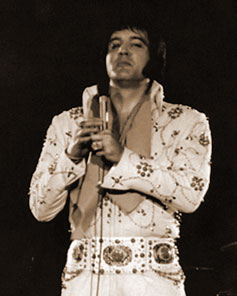
Elvis at the Richmond Coliseum, March 18, 1974 (FTD)

Elvis at the Richmond Coliseum, March 18, 1974 (FTD)

Bonus Songs
23) Sweet Caroline [Tulsa, March 1, 1974]
24) Johnny B. Goode [Memphis, March 17, 1974]
25) That’s All Right [Memphis, March 17, 1974]