The Pacific War Memorial Commission Proudly Presents In Person: Elvis Presley

Today marks the 50th anniversary of Elvis’ benefit concert in Hawaii for the Pearl Harbor USS Arizona Memorial. Below is a repost of a feature I wrote last year about this event.


Elvis was nervous at the start of the show, but the screaming audience has since calmed his fears. Truth is, he learned to use his nervous energy to his advantage on stage years ago. Despite all that has changed in his life, the fuel that powers him continues to be his fans.

This concert is a little different from most of the others, though. This time, he is in Hawaii to raise money for a cause that is very important to him. Colonel has worked out most of the details, of course, including talks with NBC to have the concert aired on TV.

A few songs in now, Elvis glances at his hastily scribbled list to see what is up next. It turns out to be one of his favorites, one sure to get a reaction from the crowd. “Treat me like a fool,” he begins and is met with more yells of approval. He still knows his audience, no matter what anybody says.

After introducing the band and backup singers, it is time for another song. He first heard this Drifters number back in 1954, but didn’t get to record it until he was out of the Army. “It was a night, ooh what a night it was, it really was such a night,” he sings into the microphone.

This time, the audience is a little quiet at first. They don’t know this one as well. No problem, Elvis throws a little leg into it and is instantly rewarded with more cheers. Secretly, he is glad Colonel’s deal fell through and those NBC cameras aren’t here after all. No need to tone this show down.

The year is 1961, and Elvis is in Hawaii to help raise money for the USS Arizona memorial. Just over seven months from now will mark the twentieth anniversary of the December 7, 1941, Japanese sneak attack on Pearl Harbor that plunged the United States into the middle of World War II.

That attack sunk the mighty Arizona, forever entombing over 1,000 officers and crew below the water in the battleship. Yet, a memorial commission established in 1949 is still having trouble finding the money to start construction on a proper tribute to the fallen.

* * *

Though NBC ended up not filming the show, fortunately at least the audio was captured and preserved for us to still hear today. It appears on the 1980 “Silver” boxed set Elvis Aron Presley, which received a CD release in 1998. The sound quality is not great, but it is certainly listenable.

I pulled this set out for the first time in years yesterday and loved hearing this top-notch and exciting concert. It also reminded me that quite some time ago I had set aside a related book for later reading. As is often the case, by the time “later” came, I had forgotten about it.

Elvis In Hawaii by Jerry Hopkins (author of Elvis: A Biography and Elvis: The Final Years) is an oversized book filled with text and photos about Elvis’ various excursions to Hawaii, including this 1961 concert. One of the cool pieces of memorabilia in the book is Elvis’ handwritten set list for the show, which helped inspire today’s post. Interestingly, he originally planned to sing “Doin’ The Best I Can,” a 1960 album cut from G.I. Blues, before scratching it out and replacing it with his 1956 hit “Don’t Be Cruel.”

Of course, Elvis would return to Hawaii a number of times after this show, including the 1973 cancer fund benefit for which the television cameras of NBC and the world were present, Aloha From Hawaii.
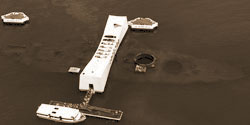
USS Arizona Memorial in 2006

USS Arizona Memorial in 2006

The 1961 USS Arizona benefit raised over $50,000 for the memorial as well as turned a spotlight on the issue to encourage contributions from others, including the US Congress. On Memorial Day 1962, the memorial was finally dedicated.

Though no one knew it at the time, the show also marked Elvis’ last live appearance for over seven years until the studio audience tapings of the 1968 ELVIS television special and his full-fledged 1969 Las Vegas shows. Instead, for better or worse, most of the rest of his 1960s career would focus on making movies.

* * *

Elvis knows he could stay on all night and they would stay, but the show is winding down now. He won’t be leaving Hawaii yet, though.

In just a couple of days, he has to start filming a new movie, Blue Hawaii. Though Mr. Wallis once told him it was to be a “drama,” Elvis is no longer so sure of that after reading the script and recording over a dozen songs for the soundtrack back in Hollywood just a few days ago.

Being on stage in Hawaii is a lot better than that stuffy recording studio. “We’d like to do a spiritual song for you, ladies and gentlemen, from our religious album called His Hand In Mine,” he says. “It goes something like this.”

He launches into “Swing Down, Sweet Chariot.” For that moment on stage, all is right in his world.

REVIEW – Live In Vegas: August 26, 1969 Dinner Show CD (FTD)

Live In Vegas: August 26, 1969 Dinner Show CD (Follow That Dream Records, 2011)

If you believe some fans, surely we’ve already heard enough 1969 Las Vegas concerts. Now that Live In Vegas: August 26, 1969 Dinner Show is available from FTD, let’s take a closer look at their claims.

Claim: If you’ve heard one 1969 show, you’ve heard them all.
Verdict: FALSE

For those who believe there are no more revelations to discover in these shows, I can easily pull one example of many from this release alone. For over 40 years now, Elvis fans have listened to the 1969 compilation Elvis In Person. How many ever realized that Elvis dedicated the specific performance of “Suspicious Minds” contained on that album to Barbara McNair, one of his Change Of Habit co-stars?

Elvis evidently thought a lot of McNair, who played Sister Irene, for he plugged her upcoming TV series, The Barbara McNair Show, when presenting her to the audience. As mentioned, Elvis’ introduction of the familiar version of “Suspicious Minds” is now slightly different: “A new record that just came out, ladies and gentlemen, I hope you like it, I’d like to do this especially for Barbie, it’s called ‘Suspicious Minds.'”

Though it is the sixth full-length show released from this engagement, Live In Vegas actually marks the first release of a concert that contributed songs to the Elvis In Person compilation (“Suspicious Minds” and “Can’t Help Falling In Love”). One of the joys of being able to hear complete 1969 shows like this one is re-discovering a song within its original context.

Claim: Every 1969 show had the same set list.
Verdict: FALSE

Live In Vegas is actually the first full show released thus far to include “My Babe” (previously compiled on Elvis Aron Presley) or “Inherit The Wind” (previously compiled on Collectors Gold). This is also the first full show so far where Elvis omits “Are You Lonesome Tonight” and only the second where he omits “What’d I Say.”

Incidentally, the inane argument that the set lists were always the same wasn’t even true of the first five shows released. Don’t get me wrong – of course, the core set lists are similar. These shows were all recorded within less than a week’s time, after all. The amusing part is that some fans apparently expect that Elvis should have completely revamped his show night after night. The 1969 concerts were about as perfect as any Elvis did in his career, but that’s not good enough for some.

Claim: If you’ve already heard the Midnight Show from this same date on All Shook Up, Live In Vegas will just be more of the same.
Verdict: FALSE

Though indeed recorded just a few hours apart from one another, the shows captured on All Shook Up and Live In Vegas are quite different from one another and do not play like repeats of the same show. The biggest difference is tone. While Elvis seems unable to control his infectious laughter through much of All Shook Up – including the fantastic “Are You Laughing Tonight” – he is much more focused on Live In Vegas. In fact, other than a few snickers here and there, there is little foreshadowing in the Dinner Show as to what will occur in the Midnight Show.

As far as the songs performed for these specific shows, the Dinner Show (Live In Vegas) features “Memories,” “My Babe,” and “Inherit The Wind,” which are not present on the later show. The Midnight Show (All Shook Up), on the other hand, features “I Can’t Stop Loving You,” “Are You Lonesome Tonight,” “Rubberneckin’” and “This Is The Story,” which are not present on the earlier show.

I find being able to listen to two shows from the same day during this incredible time of Elvis’ career to be one of the most positive aspects of this release, certainly not a drawback. It is fascinating to imagine being there for that single day, somehow fortunate enough to have tickets to both shows.

Show & Sound Quality

I’m just glad Ernst Jorgensen and the rest of Sony’s Follow That Dream team do not subscribe to the sort of claims refuted above. If they did, we might have missed out on Live In Vegas.

With that out of the way, we can now move on to more important things, like show and sound quality. The first few times I played this disc, my opinion was that no 1969 show had ever sounded this vibrant.

I have played all six full shows this week and part of me believes that Live In Vegas is the best of the complete 1969 shows released so far, in terms of Elvis’ performance. I am not quite ready to say that yet, though. I want to give more time for the newness to wear off and allow myself to compare the various shows more objectively. Like all of the other 1969 shows thus far released, though, this is without a doubt one of Elvis’ greatest concerts.

Elvis treats his classics with more respect in 1969 than he would in later years. “Blue Suede Shoes,” “All Shook Up,” “Love Me Tender,” “Jailhouse Rock,” and “Don’t Be Cruel” are all contenders as his best 1969 versions.

“You see, they fixed these lights up for Nancy Sinatra. They wouldn’t do it for me. That shows where the pull is. . . . I’ll show ’em, I won’t come back,” Elvis states shortly after welcoming the audience early on. Nancy’s engagement on the same stage would begin on August 29, just a day after Elvis’ would end. Elvis stuck around and caught her show and, despite his joke, returned to the International for another engagement just six months after this first one.

“Hound Dog” is also great, once you get past his cringe-inducing introduction of the song that also plagues every other version released so far from this engagement.

There are two tracks I always pay close attention to on the 1969 shows. One is “Suspicious Minds” – already a known factor on this album – and the other is the “Mystery Train/Tiger Man” medley. Elvis does a kickin’ rendition of this medley on Live In Vegas.

While Ronnie Tutt’s jungle drums are the focus in the first bits of “Tiger Man” before the second guitar break, the mix turns over to James Burton’s rockin’ guitar riffs for the other half of the song. It makes for a great compromise and one of the best versions of the song yet released.

I have yet to hear a bad version of “Runaway” from these shows, and this one is no exception. What a terrific performance from Elvis, driven again by James Burton. Too bad it was dropped from the show after 1969.

“Yesterday” is the typical “I’m not half the stud…” version and, as usual, the tacked on “Hey Jude” ending is no help.

After introducing the band, Elvis has Barbara McNair stand and introduces her as “a young lady that I just got through making a picture with called Change Of Habit, and I found her to be one of the nicest, warmest, lovingest people I’ve ever met.” When audience members complain they could not see her, he has the lights turned back on so she can stand up again.

It’s really cool hearing Elvis promote one of his movies on stage. Since he took a break from concerts through most of the 1960s, when he made the bulk of his movies, this was not an opportunity he had very often.

“In The Ghetto” is beautiful, similar to the Elvis In Person version.

On both of his August 26 shows, Elvis omits his breakneck speed version of “What’d I Say” and, in my opinion, the shows are all the better for it. “Suspicious Minds” is the ideal penultimate song, segueing perfectly into “Can’t Help Falling In Love.”

Speaking of “Can’t Help Falling In Love,” the Elvis In Person version has always been my favorite from 1969, and it sounds even better here.

* * *

Live In Vegas showcases Elvis Presley at his best on stage in a sound presentation that is richly mastered and crystal clear.

Sony reportedly has another six full shows from this engagement in its vault, including three more that contributed songs to the Elvis In Person album: the August 25 Dinner Show and the August 24 & 25 Midnight Shows.

There will always be complainers–even when Elvis was alive, he couldn’t please everyone, not even in 1969–but here’s hoping the rest of those 1969 shows, particularly the Elvis In Person ones, are eventually released. I’m looking forward to hearing each and every one of them.

And all four speakers were blaring Elvis

The latest FTD release, Live In Vegas: August 26, 1969 Dinner Show, arrived at my house yesterday. I resisted the urge to give it a quick listen last night so that I can give it proper attention this weekend. I’ll be reviewing this one soon, and I can’t wait to hear it. I wonder if my neighbors would mind if I blared an Elvis concert at 6:30 in the morning? Of course, it wouldn’t be the first time.

* * *

Came across a nice little Elvis mention courtesy of Google News while web surfing last night. I started to post a link here, but was too sleepy to type coherently. I’m definitely a morning person, you see. Anyway, over on JSOnline, the web site of the Milwaukee Journal Sentinel, someone wrote the following comment and question to “Mr. Music:”

I know the peak time for quadraphonic albums is around 1975. But the first quad LP I bought was ‘Aloha From Hawaii via Satellite,’ the soundtrack of Elvis Presley’s 1973 Honolulu concert. Since this came out before quad’s heyday, is it the first quad album? I’ll bet it is the top-selling quad release. Also, did anyone ever make quad singles?”- Jeremy Norbert, Milwaukee

Quadraphonic sound was an early consumer version of what we now call surround sound. In stereo sound, the audio is separated into two distinct channels. In quadraphonic sound, the audio was separated into four distinct channels – meaning you would listen with four speakers. Though it was indeed used for Aloha From Hawaii via Satellite, the format did not catch on.

I didn’t even notice this last night, but another perusal of the article just now reveals that “Mr. Music” is none other than renowned record collecting and Elvis expert/author Jerry Osborne. No wonder I was so impressed with his response. I was surprised last night that a “mainstream media” member could give such a knowledgable reply without tossing in snide comments or jokes about Elvis in the 70s. Now it all makes sense.

Check out Osborne’s reply: “Elvis in Hawaii helped take sound to a new level” — JSOnline. I’ll definitely be keeping an eye on Osborne’s Mr. Music column in the future.

An updated version of Osborne’s Elvis: Like Any Other Soldier book is available now. You can find out more information about his publications over at Jerry Osborne’s site.

FTD to release Elvis Sings Guitar Man

Just learned terrific news. The next Follow That Dream Records release is going to be the “imaginary album” Elvis Sings Guitar Man, filling in its Classic Album series with songs recorded in Nashville in 1966 and 1967 (“Elvis Sings Guitar Man” — Elvis Today). These songs originally found their homes as bonuses on various movie soundtracks. This 2-CD set will fit in perfectly with The Mystery Train’s ongoing tribute to Elvis events of the year 1967.

The CD is due out in April. From ElvisNews.com, here’s the tracklisting:

DISC 1

01) Guitar Man 2:22
02) Tomorrow Is A Long Time 5:24
03) Big Boss Man 2:54
04) Love Letters 2:52
05) Indescribably Blue 2:50
06) Fools Fall In Love 2:08
07) Hi-Heel Sneakers 2:48
08) Down In The Alley 2:54
09) Come What May 2:03
10) Mine 2:39
11) Just Call Me Lonesome 2:08
12) You Don’t Know Me 2:32
13) Singing Tree 2:22
14) I’ll Remember You 2:48

Bonus Song
15) Beyond The Reef (overdubbed version)

First Takes
16) Guitar Man – takes 1,2,5 4:22
17) Tomorrow Is A Long Time – takes 1,2 6:15
18) Big Boss Man – take 2 3:35
19) Love Letters –take 2 2:53
20) Fools Fall In Love – takes 1,4 2:40
21) Hi-Heel Sneakers – take 5 4:58
22) Down In The Alley – take 1 3:13
23) Come What May – take 2 2:12
24) Singing Tree – take 1 3:11
25) I’ll Remember You – vocal overdub take 2 4:14

DISC 2

May 1966 Sessions
01) Down In The Alley – takes 2,3,4 2:18
02) Down In The Alley – take 6 2:51
03) Love Letters – takes 3,4,5,7 4:39
04) Love Letters – take 8 3:12
05) Beyond The Reef – takes 1,2 (undubbed master) 5:42
06) Come What May – takes 3,4 2:27
07) Come What May – take 6 2:07
08) Come What May – take 7 – 2:21

June 1966 Sessions
09) Indescribably – (vocal overdub) take 1 2:55
10) I’ll Remember You – (unedited master) vocal overdub 1 4:10

1967 Sessions
11) Guitar Man – takes 7,9 2:52
12) Guitar Man – take 10 2:55
13) Guitar Man – takes 11, 12 (unedited/undubbed master) 4:02
14) Big Boss Man – takes 1,3,4,5 3:19
15) Big Boss Man – takes 7, 9 3:48
16) Singing Tree – takes 2,4 3:28
17) Singing Tree – take 8 3:03
18) Singing Tree – takes 10,13 3:44
19) Just Call Me Lonesome – takes 3,4 2:55
20) Just Call Me Lonesome – takes 5,6 2:31
21) Hi-Heel Sneakers – takes 1,6 2:51
22) Hi-Heel Sneakers – take 7 – (unedited master) 4:57
23) You Don’t Know Me – take 2 2:57
24) Singing Tree – (remake) takes 1,2,3 3:21

FTD is Sony’s collectors label for Elvis fans. The releases are available from various online stores. Since they originate in Denmark and then ship to retailers, there is sometimes a two or three week delay after the “release date” before the CDs arrive for those of us in the United States.

Introducing a new page: Elvis Presley Discography

I’ve added a new reference page to The Mystery Train Elvis Blog, Elvis Presley Discography. It lists the Elvis singles and LP albums released in the United States during his lifetime.

View The Mystery Train Elvis Blog’s Elvis Presley Discography page. You can also access it using the Elvis tab at the top of the page.

Valentines From Elvis: His Top Ten “Love” Songs

In honor of Saint Valentine’s Day, here is my top ten list of Elvis songs released during his lifetime that contained some form of the word “love” in the title. Can you believe I had about 70 different songs to choose from to compile this list? Here are the best of the best.

#1 Can’t Help Falling In Love (1961)
Blue Hawaii
Other notable versions: 1968 live (ELVIS-TV Special); 1969 live (From Memphis To Vegas/From Vegas To Memphis).

#2 Love Me (1956)
Elvis
Other notable version: 1968 live (A Legendary Performer, Volume 1).

#3 You’ve Lost That Lovin’ Feelin’ (Live-1970)
That’s The Way It Is

#4 Burning Love (1972)
Burning Love And Hits From His Movies, Volume 2
Other notable version: 1973 live (Aloha From Hawaii Via Satellite).

#5 Pledging My Love (1976)
Moody Blue

#6 Love Me Tender (Live-1968)
ELVIS-TV Special

#7 After Loving You (1969)
From Elvis In Memphis

#8 Wearin’ That Loved-On Look (1969)
From Elvis In Memphis

#9 Power Of My Love (1969)
From Elvis In Memphis

#10 Your Love’s Been A Long Time Coming (1973)
Promised Land

Happy Valentine’s Day, everyone!

“It’s the music and not the value of the collection that counts”

Thomas over at the Elvis Today blog has a real talent for summing up the experience of being an Elvis fan. In today’s post, “The Truth About Me,” he reflects on when he first became a fan, including a reprint of an article he wrote 21 years ago for a Swedish Elvis fan club.

“During the years me and my other brother have built a record collection that we’re proud [of],” he wrote in 1990. “Not because it includes a lot of valuable editions, but because we think we own most of the stuff released officially by Elvis, and to us it’s the music and not the value of the collection that counts.”

In the end, the music is all that really matters. Whether you are listening on vinyl records, MP3s, cassette tapes, CDs, or even 8-tracks, Elvis is still there. His music is what brings us all together. His music is our shared experience. And no matter what classless jokes or baseless claims people want to lob at him, Elvis always wins in the end because his music pounds through all of that noise and demands to be heard.

“The image is one thing, and a human being is another,” Elvis said in 1972. “It’s very hard to live up to an image.” While the image of Elvis has morphed over the years, the underlying truth of his statement remains. Like Thomas says, you don’t need an expensive collection to explore the music and go beyond the image.

After all, a scratched-up record of seemingly no value can in fact be priceless.