Elvis conquers Vegas in 1969 with FTD

Cover concept art for THE RETURN TO VEGAS CD

Cover concept art for THE RETURN TO VEGAS CD. One hopes this amateurish effort will be replaced by time of release.

Follow That Dream will soon release the earliest known recording from the 1969 Las Vegas engagement that helped reignite Elvis Presley’s career. Add this news to Sony’s 10-disc That’s The Way It Is: Deluxe Edition set (track listing for that coming in my next post) and Warner Home Video’s That’s The Way It Is: Special Edition Blu-ray set coming in August, and 2014 is truly the return of the “Elvis Summer Festival.”

The Return To Vegas features an undated soundboard recording from early August 1969. RCA’s formal recordings of the concert series did not begin until later that month. FTD, Sony’s collectors label for Elvis fans, plans to release the show in late June – meaning it probably will not reach most consumers until sometime in July.

Though it has made the rounds on bootleg, this marks the first official release of the show – other than an entertaining monologue track previously included on the notorious 1974 album Having Fun With Elvis On Stage.

This early August soundboard recording is probably the closest we will ever come to hearing the legendary July 31, 1969, show that opened the engagement, so this has been one of my most anticipated concert releases. What a summer this will be.

Below is the press release from FTD, as well as the track listing.

[The Return To Vegas] is the official release of the soundboard recording that Joan Deary planned as a double album release back in the late seventies. It’s the earliest known professional recording from Elvis’ 1969 engagement in Las Vegas. The original tape box has “opening night” written on the back, but that’s not the real date. Some experts believe it’s from August 3, but we have no information whatsoever to suggest a certain date.

However, the arrangements seem to suggest that this show is definitely several days earlier than the shows RCA recorded from August 20 and onwards. Why Joan Deary edited and mastered this for release is another mystery, since she of course had all the shows RCA recorded on 8-track tape with audio in substantially better quality. This release comes in a 7″ digi-pack with a 12-page booklet, featuring great photos from the collections of Steve Barile & Jim Patino, and a foreword by Ken Sharp.

Tracks

01. Blue Suede Shoes
02. I Got A Woman
03. All Shook Up
04. Love Me Tender
05. Jailhouse Rock/Don’t Be Cruel
06. Heartbreak Hotel
07. Hound Dog
08. Memories
09. Mystery Train/Tiger Man
10. Monologue *
11. Baby, What You Want Me To Do
12. Are You Lonesome Tonight
13. Yesterday/Hey Jude
14. Introductions
15. In The Ghetto
16. Suspicious Minds
17. What’d I Say
18. Can’t Help Falling In Love

* Previously released

iTunes Speedway: Race for the Elvis Cup

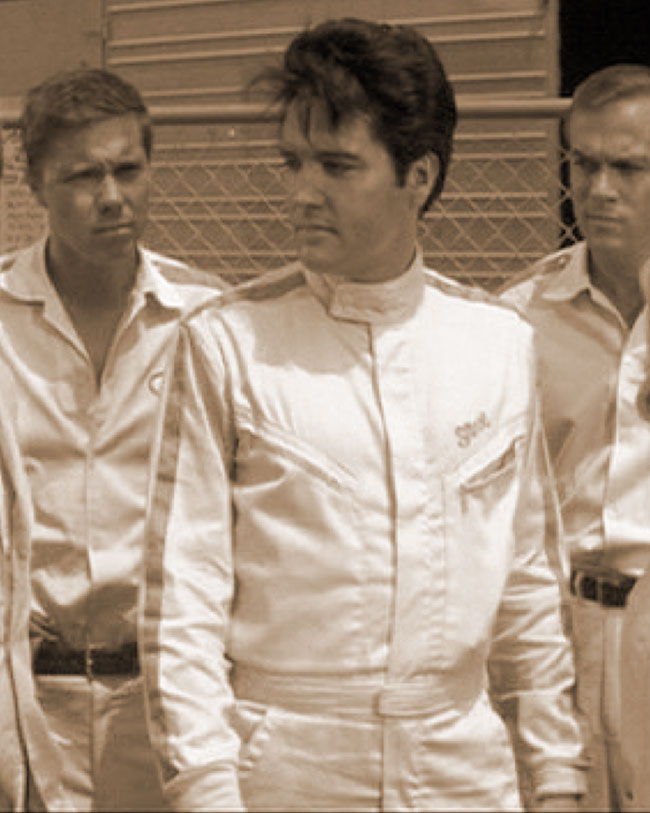
Elvis Presley is Steve Grayson in SPEEDWAY (1968)

Elvis Presley is Steve Grayson in SPEEDWAY (1968, MGM)

On the iTunes Speedway

Ever since I finished backing up all of my Elvis music to iTunes, I have been wanting to do some number-crunching. I usually rate a song when I first place it on iTunes, using the built-in star ratings of 1-5 (I reserve 0 stars to mean “not yet rated”). I then update the rating, if necessary, whenever the track plays.

For updates, I only allow myself to move the song one star rating in either direction per play. That way, if I am in an extremely bad or good mood, it will not overly influence the rating of a given song.

I now have nearly five years worth of data about how I really feel about the songs within my Elvis collection. This will allow me to determine which individual years and multi-year spans are truly my favorites, at least according to the numbers.

My Picks

Before crunching those numbers, though, I used my heart to answer some basic questions. I thought this would make for an interesting comparison against the iTunes race results.

Favorite Elvis Year: 1970
Top Five Elvis Years: 1970, 1968, 1969, 1957, 1955
Favorite 5-year Elvis Span: 1968-1972
Elvis Decade Ranking: 1970s, 1950s, 1960s

Race for the Elvis Cup: The Rules

For this analysis, I eliminated any years for which I had less than 40 Elvis tracks. This resulted in the removal of 1953 (2 tracks) and 1959 (19 tracks). I also eliminated all non-musical tracks (e.g., “Introductions By Elvis,” “Elvis Talks”).

For each of the remaining 23 years, I determined the average star rating for all applicable tracks. I also determined the percentage of tracks from that year that earned a perfect 5-star rating. For instance, the results for 1956 were:

1956
Total Tracks: 164
Average Rating: 3.91 (out of 5)
Perfect 5-star Tracks: 40.24%

The year with the highest average rating received 23 points on down to the year with the lowest average rating, which received 1 point. I then applied this same logic down the line by year for the percentage rankings for perfect 5-star tracks.

This gave each year a score ranging from a low of 2 to a high of 46. However, there were several ties down the line. The tie-breakers were:

1.) Average Rating (i.e., the tied year with the highest average rating wins the position)
2.) (If necessary) Perfect 5-Star Tracks (i.e., the year with the highest 5-star tracks percentage wins the position)

Victory Lane

The results were interesting. Leading the pack was the year 1968, with a perfect score of 46 points.

Nearly 85% of the Elvis tracks I had from 1968 were connected to the ELVIS television special project in some way, so that definitely helped stack the deck. Among them were “If I Can Dream,” one of my all-time favorite songs, and other tracks from Memories: The ’68 Comeback Special, a stellar album that includes the full June 27, 6 PM “Sit Down” show.

Top Five Elvis Years
#1 1968 (46 points)
#2 1970 (43 points, wins 2nd position over 1969 on Average Rating tie-breaker)
#3 1969 (43 points)
#4 1967 (38 points)
#5 1955 (37 points, wins 5th position over 1957 on Average Rating tie-breaker)

The real surprise for me was 1967 making the Top Five. Highlights for 1967 included the September sessions in Nashville that produced standouts like “Guitar Man,” “You’ll Never Walk Alone,” and “You Don’t Know Me.” In fact, alternate takes from that session, many of which are collected on FTD’s Elvis Sings Guitar Man, helped propel 1967 ahead due to the number of five-star ratings.

1965 came in last place, with a minimal score of 2 points (no surprise there). I was surprised that 1977 (5 points) was not able to overtake 1964 (8 points) and wound up as Elvis’ second-worst year.

5-Year Mission

I was also interested in determining my favorite 5-year span. As noted above, I usually say my favorite Elvis time period is 1968-1972, with 1954-1958 running a close second. How did the numbers match against my picks?

To my surprise, it turned out that my favorite 5-year Elvis span was actually 1966-1970, which came in at a whopping 198 points. 1968-1972 earned a collective 183 points, while 1954-1958 came in at 146 points. In other words, this race was not even close.

I often state that the opening salvos of Elvis’ comeback were actually fired in 1966 during the How Great Thou Art sessions, so perhaps I should have seen this coming. 1969 included the Memphis sessions that produced “Suspicious Minds,” “Kentucky Rain,” and “In The Ghetto,” his return to live performances, and even a strong soundtrack on the Change of Habit film. 1970 featured the That’s The Way It Is project, including the Nashville sessions, the summer rehearsals, and the August live performances.

The five-year span that earned the least points was 1961-1965, with a combined total of only 50, barely more than the single year of 1968.

Elvis Decades

Now, to answer that age-old question, what is your favorite Elvis decade? Though 1964 and 1965 are hard to love, I otherwise enjoy Elvis’ entire career. When pressed, however, I state that my favorite decade is the 1970s. What did the numbers say?

Again, they proved me wrong. The 1950s won out, with an average of 29.2 points. Second place was the 1970s, well behind at an average of 22.88 points. This barely edged out the 1960s, which had an average of 22.3 points.

Elvis professionally recorded during only five years in the 1950s, and the quality of his output was much more consistent in that time than in the 1960s and 1970s. The 1970s were brought way down by outliers like 1977 (5 points) and 1974 (10 points), while the same occurred for the 1960s with 1965 (2 points), 1962 (8 points), and 1964 (8 points). However, even the 1950s had its own outlier of 1958 (10 points).

Awarding the Elvis Cup

The analytical side of my personality loved reviewing these numbers. The emotional side of me, though, still believes that 1970 is my favorite Elvis year, no matter what iTunes says.

For me, feelings always rule out in the end, so the Elvis Cup is hereby awarded to 1970, the reigning champion.

“He always spoke the truth”

On August 28, 1963, civil rights leader Rev. Dr. Martin Luther King, Jr., stands at the Lincoln Memorial in Washington, DC, and delivers his famous “I Have A Dream” speech during the March on Washington for Jobs and Freedom.

In Elvis Day By Day, Peter Guralnick and Ernst Jorgensen note, “Dr. King’s ‘I Have A Dream’ speech is one of Elvis’ favorite rhetorical pieces, something he recites often over the years” (p. 239).

At the Lorraine Motel in Memphis, Tennessee, on April 4, 1968, King is silenced by an assassin’s bullet at the age of 39.

Longtime Elvis friend Jerry Schilling describes the singer’s reaction to King’s death when they see the news:

“I’d heard him recite [King’s] beautiful, hopeful words many times. I looked over at Elvis now and saw that he was staring hard at the TV. There were tears in his eyes. ‘He always spoke the truth,’ he said quietly” (Me And A Guy Named Elvis, p. 187).

Elvis is in Hollywood finishing up his 28th movie, Live A Little, Love A Little, and is devastated that the murder took place in his hometown. He also believes it will confirm “everyone’s worst feelings about the South” (Careless Love, Guralnick, p. 297).

Actress Celeste Yarnall, who had a small role in Live A Little, Love A Little, states that she watched King’s funeral on TV with Elvis and held him in her arms as he cried (The Elvis Encyclopedia, Victor, p. 289).

Only nine weeks later, Senator Robert F. Kennedy is assassinated at the Ambassador Hotel in Los Angeles while running for President. This time, Elvis is in nearby Burbank – less than ten miles away. Rehearsals have begun for his ELVIS television special.

A few days later, W. Earl Brown writes “If I Can Dream” for Elvis to close the show. The song can be interpreted as a tribute to both fallen leaders, particularly King. “If I can dream of a better land, where all my brothers walk hand-in-hand, tell me why can’t my dream come true?” pleads Elvis in the song, echoing King’s 1963 speech.

It is a huge departure for Elvis, who has thus far avoided public commentary on social issues. His manager even tries to nix the song, but in a rare moment of defiance, Elvis insists on recording it.

NBC airs the ELVIS special on December 3, 1968, and it becomes the highest-rated program of the week and one of the most-watched specials of the year. “If I Can Dream” turns out not only to be the perfect song to close the special, but also an appropriate way to reflect on a tragic chapter in American history.


Martin Luther King, Jr., would have turned 84 on January 15. Today, the United States observes this hero’s birthday with a national holiday. His words, his ideas, his dreams live on.

New winner takes the victory seat for Elvis Trivialities #13

Congratulations to George Millar, who sat his way to victory in Elvis Trivialities #13.

A first-time winner, he receives a freshly baked slice of bragging rights and a chair among The Mystery Train’s Night Riders.

And the answer is…

“NBC” is printed on the backrest of the chair Elvis used during the “sit-down” shows portion of the ELVIS (’68 comeback) television special.

Now, folks, don’t feel bad if you didn’t get this one. For one thing, Elvis is sitting on his chair for most of this segment, so the “NBC” is covered.

I’ve been watching the Comeback Special for over 25 years, but never noticed the chair had anything written on it until my last viewing.

The “NBC” is most noticeable just before Elvis takes his seat in “Black Leather Sit-down Show #1” on DVD 1 of the excellent ELVIS: ’68 Comeback Special – Deluxe Edition.

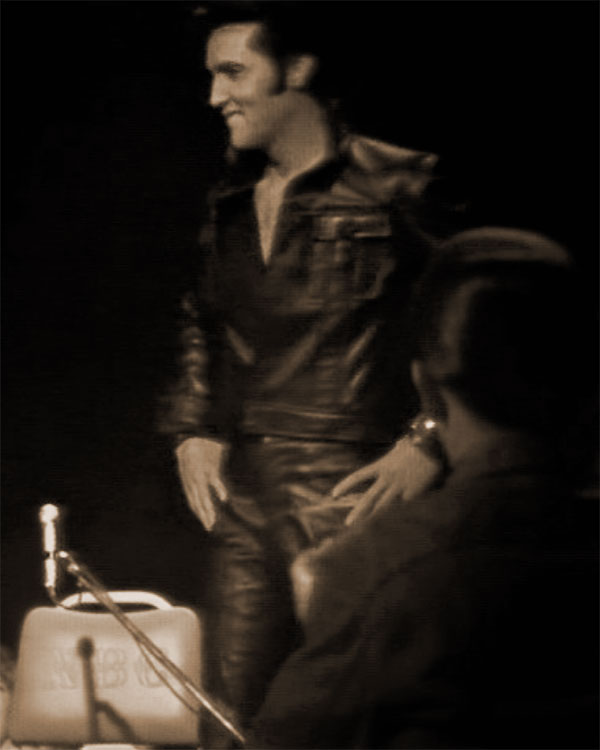
Elvis and his NBC chair, 1968

Elvis and his NBC chair, 1968

Presumably, all of the chairs on stage carry the NBC designation, but the Elvis one is most visible because the other guys generally remain seated.

* * *

George can now brag to his friends and family that he can conquer obscure Elvis trivia questions like the above against the most knowledgable of fans. If you would like the same opportunity, subscribe to The Mystery Train using the feature below this post. That way, you’ll be notified whenever there is a new post – because you never know when the next trivia challenge will come along.


The Mystery Train’s Night Riders

  • January 11, 2013: George Millar (4:19)
  • December 23, 2012: Thomas (0:36)
  • October 9, 2012: David (14:38) | Honorable Mention: John (22:06)
  • February 4, 2012: Thomas (13:52)
  • February 3, 2012: Thomas (2:18)
  • December 21, 2011: Wellsy (2:37)
  • October 31, 2011: Thomas (17:32)
  • October 1, 2011: Jimmy Cool (1:01)
  • September 9, 2011: Steve Brogdon (0:17) <— Record time
  • August 6, 2011: Thomas (2:26)
  • July 9, 2011: Thomas (5:26)
  • June 23, 2011: Fred Wolfe (0:18)
  • June 22, 2011: Ty stumps the train (no winner)

Empty And Bare: Elvis Trivialities #13

Welcome to the first Elvis Trivialities of 2013. On June 27, 1968, Elvis Presley performed two shows in the round at NBC Studios in Burbank, California, for his ELVIS television special. Known today as the “sit-down” shows, they featured Elvis on electric guitar jamming with friends and bandmates.

Your question is…

What was printed on the backrest of the chair Elvis used during this portion of the ’68 Comeback Special?

If you’re lookin’ for trivia, you came to the right place! The first person to answer this question correctly in the comments below gets a huge slice of freshly baked bragging rights.

Good luck!

Elvis Trivialities On TheMysteryTrainBlog.com

FTD elevates Back In Memphis to essential status

Last month, Sony’s Follow That Dream collectors label for Elvis fans released its Classic Album version of Back In Memphis. With the holidays over, I’ve finally had some time to listen to this 2-CD set.
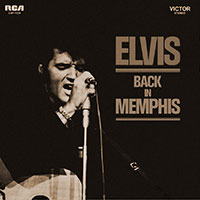
Back In Memphis, 2012 FTD Edition

Back In Memphis, 2012 FTD Edition

Original Album

Elvis loved Memphis, and no matter which of his eras you reference, he made some of his best music there.

The original Back In Memphis album was actually a 1970 re-release of Record 2 of the 1969 2-LP set From Memphis To Vegas/From Vegas To Memphis. Record 1 of that set was also re-released in 1970, as Elvis In Person.

Back In Memphis was a follow-up to the impeccable From Elvis In Memphis, recorded during the same 1969 sessions at American Sound Studio in Memphis. Unfortunately, the results were not nearly as strong.

In fact, Back In Memphis was one of the only disappointments I encountered in my first few years of collecting Elvis music. I was a huge fan of The Memphis Record, a 1987 retrospective album for the American sessions – compiling the entirety of From Elvis In Memphis, most of the singles, and selections from Back In Memphis.

While sound quality has come a long way since then, The Memphis Record was definitely a huge influence on me becoming the borderline obsessive Elvis fan I am today. I couldn’t wait to hear the remaining songs when RCA re-released Back In Memphis in the early 1990s on CD.

It turned out, though, that every “new-to-me” song on the album (i.e., those that weren’t on The Memphis Record) bordered on horrible. A bad Elvis CD, and from 1969 at that… I was shocked. I rarely played it.

Since that time, I’ve come to appreciate at least one of those Back In Memphis recordings that I initially hated: “Do You Know Who I Am,” which is a beautiful song.

If I play Back In Memphis these days, I prefer to kick it off by playing Elvis In Person. To me, Back In Memphis holds up better as Record 2 of a 2-LP set than it does as a stand-alone title. Elvis In Person, on the other hand, is powerful enough on its own.

Back In Memphis begins with “Inherit The Wind,” a great song written by Eddie Rabbitt – who also wrote “Kentucky Rain.” While I enjoy “Inherit The Wind,” I do not believe it was a good choice for first song.

Up next is “This Is The Story,” which sounds like a leftover – leading to an abysmal feeling for the beginning of Back In Memphis.

Fortunately, “Stranger In My Own Home Town” revs things into high gear. This is one of Elvis’ best performances from the American sessions, and it should have been the lead-off song for Back In Memphis. In fact, RCA wisely used it to kick off The Memphis Record. Say what you will about the sound, The Memphis Record had flawless sequencing.

Back In Memphis downshifts into low gear again with “Just A Little Bit Of Green.” Though better than “This Is The Story,” this is still lesser material. Elvis’ performance, as with just about everything he touched in 1969, is commendable, but the song itself is simply not worthwhile.

“Side 1” of the original album closes out with a real stinker, Neil Diamond’s “And The Grass Won’t Pay No Mind.” This is one of the few Elvis songs that I find nearly unlistenable. Keep in mind that this is coming from a guy who is a fan of “Old MacDonald.” To say that I give Elvis songs the benefit of the doubt is an understatement. This one is horrible, by far the worst on the album.

“Side 2” kicks off with “Do You Know Who I Am,” a very moving performance that always gets to me when I take the time to feel the words.

“I remember you said that you had to forget about me and be free. Do you know who I am, or have you forgot about me?”

Then we are back to sub-mediocre material with “From A Jack To A King.” Perhaps better than a typical movie song, but not by much.

Back In Memphis finishes strong, though. “The Fair’s Moving On,” “You’ll Think Of Me,” and, to a lesser extent, “Without Love” are all terrific songs.

All in all, it makes for an uneven album that pales in comparison to From Elvis In Memphis.

Bonus Song

As a bonus, FTD includes the stereo version of “Suspicious Minds,” which was not released until a few years after Elvis’ death. The original single released in 1969 was mono and can be found on the 2009 Legacy Edition of From Elvis In Memphis.

What else can be said about “Suspicious Minds” beyond that it is one of Elvis Presley’s true masterpieces?

Some have argued that RCA should have included it on the original Back In Memphis, but that would have been problematic because a live version of “Suspicious Minds” was included on the Elvis In Person portion of the original release.

Instead, RCA should have considered using “Don’t Cry Daddy,” “Rubberneckin'”, “Kentucky Rain,” and even “My Little Friend” to bolster this lackluster album. The problem with those, however, is that they had not yet been released as singles prior to From Memphis To Vegas/From Vegas To Memphis hitting stores.

Anyway, the “Suspicious Minds” bonus song is welcome here, particularly since it allows the meat of this 2-CD edition to include every take of this classic.

Sound quality on this release is amazing, by the way. I probably don’t mention that enough anymore, because I have gotten used to this level of quality over the last few years of Elvis releases.

First Takes

Inherit The Wind (Take 1; rehearsal; Take 4/master with vocal overdub #1): Take 1 and the rehearsal are instrumental only, both short. Vocal overdub #1 that Elvis performed against Take 4 is a gem. This is one of those where it is so clear that it sounds as if he is standing in your living room while performing the song. I’m thrilled to add this one to my collection. Previously unreleased.

A Little Bit Of Green (Take 1): Elvis sounds great here, of course, but I still don’t care very much for the song. This is a previously unreleased take. I think I like it better than the master, though that may just be the fact that it is “new” compared to that one. It is possible that this take could make the song grow on me. I like the stripped-down nature of it.

And The Grass Won’t Pay No Mind (Takes 1-3; 5): This is a collection of previously unreleased false starts that did not change my opinion of this awful song.

Do You Know Who I Am (Take 1): This is a nice alternate, though I prefer the master. Previously released on Memphis Sessions.

From A Jack To A King (Takes 1-3): Takes 1 and 2 are false starts. Take 3 is worse than the master. Previously released on Memphis Sessions.

You’ll Think Of Me (Takes 1-6): Takes 1 through 5 are false starts. Take 6 is pleasant, but feels somewhat plodding at times compared to the master. Previously unreleased.

Without Love (Take 1): This alternate, which is very similar to the master, was previously released on Suspicious Minds.

Suspicious Minds (Takes 1-4; rehearsal; Take 5; rehearsal): This one track is the reason I had to have this CD upon release, rather than picking it up at some point down the road in 2013. Here are Elvis Presley’s first five attempts at “Suspicious Minds,” all blown takes. Elvis swears on some of his mistakes, and FTD has not edited his language. I commend this decision, since this is a collectors label. Anyway, I love hearing “Suspicious Minds” start to come together. Other than parts of the rehearsal segments, most of this track is previously unreleased.

Suspicious Minds (Take 6): This track begins with two more previously unreleased false starts before Elvis finally nails a complete take – as previously released on ELVIS: From Nashville To Memphis – The Essential 60s Masters I.
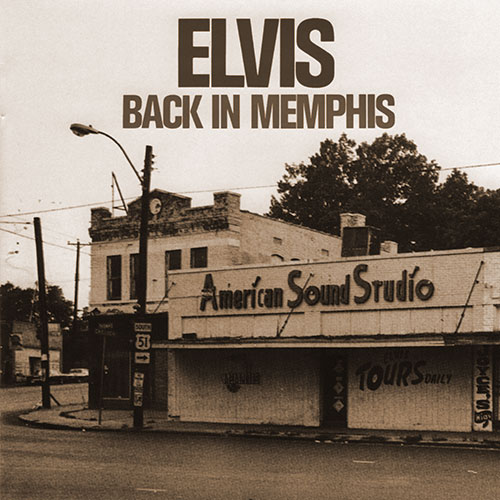
Back In Memphis - FTD Booklet Cover

Back In Memphis – FTD Booklet Cover

Rehearsals

For some reason, FTD includes the undubbed “Stranger In My Home Town” master in this rehearsal section. This version was available before on Reconsider Baby and Memphis Sessions. “Stranger In My Own Home Town” is a song where I strongly prefer the dubbed version.

There is also a true rehearsal of “A Little Bit Of Green.” Elvis sings it very slow at first but eventually moves it closer to the familiar speed. I like this previously unreleased informal version better than the master.

January Outtakes

Up next are three takes of “You’ll Think Of Me.” Take 8, though previously released on Made In Memphis, is new to me. Take 14 was previously released on Memphis Sessions. Take 16 was previously released on Suspicious Minds. All three takes are enjoyable.

Then, it’s back to “A Little Bit Of Green” for takes 2 and 3. Take 2 consists of a couple of false starts, while take 3 is actually the undubbed master with Elvis’ original vocals (he re-recorded his vocals to the song at a September session later that year in Nashville). He struggles with it in the January session. Fascinating, and exactly the kind of previously unreleased track that a collectors label should provide.

The previously unreleased vocal overdub #2 for “Inherit The Wind” proves interesting because Elvis spends part of it joking around, including use of his mock country voice.

Two false starts of “Without Love” are followed by Take 4 – previously released on Memphis Sessions. It’s a decent take, but this song wears on me after awhile. Too much style, not enough substance.

Take 7 of “Suspicious Minds” quickly re-energizes me, though. How I love this song. This take was previously released on Platinum: A Life In Music, though there are some extra talking bits before and after the song here.

February Outtakes

Up first is the master Take 6 of “And The Grass Won’t Pay No Mind”, undubbed except for Elvis vocal repairs. While I still detest the underlying song, I do find this version better than the master.

Take 4 of “Do You Know Who I Am” was first released on Made In Memphis, but it is new to me and, thus, a highlight of this release. Elvis seems really into the song. He begins to clown around at the end and states afterwards, “You’re gonna save that last take, aren’t you? Because the first part of the take was pretty good.”

Unfinished Masters

“This Is The Story” kicks off with a false start Take 1, followed by the undubbed Take 2 – previously released in shorter form on Memphis Sessions. This simpler version is far preferable to the master. I also enjoy the live version (Collectors Gold) due to Elvis injecting some humor into this melodramatic piece.

More “You’ll Think Of Me”, this time the undubbed master Take 23. This is a terrific track.

Back to “A Little Bit Of Green.” This time, it is master Take 3 with Elvis’ vocal overdub replacement, but without the other dubs. Accordingly, Elvis sounds much stronger here than in the “January Outtakes” instance of this track. Also, the song is admittedly much improved in its simpler form without the other overdubs. Oh what confusing webs ensnare Elvis fans.

Two false starts from Take 4 kick off “From A Jack To A King,” followed by the undubbed and unedited master Take 5 – previously unreleased. I prefer it over the released master, though this still won’t be a favorite. I may play it a little more often, though.

Next is the undubbed master (Take 5) of “Without Love,” previously unreleased and mostly unremarkable.

Here, at last, is the undubbed/unedited master Take 8 of “Suspicious Minds.” Boy, was it worth the wait. You’ll want to crank this one up and wake up your neighbors, folks. Wow. It is incredible to hear this song in its stripped-down form. While it is not better than the official master, I believe it will stand right alongside it for me. There are plenty of other great tracks on FTD’s Back In Memphis, but this one alone is worth the cost of admission.

From “Suspicious Minds” to “And The Grass Won’t Pay No Mind” (master Take 6 with vocal overdub). Maybe this illustrates as well as any other two examples of the contradictory nature of Elvis’ career. So much incredible talent that is alternatively poured into a treasured work or into utter dreck. Yet, in both cases, the talent is always there.

Further proving my point, after “And The Grass Won’t Pay No Mind” comes another great track, Take 7 (master, with vocal overdub) of “Do You Know Who I Am”. I love this one, too – including more fooling around by Elvis near the end. I can’t wait to go back and listen again to all of these “Do You Know Who I Am” takes.

Finally, “The Fair’s Moving On” (Take 1 master, with vocal overdub) provides an approriate album closer as Elvis sings, “Yes, the fair’s moving on, and I’ll soon be gone…” Another delightful track.

Cover & Booklet

As when FTD released Elvis In Person in the Classic Album series, the front cover art duplicates the reissue version of Back In Memphis, leaving out the From Vegas To Memphis title. At least they were consistent, but I would have preferred both use the From Memphis To Vegas/From Vegas To Memphis cover variants, as the odds of the original 2-LP version getting a re-release on its own are slim to none.

From Memphis To Vegas/From Vegas To Memphis actually would have made a great Legacy Edition release, but both Elvis In Person and Back In Memphis have already been part of separate releases in that series as supporting titles for On Stage and From Elvis In Memphis respectively.

The Back In Memphis FTD booklet cover is fantastic. I like to think of these as the album covers for the FTD editions, and this is one of their best alternate designs – right up there with the booklet cover for That’s The Way It Is FTD Classic Album edition.

The liner notes reveal no new information and often sound awkward. For example:

“One of the new songs Elvis performed at his shows was an extended seven-minutes plus arrangement of a yet to be released song from the Memphis Sessions, a Mark James penned song about the break-up of a relationship titled ‘Suspicious Minds’.”

I also wish the “In And Outtakes” notes had been more informative about the various takes, overdubs, etc. Instead, I had to use the Elvis Presley Recording Sessions section of the excellent Keith Flynn’s Elvis Presley Pages to unravel some of my personal confusion when compiling this review. Compared to initial releases, FTD has come a long way in the amount of information provided – but there is still room to grow.


When I first heard the original Back In Memphis, over twenty years ago, I was surprised by my disappointment. After listening to this expanded FTD release of the album, I am surprised yet again. Not by disappointment this time, but by how much I enjoyed it.

Verdict: 10 (out of 10)
REVIEW: Elvis – The Complete Masters Collection (Part 5)

This is Part 5 of an ongoing series reviewing Elvis: The Complete Masters Collection. Read Part 4.

I’m planning to significantly scale back this review series. I’m actually up to Volume 17 now in listening, as I gave up trying to review them as I go. This is mostly because I was not patient enough to wait. The process was just going too slow and taking away from the enjoyment. However, since I already had a draft of the below review for weeks now, I figured I might as well share it with you.


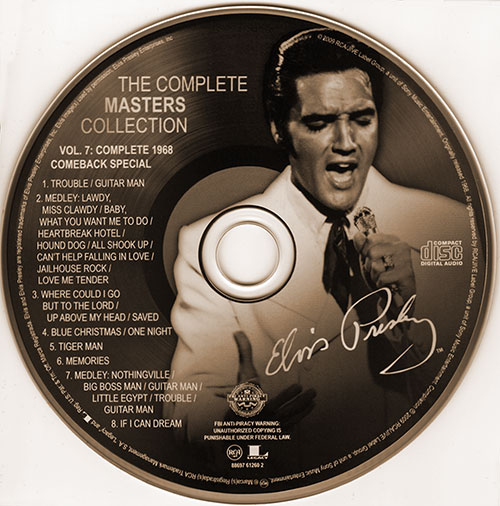
CD Vol. 7: Complete 1968 Comeback Special

This volume of The Franklin Mint‘s 36-disc Elvis: The Complete Masters Collection (mastered by Vic Anesini) presents songs recorded for the ELVIS television special in June 1968.

Elvis: The Complete Masters Collection - Volume 7

01. Trouble/Guitar Man: This was the perfect way to open both the ELVIS special and the accompanying soundtrack album. Culled from 1958’s King Creole, “Trouble” has never sounded better than it does in this performance a decade later.

In the setting of the special, “Guitar Man” bares little resemblance to Elvis’ 1967 country recording. This version rocks.

Though true to the original album, I would have preferred that the overdubbed applause at the end of this studio track had been omitted for this release. Exceptions were made for other recordings on this set, including on this very CD, and this is another exception I would have welcomed.

02. Lawdy, Miss Clawdy [Live]: In the live, “sit down” segment of the show, Elvis tears into “Lawdy, Miss Clawdy.” This is a terrific rendition that helps set the tone for the entire album. Elvis is back.

Baby, What You Want Me To Do [Live]: Elvis performs a brief snippet of “Baby, What You Want Me To Do” and then launches into a fun bit of reminiscing.

Heartbreak Hotel/Hound Dog/All Shook Up [Live]: The album then transitions to the “stand up” segment with a rocking “Heartbreak Hotel,” combined with strong versions of “Hound Dog” (I love the Native-American-inspired percussion) and “All Shook Up.”

This is the best live version of “Heartbreak Hotel.” Too bad it is part of a medley and incomplete. Years ago, I made an edit of this recording and the one at his first sit down show in order to create a “complete” version for my own personal use (inspired by a similar edit of “Blue Suede Shoes” on This Is Elvis, except mine began with the stand up show and ended with the sit down show).

Sound quality is so excellent on Complete 1968 Comeback Special that it makes a recording flaw in this medley more obvious – a microphone or amplifier feedback sound is present in the background through much of the medley, beginning with “Hound Dog.” When I went back to check, I was surprised to find that this actually existed on previous release sources as well – though not as obvious.

Can’t Help Falling In Love [Live]:  Hands-down, this is the best live version of “Can’t Help Falling In Love.” Absolutely beautiful. Again, here we have excellent sound quality, but that feedback tone is also present at times in the background. I fear it is one of those things where, now that I have heard it, I will not be able to “un-hear” it.

Jailhouse Rock [Live]: For my money, there are really only two killer versions of “Jailhouse Rock.” The 1957 original and this 1968 live recording. Even just a year later, Elvis had lost the raw edge to this song.

Unfortunately, there is noticeable distortion near the end of “Jailhouse Rock,” almost like garbled tape (not the feedback tone discussed earlier). What a disappointment. Not present on previous releases, this issue was first introduced on 2008’s ELVIS: The Complete ’68 Comeback Special boxed set (Disc 3, Track 21). Also on that set, the same version of “Jailhouse Rock” can be heard without the distortion on Disc 1 – which presents the original ELVIS-TV Special album. However, the overall recording is in much lesser sound quality. I understand that tapes can be damaged, but surely a better effort could be made for one of the pivotal moments of Elvis’ career? As this also affected The Complete Elvis Presley Masters, a pricier incarnation of the complete masters [7], Sony should be embarrassed.

Love Me Tender [Live]: I have to admit, though some may not be able to comprehend this, I am not a big fan of Elvis’ original 1956 recording of “Love Me Tender.” It bores me to tears. I definitely prefer his 1968 live versions. As with “Can’t Help Falling In Love” earlier in the show, I love the velvet sound of his voice on this.

03. Where Could I Go But To The Lord/Up Above My Head/Saved: This track begins with Elvis discussing the gospel and rhythm & blues origins of rock ‘n’ roll at one of the sit down shows. It then segues into a medley of studio-recorded inspirational songs. In the actual television special, the medley is a huge production number with Elvis surrounded by dancers while the Blossoms, including Darlene Love, provide backing vocals. Though the recording is great, I find this one much more interesting to watch than only hear.

04. Blue Christmas [Live]: In both the original broadcast version of the ELVIS special and its accompanying soundtrack, creative editing inspired a myth. “I’d like to do my favorite Christmas song, of all the ones I’ve recorded,” Elvis says. He then launches into “Blue Christmas.” For years, people justifiably believed that “Blue Christmas” was Elvis’ favorite Christmas song.

It was not until the 1998 release of Tiger Man, containing the unedited version of the sit down show from which the recording was taken, that the truth became known to a wider audience. It turned out that Elvis did not sing “Blue Christmas” as his favorite but “Santa Claus Is Back In Town.” In fact, though he could not remember some of the words, he sang a bluesy version that was a highlight of that particular show. Not only that, but when he did finally launch into “Blue Christmas,” it was an extended version compared to the original master. So, not only did the TV special and original album create the “Blue Christmas” as Elvis’ favorite Christmas song myth, they even artificially shortened said song.

True to the original master as released in Elvis’ lifetime, the recording here on Complete 1968 Comeback Special matches that of the original album. Elvis performs a terrific version of “Blue Christmas,” far exceeding his 1957 studio recording. I’ll stick to the real story and full-length version on Tiger Man, though.

One Night [Live]: “I think I’ll put a strap around this and stand up,” Elvis says near the end of the first sit down show, but there is no strap to be found for the electric guitar he has borrowed from Scotty Moore. Drummer DJ Fontana announces the next song as “No Strap” and Charlie Hodge, also on stage, sings “No strap today. . .” which Elvis immediately turns into a brief parody of “One Night” by picking up with “. . . is what I’m now looking for, the things I did and I saw, would make the dream . . . where, where, where, where’s the strap?”

He then launches into the song proper, including some of the original “One Night Of Sin” lyrics that had been too risque for 1957. He soon stands up, placing one foot on his chair to prop the guitar on his knee, while Charlie (and later Lance LeGault) holds the microphone for him. While some of the “ad-libs” earlier in the night were indeed scripted, Elvis wanting to stand up with the guitar during the sit down show is not one of them. For the second sit down show, though the guitar still had no strap, it was obvious they had worked out more of the logic – including how to adjust the microphone stand, allowing Elvis to stand up a few times. It is this off-the-cuff moment in the first show that holds the real magic, though. All the fun aside, it is also a great, raw performance of “One Night.”

05. Tiger Man [Live]: Though it originally appeared neither on the ELVIS-TV Special album nor the broadcast, “Tiger Man” was actually the first recording released from those made for the 1968 ELVIS special, on the album Singer Presents Elvis Singing Flaming Star And Others. “Tiger Man” was originally slated for the special, but was replaced by “Blue Christmas” at the insistence of Elvis’ manager due to the December air date. “Tiger Man” is another wonderful performance that Elvis drives with the electric guitar. The compiler made a good choice placing it back in context with other songs from the special rather than saving it for a separate disc.

[Side note: Elvis only performed “Tiger Man” on the second sit down show. Near the end of the first sit down show, Elvis states, “We’d like to do one more song for you because we have another audience waiting to come in” and then proclaims, “Man, I just work here,” when the audience sounds disappointed. He then starts looking for the guitar strap as described with “One Night” above. While he was apparently not referring to the closer “Memories” as the “one more song,” I wonder if it was actually “Tiger Man” that he was planning to sing before being inspired to do the impromptu reprise of “One Night”? Most of the renditions on the first sit down show are superior to those of the second, so a first show “Tiger Man” might have been quite the performance if the proper guitar strap had been available.]

06. Memories [Stereo Version]: Though Elvis performed two live versions of “Memories” during the special tapings, they were not nearly as good as his studio master. Rather than use the live recording featured on the television broadcast, the ELVIS-TV Special soundtrack album featured a mono version of the studio recording with overdubbed applause. RCA sure did love faking live versions with overdubbed applause in the late 1960s and early 1970s.

In this instance, the compiler makes an exception and uses a stereo version of the studio recording, fortunately without the fake audience. Technically, this mix was never released in Elvis’ lifetime, though, for even his 1968 single of the studio version was in mono.

Written by Mac Davis, “Memories” is a beautiful song and this is, by far, my favorite version. 1968’s “Memories” would go on to play over the closing credits of 1972’s Elvis On Tour, as well as posthumous documentaries – including This Is Elvis.

07. Nothingville/Big Boss Man: I have often wondered if “Nothingville” was slamming Nashville or Hollywood (“phony little two-bit town where nothing’s real”). If “Nothingville” is about Hollywood and the movies, that puts an interesting spin on this segment of the special – which is more than a little reminiscent of Elvis’ movies anyway.  In any event, the song fits within the context of one of the show’s production numbers, but it is almost too short to really matter. Next up is a carny barker inviting passers-by to experience an exotic dancer. Elvis launches into an altered version of “Big Boss Man” where the one being worked to death is actually the dancer rather than the singer. The song loses most of its blues roots here, but the arrangement is still effective.

Guitar Man/Little Egypt/Trouble/Guitar Man: To be honest, all of track 7 is really a letdown compared to the quality of the rest of the special.

08. If I Can Dream [Stereo Version]: Always a contender for his greatest performance, “If I Can Dream” caps off the special just right – with Elvis moving forward. As with “Memories,” a stereo mix is used here that was not released during Elvis’ lifetime. The album version was in mono and included overdubbed applause on the studio recording, while the single version of the studio recording was in mono as well.

All-in-all, due to the sound issues on “Jailhouse Rock,” and, to a lesser extent, “Hound Dog,” “All Shook Up,” and “Can’t Help Falling In Love,” Complete 1968 Comeback Special turns out to be the most disappointing volume of this set thus far. A real travesty since this is some of his best material. Does anyone bother to listen to Elvis CDs prior to release?

Though a minor issue, the CD also has a misleading title, for it would take several CDs to truly represent the “complete” 1968 “Comeback Special” recordings. This is but a small sampling. Even a few Comeback recordings released during Elvis’ lifetime, if restricted to that, have been left out.

Sources

(7) “Complete Masters compared/contrasted with Franklin Mint” by elvissessions, For Elvis CD Collectors Forum, 2010.


Read Part 6.