A day long remembered
The package first arrived here 58 years to the day of Elvis Presley making his first record. However, I was not home to sign for it the afternoon of July 5. That would have been just too cool. Instead, on July 6, the special delivery successfully made its way inside my front door.
For over two years now, I have been living vicariously through reviews and other online postings of fellow fans who obtained either the budget-friendly Elvis: The Complete Masters Collection from The Franklin Mint or its rich cousin, Sony’s The Complete Elvis Presley Masters. Now, I can finally experience these masters for myself.
Background: A tale of two sets
Sony’s The Complete Elvis Presley Masters (2010) is a 30-CD set containing 711 master recordings and 103 “rarities” (alternates, informal recordings, rehearsals, etc.). It also includes a 240-page book and a massive, foldout display case. For the most part, songs are sequenced in the order in which Elvis recorded them. Sony’s premium release is, no doubt, a luxurious and finely packaged collection of Elvis music.
Franklin Mint’s Elvis: The Complete Masters Collection (2009) is a 36-CD set that contains the same 711 master recordings, but none of the rarities. It includes a 24-page booklet, a record-player-inspired display case, and a reproduction of Elvis’ first single, the SUN record “That’s All Right” backed with “Blue Moon of Kentucky.” Each of the CDs has a theme, so songs often appear in a non-standard order.
Perhaps the packaging and sequencing of the Franklin Mint set are chintzy in comparison with the Sony version, but it does check in at about half the price. It also includes individual sleeves for the CDs, while the more expensive Sony version has them inserted into the cardboard of the display case. Both sets are occasionally on sale, so if you are in the market for either one, be patient and avoid paying full price.
Decisions, decisions
Ultimately, once a good deal synched up with my budget, I chose the Franklin Mint set. I bought it well aware that the packaging and presentation would be lesser than that of the Sony set. “Never judge a book by its cover” is an adage I have long heeded. In this case, I decided to take a chance and hope that “Never judge a CD set by its packaging” would hold just as true.
For me, as always, it is all about the music. With this Franklin Mint set, I now have the identical 711 Elvis masters as presented on the Sony set. I have been buying Elvis CDs for over twenty years, so my music library already had nearly all of the masters in some form. Sound quality, mixes, and masterings vary widely in those two decades worth of CDs. My goal was to achieve a more uniform sound quality by upgrading my Elvis masters to Vic Anesini’s remastered versions from 2007.
Sony’s Elvis chief, Ernst Jorgensen, explains:
“In March of 2007 SONY decided to go through all Elvis masters […]. We retransferred everything [and] remastered all tracks including repairing as many clicks, pops, bad edits and dropouts as we could. Vic Anesini spent literally hundreds of hours on the project, as did Sebastian Jeansson, who worked as our audio consultant […] tirelessly pushing Vic and I to try new ways of improving the sound (1).”
Selections from the 2007 remasters have also appeared sporadically on other releases – including Elvis 75: Good Rockin’ Tonight, I Believe: The Gospel Masters, and various Legacy Edition releases. With some exceptions, I have attempted to avoid collecting these individual releases, as I have known I would eventually buy one of the full sets.
Most of the Anesini remasters feature the original mixes from Elvis’ lifetime. The most notable category of exceptions is that stereo mixes were favored over mono mixes for applicable 1960s and 1970s singles. I would love to hear a subsequent compilation with the original mono mixes to those singles. The mono singles released on the Legacy Edition of From Elvis In Memphis are terrific.
As with the masters, I already have all of the so-called “rarities” in my collection from other releases. Most reviews indicate that the sound upgrades on the rarities are negligible compared to that of the masters. Even with Sony’s larger set, the 711 masters are the real stars. [For the purposes of this discussion, I am going to defer to what Sony considers the 711 masters released during Elvis’ lifetime, rather than using my personal list.]
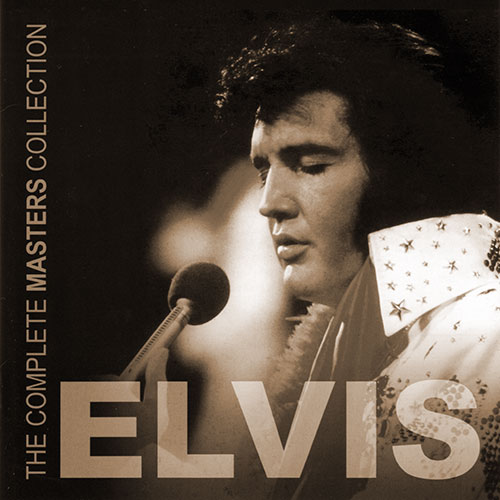
Now that The Complete Masters Collection is finally here, what am I going to do with it? To quote Elvis, “Just play it, man, play the @!#?@! out of it!”
No doubt, my next mission is to play all 711 tracks, some 31 hours of music. The real question is, in what order should I listen? It would seem that I have at least three options:
- Recording order (essentially synching with the Sony set)
- Release order (based on his original albums and singles)
- Thematic order (based on the Franklin Mint compilations)
Originally, I was leaning towards recording order. However, using my existing library, I have previously explored Elvis’ lifetime releases in both release order and recording order.
Instead, I have decided to “embrace the themes” for my first listen to this set. After all, I bought the Franklin Mint set, not the Sony set, so I want to try it out in the manner they presented before changing it around to suit my tastes. Besides, I think it will be fun to listen to these songs in such a non-standard way.
Originally, I did not plan to write a formal review of the set. First of all, it is nearly three years old. Most people have already made up their minds as to whether to buy this one. Second, properly reviewing a 36-CD set is a massive undertaking. The closest thing I have done to this before is reviewing 2006’s Superman: The Ultimate Collector’s Edition, a 14-DVD set. My eleven-part review took me nine months to complete. That’s right, it takes women the same amount of time to have babies as does for me to review a Superman DVD set.
Forget Superman, though. This is Elvis! Not only that, but the 2007 remastering effort rates among the top three or four most important Presley projects since his death in 1977. How could I not take a moment, or several, to review them on my little site devoted to Elvis?
So, a couple of years late, but just as enthusiastic as I would have been back then, I now begin my review of Elvis: The Complete Masters Collection.
Packaging
The Franklin Mint set arrives relatively well-secured in a large white shipping box. The black display case comes bubble-wrapped and also surrounded in the box by four padded envelopes, labeled 1 through 4.
The first envelope contains the SUN record reproduction, the booklet, a needless certificate of authenticity, an equally needless welcome letter, and the first three CDs. Though I think this service is no longer available, Franklin Mint originally provided a subscription option for the set, where you could buy three CDs a month. Of course, the overall cost was more expensive that way. Since the first shipment to subscribers also included the display case and record, the first three discs are more like samplers with extremely short running times.
The subscription option also explains the relatively short running times of most other discs in the set. While the Sony set presents 814 tracks spread over 30 discs, the Mint spreads its 711 tracks over 36 discs. More discs meant the subscription lasted longer. The subscription model probably contributed as well to the decision to arrange the songs in themes rather than simply placing them in recording order. Otherwise, 1950s fans might have canceled out right after the last 1958 song, while 1970s fans may have tired of waiting to get to their favorite decade.
The remaining envelopes contain the other 33 discs. Each disc is housed in a lightweight card stock sleeve – reminiscent of the ones used in the ELVIS: The Complete ’68 Comeback Special CD set, but not as wide.
Each sleeve is individually shrink-wrapped. Unfortunately, two or three of the sleeves arrived with creases in them. I am not truly a “collector” as such, and the damage did not affect the actual CDs, so I was not concerned enough about this to request replacements, which I am sure Franklin Mint would have provided. Plus, I will not be upset when I inevitably damage one of the sleeves myself at some point since the set already has its first dents.
Though I know it has been criticized in some circles, I actually rather like the art design on Franklin Mint’s sleeve covers and disc labels. Incidentally, the back cover of each Franklin Mint CD sleeve includes RCA, Legacy, and Franklin Mint logos. Each disc contains the RCA and Legacy logos and is noted as a product of RCA/JIVE Label Group, a unit of Sony Music Entertainment.
Display case
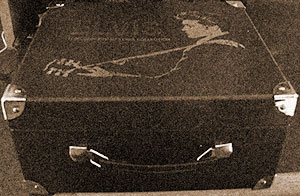
If only Franklin Mint had invested another few dollars into the display case, it might have been special. At a glance, it appears like a quality item. The “gold”-embossed depiction of a classic Elvis pose on top is perfect. Though it includes a carrying handle, the fatal flaw of the case is that it inexplicably has no latch to lock the top.
 Underneath the covers, things get worse. First, there is a faux record player illustration. Though I have no plans of leaving it there, the SUN 45 is apparently supposed to reside on it. Underneath this layer are the slotted compartments that house the CDs.
The CDs are difficult to place in the poorly-designed slots. The cheap slot trays also feel as if they could break away from the bottom of the display case at any moment. By the time I made it to disc 36, though, I finally had the hang of it.
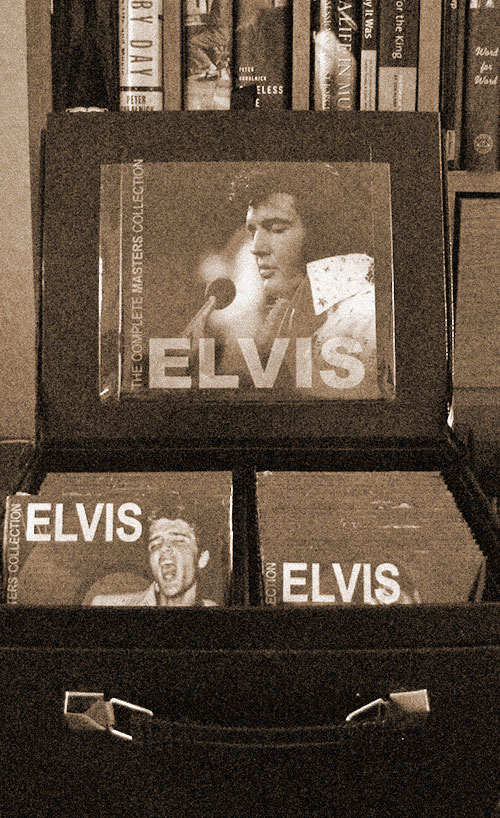 The display case could have been so much more with just an inexpensive tweak or two. Instead, it is barely functional. Fortunately, I do not plan to remove the original discs very often.
Booklet
The barebones booklet begins with a one-page, marketing-style introduction (uncredited). The remaining pages note the theme and track listings of each CD. Though this is probably the easiest way to find a specific song on the 36 discs, no one is buying this set in order to obtain this meager booklet. The booklet is noted as a product of Sony Music Entertainment.
45-RPM single
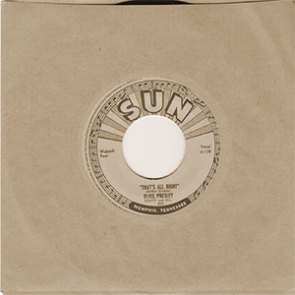 As I said before, my interest in this set is about the music. What better way to represent the music of Elvis Presley than to include a wonderful reproduction of the very record that started it all? This is the closest I can come right now to owning SUN 209: “That’s All Right”/”Blue Moon Of Kentucky” by “Elvis Presley, Scotty and Bill.” Given the shortcomings of the rest of this set’s accessories, this incredible record is a welcome surprise. In fact, I like it so much that I have ordered a frame for it. Maybe someday I can swap out this reproduction for the real thing.
A brief note on sources
Before I begin the actual CD reviews, I want to acknowledge the spectacular coverage of Vic Anesini’s remastering efforts on these 711 tracks over on the For Elvis CD Collectors forum. Members elvissessions, luckyjackson1, Matthew, Claus, and others are far more knowledgeable than I am on the particulars of the Elvis masters. While the opinions I present are my own, I have consulted their observations many times over to expand the context of my listening experience. Here are links to some of the relevant threads:
- Complete Masters compared/contrasted with Franklin Mint
- … and the worst about the SONY BOX is …
- … and the BEST about the SONY BOX is …
CD Vol. 1: Songs Of The Fifties
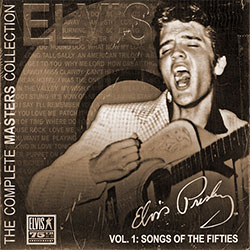 This volume gives a brief sampling of songs that Elvis recorded between 1954 and 1958. Appropriately, the image on the cover and CD is derived from his debut album, 1956’s Elvis Presley.
01. That’s All Right: And we’re off! This journey has a perfect beginning, too, with the A-Side of Elvis’ first record. There’s something special about “That’s All Right.” Though this was originally a blues number, you can hear the joy in his voice. (Recorded: 1954)
02. Heartbreak Hotel: Leaving the SUN years behind for now, the set now moves to the A-Side of Elvis’ first new record with RCA. I love Scotty Moore’s guitar solo on “Heartbreak Hotel,” segueing into Floyd Cramer on piano. (1956)
03. I Was The One: Flip “Heartbreak Hotel” over and you get one of my all-time favorites, “I Was The One.” You can definitely hear a new maturity in his voice here versus the raw SUN years. (1956)
04. Don’t Be Cruel: This is the A-Side of what was arguably his most popular single. In July 1956, with “Hound Dog” as the B-Side, Elvis fans must have had a hard time deciding which side of this record to play first. As for me, I’m definitely more of a “Don’t Be Cruel” kinda guy. Scotty Moore’s opening guitar lick sells this one right from the start. (1956)
05. When My Blue Moon Turns To Gold Again: Is it country? Is it rock ‘n’ roll? Does it matter? Though lesser known, “When My Blue Moon Turns To Gold Again” is one of those perfect “Elvis blend” songs, and his delivery oozes cool. (1956)
06. (There’ll Be) Peace In The Valley (For Me): While in the midst of a public controversy regarding rock ‘n’ roll, Elvis records a gospel EP – naturally. Though the song suffers from overexposure on too many compilations these days, “Peace In The Valley” features another stellar vocal performance from Elvis. (1957)
07. My Wish Came True: Six perfect songs in a row, and the title of this next tune reflects what I’m thinking. Unfortunately, though, the trend does not continue. Elvis receives much criticism for the overblown nature of some of his 1970s song arrangements, including the background vocalists. Overpowering background vocals on Elvis recordings did not begin in that decade, though, as evidenced by the positively obnoxious vocals of the Jordanaires and Millie Kirkham on “My Wish Came True.” I often wish for a “Jordanaires mute button,” but this is one of those times where I would like a “Millie Kirkham mute button,” too. A good song ruined. (1957)
08. Doncha’ Think It’s Time [Single Master]: It took me years to warm up to this song, but now I absolutely love it. This is Elvis at his coolest. Just listen to that laid-back, yet effective vocal. This is a case where a B-Side outshines the A-Side in terms of quality. (1958)
09. Wear My Ring Around Your Neck: What do you get when you take 45-seconds of mediocre song and repeat them three times? The boring “Wear My Ring Around Your Neck,” which was the A-Side of “Doncha’ Think It’s Time.” (1958)
10. I Got Stung: “I Got Stung” is a song that just tries too hard, bordering on parody at times. Notably, this is one of only five songs that Elvis formally recorded while in the Army. (1958)
While a very short CD, Songs Of The Fifties is comparable in length to albums of that time period (e.g., For LP Fans Only and 50,000,000 Elvis Fans Can’t Be Wrong). In the CD era, we have become accustomed to longer albums.
The disc does an effective job of presenting a high-level overview of his 1950s recordings, acting as a teaser for subsequent albums in the collection. It touches on the SUN era, his early RCA records, gospel, and his final professional recordings as he entered the Army. The only songs notably lacking are tunes from his first four movies. Sound quality is stellar throughout.
CD Vol. 2: Songs Of The Sixties
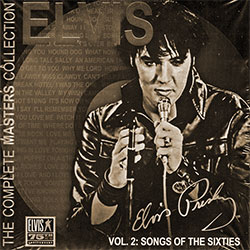 This volume samples 1960 through 1969. The famous cover shot is from the 1968 ELVIS television special, though none of its songs feature in this volume.
01. It’s Now Or Never: Based on the Italian song “O Sole Mio,” “It’s Now Or Never” became one of Elvis’ big hits after he returned from the Army. A good song, though I much prefer “Are You Lonesome Tonight” from the same era. (1960)
02. Blue Hawaii: The set’s first movie song, “Blue Hawaii” features Elvis in fine form. (1961)
03. Good Luck Charm: “Good Luck Charm” is one of those simple but fun songs that would have been right at home in his 1950s repertoire. (1961)
04. (You’re The) Devil In Disguise: Here is a terrific, 40-second song. Rather than fully developing beyond that, however, it just repeats over and over until it is long enough to be a single. I love the clap-filled instrumental break near the end of this hit, though. “Devil In Disguise” is not one of his greatest, but it is definitely a fun song. (1963)
05. What’d I Say: Wow, this song finally sounds as wonderful as I remember it from the vinyl days! My previous CD source, 1993’s Double Features: Viva Las Vegas/Roustabout, sounds abysmal and often makes me avoid this song. This huge sound improvement has me playing this one over and over now. Incredible. Ray Charles owns the definitive version of “What’d I Say,” of course, but there’s still much of interest here in this performance for Elvis fans. They could have toned down the kazoo a touch for my tastes, though. (1963)
06. I’m Yours [Single Master]: The single version of “I’m Yours” is actually new to me. Unlike the version from Pot Luck, the single lacks Elvis’ harmony vocals and recitation overdubs. Background instrumentation ruins both versions of “I’m Yours.” I hardly ever play the album version, and I doubt this single version will get much play, either. Still, it is an interesting variant to finally have in my collection. Maybe it is the sound quality and the relative “newness,” but after repeated plays, this one seemed to grow on me a little. Incidentally, to this point in the collection, all of the tracks within a particular themed CD have been presented in recording order. “I’m Yours” is the first that is out of sequence. I assume the compiler moved it here as a buffer so that the “dirty” “What’d I Say” would not have to transition right into the gospel “How Great Thou Art.” (1961)
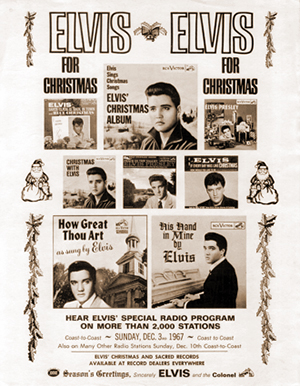
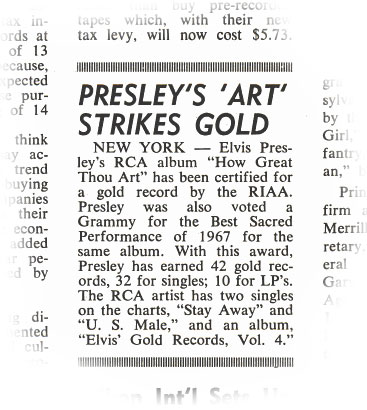
07. How Great Thou Art: Elvis creates a true masterpiece with “How Great Thou Art,” one of his most beautiful recordings. The How Great Thou Art album went on to earn Elvis his first Grammy. I consider this session the opening round of the comeback. (1966)
08. I’ll Remember You: I first knew “I’ll Remember You” from the live version on Aloha From Hawaii. In fact, I wrongly thought for years that it was one of the “new” songs for that show. When From Nashville To Memphis came out in 1993, the studio version was a revelation to me. In addition to Elvis’ smooth vocals, I love Buddy Harman’s tympani work on this. (1966)
09. In The Ghetto: Hot off the heels of the ELVIS special, Elvis returned to the studio and the top of the charts. Though I prefer the alternate takes with simpler backgrounds, “In The Ghetto” is a classic not to be missed. (1969)
10. Kentucky Rain: “Kentucky Rain” is country, Elvis style, and another of his best-ever recordings. Listen to that musical “thunder” – reminiscent of “How Great Thou Art,” actually. (1969)
Elvis recorded more songs in the 1960s than any other decade. It is difficult to cover such a broad range of material with only 10 songs. Given that limitation, Songs Of The Sixties is effective. While the first disc started with a bang and ended with a fizzle, this one starts with a fizzle and ends with a bang.
CD Vol. 3: Songs Of The Seventies
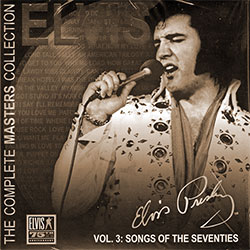 You folks are pretty smart, so I bet you have already guessed that Songs Of The Seventies provides a sampling of songs Elvis recorded in the 1970s.
01. You Don’t Have To Say You Love Me: What a poor choice of song to begin this CD. Unfortunately, it seems the compiler continues to feel compelled to go in recording order within the confines of each disc. Why not take advantage of the theme concept and be a little more creative? That being said, “You Don’t Have To Say You Love Me” is a fine performance. It just should not be the leadoff track. (1970)
02. Love Letters [Re-recording]: This is not one of my favorite songs, no matter the version. I usually give this re-recording of “Love Letters” a slight edge over Elvis’ 1966 original, though. (1970)
03. Patch It Up: This is the version of “Patch It Up” that should have been included on the original That’s The Way It Is album, rather than the comparatively weak live performance. Great song. (1970)
04. We Can Make The Morning: This stunning performance is all too often overlooked. “We Can Make The Morning” starts out as a quiet, unassuming song and builds into a powerful vocal showcase. (1971)
05. Where Do I Go From Here: “”Where Do I Go From Here” is a good, but ultimately unremarkable, performance. Using these lyrics, I think Story Without Meaning would make a good album title, though. (1972)
06. Burning Love: How can the compiler include “Burning Love” on this CD and not use it as the leadoff track? Anyway, this is the song that proved to doubters that Elvis could still rock in the 1970s. “Burning Love” is one of those all-time classics that I just have to crank up each time it comes on. The mix on this is awesome, too! (1972)
07. It’s A Matter Of Time: Turn “Burning Love” over and you get its flipside, “It’s A Matter Of Time.” This is an okay song that works well as a B-Side. It offers pleasant enough support without overshadowing the A-Side. Oddly, this 10-song compilation includes a full half of the cuts released during Elvis’ lifetime from this 1972 studio session. Why not space them out a bit? (1972)
08. Raised On Rock: I searched for this song for years when I was growing up. I assumed it would be a rocker in the same vein as “Burning Love.” When I finally found a used 45 of it, I realized, boy, was I wrong. Ironically, “Raised On Rock” sounds more like country than rock ‘n’ roll. It is an all right song, but not one that I play too often. As Elvis once said, “That don’t move me.” (1973)
09. Promised Land: Unfortunately, this track begins with a flaw. The first split-second of “Promised Land” is missing. On FECC, this has been referred to as the “missing initial cowbell strike” (2), though I believe the beginning of the guitar lick is also chopped. I wondered if an absent cowbell strike would really make a difference for someone like me, who is not an audiophile. Now that I can play the track on my own system, yes, it is very obvious that the song starts in progress, and it does ruin the beginning of “Promised Land.” Sony corrected the issue in time for the subsequent pressing of the 4-CD set Elvis 75: Good Rockin’ Tonight. However, unbelievably, Sony issued its premium The Complete Elvis Presley Masters over ten months later with this error again present on “Promised Land” (3). Apparently, the “glass master” used to create the CD had already been finalized for that release well in advance (4). For one of Elvis Presley’s best performances, of any decade, I find this completely unacceptable – particularly on a premium release like the Sony set. In reality, they should have fixed this one on both sets. For what it is worth, the rest of the track sounds terrific. You will want to source it from Good Rockin’ Tonight, though. Can you imagine if the first split-second of “Don’t Be Cruel” had been chopped off? I guarantee, glass master or not, this would have been fixed. For me, “Promised Land” should be treated the same way. In fact, I personally like “Promised Land” more than “Don’t Be Cruel.” A sacrilege, I know. (1973)
10. Bringin’ It Back: “Bringin’ It Back” is one of Elvis’ most modern-sounding recordings. This beautiful song is my absolute favorite of the Hollywood sessions that produced Elvis Today. (1975)
And with that, the disc ends . . . because, as we all know, Elvis did not record anything after 1975. Oh wait! That’s right, the 1976 Graceland sessions and the 1977 live recordings have been snubbed on Songs Of The Seventies.
Out of the three sampler discs, this one seems the most haphazard – as if the compiler really did not “get” Elvis in the 1970s. Overall, it is a disappointing disc – made worse by the error on “Promised Land.”
Speaking of “Promised Land,” why would someone include both “Promised Land” and “Burning Love” on the same disc of a 36-CD collection? Elvis recorded so few rockers in the studio in the 1970s, yet two of them are used up right off the bat here on a 10-song CD. “Promised Land” (complete with the first cowbell strike) should have been saved for a later disc, while a much more representative 10-song sampler for the 1970s should have been compiled.
Though not as cohesive as the first two volumes, Songs Of The Seventies manages to work only because of the strong Elvis performances.
* * *
What is really important here, though, is not the thematic song selections or the sequencing, but the sound, the sound, the sound. Sometimes, I wish I were an audiophile, because I might be able to more effectively communicate to you how incredible it is to hear all of these songs – recorded over a span of some 21 years – in such a uniform and pristine sound quality.
However, I am not going to lie to you. While I could tell at least a slight difference on most songs, on some songs, I could not hear any difference compared to my existing CD versions from 2006 or earlier. To an extent, the point of these masters is to duplicate the sound of the original releases from Elvis’ lifetime. With that in mind, it is probably to be expected that there is not a huge difference on every single track. In addition, I am sure my amateur ears are missing many subtleties.
For me, the most striking upgrade so far is “What’d I Say.” I just keep playing that one. It is like rediscovering an old friend.
“Rediscovering old friends,” maybe that best sums up being on this new journey through Elvis’ complete masters. Look for future installments here on The Mystery Train.
Sources
(1) “Re: ISRCs ‘Franklin Mint Set’ (Selected Discs Only)” by Ernst Jørgensen, For Elvis CD Collectors Forum, 2009.
(2) “Re: Complete Masters compared/contrasted with Franklin Mint” by elvissessions, For Elvis CD Collectors Forum, 2010.
(3) “Re: … and the BEST about the SONY BOX is … CONTINUED…” by luckyjackson1, For Elvis CD Collectors Forum, 2010.
(4) “Re: Out of a possible 10 – Rate the Complete Elvis Masters Box?” by Matthew, For Elvis CD Collectors Forum, 2011.

 The Mystery Train