A Squirrel Loose at the Big, Freaky International Hotel (Part 2)

This is Part 2 of a look at Sony’s Elvis Live 1969 boxed set (2019), which contains all 11 concerts RCA recorded in Elvis Presley’s August 1969 engagement at the International Hotel in Las Vegas.

[Read Part 1.]

“It’s getting loose at the International, boy!”
–Elvis Presley, 1969

The 11-disc Elvis Live 1969 is unfortunately housed in an 8-inch format box, such as used for 2012’s 3-disc Prince From Another Planet, rather than the 12-inch style, such as used for 2014’s 10-disc That’s The Way It Is: Deluxe Edition or 2018’s 6-disc ELVIS: ’68 Comeback Special – 50th Anniversary Edition. The 12-inch style harkens back to the days of LP record albums, while the 8-inch style is out of place on both CD and record shelves. Use of the 8-inch box was evidently a cost-saving move, but the set would have benefited so much from the larger format. Even at 8-inches, the set at a glance appears beautiful, but looks can be deceiving.

Elvis Live 1969 includes a 50-page booklet documenting the 1969 Vegas engagement. The opening Foreword, as with some of the marketing material associated with this set, quotes Elvis from his 1972 press conference for his Madison Square Garden appearances three years later about why he returned to performing live. As he tells the same story no less than 11 times on this very set, I would have preferred the use of 1969 quotes.

Reading like one of the over-the-top press releases that Sony lately uses to promote Elvis CDs, the unsigned Foreword also notes:

“After Elvis’ disastrous two-week 1956 Vegas engagement at the New Frontier Hotel, thirteen years later, his victorious live return in the same city made the meteoric success of his sold-out run (July 31-August 28, 1969/29 shows in total) that much sweeter.”

I call this out not to sicken you with the syrupy language, but to highlight an error. Elvis performed 57 shows during the date ranges of this engagement, not 29. The singer performed two shows a night throughout the month-long engagement (July 31 consisted only of the Opening Show). Even the very boxed set that the Foreword introduces features 11 shows recorded in the course of 6 days (beginning with the August 21 Midnight Show and concluding with the August 26 Midnight Show).

A bigger guffaw occurs in the tracklisting at the end of the booklet. Both CD 5 and CD 9 are listed as the “August 25, 1969, Midnight Show.” CD 5 actually contains the August 23 Midnight Show. Thankfully, the disc contents and label are correct.

Regarding such mistakes, you might ask, “Who cares?” Apparently not those responsible for Elvis releases. Allowing myself to veer off track just for a moment, Sony’s Follow That Dream (FTD) collectors label for Elvis fans routinely releases such errors. Two of the most embarrassing examples when it comes to text are misspelling “Presley” on the spine of 2008’s Wild In The Country and misspelling “Burning Love” on the back cover of this year’s St. Louis/Spokane. On the same St. Louis/Spokane release, the back cover numbers tracks 15-20 as: 15, 16, 16, 16, 21, 20. Though collectors pay premium prices for these releases compared to mainstream CDs, FTD is a small, boutique label with minimal resources and a limited target market. Sure, most 5-year-olds could have caught the counting errors, but let’s not talk about that.

Getting back to Elvis Live 1969, I note the two sloppy examples in the booklet (and there are others, but that is not the focus of this review) as unfortunate indicators that the carelessness condoned at the small FTD label has bled over into a full-fledged release like this one on the main Sony Legacy label.
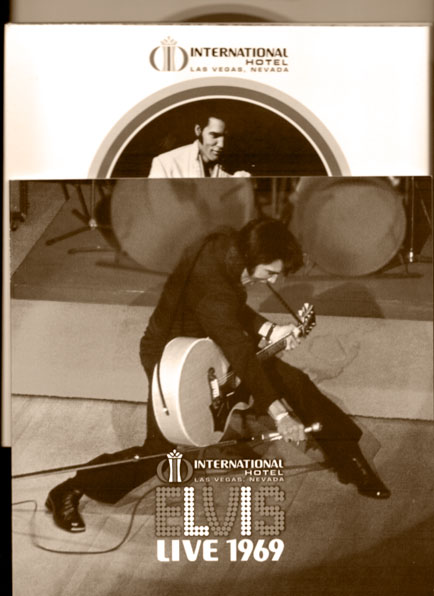
Sony Legacy’s ELVIS LIVE 1969 boxed set – booklet in foreground of CD holders (2019, from TY’s collection)

The rest of the booklet consists primarily of excerpts from Ken Sharp‘s excellent Elvis: Vegas ’69 book from 2009. Those who were there, including Elvis himself, tell the story of the concert engagement through first-hand accounts. If you are a fan of the era, as I am, the full book is definitely worth seeking. However, the booklet as presented in Elvis Live 1969 provides a nice, abridged version to go with the CDs.

The 11 CDs are packaged in two cardboard holders. “Packaged” is a polite term. They are mercilessly wedged into two cardboard holders. Use caution extracting a CD to prevent damaging the disc, the holder, or both. Why Sony continues to use ridiculous forms of packaging, which so often fail to serve the singular purpose of protecting the discs, is beyond me. While I backed mine up to iTunes, if you plan routinely to play the original discs I would suggest you place them in more accessible cases as to avoid almost certain damage over time.

Use of imagery from vintage International Hotel menus and advertising in the holder for CDs 1-5 is fun, and I wish that concept had been extended to both holders. Some of the interior Elvis photo choices for the holders are baffling, including two, count them, two photos of Elvis apparently raising his armpit to the audience in the holder for CDs 6-11. These are, of course, shots capturing a split moment in time while Elvis is in motion, but why spotlight such awkward photos when better ones are available elsewhere in this very same set?

I must remind you that I did not set out to write a review when I began this post a week ago. I, therefore, have gone about this in a different manner than if I planned it out in a logical fashion. So, I have covered thus far mixing and packaging, but what I have mostly left out to this point is the star of the show, Elvis Presley.

When it comes to the Elvis aspects of Elvis Live 1969, I must admit to a small degree of disappointment. I have enthusiastically reviewed a number of previous releases of individual concerts from this engagement in the past, so I was surprised at this reaction.

Compared to That’s The Way It Is: Deluxe Edition, which similarly compiles 6 of his shows from his 3rd engagement at the same Vegas hotel the following summer, Elvis Live 1969 feels like a slight let-down.

While Summer 1969 wins out in head-to-head comparisons of the same songs in just about every case (“Words” and “I Can’t Stop Loving You” being the only two exceptions that come immediately to mind), the overall Summer 1970 shows are superior, if that makes any sense, at least during the filming of That’s The Way It Is, with better/more varied setlists and a more polished performer. In both seasons, Elvis is at the very top of his game, to be clear, but Summer 1970 is more entertaining than Summer 1969. How blessed we are, as fans, to have his two best concert series so well documented.

Next week, we’ll dive into more of the Elvis details as we continue and possibly conclude our look at Elvis Live 1969.

Blessings,
TY

[Read Part 3]


“He holds in his hands the depths of the earth and the mightiest mountains. The sea belongs to him, for he made it. His hands formed the dry land, too.”
Psalm 95:4-5
A Squirrel Loose at the Big, Freaky International Hotel (Part 1)

“Welcome to the big, freaky International Hotel, with these little, weirdo dolls on the walls and these little funky angels on the ceiling. You ain’t seen nothing until you’ve seen a funky angel, boy. I tell you for sure.”
–Elvis Presley, 1969, on the ornate design of the hotel’s concert showroom

Sony Legacy last year released Elvis Live 1969, a boxed set containing all 11 concerts RCA recorded during Elvis Presley’s August 1969 engagement at the International Hotel in Las Vegas, Nevada.

The concert series, which spanned 57 shows from July 31 to August 28, represented the singer’s first appearance on a public stage in nearly 9 years – though he had performed 4 shows in front of small audiences at NBC’s studio in Burbank, California, as part of taping his ELVIS television special the previous summer.

RCA cherry-picked 12 of the strongest performances from 3 of the 1969 shows to form the Elvis In Person portion of the From Memphis To Vegas/From Vegas To Memphis double album, released in November 1969. A year later, RCA re-released Elvis In Person as a stand-alone album with the same content.

As for the rest of the performances, they amazingly remained in the vault until after Elvis’ death. While RCA released several individual songs over the years, including a compilation disc on 1991’s Collectors Gold boxed set, a complete 1969 show did not officially surface until 2001’s Live In Las Vegas boxed set.

By the time of Elvis Live 1969 last year, however, 7 of the 11 shows had already been released in their entireties on CD, with a good portion of songs from 3 of the 4 remaining shows having been released as well – many of them on Sony’s Follow That Dream (FTD) collectors label for Elvis fans.

Elvis Live 1969 stands out among the previous releases because it gathers all of the recordings in one place for the first time, with homogeneous sound quality. The recordings capture the August 21-26 portion of the engagement.

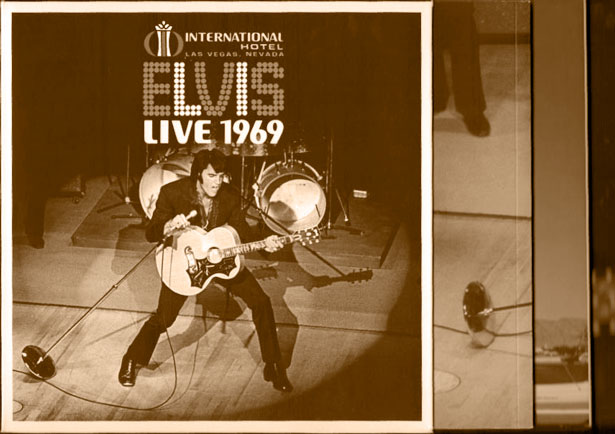
Sony Legacy’s ELVIS LIVE 1969 boxed set (2019, from TY’s collection)

Mixed by Matt Ross-Spang in what was apparently a marathon session, Elvis Live 1969 features a “slapback” echo effect mimicking the sound of Elvis’ first recordings in 1954 & 1955 at Sun Studio in Memphis. Ross-Spang had applied the same effect to alternate takes on 2016’s Way Down in the Jungle Room, an overview of Elvis’ last formal recordings in 1976 at Graceland.

As it was not representative of the original intent in 1976 or 1969, some fans have been quite critical of Ross-Spang’s slapback effect. As for me, I don’t mind it at all. It breathed some life into the 1976 studio recordings and brought Elvis’ music full-circle, in a sense, with an homage to the Sun sound. Though less effective on the 1969 live recordings, it’s not too distracting. On a few songs, such as “Mystery Train,” which of course originated in the Sun era anyway, the effect can actually be phenomenal.

Where I differ from Ross-Spang on Elvis Live 1969 is on some of his mixing choices, especially as far as which instruments are prominent. For instance, horns overwhelm a portion of James Burton’s lead guitar solo in the middle of the “Blue Suede Shoes” opener on all 11 shows. The horns weren’t even audible at all during Burton’s solo on the original Elvis In Person album and most of the subsequent revisits of this material.

The horns distracting from the lead guitar vaguely reminds me of Elvis’ February 11, 1956, appearance on Stage Show (CBS), the Jackie Gleason-produced television series hosted by Tommy and Jimmy Dorsey. In his third of six appearances on the program, Elvis debuts “Heartbreak Hotel” for the national TV audience. At the point where Scotty Moore would normally rip into his now classic electric guitar solo, a trumpeter improvises a jazz-inspired solo instead. While I enjoy jazz, it did not work in the context of this rock ‘n’ roll song. Fortunately, Moore is able to let loose in performances of “Heartbreak Hotel” on two subsequent shows. The 1969 “Blue Suede Shoes” is thankfully not affected to nearly this extent, though, for Burton is at least playing his solo!

Another example is that Larry Muhoberac’s piano is mixed far too loudly on certain shows, especially the August 26 Midnight Show, the last 1969 concert captured. Was Ross-Spang running out of time or is this truly how he felt the show should sound? “Mystery Train/Tiger Man,” which should be a showcase for the guitar and drums, suffers greatly from the distracting and overbearing piano in this particular show.

The August 25 Dinner Show and August 26 Dinner Show versions of “Mystery Train/Tiger Man” are similarly impacted by too much piano in the mix. Five of the remaining shows that include this medley fortunately keep the piano at low or moderate volumes, while the August 25 Midnight Show version, which was the performance used as the master on Elvis In Person, actually strikes a great balance – having the piano quite present but at an appropriate level.

Of course, it is all a matter of taste. For an Elvis live show, I want the lead guitar (Burton), Elvis guitar (when applicable), drums (Ronnie Tutt), and bass (Jerry Scheff) prominent in the mix among the instruments, generally in that order of priority, but certainly varying to some extent per song.

The rock ‘n’ roll numbers, at least, should heavily feature guitar, drums, and bass. That is the core of rock ‘n’ roll, Elvis style. The piano, other guitars, and orchestra should be present as needed, but not so much as to overwhelm that core. The piano is far less annoying on a slow song like “Love Me Tender,” for instance, where it better suits being prominent in the mix.

To be clear, the mixing on the majority of these shows is great. For example, “Mystery Train/Tiger Man” is mixed to perfection on the August 22 Midnight Show and is of course buoyed by a committed and powerful vocal performance by Elvis, as with many of the songs in this boxed set. This version of “Mystery Train” I can’t help but crank up every single time it comes on, much as I do with the 1955 Sun studio master.

Ross-Spang also tends to favor the Sweet Inspirations over the Imperials, as far as the background vocalists – an approach I heartily support. Millie Kirkham notwithstanding, Elvis sounds better with female voices behind him instead of males, and I love the Gospel-infused quality of the Sweet Inspirations. I should note that I intend no disrespect to any of the musicians and singers involved, all of whom are very talented. I am just talking about how I best feel the music when it comes to Elvis.

Before I get too far off track here, I think that covers it for the technical aspects of the set. I actually wasn’t even intending for this to become a review per se, but I just go where the writing leads me.

Next week, we’ll continue our look at Elvis Live 1969 and, possibly, get to the actual reason I started this post.

Blessings,
TY

[Read Part 2]


“Speak up for those who cannot speak for themselves; ensure justice for those being crushed. Yes, speak up for the poor and helpless, and see that they get justice.”
Proverb 31:8-9

Vinyl Elvis: ELVIS SINGS HITS FROM HIS MOVIES, VOLUME 1 (1972) [Pastimescapes blog]

ELVIS SINGS HITS FROM HIS MOVIES, VOLUME 1 (Pickwick, 1975/1980) [Photo by the author]

ELVIS SINGS HITS FROM HIS MOVIES, VOLUME 1 (Pickwick, 1975/1980) [Photo by the author]

Elvis Sings Hits From His Movies, Volume 1
Label: RCA Camden [Reissue: Pickwick]
Catalog Number: CAS-2567
Recorded: 1962-1967 | Hollywood, CA; Nashville, TN
Released: 1972 [Reissue: 1975/1980]

A glance by an unknowing fan at the front cover of Elvis Presley’s Elvis Sings Hits From His Movies, Volume 1 (above), might lead her or him to believe that the album contains Elvis singing live versions of various movie songs in the early 1970s. While that might have actually made for an intriguing concept, the reality is this album, first available on RCA’s Camden budget label in 1972, simply re-releases a number of songs as recorded for or during the time of his mid-1960s movies. As with the original soundtracks of that era, the result is a mixed bag – ranging from stellar to awful.

Side 1 of ELVIS SINGS HITS FROM HIS MOVIES, VOLUME 1 (Pickwick, 1975/1980) [Photo by the author]

Side 1 of ELVIS SINGS HITS FROM HIS MOVIES, VOLUME 1 (Pickwick, 1975/1980) [Photo by the author]

Side 1

  1. Down By The Riverside and When The Saints Go Marching In (1965)
    A pleasant-enough medley, from Frankie And Johnny, opens Side 1. The Dixieland-infused “Down By The Riverside/When The Saints Go Marching In” is fun, but suffers from a chintzy arrangement typical of too many Elvis movie tunes.
  2. They Remind Me Too Much Of You (1962)
    From It Happened At The World’s Fair, “They Remind Me Too Much Of You” offers a quiet mood and a simple, effective arrangement. A highlight.
  3. Confidence (1967)
    When I first heard “Confidence,” as a teen, I declared it as Elvis’ worst song ever. I can’t say my opinion of this song from Clambake has really evolved since then. If you have never heard this one, you are lucky.
  4. Frankie And Johnny (1965)
    Another overblown arrangement detracts from an otherwise nice rendition by Elvis of the title tune of Frankie And Johnny.
  5. Guitar Man (1967)
    What’s this? A top-notch song to close out Side 1? Unbelievable. Though noted as from the movie Clambake on the label (it neither appeared in the film nor was recorded for it), “Guitar Man” is actually a bonus song, as correctly specified on the back cover. The confusion comes in because it was also a bonus song on the Clambake album. Jerry Reed, writer and original recorder of the song, features on lead guitar. Elvis would return to “Guitar Man” a year later for his 1968 television special, ELVIS.

Side 2

Side 2 of ELVIS SINGS HITS FROM HIS MOVIES, VOLUME 1 (Pickwick, 1975/1980) [Photo by the author]

Side 2 of ELVIS SINGS HITS FROM HIS MOVIES, VOLUME 1 (Pickwick, 1975/1980) [Photo by the author]

  1. Long Legged Girl (With The Short Dress On) (1966)
    From Double Trouble, “Long Legged Girl” ably represents another staple of the Elvis movie tune catalog, the overblown, pseudo rock & roll song. Enjoyable, but forgettable.
  2. You Don’t Know Me (1967)
    And then, out of nowhere, another of Elvis’ best recordings ever – “You Don’t Know Me.” The lyrics of this beautiful song, a different and inferior recording and arrangement of which appeared in the movie Clambake, speak to the sorrow of opportunity lost. I first noticed this song by Ray Charles, in the 1993 movie Groundhog Day – although I must have heard the Elvis version before via this record and missed its significance, probably because an album like this one is so easy to overlook. After loving the Charles version in the movie, I was thrilled when I came across the Elvis version on From Nashville To Memphis just a few months later. It is my completely unbiased opinion as a lifelong Elvis fan that the Elvis version is superior, of course.
  3. How Would You Like To Be (1962)
    What is the price for listening to “You Don’t Know Me”? That’s right, the wretched “How Would You Like To Be.” Almost as bad as “Confidence,” this one is from It Happened At The World’s Fair, and it is the stuff of which nightmares are made.
  4. Big Boss Man (1967)
    Though not quite up to par with “Guitar Man” or “You Don’t Know Me,” “Big Boss Man” sounds like a comparative masterpiece after “How Would You Like To Be.” Reed again features on guitar. Elvis later re-recorded this one for the ELVIS special as well.
  5. Old MacDonald (1966)
    I know, I know, many fans consider this one of Elvis’ worst songs and a nadir in his recording career. I’ve always found it fun, and that opinion has not evolved over the years, either. It remains a guilty pleasure.

Though in fine condition, with no crackles, pops, or skips, the overall sound of Elvis Sings Hits From His Movies, Volume 1 is disappointingly dull. It is simply not as vibrant as most other vintage records I have played in recent years.

Inner sleeve from ELVIS SINGS HITS FROM HIS MOVIES, VOLUME 1 (Pickwick, 1980) [Photo by the author]

Inner sleeve from ELVIS SINGS HITS FROM HIS MOVIES, VOLUME 1 (Pickwick, 1980) [Photo by the author]

There is some truth in advertising in the album’s back cover (below), which at least features covers of the original 1960s albums from which these recordings were drawn – despite another potentially misleading 1970s live shot.

Back cover of ELVIS SINGS HITS FROM HIS MOVIES, VOLUME 1 (Pickwick, 1975/1980) [Photo by the author]

Back cover of ELVIS SINGS HITS FROM HIS MOVIES, VOLUME 1 (Pickwick, 1975/1980) [Photo by the author]

Misleading covers were typical for the Camden/Pickwick Elvis releases, though. This one appeared on store shelves around the same time as the all-new Elvis As Recorded At Madison Square Garden – in which, ironically, Elvis really did sing live versions of a few of his movie hits (“Can’t Help Falling In Love,” “Love Me Tender,” and “Teddy Bear”) as well as other songs from throughout his career to that point.

As for the muffled sound, if it is a result of the mastering, the material, the budget nature of the label, my setup, my ears, or some other technical factor is beyond my current knowledge. Ultimately, it makes little difference.

Though there is some enjoyment to be found here (it is Elvis, after all), Elvis Sings Hits From His Movies, Volume 1 is not a record I would return to very often even were it in excellent sound quality. The Camden/Pickwick records served their purpose, and I freely admit that Elvis fans, especially this one, are spoiled these days, but even I do not have enough nostalgia to propel this record into something it is not.


Thank you to my brother for giving me the Elvis records that inspired this series of posts.

Royal Philharmonic Orchestra Makes Me Wonder If I Really Need a New Elvis CHRISTMAS Album [Pastimescapes blog]

If there is one constant at Christmastime, it is that there will be a “new” Elvis Christmas album available for purchase. These are normally just reshuffled sequences of selections from the two dozen or so seasonal songs Elvis Presley first released in 1957, 1966, 1968, and 1971. Only occasionally has there been any creativity in these posthumous releases–such as 1982’s Memories of Christmas or 2008’s Elvis Presley Christmas Duets albums.

While Christmas Duets was mostly a “miss,” at least it was an attempt to try something new. Now, in 2017, RCA/Sony/Legacy attempts again to freshen up the classics with Christmas. The album features the Royal Philharmonic Orchestra (RPO) providing new backing music for Elvis’ vocals. How does this latest attempt fare?

As I enjoyed both of the previous Elvis/RPO offerings (2015’s If I Can Dream and 2016’s The Wonder of You), I mostly knew what to expect going in. One aspect I found surprising this time, though, is that I immediately loved this album. With the two former albums, I had to play them through a couple of times to really “get” them. You could say I learned to love the If I Can Dream and The Wonder of You Elvis/RPO albums, while it was love at first listen with Christmas.

The Deluxe Edition of Christmas includes the Elvis vocals from all 12 (8 Christmas and 4 gospel) songs on 1957’s Elvis’ Christmas Album. It also contains Elvis performances of five Christmas selections originally part of 1971’s Elvis Sings the Wonderful World of Christmas. I recommend the Deluxe Edition (red cover) because it contains four more tracks than the standard version (tan cover), yet is at a similar price point.

I must admit, I was skeptical of the track listing before actually playing the album. Surely, the RPO would not mix well with bluesy classics like “Santa Claus Is Back In Town” and “Merry Christmas Baby.” While the originals are stone-cold classics, these new interpretations also manage to work in their own right.

What really makes this album stand out, though, are the Elvis vocals. They are so crystal clear. It is frustrating that they do not sound this way more often on standard releases, without newly recorded backgrounds, but I can only assume there is some technological reason that prevents this.

Though strong albums, If I Can Dream and The Wonder of You both had a few tracks where the RPO concept just did not work very well. Not so here. Every track on Christmas works. This is the best of the Elvis/RPO trilogy.

While I consider this a near-perfect album, given the concept, there is, unfortunately, a missed opportunity. “I’ll Be Home On Christmas Day,” which ranks second only to “Santa Claus Is Back In Town” as the best Elvis Christmas song of all, is missing in action here. Unless they plan an EP for some future Christmas, there are really not enough Elvis Christmas songs remaining to warrant a second full-length album, so they are probably not holding it back for that reason. I am not sure what happened, but perhaps an orchestral arrangement for the song simply did not work.

Unlike Christmas Duets, which had a pedestrian approach to many tracks, the arrangements here, by Robin Smith and Sally Herbert, offer much interest. I love the fuller sound. Also unlike Christmas Duets, I suspect this album will become a permanent fixture in my Christmas music rotation in the years ahead – alongside the originals, of course.

Do I really need a new Elvis Christmas album? It turns out the answer is, yes. This year, more than ever.

Christmas is a beautiful album.

Overall Rating: 10 out of 10.

CHRISTMAS (2017) [Deluxe Edition]

CHRISTMAS (2017) [Deluxe Edition]

Tracks

Christmas
Elvis Presley with the Royal Philharmonic Orchestra

  1. Santa Claus Is Back In Town [Elvis portions recorded 1957, Hollywood]
  2. White Christmas [Elvis portions recorded 1957, Hollywood]
  3. Here Comes Santa Claus [Elvis portions recorded 1957, Hollywood]
  4. Merry Christmas Baby [Elvis portions recorded 1971, Nashville]
  5. Blue Christmas [Elvis portions recorded 1957, Hollywood]
  6. I’ll Be Home For Christmas [Elvis portions recorded 1957, Hollywood]
  7. Winter Wonderland [Elvis portions recorded 1971, Nashville]
  8. Santa Bring My Baby Back [Elvis portions recorded 1957, Hollywood]
  9. Silver Bells [Elvis portions recorded 1971, Nashville]
  10. O Little Town Of Bethlehem [Elvis portions recorded 1957, Hollywood]
  11. O Come All Ye Faithful [Elvis portions recorded 1971, Nashville]
  12. The First Noel [Elvis portions recorded 1971, Nashville]
  13. Silent Night [Elvis portions recorded 1957, Hollywood]
  14. Peace In The Valley (Deluxe Edition only) [Elvis portions recorded 1957, Hollywood]
  15. I Believe (Deluxe Edition only) [Elvis portions recorded 1957, Hollywood]
  16. Take My Hand, Precious Lord (Deluxe Edition only) [Elvis portions recorded 1957, Hollywood]
  17. It Is No Secret (Deluxe Edition only) [Elvis portions recorded 1957, Hollywood]

The Royal Philharmonic Orchestra recorded 2017 at Abbey Road Studio 2, London.

Vinyl Elvis: 1977’s MOODY BLUE Closes a Lonely Journey [Pastimescapes blog]

Today marks the 40th anniversary of the July 19, 1977, release of Moody Blue, an album that turned out to be the last Elvis Presley record before his death four weeks later.

MOODY BLUE (RCA, 1977) [Photo by the author]

MOODY BLUE (RCA, 1977) [Photo by the author]

Moody Blue
Label: RCA
Catalog Number: AFL1-2428
Recorded: 1974-1977 | Memphis, TN; Ann Arbor, Michigan; Kalamazoo, Michigan
Released: 1977
Ranked: #7 in Pastimescape’s 50 Greatest Elvis Albums of All Time

Before I had Elvis records of my own, I remember checking out a couple of his albums from the public library. I must have been about ten-years-old.

The two records I took home that day in 1985, which I believe represented the entirety of the library’s Elvis music collection, were The Sun Sessions and Moody Blue. The irony that I had borrowed both his very last record and a compilation of his very first records escaped me.

I enjoyed both albums, but the one that really drew me in was Moody Blue. For one thing, the record was pressed on blue vinyl. I had never seen anything like that. Plus, I just loved the sound of the album — particularly “Way Down,” which I played over and over. I even thought it was Elvis doing the low vocals, which were actually supplied by JD Sumner.

I played “Way Down” for my older brother later that day to show off knowing a “new” Elvis song, only for him to inform me that he had his very own copy of Moody Blue.

At that time, I was not allowed to touch my brother’s records. Today, his copy of Moody Blue is mine.

Side A of MOODY BLUE (RCA, 1977) [Photo by the author]

Side A of MOODY BLUE (RCA, 1977) [Photo by the author]

Side A

  1. Unchained Melody (1977)
    A compelling live version of “Unchained Melody” leads off the album. I normally prefer to open with a rocker, but this choice works perfectly for Moody Blue. Overdubs conceal that much of the fire had unfortunately gone out of Elvis’ live shows by this point.
  2. If You Love Me (Let Me Know) (1977)
    I distinctly remember recognizing this live song from the Elvis In Concert album and wondering why this one sounded better. Part of the reason was that it was actually recorded a couple of months earlier than the version on Elvis In Concert. Some debate whether this song, made popular by Olivia Newton-John, should have been in his setlist. No matter, this is his best version of a song that obviously spoke to him.
  3. Little Darlin’ (1977)
    Next up is another live recording, Elvis’ fun take on the 1950s classic, “Little Darlin'”, which also provides a much-needed change in tempo. I love his ad-lib of “To hold in mine…your little foot…uh, hand!”
  4. He’ll Have to Go (1976)
    The tempo slows back down for “He’ll Have To Go,” the last studio recording ever made by Elvis. In addition to the resonance of the Elvis vocals, I love the guitar work of James Burton here. Six of the songs on this album were recorded at Graceland in 1976 in an effort to make the artist feel more comfortable, as Elvis in later years had become reluctant to record in a formal studio setting. Two sessions at a makeshift studio in his den resulted in sixteen songs, ten of which had already been used on the From Elvis Presley Boulevard album by the time RCA was assembling Moody Blue.
  5. Let Me Be There (1974)
    In early 1977, Elvis backed out of a planned session in Nashville to finish the album. Instead, a few live performances were recorded that April. Only three suitable songs were captured, however, which brought the album’s total to nine. In desperation, RCA re-released “Let Me Be There” from 1974’s Recorded Live On Stage In Memphis album to round out Side A of Moody Blue. Another Olivia Newton-John hit, “Let Me Be There” fits well on Moody Blue, despite being slightly older than the other recordings. It is certainly the weakest aspect of the album, however.

Side B

Side B of MOODY BLUE (RCA, 1977) [Photo by the author]

Side B of MOODY BLUE (RCA, 1977) [Photo by the author]

  1. Way Down (1976)
    All of the songs on Side B of Moody Blue were recorded at Graceland. I probably have the master of “Way Down” on at least a half dozen CDs. None of them sound as incredible as listening to this record. Is it all in my head? Possibly, but if it is, do not tell me. “Way Down” really rocks, making it an appropriate A-side for what turned out to be Elvis’ last single before his death.
  2. Pledging My Love (1976)
    “Pledging My Love” is another terrific performance by Elvis. He might have lost much of the joy in his life by this point, but you can still hear it on this song.
  3. Moody Blue (1976)
    I find it cool that the album’s title song is buried in the middle of Side B. “Moody Blue,” another great song, almost sounds like disco. Compare the guitar licks on “Moody Blue” with Kool & the Gang’s “Celebration” (1980), for instance.
  4. She Thinks I Still Care (1976)
    Elvis recorded many country songs, particularly in the 1970s. “She Thinks I Still Care” is a stellar performance. At the end, he just will not let the song go, either.
  5. It’s Easy For You (1976)
    Elvis covered the gamut when it comes to break-up songs. This one is aimed at the other woman. “It’s Easy For You” was written by Broadway legends Andrew Lloyd Webber and Tim Rice, bringing to a close an album that was almost as varied as Elvis’ entire career: Adult Contemporary, Country, and Rock ‘n’ Roll. It is hard to ask for more in an Elvis album, and I still consider Moody Blue one of his best. A fun bit of trivia: Note the misspelling of Webber’s name on the Moody Blue Side B label in the image above. Proofreading has apparently never been a strong point for Elvis’ music label.

I mentioned that my brother did not let me touch his records when I was young. This turned out to be a good thing for me, as Moody Blue sounds flawless. Not a crackle or a pop to be heard on either side.

Back cover of MOODY BLUE (RCA, 1977) [Photo by the author]

Back cover of MOODY BLUE (RCA, 1977) [Photo by the author]

The interesting thing about Moody Blue is that such a fantastic album could result from not only a hodgepodge of recordings but also such a low point in Elvis’ life. “You don’t have to face the music, you don’t have to face the crowd,” he laments on “It’s Easy For You.” Depression, loneliness, and various personal demons were consuming his life by this point. Years of prescription drug addiction and abuse were beginning to take a public toll.

Part of the credit for the unlikely strength of Moody Blue must go to producer Felton Jarvis. While he occasionally went too far with overdubs on previous Elvis projects, Moody Blue is all the better for his extra work and attention to detail–particularly on the 1977 live recordings. Credit must also go to the musicians and vocalists who worked with Elvis on the album. On occasion, they carry Elvis. Finally, credit is due to Elvis as well, who managed to pull these performances from somewhere inside himself, despite not being in the right frame of mind to record.

Inner sleeve (front) from MOODY BLUE (RCA, 1977) [Photo by the author]

Inner sleeve (front) from MOODY BLUE (RCA, 1977) [Photo by the author]

I love the inner sleeves on vintage Elvis albums. Check out the ads for other albums, which must have acted as combination check lists and wish lists for fans of the time. In some cases, it was also a way to see some alternate cover designs. For example, note the Moody Blue concept artwork in the bottom left of the image below.

Inner sleeve (front) from MOODY BLUE (RCA, 1977) [Photo by the author]

Inner sleeve (back) from MOODY BLUE (RCA, 1977) [Photo by the author]

The fall of the curtain came much too early for Elvis, but Moody Blue certainly made for an impressive last act. If you collect Elvis on vinyl, this one is a must.

"The Blue Album" [Photo by the author]

“The Blue Album” [Photo by the author]


Thank you to my brother for giving me the Elvis records that inspired this series of posts.

Vinyl Elvis: 1954’s THAT’S ALL RIGHT/BLUE MOON OF KENTUCKY Launches the Quest [Pastimescapes blog]

Today marks the 63rd anniversary of the release of Elvis Presley’s first record on July 19, 1954.

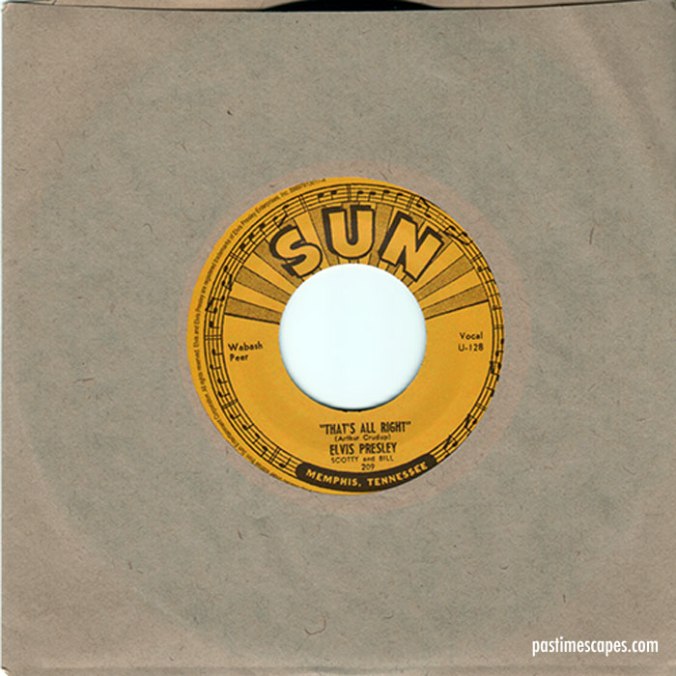
I have two near-mint copies of That’s All Right/Blue Moon of Kentucky.

By far, they would be the most valuable pieces of my entire record collection, or of all of my collections of anything, for that matter, except that they were both pressed in 2009, rather than 1954. Oh well.

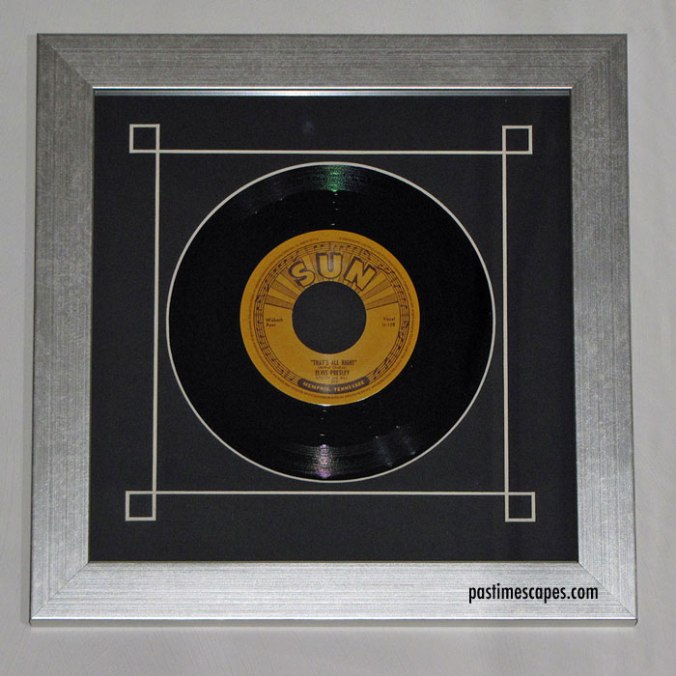
THAT'S ALL RIGHT/BLUE MOON OF KENTUCKY (Single), SUN 1954; Reissue: Sony RCA/Legacy 2009--included as bonus with the Franklin Mint's ELVIS: THE COMPLETE MASTERS COLLECTION CD set. (From the author's collection.)

THAT’S ALL RIGHT/BLUE MOON OF KENTUCKY (Single), SUN 1954; Reissue: Sony RCA/Legacy 2009–included as bonus with the Franklin Mint’s ELVIS: THE COMPLETE MASTERS COLLECTION CD set. (From the author’s collection.)

That’s All Right/Blue Moon of Kentucky (Single)
Label: SUN [Reissue: Sony RCA/Legacy]
Catalog Number: 209 [Reissue: 88697613017 (Label) / 88697673597 (2010 Outer Sleeve)]
Recorded: 1954 | Memphis, TN
Released: 1954 [Reissue: 2009]
Ranked: #31 in Pastimescape’s 100 Greatest Elvis Songs of All Time for “That’s All Right”

Packaged in a plain, brown sleeve much like the original, my first copy of the record was included with Franklin Mint’s Elvis: The Complete Masters Collection CD set from 2009. I framed the record back when I bought the set on clearance in 2012, and it remains on the wall here in my Fortress of Solitude.

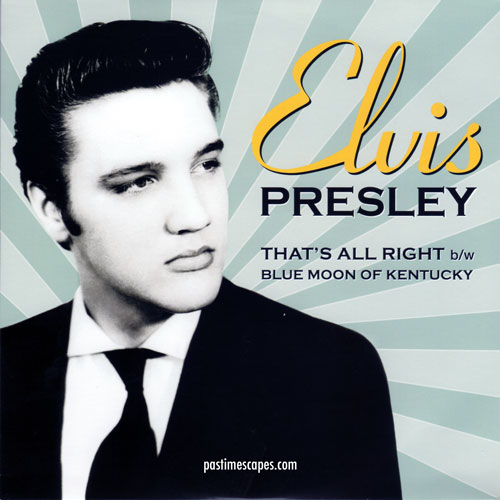
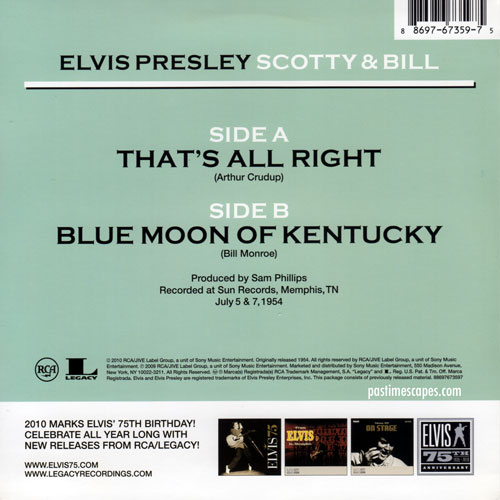
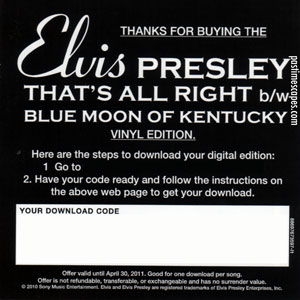
With today’s feature in mind, and not wanting to disturb my framed version, I recently acquired my second copy of That’s All Right/Blue Moon of Kentucky. Sony released it back in April 2010 for Record Store Day. It includes a gaudy cover, but I was surprised to discover that the record contained within is actually identical to the one that shipped with the Franklin Mint set. Sony must have been thinking ahead and pressed extra copies for the Record Store Day promotion.

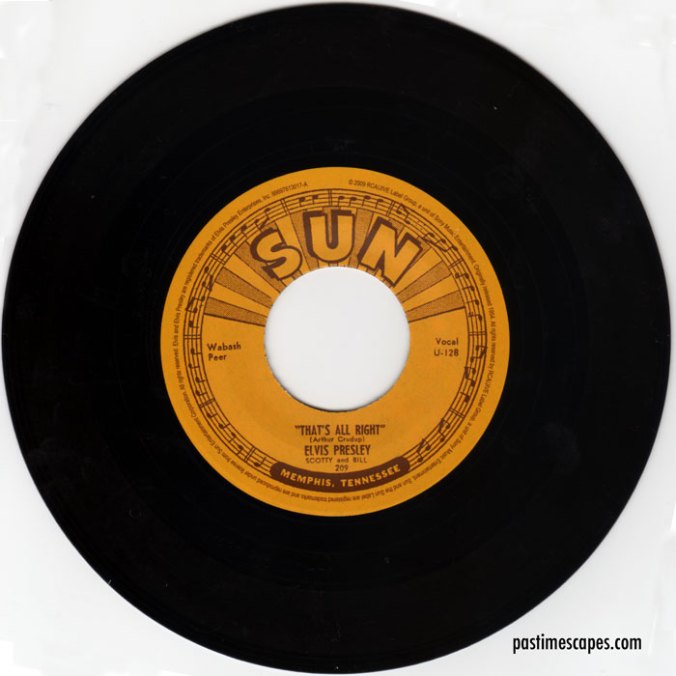
Side A

Side A of THAT'S ALL RIGHT/BLUE MOON OF KENTUCKY (Single), SUN 1954; Reissue: Sony RCA/Legacy 2009. (From the author's collection.)

Side A of THAT’S ALL RIGHT/BLUE MOON OF KENTUCKY (Single), SUN 1954; Reissue: Sony RCA/Legacy 2009. (From the author’s collection.)

“That’s All Right” (1954)
One of the endearing aspects of this performance of “That’s All Right” is the sheer joy in the voice of Elvis as he sings. He finally has his opportunity in the studio, and he is making the most of it.

Elvis in 1970 reflected on his style, stating that it was “a combination of country music and gospel and rhythm & blues […]. That’s what it really was. As a child, I was influenced by all that.”

He added, “Of course, the Grand Ole Opry is the first thing I ever heard, probably, but I liked the blues, and I liked the gospel music–gospel quartets–and all that.”

On this first single, the blues and country influences are as clear as they ever would be. Some credit That’s All Right/Blue Moon of Kentucky as the first rock ‘n’ roll record, but to say Elvis invented the style is to make a false assumption that any one person did.

Rock ‘n’ roll evolved from the very sources that Elvis himself described. Besides, “Rocket 88,” “Rock Around the Clock,” and other potential contenders pre-date Elvis’ version of “That’s All Right.”

What Elvis did with his early records for SUN and RCA, though, was ignite the smoldering evolution of rock ‘n’ roll into a full-blown blaze. By melding country into the blues of “That’s All Right,” Elvis in 1954 unleashed a sound that not only built upon the foundation established by Arthur “Big Boy” Crudup‘s original 1946 recording, but took the song in a new direction. Absorbing the music of his youth, Elvis knew instinctively that blues and country explore many of the same themes, which allowed him to re-interpret these kinds of songs in a unique way.

Unfortunately, despite what the beautiful record label would have you believe, this reissue actually contains an RCA mastering of “That’s All Right,” with added echo, rather than the original SUN mastering. I suspect it is the version from 2004’s Elvis At SUN, though I do not have that release to verify.

A few years after this reissue of SUN 209, the “dry” version of “That’s All Right” finally became available again via FTD’s A Boy From Tupelo in 2012. If you missed that collectors set back then, you will have another chance to obtain the material later this month when Sony RCA/Legacy re-releases it in a package for mainstream retail.

The dry version of “That’s All Right” is superior, though it takes some getting used to because the echo versions were used in every official release of the song from December 1955 through 2011. Unless, of course, you have been spinning a SUN original.

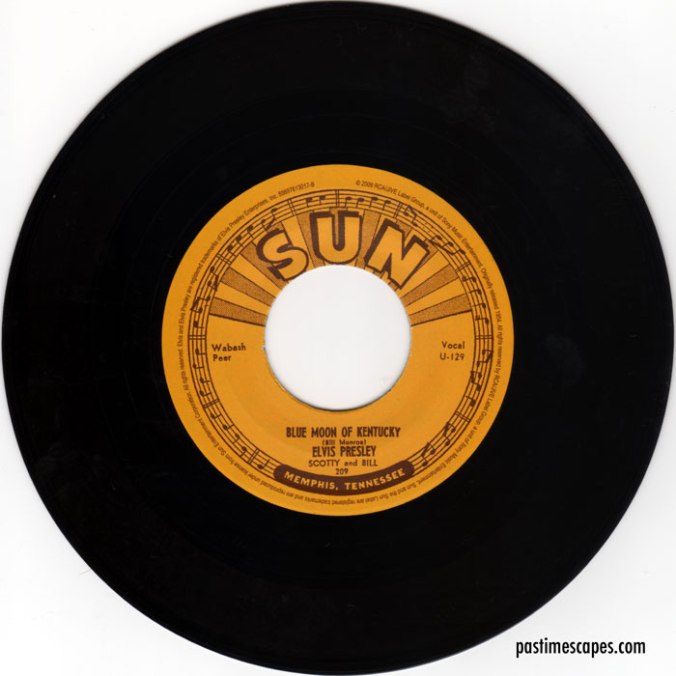
Side B

Side B of THAT'S ALL RIGHT/BLUE MOON OF KENTUCKY (Single), SUN 1954; Reissue: Sony RCA/Legacy 2009. (From the author's collection.)

Side B of THAT’S ALL RIGHT/BLUE MOON OF KENTUCKY (Single), SUN 1954; Reissue: Sony RCA/Legacy 2009. (From the author’s collection.)

Blue Moon of Kentucky (1954)
While Elvis added country to the blues of “That’s All Right,” he created a literal flip side by melding rhythm & blues into the country bluegrass of “Blue Moon of Kentucky.” Again, the sound is markedly different from Bill Monroe’s 1946 original. Again, there is that joy in his voice.

A fun tidbit is that this record contains only three musicians: Elvis on acoustic guitar, Scotty Moore on electric guitar, and Bill Black on the upright bass.

One of the earliest rock ‘n’ roll records, and no drummer to be heard. Credit goes to Black, whose bass makes it sound like there must be a drummer.

DJ Fontana did not join the group in the studio on drums until the early 1955 session that produced “I’m Left, You’re Right, She’s Gone,” the flip side of Elvis’ fourth record for SUN.

Front of THAT'S ALL RIGHT/BLUE MOON OF KENTUCKY (Single), SUN 1954; Reissue: Sony RCA/Legacy 2009--with 2010 cover for Record Store Day. (From the author's collection.)

Front of THAT’S ALL RIGHT/BLUE MOON OF KENTUCKY (Single), SUN 1954; Reissue: Sony RCA/Legacy 2009–with 2010 cover for Record Store Day. (From the author’s collection.)

Though I much prefer the simplicity of the brown sleeve, I am including full coverage here of the 2010 version, particularly since that is the single I actually played when writing this entry.

Back of THAT'S ALL RIGHT/BLUE MOON OF KENTUCKY (Single), SUN 1954; Reissue: Sony RCA/Legacy 2009--with 2010 cover for Record Store Day. (From the author's collection.)

Back of THAT’S ALL RIGHT/BLUE MOON OF KENTUCKY (Single), SUN 1954; Reissue: Sony RCA/Legacy 2009–with 2010 cover for Record Store Day. (From the author’s collection.)

Hype sticker from 2010 Record Store Day reissue of THAT'S ALL RIGHT/BLUE MOON OF KENTUCKY (Single), Sony RCA/Legacy 2009. (From the author's collection.)

Hype sticker from 2010 Record Store Day reissue of THAT’S ALL RIGHT/BLUE MOON OF KENTUCKY (Single), Sony RCA/Legacy 2009. (From the author’s collection.)

Hype sticker from 2010 Record Store Day reissue of THAT'S ALL RIGHT/BLUE MOON OF KENTUCKY (Single), Sony RCA/Legacy 2009. (From the author's collection.)

Hype sticker from 2010 Record Store Day reissue of THAT’S ALL RIGHT/BLUE MOON OF KENTUCKY (Single), Sony RCA/Legacy 2009. (From the author’s collection.)

Front of insert from 2010 Record Store Day reissue of THAT'S ALL RIGHT/BLUE MOON OF KENTUCKY (Single), Sony RCA/Legacy 2009. (From the author's collection.)

Front of insert from 2010 Record Store Day reissue of THAT’S ALL RIGHT/BLUE MOON OF KENTUCKY (Single), Sony RCA/Legacy 2009. (From the author’s collection.)

Back of insert from 2010 Record Store Day reissue of THAT'S ALL RIGHT/BLUE MOON OF KENTUCKY (Single), Sony RCA/Legacy 2009. (From the author's collection.)

Back of insert from 2010 Record Store Day reissue of THAT’S ALL RIGHT/BLUE MOON OF KENTUCKY (Single), Sony RCA/Legacy 2009. (From the author’s collection.)

“That’s All Right” and “Blue Moon of Kentucky” became regional hits for Elvis. He would follow-up the single with four more records on the SUN label before signing with RCA in late 1955.

THAT’S ALL RIGHT/BLUE MOON OF KENTUCKY (Single), SUN 1954; Reissue: Sony RCA/Legacy 2009–included as bonus with The Franklin Mint’s ELVIS: THE COMPLETE MASTERS COLLECTION CD set. (Photo by the author.)

Vinyl Elvis: 1982’s MEMORIES OF CHRISTMAS Inspires Nostalgia for Holidays Past [Pastimescapes blog]

MEMORIES OF CHRISTMAS (RCA, 1982) [Photo by the author]

MEMORIES OF CHRISTMAS (RCA, 1982) [Photo by the author]

Memories Of Christmas
Label: RCA
Catalog Number: CPL1-4395
Recorded: 1957-1971 | Nashville, Hollywood
Released: 1982
Ranked: #15 in Pastimescape’s 50 Greatest Elvis Albums of All Time

Other than listening to the radio, Christmas music at my family’s house as I was growing up consisted of this 1982 record album and Merry Christmas From Elvis (1987, cassette tape). Though my family also had a decades-old copy of Elvis’ Christmas Album, that record was not often played in my childhood due to being in poor condition.

Memories Of Christmas is a perfectly named album for me, because it indeed fills me with nostalgia for many special Christmases in the 1980s. My brother recently gave me the album, along with the rest of his Elvis records, and this marks the first time I have played Memories Of Christmas on vinyl in over 20 years.

Side A of MEMORIES OF CHRISTMAS (RCA, 1982) [Photo by the author]

Side A of MEMORIES OF CHRISTMAS (RCA, 1982) [Photo by the author]

Side A

  1. O Come, All Ye Faithful (1971)
    This previously unreleased version is a splice between the master (Take 1) and Take 2. It actually proves to be better than either take alone, making it my “go to” version of the song by Elvis. Fantastic performance and a perfect opener to the album. Sound quality on the record itself is excellent.
  2. Silver Bells (1971)
    Another stellar Christmas performance, first heard on Elvis Sings The Wonderful World Of Christmas (1971). I love the acoustic guitar here.
  3. I’ll Be Home on Christmas Day (1971)
    Here it is, the highlight of the album–the previously unreleased re-recording of “I’ll Be Home On Christmas Day.” Attempted in June 1971, this is a bluesier take on the Michael Jarrett song than the May 1971 version that became the official master on The Wonderful World Of Christmas. For my money, this is Elvis at his best.
  4. Blue Christmas (1957)
    It is apparently unlawful for RCA to release an Elvis Christmas compilation without this worn-out tune, featuring the grating background vocals of Millie Kirkham. I would have preferred the use of a live version from 1968. In fact, what would have been at the time the previously unreleased June 27 6 PM Show performance captured for the ELVIS special would have been perfect.
  5. Santa Claus Is Back in Town (1957)
    Side A finishes up in style with the greatest Elvis Christmas song of all, the down and dirty “Santa Claus Is Back In Town,” arguably the only real competition against “Reconsider Baby” (1960) as his finest blues performance.

Side B of MEMORIES OF CHRISTMAS (RCA, 1982) [Photo by the author]

Side B of MEMORIES OF CHRISTMAS (RCA, 1982) [Photo by the author]

Side B

  1. Merry Christmas Baby (1971)
    Speaking of bluesy Elvis Christmas songs, here is another fine entry. This is the previously unreleased extended version of “Merry Christmas Baby,” over two minutes longer than the album master (Wonderful World Of Christmas) and nearly five minutes longer than the single version. As a kid, I loved hearing Elvis ad-lib, “Gave me a diamond ring for Christmas; now I’m putting it through Al’s mike.” Unfortunately, there are a couple of pops/crackles on the record on this song, but nothing too distracting. Side A had no noise at all! Like the 1969 live versions of “Suspicious Minds,” “Merry Christmas Baby” just goes on forever. In both cases, a very, very good thing.
  2. If Every Day Was Like Christmas (1966)
    This is the previously unreleased “undubbed” version of the master. The piano is beautiful here, and I believe more prominent than on the CD version I have of this performance. There is a “raw” sound to this version, but it makes for a very beautiful and effective performance.
  3. Christmas Message from Elvis/Silent Night (1967/1957)
    The opening message was recorded for Season’s Greetings From Elvis, his 1967 Christmas special that aired on radio stations across the United States. My only gripe here is that the message originally flowed into “I’ll Be Home For Christmas” (1957). The compilation producers decided to splice “Silent Night” on instead. I am assuming it is because they wanted to “bookend” the album with traditional religious songs. You can actually hear “I’ll Be Home For Christmas” begin during Elvis’ message before the segue into “Silent Night.” Unfortunately, this has never been corrected on subsequent releases of the message. The label has even released “Silent Night” on at least one Christmas compilation since then that did not contain the message, yet had the beginning of the song chopped off due to apparently using this version. Sloppy. I knew and recognized none of this when I first heard this album back in the 1980s. I loved hearing the message from Elvis, and I must admit, I still find it pretty cool today. Overall, this record sounds incredible, with the only extraneous noise being those two pops on “Merry Christmas Baby.”

Back cover of MEMORIES OF CHRISTMAS (RCA, 1982) [Photo by the author]

Back cover of MEMORIES OF CHRISTMAS (RCA, 1982) [Photo by the author]

Elvis recorded less than 25 Christmas songs during his entire career. Every year, though, it seems there is a “new” Elvis Christmas compilation that rearranges those songs with a new, cheap cover. Memories Of Christmas offers not only beautifully conceived cover art, but unique album content that is truly worthy of standing alongside the two Christmas albums that Elvis released in his lifetime, Elvis’ Christmas Album (1957) and Elvis Sings The Wonderful World Of Christmas.

Calendar insert from MEMORIES OF CHRISTMAS (RCA, 1982) [Photo by the author]

Calendar insert from MEMORIES OF CHRISTMAS (RCA, 1982) [Photo by the author]

Christmas has been called “the most wonderful time of the year.” While I would agree, it is also the busiest time of the year. This is probably the last post I’ll be able to squeeze in until after the big day.

With that in mind, I’d like to wish you and your family a Christmas full of joy and peace.


Thank you to my brother for giving me the Elvis records that inspired this series of posts.