Elvis Movies: SPINOUT

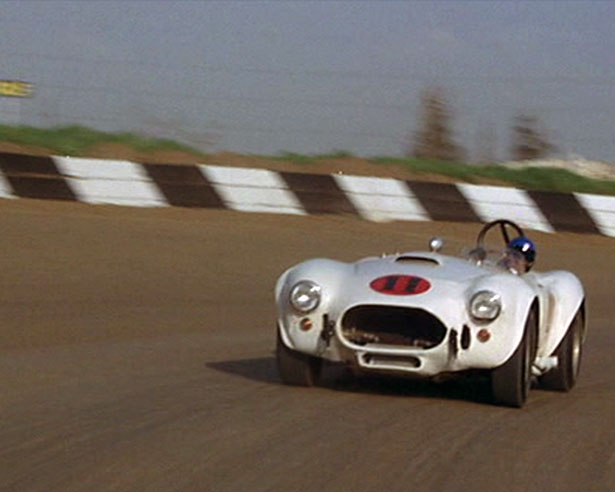
Mike McCoy tests his #11 427 Cobra in 1966's SPINOUT (MGM)

Mike McCoy tests his #11 427 Cobra in 1966’s SPINOUT (MGM)

Today, we will look at Elvis Presley’s 22nd movie, Spinout. Before we do that, however, I want to take a sidetrack to mention Baz Luhrmann’s ELVIS film. I usually dislike movies that attempt to portray Elvis, so I was fully intending to skip this one. That is, until I saw the preview trailer that Warner Brothers released last week.

Credit: Warner Bros. Pictures channel (YouTube)

The ELVIS trailer shocked me. Austin Butler seems to have captured the essence of Elvis. He has the body language and moves down without looking like an impersonator. I figured he would look like a clown once they showed him in a jumpsuit, but he pulls that difficult look off, too. I loved the unexpected use of “Unchained Melody” from 1977, which gave me chills. The production design is obviously top-notch, with a keen attention to detail.

The story of Elvis is a challenge to portray in an effective way. It is a tale of both triumph and tragedy. His life is both inspiring and depressing. He achieves the American dream many times over, but slowly allows it all to erode.

“The image is one thing, the human being is another,” Elvis said in 1972. “It’s very hard to live up to an image.” Once Elvis died in 1977, the image won and the human that he once was all but disappeared. Can Luhrmann’s film humanize Elvis again? If the script is as solid as the trailer, this could really turn out to be something special. ELVIS opens in the United States on June 24.

No need to wait until June to enjoy Elvis, though. Let’s take a drive with the real Elvis in Spinout.

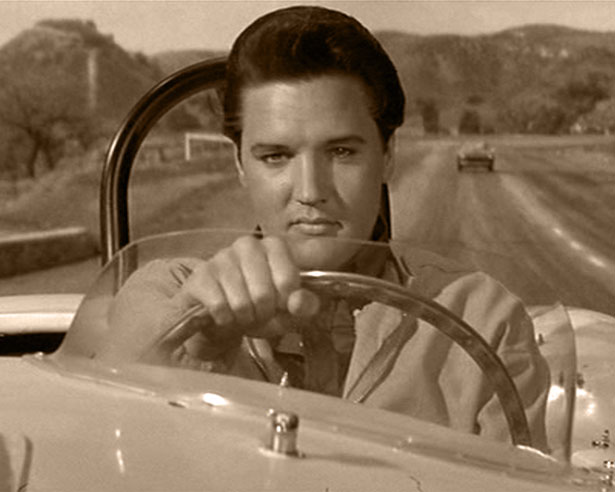
Elvis Presley is Mike McCoy in 1966's SPINOUT (MGM)

Elvis Presley is Mike McCoy in 1966’s SPINOUT (MGM)


“It’s Elvis with his foot on the gas and no brakes on the fun!!!”

Spinout

Spinout (MGM)
Wide Release: November 23, 1966 (United States)
Starring: Elvis Presley, Shelley Fabares, Diane McBain
Written By: Theodore J. Flicker & George Kirgo
Music Score By: George Stoll
Produced By: Joe Pasternak
Directed By: Norman Taurog
Running Time: 93 Minutes


In Spinout, Elvis Presley stars as Mike McCoy. Is Mike a racecar driver who also sings or a singer who also races cars? Folks, we don’t ask such questions when watching an Elvis Movie. We just sit back and enjoy the ride.

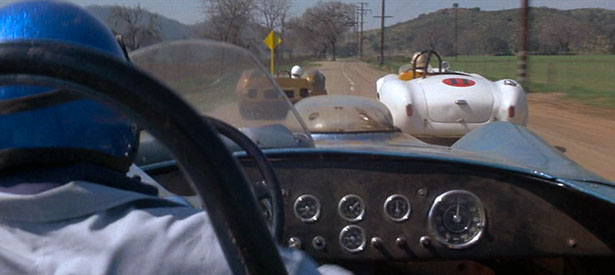
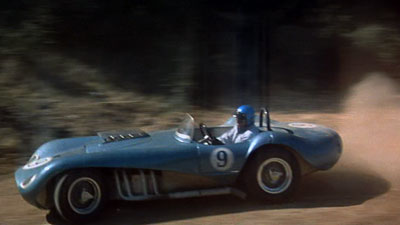
View from the #9 car, driven by Mike McCoy, during the Santa Fe Road Race in 1966's SPINOUT (MGM)

View from the #9 car, driven by Mike McCoy, during the Santa Fe Road Race in 1966’s SPINOUT (MGM)

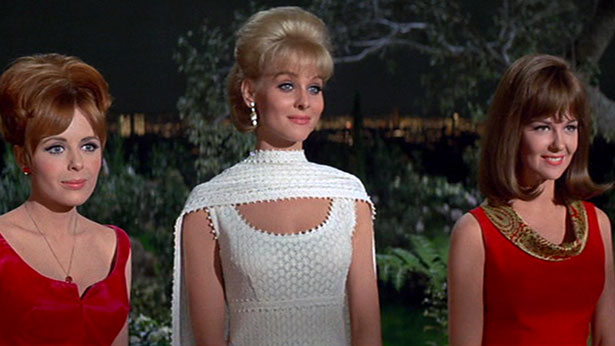
Outside of the cars, there is not a lot of action in Spinout. The film focuses more on the romance side of the Elvis Movie formula. Three, count them, three women are vying for Mike’s affections. There’s heiress Cynthia (Shelley Fabares), who runs him off the road in the opening scene. There’s also author Diana (Diane McBain), who declares him the “perfect American male,” with the prize being herself, naturally. Even the drummer in his band, Les (Deborah Walley), has been secretly holding feelings for him.

Deborah Walley is Les, Diane McBain is Diana, and Shelley Fabares is Cynthia in 1966’s SPINOUT (MGM)

Deborah Walley is Les, Diane McBain is Diana, and Shelley Fabares is Cynthia in 1966’s SPINOUT (MGM)

Mike is initially unable to decide what to do about his admirers. “I’ve gotta think about it,” he says. “I’ll let you know after the race. I think better when I’m driving.”

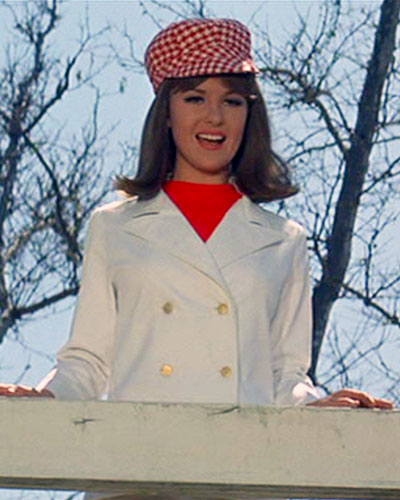
Shelley Fabares is Cynthia Foxhugh in 1966's SPINOUT (MGM)

Shelley Fabares is Cynthia Foxhugh in 1966’s SPINOUT (MGM)

Spinout is the second of three Elvis Movies in which Shelley Fabares appears. She is one of my favorite Elvis co-stars, so I really don’t understand how Mike found deciding among the three women to be so difficult. Anyway, the movie also includes a couple of fun in-jokes in regards to Elvis’ real-life past – the Ed Sullivan Show warrants a mention and Mike refers to a wandering canine as a “hound dog.”

Though production on Spinout began only a few months after the premiere of the Get Smart television series, be sure to listen out for Mike doing what sounds to my ears like a quick Don Adams impression with Agent 86’s “Would you believe?” catch-phrase.

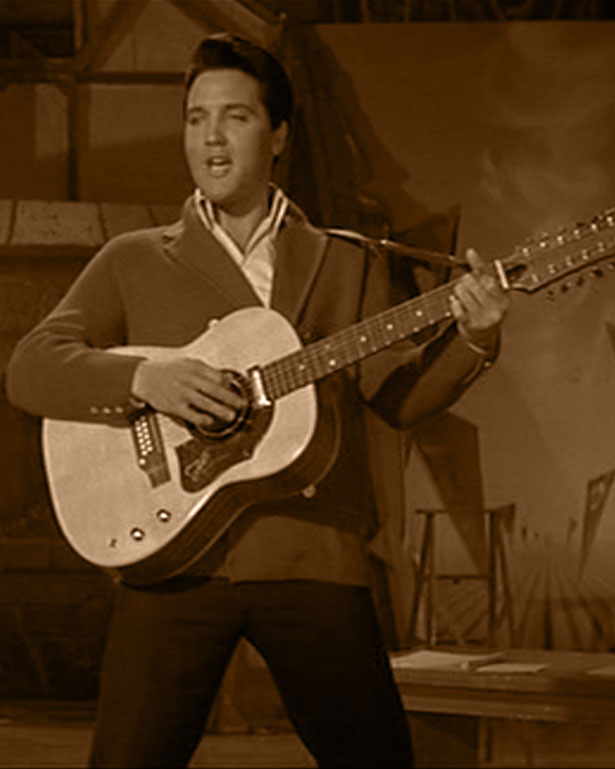
Mike McCoy (Elvis Presley) rehearses "Never Say Yes" in 1966's SPINOUT (MGM). Note the 12-string guitar.

Mike McCoy (Elvis Presley) rehearses “Never Say Yes” in 1966’s SPINOUT (MGM). Note the 12-string acoustic electric guitar.

Mike does sing quite a bit in the movie. “All That I Am,” “Am I Ready,” “Never Say Yes,” and “Spinout” are all strong songs. “Never Say Yes” is rare in the Elvis catalog in that it includes the “Bo Diddley Beat,” which is fun to hear. On the other side of the coin, “Smorgasbord” is awful.

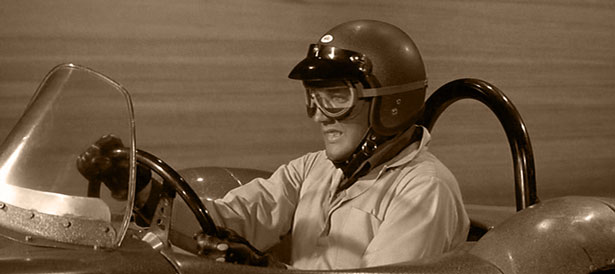
Mike McCoy drives the #9 car during the Santa Fe Road Race in 1966’s SPINOUT (MGM)

Mike McCoy drives the #9 car during the Santa Fe Road Race in 1966’s SPINOUT (MGM)

For a movie named Spinout, there is less racing than you might expect. The Santa Fe Road Race featured in the finale is well-filmed. A humorous subplot involving Mike’s #11 car being stolen by another man vying for Cynthia becomes tiresome, though. Mike ends up substituting for Shorty Bloomquist (James McHale) in car #9 to chase after his own car. Look quick and you’ll see Elvis’ friends Red West and Joe Esposito in Shorty’s pit crew. Cynthia also winds up driving onto the road course, so she and Mike tangle again, creating a bookend of sorts to the opening.

Spinout sometimes qualifies as fun, but all too often feels like it is running on empty.

Mike McCoy (Elvis Presley) races in 1966’s SPINOUT (MGM)

Mike McCoy (Elvis Presley) races in 1966’s SPINOUT (MGM)


Spinout Tote Board

  • Kisses: 28
  • Songs: 10
  • Cars Driven By Mike: 4
  • Women Chasing Mike: 3
  • Cars Crashed Into Water: 2
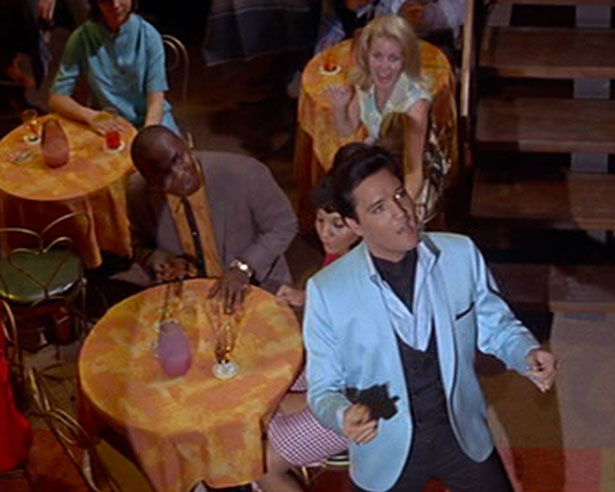
Audience members look on as Mike McCoy (Elvis Presley) sings "Adam And Evil" in 1966's SPINOUT (MGM)

Audience members look on as Mike McCoy (Elvis Presley) sings “Adam And Evil” in 1966’s SPINOUT (MGM)

Songs In Spinout

  1. “Spinout” (1966) [performed twice], written by Sid Wayne, Ben Weisman, & Dolores Fuller
  2. “Stop, Look, and Listen” (1966), written by Joy Byers
  3. “Adam And Evil” (1966), written by Fred Wise & Randy Starr
  4. “All That I Am” (1966), written by Sid Tepper & Roy C. Bennett
  5. “Never Say Yes” (1966), written by Doc Pomus & Mort Shuman
  6. “Am I Ready” (1966), written by Sid Tepper & Roy C. Bennett
  7. “Beach Shack” (1966), written by Bill Giant, Bernie Baum, & Florence Kaye
  8. “Smorgasbord” (1966), written by Sid Tepper & Roy C. Bennett
  9. “I’ll Be Back” (1966), written by Sid Wayne & Ben Weisman
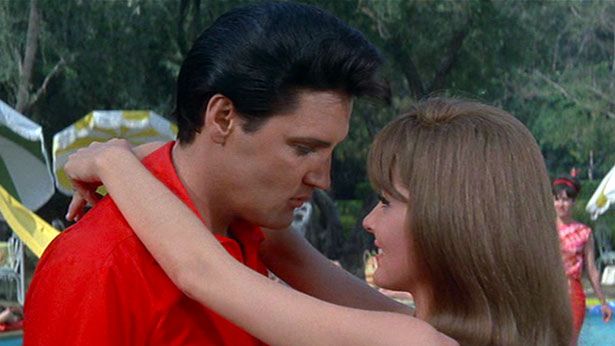
Elvis Presley is Mike McCoy and Shelley Fabares is Cynthia Foxhugh in 1966's SPINOUT (MGM)

Elvis Presley is Mike McCoy and Shelley Fabares is Cynthia Foxhugh in 1966’s SPINOUT (MGM)

The Mystery Train’s Spinout Scorecard

  • Story: 2 (out of 10)
  • Acting: 5
  • Fun: 4
  • Songs: 6
  • Overall: 4 (For Elvis Fans Only)

Further Spinout Reading


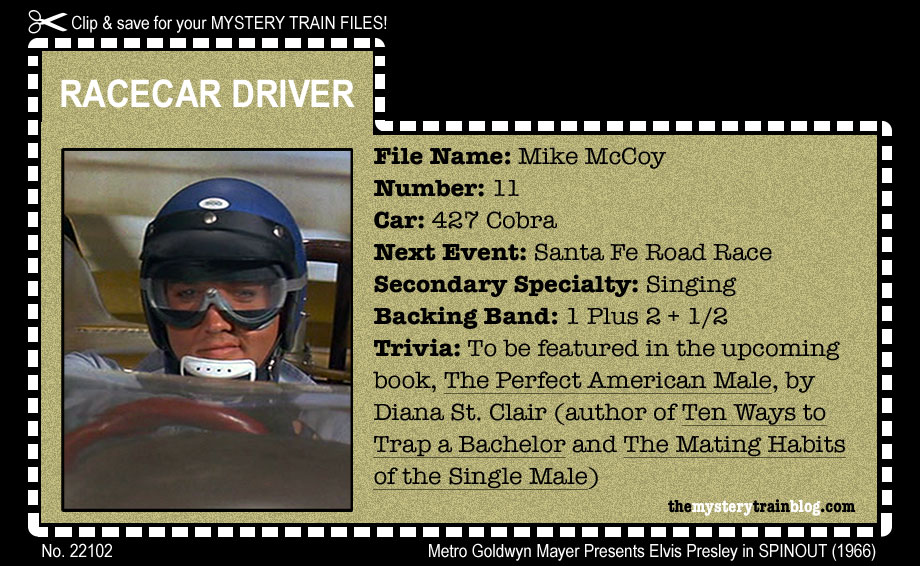
TMT Files: Mike McCoy

Click image for larger, full-color version


“I do everything to spread the Good News and share in its blessings. Don’t you realize that in a race everyone runs, but only one person gets the prize? So run to win! All athletes are disciplined in their training. They do it to win a prize that will fade away, but we do it for an eternal prize.”
1 Corinthians 9:23-25

Vinyl Elvis: HIS HAND IN MINE (1960)

Portions of this post originally appeared in a review I wrote of His Hand In Mine for the album’s 60th anniversary in Kees Mouwen’s Elvis Day By Day 2020: The Year In Review. The 2021 volume is available now.


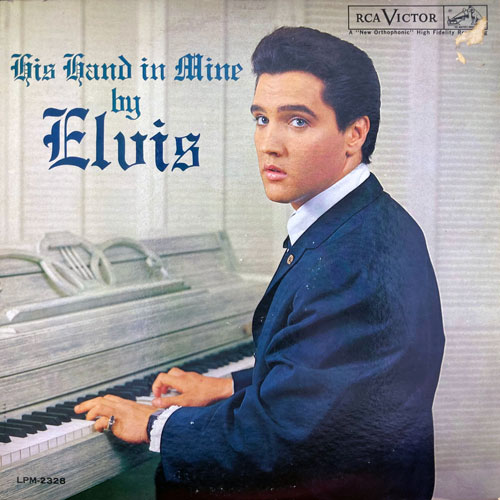
HIS HAND IN MINE (RCA, 1960; from TY’s collection) | Click image for full-color version

His Hand In Mine
Label: RCA
Catalog Number: LPM-2328
Recorded: 1960 | Nashville
Released: 1960

1960 was Elvis Presley’s most productive year to that point in his career. He recorded 52 studio masters, released 3 albums, and filmed 3 movies; and all that with being out of commission for almost the entire first 3 months while completing his stint in the U.S. Army.

For the 25-year-old singer, the albums Elvis Is Back! and His Hand In Mine represented artistic achievements on par with his outstanding work in the previous decade. The latter title was his first Long Play (LP) sacred album, a follow-up of sorts to his 1957 Extended Play (EP) sacred album Peace In The Valley.

Elvis recorded the entire His Hand In Mine album the night of October 30, finishing in the early morning hours of October 31, 1960. Amazingly, the record was in stores within a month – presumably rushed to have it ready for the Christmas season. RCA released His Hand In Mine in both mono and stereo formats.

As a second generation Elvis fan, I first heard His Hand In Mine in the early 1990s on CD. As with so many Elvis albums, I have bought it a number of times in different CD configurations over the years since then. When Kees asked me to review the album for its 60th anniversary back in 2020, I sought out a vinyl version – a first pressing of the 1960 mono release.

One of the things I enjoy about collecting used records is pondering their history. I imagine a young Elvis fan in 1960 buying this album at her or his local record shop and taking it home to play it for the first time. What else is happening in November 1960?

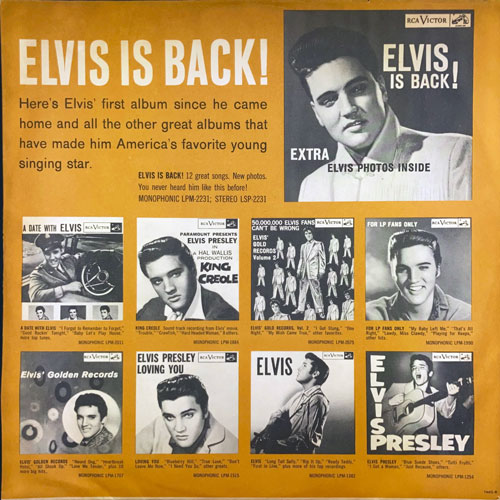
Inner sleeve of HIS HAND IN MINE (RCA, 1960; from TY’s collection) | Click image for color version

How many others owned this particular copy of His Hand In Mine before it made its way into my hands 60 years later? Whose hands will hold it 60 years from now?

The album is in remarkable condition for its age. The outer sleeve, featuring a photo of Elvis at the piano, taken during a break while filming Flaming Star, is still vibrant. Only a small tear beneath the RCA logo on the front cover, where a fan was perhaps too aggressive in removing a price tag, and minor splitting in the bottom seam betray its age. The inner sleeve, promoting Elvis Is Back!, is in great shape. On the vinyl itself, there are but a few little crackles in quiet portions. Whether this is an indication that the original owner(s) did not play this album very often or simply treated it with reverence, there is no way to know.

When I first heard His Hand In Mine nearly 30 years ago, I believed in God but had little understanding of Christianity. While I thought Elvis’ voice sounded beautiful on many of the songs, I really did not connect with them beyond that. I did occasionally play this or one of his other sacred albums on a random Sunday, seeking something.

In 2018, I accepted Jesus into my heart, and I was literally reborn (2 Corinthians 5:17). While I still stumble every day, I now have a personal relationship with Jesus through daily reading of the Bible and prayer that helps me get back on track to becoming who He created me to be.

As for Elvis’ sacred recordings, they began to take on new meaning for me. It is within this context that I want to examine His Hand In Mine.

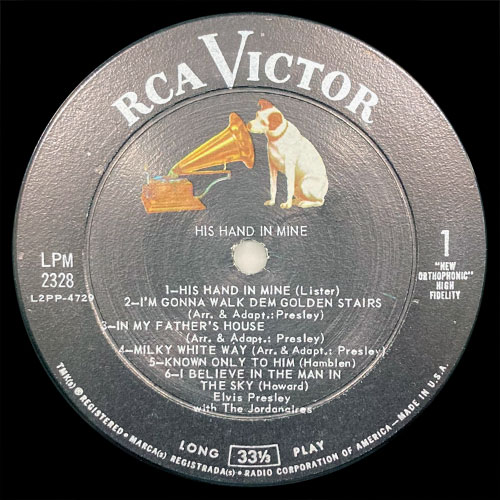
Side 1 of HIS HAND IN MINE (RCA, 1960; from TY’s collection) | Click image for full-color version

Side 1

  1. His Hand In Mine
    The album kicks off with the title track, “His Hand In Mine.” Elvis’ voice is full of new confidence and strength on this slow number – as compared to 1956’s more faltering “Love Me Tender,” for instance.
  2. I’m Gonna Walk Dem Golden Stairs
    Up next, the pace picks up with “I’m Gonna Walk Dem Golden Stairs.” This song sounds like Elvis fulfilling his dream of being in a gospel quartet. The line “When Jesus says to me, ‘Well done'” recalls the following verse from the Bible: “His lord said unto him, ‘Well done, thou good and faithful servant: thou hast been faithful over a few things, I will make thee ruler over many things: enter thou into the joy of thy lord'” (Matthew 25:21 KJV). As a Christian, I do not fear death, as I know it is when I will go to meet Jesus. I pray I will live the rest of my life such that He will say, “Well done.”
  3. In My Father’s House
    There is an even more direct Scriptural reference in the next song, “In My Father’s House.” Elvis sings, “In my Father’s house are many mansions; if it were not true He would have told me so.” In the Bible, Jesus states: “In My Father’s house are many mansions: if it were not so, I would have told you. I go to prepare a place for you” (John 14:2 KJV). Elvis’ vocals are exquisite on lines like, “Jesus died upon the cross to bear my sorrow. Freely died that souls like you might have new life.” A highlight of the album.
  4. Milky White Way
  5. Known Only To Him
    “Known Only To Him” is an interesting 1960 recording by Elvis because it is one of those where portions sound like his later voice from the 1970s. His inspirational and Christmas songs do tend to blend together better across the decades, though, compared to many of his other recordings. It would have been interesting to hear Elvis take another try at this song in 1970 or 1971, even if live. I don’t think he would have been able to better this version, though.
  6. I Believe In The Man In The Sky

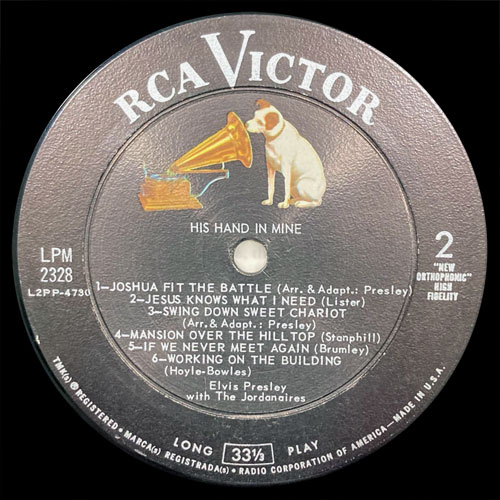
Side 2 of HIS HAND IN MINE (RCA, 1960; from TY’s collection) | Click image for full-color version

Side 2

  1. Joshua Fit The Battle
    My first complete read-through of the Bible in 2018 had a secondary and unexpected benefit of filling in details for me on a number of songs. For instance, in the upbeat “Joshua Fit The Battle,” I had always heard the lyrics as, “I know you’ve heard about Joshua, he was the son of none.” Yes, for 25 years I thought Joshua was an orphan until I finally learned that his father’s name was Nun. The song recounts the battle of Jericho, which is featured in chapter 6 of Joshua in the Old Testament. In his later years, Joshua was one of only two adults from Moses’ original followers to make it to the Promised Land.
  2. Jesus Knows What I Need
    “Jesus Knows What I Need” is one of those songs that speaks Truth whenever I need comfort. I can imagine Elvis singing this one around the piano with friends. A bit of trivia: In subsequent pressings of His Hand In Mine, this song’s title was corrected to “He Knows Just What I Need.”
  3. Swing Down Sweet Chariot
    The humorous “Swing Down Sweet Chariot” takes us back to the Old Testament. Called “Zeke” in the song, the prophet Ezekiel’s encounter with the chariot of God is described in chapter 1 of Ezekiel. Though I love this song, I much prefer the alternate version of Elvis’ 1968 re-recording that features the Blossoms as the backing vocalists.
  4. Mansion Over The Hilltop
    Like “In My Father’s House” on Side 1, “Mansion Over the Hilltop” and “If We Never Meet Again” on Side 2 provide beautiful illustrations of the Perfect Place, Heaven. In “Mansion,” a favorite line is, “Someday yonder we will never more wander, but walk on streets that are pure as gold.” I just love the sound of Elvis’ voice as he paints this picture.
  5. If We Never Meet Again
    Elvis’ mother, Gladys, passed away in August 1958 at the age of 46, and I’m sure Elvis had her in mind while recording “If We Never Meet Again,” which states: “If we never meet again this side of Heaven, as we struggle through this world and its strife, there’s another meeting place somewhere in Heaven, by the side of the River of Life – where the charming roses bloom forever and ever, and separations come no more.” The “River of Life” is from Revelation 22:1 in the Bible, which describes God’s throne in Heaven. Elvis was only 23 when he lost his mother. At a September 1958 press conference before leaving to be stationed in Germany until his return to the U.S. and civilian life in March 1960, he had this to say about her, captured on the Elvis Sails EP: “My mother, I suppose since I was an only child, that we might have been a little closer. Everyone loves their mother, but I was an only child, and Mother was always right with me, all my life. It wasn’t only like losing a mother, it was like losing a friend, a companion, someone to talk to. I could wake her up any hour of the night, and if I was worried or troubled about something, she’d get up and try to help me.”
  6. Working On The Building
    I first heard the energetic “Working On The Building” on the 1988 album Elvis In Nashville and loved it right away. Take 2, released on the 2006 FTD edition of His Hand In Mine, is also a favorite. In the gospel segment of the 1968 ELVIS television special, wheelbarrows can be seen as part of the set decoration – reminding me of this 1960 song, which was unfortunately not performed on the show. “I’m working on the building, it’s a true foundation,” sings Elvis. In Matthew 7:24-27, Jesus talks about the importance of building a strong spiritual foundation. “Working On The Building” serves as a perfect conclusion to His Hand In Mine.

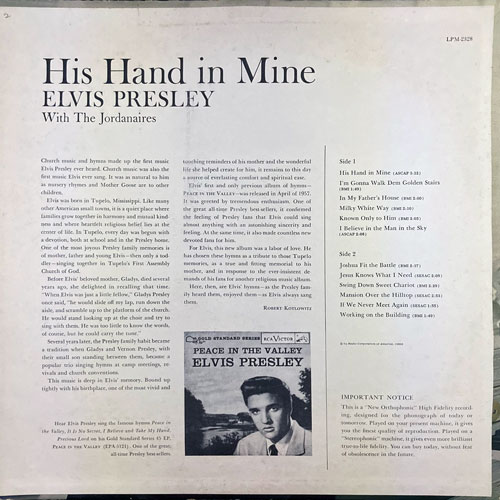
Back cover of HIS HAND IN MINE (RCA, 1960; from TY’s collection) | Click image for color version

I enjoy looking at album covers while playing records. His Hand In Mine includes liner notes on the back by Robert Kotlowitz. He explores Elvis’ early faith through attending the First Assembly Church of God in Tupelo, Mississippi.

An interesting tidbit in the liner notes, which I do not recall reading elsewhere, is, “Gladys and Vernon Presley, with their small son [Elvis] standing between them, became a popular trio singing hymns at camp meetings, revivals and church conventions.” Truth or legend?

The liner notes also include a quote from Elvis’ mother: “When Elvis was just a little fellow, he would slide off my lap, run down the aisle, and scramble up to the platform of the church. He would stand looking up at the choir and try to sing with them. He was too little to know the words, of course, but he could carry the tune.”

Except for a quick session in June 1958, which was a couple of months before his mother’s death, Elvis made no formal recordings while serving in the Army. While Elvis Is Back! and the G.I. Blues soundtrack afforded no such opportunities, I firmly believe His Hand In Mine is a “labor of love” by Elvis in tribute not only to Jesus but, as Kotlowitz states, to Gladys Presley.

Back inner sleeve of HIS HAND IN MINE (RCA, 1960; from TY’s collection) | Click image for color version


“The eyes of the LORD are everywhere, keeping watch on the wicked and the good.”
Proverb 15:3

Elvis Movies: DOUBLE TROUBLE

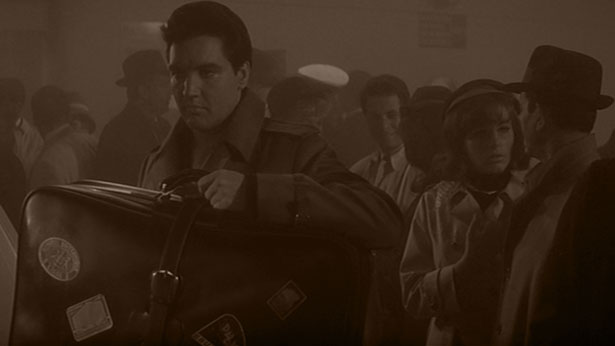
Guy Lambert (Elvis Presley) departs for Belgium in 1967's DOUBLE TROUBLE (MGM)

Guy Lambert (Elvis Presley) departs for Belgium in 1967’s DOUBLE TROUBLE (MGM)

“[F]or the most part, Elvis movies take place in Elvis Land, a time outside of time, a time where Elvis is King, there is no outside world, there is no larger context – because when you have Elvis, that’s all the context you need. He justified films merely by being in them. You can imagine how that could be a disheartening experience for someone so competitive as Elvis, someone so determined to do well, but it is just one of the elements that make him fascinating as a performer.”
-Sheila O’Malley, 2012, The Sheila Variations

In his lifetime, Elvis Presley released 31 narrative movies and 2 documentaries. At the height of his film career in the 1960s, he was cranking out 3 movies a year.

When I was a teen, the local video rental store had dedicated sections for Action, Drama, Romance, Musicals, Horror, Science Fiction, and the like. It also had an entire section called Elvis Movies, with shelves full of VHS tapes of many of his films and concerts. Like Monster Movies or Superhero Movies, Elvis Movies really are their own genre. As writer Sheila O’Malley aptly notes above, they also occur in their own little reality.

As a second generation Elvis fan, and a child of the late 1970s and 1980s, my first exposure to Elvis Movies was not in the theater or even on VHS, but on broadcast television. A local, independent UHF channel would show a mini-marathon of themed movies on Saturday afternoons. On some Saturdays, for instance, I watched a double or triple feature of Monster Movies like King Kong vs. Godzilla (1963). On other Saturdays, I watched two or three Elvis Movies on this station. I can still hear the announcer excitedly proclaiming, “Up next, more Elvis in Harum Scarum!”

Though there are occasional exceptions, Elvis Movies are usually not remarkable achievements from an artistic perspective. Near the end of his film career, Elvis admitted that his movies made him “physically ill.” Though I cannot confirm the authenticity of this next quote, Elvis is also purported to have once said, “The only thing worse than watching a bad movie is being in one.”

As a child, though, I loved watching Elvis Movies with my family. They were fun, and Elvis played any number of characters of interest to an 8-year old: A racecar driver, a cowboy, a boxer, an Army man, etc. Elvis was the ultimate action hero, destined to win every fight and every girl. Elvis had a natural comedic flair, and there were also action scenes, often involving karate, that kept me interested as well. Of course, music was ever-present. The quality of many of his movie tunes were subpar, to say the least, but I didn’t really notice this back then, either. Elvis Movies were complete fantasy packages, as entertaining to young me as watching Godzilla and King Kong duke it out.

At some point, I suppose in my early adulthood, I began to see Elvis Movies in a different light. Maybe it was slogging through those dreadful movie tunes as I began exploring his entire catalog of music. Maybe it was reading about how much he disliked making them. Maybe it was the constant re-running of his movies on cable stations every January and August. At some point, I began to find it harder to sit through Elvis Movies. The completist in me has collected all of them on DVD, and I have watched each at least once. I don’t return to most of them too often, though. I love movies almost as much as I love music. I watched nearly 100 movies last year, but only one Elvis Movie.

In the spirit of that 8-year-old who watched a string of Elvis Movies on Saturday afternoons so long ago, I’ve decided to rewatch Elvis Movies over the next few years. I’m going to approach this in a random fashion, for that is how I first watched them. Along the way, I plan to blog about them. While I won’t go as deep into the details of these movies as someone like Gary Wells over at the Soul Ride blog might, I’ll hit what I consider the highlights as well as quirky tidbits that jump out at me, often on a personal level. Up first is Double Trouble.


“Elvis takes mad mod Europe by song as he swings into a brand new adventure filled with dames, diamonds, discotheques, and danger!!”

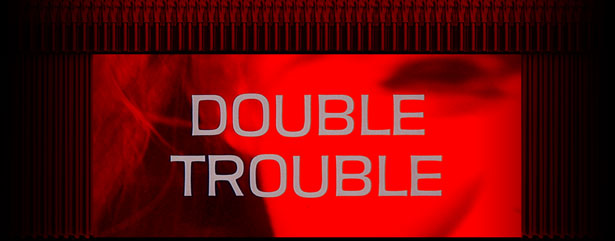
Double Trouble

Double Trouble (MGM)
Wide Release: April 5, 1967 (United States)
Starring: Elvis Presley, John Williams, Yvonne Romain, Annette Day
Screenplay By: Jo Heims
Story By: Marc Brandel
Music Score By: Jeff Alexander
Produced By: Judd Bernard and Irwin Winkler
Directed By: Norman Taurog
Running Time: 92 Minutes


You would be forgiven if, based on the movie’s title or the fact that he appears twice on its poster, you expected Elvis Presley to play dual roles in Double Trouble, his 24th film to be released. Alas, this is not the case, for he had already performed that schtick a few years earlier in Kissin’ Cousins (1964). The double in the trouble represents our hero, singer Guy Lambert (Elvis), being torn between two love interests – the innocent but zany Jill (Annette Day) and the seductive Claire (Yvonne Romain). The movie isn’t really about any of that, though. While Guy seems intrigued by Claire, his heart is obviously with Jill – despite his own misgivings, including a subplot involving Jill’s age that is cringe-worthy by today’s standards.

Instead, Double Trouble tries to be a madcap comedy/thriller. Most of the comedy external to Elvis doesn’t really work (I’m looking at you, Wiere Brothers).

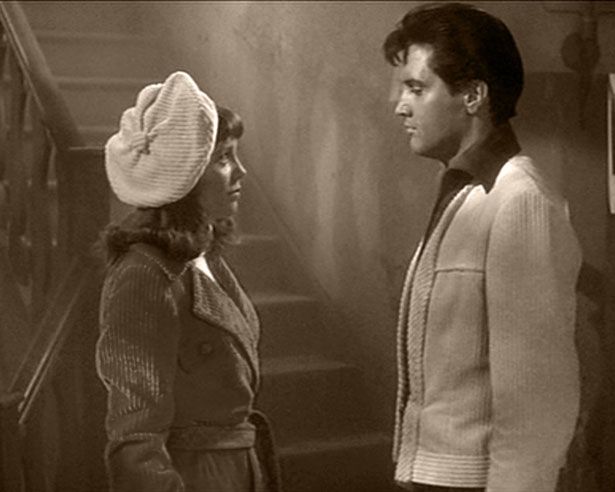
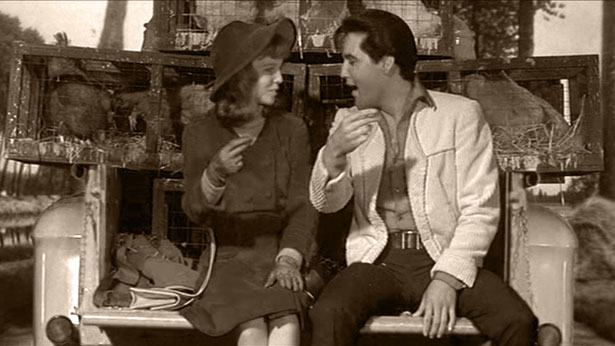
Annette Day is Jill Conway and Elvis Presley is Guy Lambert in 1967's DOUBLE TROUBLE (MGM)

Annette Day is Jill Conway and Elvis Presley is Guy Lambert in 1967’s DOUBLE TROUBLE (MGM)

Double Trouble doesn’t really work as a thriller, either. Someone wants Guy and/or Jill dead. Though the ultimate mastermind of the murder plot might come as a surprise, this revelation comes about through the hackneyed explanation of a hired killer right before he is going to off his victim. Guy, of course, saves the day, and the would-be killer ends up succumbing to the very trap he had planned for his target. Death is rare in Elvis Movies, but it does happen.

1967’s DOUBLE TROUBLE includes multiple murder attempts (MGM)

Double Trouble is also rare among Elvis Movies in that it takes place in Europe. The film opens in London, England, and then takes us to Belgium. Not really, though, as Double Trouble was filmed in Culver City, California.

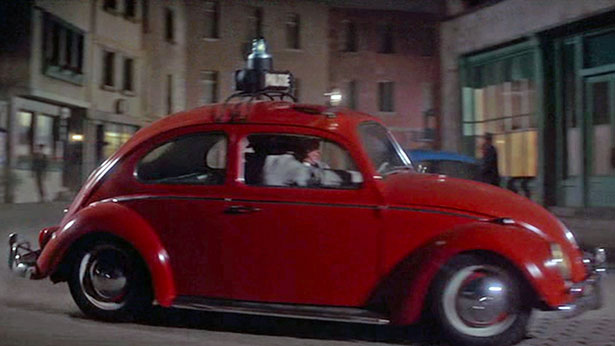
In Double Trouble, the Belgian police drive Volkswagen Beetles. The interesting thing about this, for me, is that, as a child, I was obsessed with wanting a red VW Beetle. I drew pictures of one throughout my elementary school years, often including a police siren on top and other special devices, like spotlights and ejection seats. Though I have no memory of picking up this particular fascination from an Elvis Movie, sure enough, a red VW Beetle police car appears during a chase sequence.

A Volkswagen Beetle police car appears in 1967’s DOUBLE TROUBLE (MGM)

Double Trouble marks the acting debut of Annette Day (Jill). You wouldn’t know it from the film, as she does a commendable job in both comedic and dramatic scenes. I love watching her observe and then mimic Elvis’ movements as he sings “Old MacDonald” to her. Unfortunately, this is Day’s only movie.

Jill Conway (Annette Day) snaps along as Guy Lambert (Elvis Presley) sings "Old MacDonald" in 1967's DOUBLE TROUBLE (MGM)

Jill Conway (Annette Day) snaps along as Guy Lambert (Elvis Presley) sings “Old MacDonald” in 1967’s DOUBLE TROUBLE (MGM)

I enjoyed watching many of the songs in the context of this film far more than I do listening to the soundtrack album in isolation. Elvis does appear quite stiff at times, though, particularly during his opening number, the title song. Incidentally, I really enjoyed the funky instrumental opening to the film and wish that ambience had been present on the actual Elvis music.

I admitted long ago that I’m a fan of Elvis’ version of “Old MacDonald” but the beautiful “City By Night” and “Could I Fall In Love” are Double Trouble‘s musical highlights.

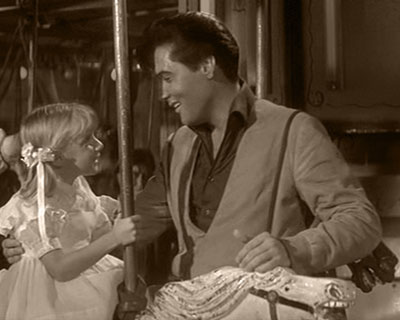
A child (portrayed by Laurie Lambert) and Guy Lambert (Elvis Presley) ride a carousel as he sings “I Love Only One Girl” in 1967’s DOUBLE TROUBLE (MGM)

If you go with the flow, as is necessary with most Elvis Movies, Double Trouble is entertaining.


Boldly Go

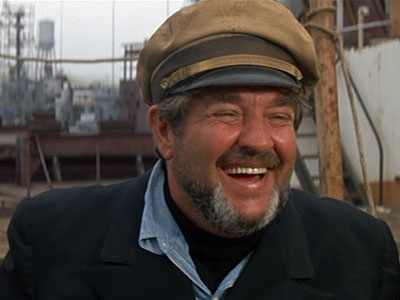
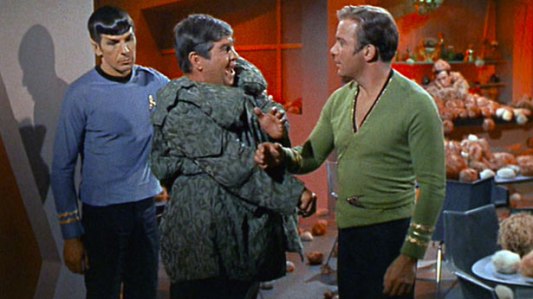
Stanley Adams plays Captain Roach in Double Trouble. Adams is known to fellow Trekkies for his portrayal of Cyrano Jones in the Star Trek episode “The Trouble With Tribbles” (1967) and the animated Star Trek follow-up episode “More Tribbles, More Troubles” (1973).

Stanley Adams is Captain Roach in 1967's DOUBLE TROUBLE (MGM)

Stanley Adams is Captain Roach in 1967’s DOUBLE TROUBLE (MGM)

Leonard Nimoy is Mister Spock, Stanley Adams is Cyrano Jones, and William Shatner is Captain James T. Kirk in the 1967 STAR TREK episode "The Trouble With Tribbles" (Desilu)

Leonard Nimoy is Mister Spock, Stanley Adams is Cyrano Jones, and William Shatner is Captain James T. Kirk in the 1967 STAR TREK episode “The Trouble With Tribbles” (Desilu)


Double Trouble Tote Board

  • Kisses: 13
  • Karate Chops: 9
  • Songs: 8
  • Karate Kicks: 4
  • Broken Windows: 2
Elvis Presley is Guy Lambert in 1967's DOUBLE TROUBLE (MGM)

Elvis Presley is Guy Lambert in 1967’s DOUBLE TROUBLE (MGM)

Songs In Double Trouble

  1. “Double Trouble” (1966), written by Doc Pomus & Mort Shuman
  2. “Baby, If You’ll Give Me All Of Your Love” (1966), written by Joy Byers
  3. “Could I Fall In Love” (1966), written by Randy Starr
  4. “Long Legged Girl” (1966), written by J. Leslie McFarland & Winfield Scott
  5. “City By Night” (1966), written by Bill Giant, Bernie Baum, & Florence Kay
  6. “Old MacDonald” (1966), written by Randy Starr, based on the traditional composition
  7. “I Love Only One Girl” (1966), written by Sid Tepper & Roy C. Bennett, based on the traditional composition “Auprès de ma blonde
  8. “There Is So Much World To See” (1966), written by Sid Tepper & Ben Weisman

The Mystery Train’s Double Trouble Scorecard

  • Story: 2 (out of 10)
  • Acting: 5
  • Fun: 6
  • Songs: 5
  • Overall: 4 (For Elvis Fans Only)

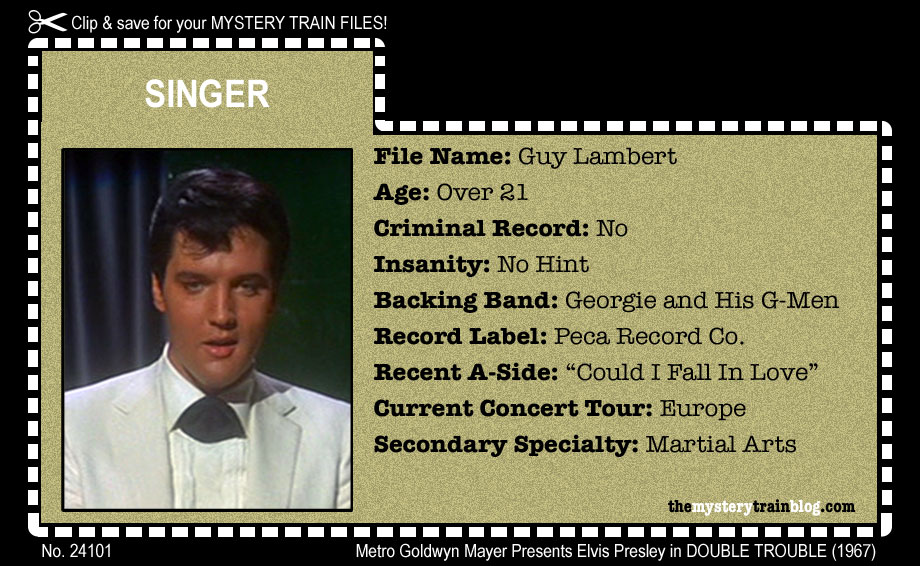
TMT Files: Guy Lambert

Click image for larger, full-color version


“And whatever you do or say, do it as a representative of the Lord Jesus, giving thanks through him to God the Father.”
Colossians 3:17

THAT’S THE WAY IT IS: Six in the Summer of ’70

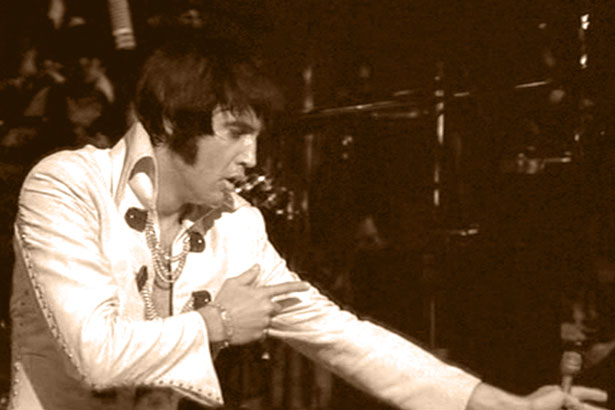
Elvis Presley performs “Polk Salad Annie” at the August 12, 1970, Midnight Show, in Las Vegas, Nevada, captured for the ELVIS: THAT’S THE WAY IT IS documentary film (MGM)

About seven years ago, I wrote a review of That’s The Way It Is: Deluxe Edition. The 2014 Elvis Presley boxed set included 8 CDs and 2 DVDs, and my review rambled on about them for nearly 10,000 words.

Despite the length of that review, there are some loose ends that I would finally like to begin tying up regarding my all-time favorite Elvis event. I don’t know how many posts this will actually take, and they won’t necessarily run sequential to one another, either. Such is the way of things when you ride The Mystery Train.

By the time of the That’s The Way It Is project, Elvis had already performed two month-long engagements at the International Hotel in Las Vegas. From July 31 to August 28, 1969, he performed 57 concerts, 11 of which RCA recorded in full near the end of the series and compiled into the Elvis In Person half of the From Memphis To Vegas/From Vegas To Memphis double album.

Elvis performed another 57-show engagement from January 26 through February 23, 1970. RCA recorded portions of nine shows from the middle of this engagement, which resulted in the core of the album On Stage.

MGM’s camera crews were rolling for the Elvis: That’s The Way It Is documentary as he began his 3rd engagement on August 10, 1970. Marketed as the “Elvis Summer Festival,” this one ran through September 8 and included 59 shows. RCA recorded the first 6 concerts in full–concluding with the August 13 Dinner Show. Only four of the live songs found their way onto the That’s The Way It Is album, which acted as a tie-in to the film but otherwise featured studio songs Elvis had recorded in June.

These first three engagements at the International Hotel include some of the greatest live performances of Elvis’ career, but the vast majority of the recordings languished away in RCA’s vaults until long after his death. While performances of individual songs were often superior in the two previous engagements, to the extent there was overlap, the overall shows in the third engagement, as captured for That’s The Way It Is, are better than any that preceded or followed them.

All right, if I’m not careful, I’ll be on the way to another unreadable 10,000 word post. I love this topic, but let’s get on with it.

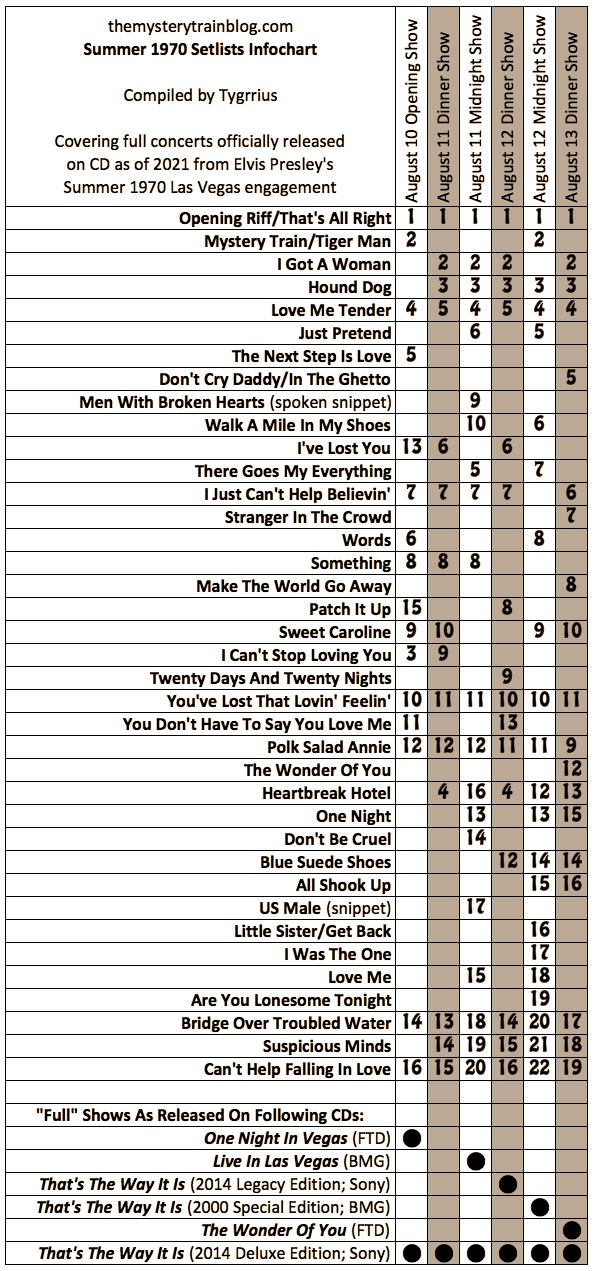
To assist with today’s post, I created the following infochart covering the six concerts RCA recorded for That’s The Way It Is. The numbers in the concert columns represent the sequence he performed those songs in that particular show.

Elvis Presley Summer 1970 Setlists Infochart | Compiled by TY

Focusing on the 6 shows that RCA recorded in the course of 4 days, Elvis performed only 6 of the songs at every single concert:

  • That’s All Right
  • Love Me Tender
  • You’ve Lost That Lovin’ Feelin’
  • Polk Salad Annie
  • Bridge Over Troubled Water
  • Can’t Help Falling In Love

All of these are strong highlights, with only a couple of exceptions in individual shows.

The following songs appeared in 5 of the 6 concerts:

  • Hound Dog
  • I Just Can’t Help Believin’
  • Heartbreak Hotel
  • Suspicious Minds

Of these, the highlights are tremendous versions of “Suspicious Minds” and “I Just Can’t Help Believin'”. While the “Suspicious Minds” live performances are not quite as good as his August 1969 renditions, the August 1970 versions are still stellar and far better than the ones captured in February 1970. Though again inferior to 1969, “Hound Dog” and “Heartbreak Hotel” remain entertaining at this point and are not yet the throwaways they would unfortunately soon become – particularly “Hound Dog.”

Not including snippets, the following songs appeared in only 1 of the 6 concerts:

  • The Next Step Is Love
  • Don’t Cry Daddy/In The Ghetto
  • Stranger In The Crowd
  • Make The World Go Away
  • Twenty Days And Twenty Nights
  • The Wonder Of You
  • Don’t Be Cruel
  • Little Sister/Get Back
  • I Was The One
  • Are You Lonesome Tonight

All of the one-off songs have something to offer. One of the great “misses” of the time period, in my opinion, is “Stranger In The Crowd” not being chosen and promoted as a single for That’s The Way It Is, in lieu of “You Don’t Have To Say You Love Me.” The “Stranger In The Crowd” studio track is amazing, and his subsequent rehearsals with his core rhythm group for the live show prove it could have been dynamite. Unfortunately, the sole live version is marred by featuring too much of the Imperials vocal group and the orchestra’s horns. If only the Elvis team had worked out a simpler arrangement that was closer to those early rehearsals.

As it was his most recent hit at the time of these concerts, it is interesting that Elvis performed “The Wonder Of You” only once during the six shows.

Featuring Elvis on electric guitar, “Little Sister/Get Back,” “I Was The One,” “Love Me” (August 12 version only), and “Are You Lonesome Tonight” are all top-notch. Even the non-guitar version of “Love Me” (August 11) is a stand-out and far better than any post-1970 version.

With revised arrangements, “Words” and “I Can’t Stop Loving You” are two songs Elvis improves in Summer 1970 over his Summer 1969 performances.

Other highlights of the overall six-concert span include “Mystery Train/Tiger Man” (of course) and “Just Pretend.”

These are darn-near perfect shows. The only major Elvis categories they are lacking are gospel and the blues. It is unfortunate that Elvis did not perform “Oh Happy Day” at any of these concerts, despite having rehearsed it at the last minute, as he surely would have recorded a superlative version at this time in his career. However, the gospel sound is certainly present on a few of the secular recordings, including showstoppers “I Just Can’t Help Believin'” and “Bridge Over Troubled Water.” As for the blues, some of that influence can certainly be heard in the aforementioned electric guitar segment from the August 12 Midnight Show.

Here is my “August 1970 Ultimate Show” playlist recipe for this concert engagement. As noted, Elvis’ setlist varied widely each night, so no single show actually contained all of these songs. In fact, such a concert would have been longer than any show Elvis actually gave in his entire life, to my knowledge.

  1. Opening Riff/That’s All Right (August 10, 1970, Opening Show [OS])
  2. Mystery Train/Tiger Man (August 12, 1970, Midnight Show [MS])
  3. I Got A Woman (August 13, 1970, Dinner Show [DS]
  4. Hound Dog (August 11, 1970, MS)
  5. Love Me Tender (August 11, 1970, MS)
  6. The Next Step Is Love (August 10, 1970, OS)
  7. Just Pretend (August 11, 1970, MS)
  8. Don’t Cry Daddy/In The Ghetto (August 13, 1970, DS)
  9. Men With Broken Hearts/Walk A Mile In My Shoes (August 11, 1970, MS)
  10. I’ve Lost You (August 11, 1970, DS)
  11. There Goes My Everything (August 11, 1970, MS)
  12. I Just Can’t Help Believin’ (August 12, 1970, DS)
  13. Stranger In The Crowd (August 13, 1970, DS)
  14. Words (August 12, 1970, MS)
  15. Something (August 11, 1970, MS)
  16. Make The World Go Away (August 13, 1970, DS)
  17. Patch It Up (August 10, 1970, OS)
  18. Sweet Caroline (August 12, 1970, MS)
  19. I Can’t Stop Loving You (August 11, 1970, DS)
  20. Twenty Days And Twenty Nights (August 12, 1970, DS)
  21. You’ve Lost That Lovin’ Feelin’ (August 12, 1970, MS)
  22. You Don’t Have To Say You Love Me (August 10, 1970, OS)
  23. Polk Salad Annie (August 12, 1970, MS)
  24. The Wonder Of You (August 13, 1970, DS)
  25. Heartbreak Hotel (August 12, 1970, MS)
  26. One Night (August 12, 1970, MS)
  27. Don’t Be Cruel (August 11, 1970, MS)
  28. Blue Suede Shoes (August 12, 1970, MS)
  29. All Shook Up (August 12, 1970, MS)
  30. US Male (August 11, 1970, MS)
  31. Little Sister/Get Back (August 12, 1970, MS)
  32. I Was The One (August 12, 1970, MS)
  33. Love Me (August 12, 1970, MS)
  34. Are You Lonesome Tonight (August 12, 1970, MS)
  35. Bridge Over Troubled Water (August 11, 1970, DS)
  36. Suspicious Minds (August 12, 1970, MS)
  37. Can’t Help Falling In Love (August 12, 1970, MS)

Though I did not structure it this way on purpose, all 6 shows are represented in this “best of” playlist. If you want an even fuller compilation, you could even include “Introductions By Elvis” from the August 12 Midnight Show after “Polk Salad Annie” and before “The Wonder Of You.”

As you can probably predict from the above playlist, my favorite show of the Summer 1970 engagement is the August 12 Midnight Show (disc 6 of 2014’s That’s The Way It Is: Deluxe Edition and disc 2 of 2000’s That’s The Way It Is: Special Edition). In fact, this is my favorite Elvis concert ever. It features an impeccable setlist, Elvis in top form, and the fun electric guitar segment.

Though he still had many stellar recordings and accomplishments ahead of him, Elvis was never quite as awesome again as he was in Summer 1970. I am grateful we have so much material from that time period to enjoy. I wouldn’t be as strong an Elvis fan without the magic of That’s The Way It Is.

Blessings,
TY


“We put our hope in the LORD. He is our help and our shield. In him our hearts rejoice, for we trust in his holy name. Let your unfailing love surround us, LORD, for our hope is in you alone.”
Psalm 33:20-22

REVIEW: Elvis – The Complete Masters Collection (Part 7)

This is Part 7 of an occasional series reviewing Elvis: The Complete Masters Collection.

[Read Part 6]
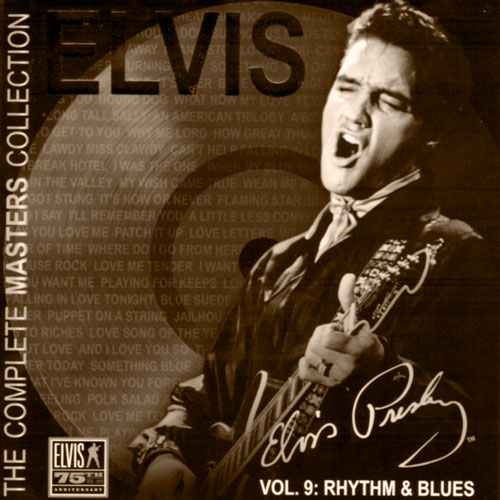
ELVIS: THE COMPLETE MASTERS COLLECTION – VOLUME 9 CD sleeve (2009, from TY’s collection) | Click image for full-color version

CD Vol. 9: Rhythm & Blues

One of the fun parts about bringing back The Mystery Train is the potential to continue old series, such as Elvis Trivialities, and to revisit other loose ends from the first iteration of this site.

One of those loose ends was my ongoing review of Elvis: The Complete Masters Collection. At first, however, I hesitated to continue reviewing a 36-CD set that came out 11 years ago and is now long out-of-print. Then, I realized, if I were to apply a “newness” rule to potential topics here on The Mystery Train, we’d have little left to discuss. After all, Elvis Presley created his most recent recordings over 43 years ago now. With that in mind, on with the review!

Since it has been over 7 years since I wrote Part 6 of this review, I first want to reset the stage. Back in 2007, Sony digitally remastered for optimum sound quality all 711 of the recordings Elvis released during his lifetime. With various exceptions, the mixes matched the original vinyl releases. Vic Anesini performed the mastering work. These upgraded digital masters slowly began popping up on various compilations and re-releases.

In 2009, the Franklin Mint licensed the upgraded digital masters from Sony to release Elvis: The Complete Masters Collection on CD. At the time, there were two ways to buy the set – as a monthly subscription (3 discs a month for a year, “cancel anytime!”) or as an outright purchase of the entire set (36 discs) at a lower price than the combined total of all the monthly subscription fees. Each CD represented a theme, so the majority of the discs featured new sequencing and combinations compared to previous releases of this material. Unfortunately, within each individual disc, Franklin Mint generally sequenced the songs in recording order. I do appreciate the creativity behind dividing Elvis’ vast catalog into themes, but I wish they had taken this a step further and applied such creativity to more of the track sequencing as well. The Franklin Mint set also included a 24-page booklet, a record-player style display case, and a reproduction of Elvis’ first record, “That’s All Right” b/w “Blue Moon of Kentucky” on the Sun label.

In 2010, Sony released a high-end boxed set called The Complete Elvis Presley Masters. It featured the same 711 upgraded digital masters as the Franklin Mint set, but in 27 CDs – due to using more space per CD than Franklin Mint (for which, obviously, the higher disc count benefited them for their subscription program). The Sony set included three additional discs of “bonus material” in lesser sound quality, featuring various previously released tracks that came out after Elvis’ death. For the most part, the 711 masters were presented in “recording order” on the Sony set, which also included a 240-page book covering all of Elvis’ recording sessions. The first run of the Sony set was limited to 1,000 copies, numbered. It rapidly sold out, so a second, unnumbered run of 1,000 was produced in 2011 and eventually sold out as well. The luxurious Sony set cost about twice as much as the comparatively low-budget approach of the Franklin Mint set. Yet, I could never get out of my head that the underlying “complete masters” on both sets were exactly the same. The massive difference in price was solely due to the Sony set’s premium presentation and book, not the music itself.

As I already had nearly all of Elvis’ lifetime masters in varying sound quality on a myriad of CDs dating back to the late 1980s, I passed on both the Franklin Mint and Sony sets at the time of release. They were both out of my price range, anyway. In 2012, Franklin Mint began offering their entire set at a substantially reduced price. Wanting the opportunity to own all of Elvis’ lifetime masters in consistent and upgraded sound quality, I jumped on it and, naturally, started reviewing it here. At first, I would only allow myself to listen to a CD from the set for the first time when I wrote a review about it. Fortunately, my impatient side won out over my procrastination side, and I dropped that concept, or I suppose I would only now be listening to disc 9 for the first time! Not to mention the other 27 discs that would have been waiting behind it.

In 2016, Sony re-released the upgraded masters in yet another boxed set. The 60 CD Elvis Presley: The Album Collection featured essentially the same masters spread over even more discs than Franklin Mint did, but this time, for the most part, in sequence of their original album releases. As I backed up the Franklin Mint set to iTunes, I can sequence the songs in any way I please, so I passed on this Sony release, too. Of the three sets, this is the one that is the easiest to obtain in 2020, however, and is relatively affordable given the contents. Be sure to read reviews by Elvis fans before investing, though, as Elvis Presley: The Album Collection has its own eccentricities you should know about – much like Elvis: The Complete Masters Collection and The Complete Elvis Presley Masters do as well. Bottom line is, unless you are simply an obsessive collector that wants to own every single Elvis CD release, there is really no reason to obtain more than one of these three sets. Were I in the market for these masters today, I would go for Elvis Presley: The Album Collection, simply because it is the easiest to find at a reasonable price.

With that out of the way, the theme and title of the ninth volume of Franklin Mint’s Elvis: The Complete Masters Collection is Rhythm & Blues. This should be a treat!
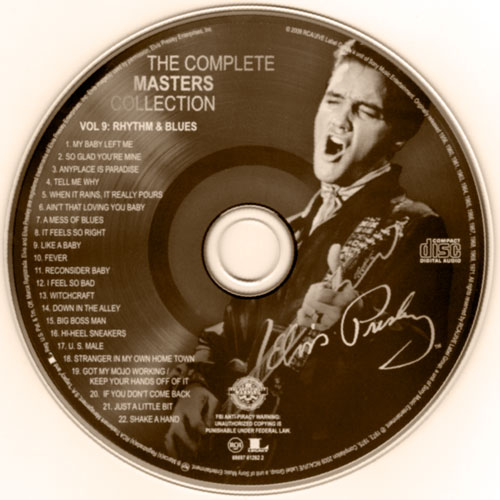
ELVIS: THE COMPLETE MASTERS COLLECTION – VOLUME 9 CD (2009, from TY’s collection) | Click image for full-color version

01. My Baby Left Me: Now, this is how you kick off an Elvis CD! Due to its similarity to “That’s All Right” (both written by Arthur “Big Boy” Crudup), I think “My Baby Left Me” gets lost in the shuffle sometimes. This is unfortunate, as it is an incredible recording – one of my favorites from Elvis’ breakout year. (Recorded: 1956)

02. So Glad You’re Mine: “So Glad You’re Mine” is another Crudup number, but this one is not nearly as effective as “That’s All Right” or “My Baby Left Me.” Elvis sounds bored. I am thankful Elvis happened to record “My Baby Left Me” prior to “So Glad You’re Mine” or Franklin Mint certainly would have started the CD with this song instead of the superior “My Baby Left Me.” (Recorded: 1956)

03. Anyplace Is Paradise: While Elvis’ performance is sometimes lacking on “Anyplace Is Paradise,” I love the lyrics, including: “Whether we’re standing on your doorstep or sitting in a park or strolling down a shady lane or dancing in the dark, where I can take you in my arms and look into your pretty eyes, anyplace is paradise when I’m with you.” If only this song had a better arrangement and approach, it could have been a classic love song. (Recorded: 1956)

04. Tell Me Why: Recorded at the same session as “All Shook Up,” “I Believe,” and others, “Tell Me Why” is hardly a standout with a sleepy performance by Elvis – similar to “So Glad You’re Mine.” (Recorded: 1957)

05. When It Rains, It Really Pours: Things get back on track here in a big way with “When It Rains, It Really Pours.” This is Elvis at his raw, powerful best. (Recorded: 1957)

06. Ain’t That Loving You Baby: When I visited Graceland in 1990, “Ain’t That Loving You, Baby” was one of the three songs that seemed to play on a constant loop at the various facilities and souvenir shops. This was long before the days of SiriusXM’s Elvis Radio channel broadcasting from Graceland, so I guess all they had was this little loop of three songs (the other two were “Playing For Keeps” [1956] and “For The Heart” [1976]). Anyway, for that reason, “Ain’t That Loving You, Baby” is memorable to me. Otherwise, it is just an okay performance. (Recorded: 1958)

07. A Mess Of Blues: The CD kicks into stereo mode with the awesome “A Mess Of Blues.” I love hearing all of the claps, finger snaps, and other noises. Just a fun song. No surprise, since it was written by Doc Pomus and Mort Shuman. (Recorded: 1960)

08. It Feels So Right: “It Feels So Right” is another good one. The CD is plugging along just fine now. (Recorded: 1960)

09. Like A Baby: “Like A Baby” is another often overlooked Elvis track. This is another of my favorites, and it fits perfectly on this CD. Not only is the Elvis vocal perfect, I love the saxophone accompaniment by Boots Randolph. (Recorded: 1960)

10. Fever: I have to say, “Fever” feels completely out of place here. I suspect it was deposited here by the compiler after not finding a suitable spot for it on another disc. It is also the one song on this CD that is not in recording order, as “Reconsider Baby” preceded it. In any event, I am not a big fan of Elvis’ studio recording of this song. (Recorded: 1960)

11. Reconsider Baby: Here it is, friends, Elvis’ best blues performance – his 1960 studio version of Lowell Fulson’s “Reconsider Baby,” and again accompanied by the incredible Boots Randolph on sax. One of Elvis’ greatest recordings and certainly the highlight of this CD. Not to be missed. (Recorded: 1960)

12. I Feel So Bad: After his release from the US Army, Elvis was on fire in the early 1960s. “I Feel So Bad” is another stellar blues number from this period, written by Chuck Willis. More great sax work from Boots. Be sure to listen for the sax switching from the left to the center channel during his solo. According to legend, Elvis walked up to Boots to enjoy the moment, accidentally picking up the sound of the sax with his handheld vocal microphone. Elvis knew what he was after, and the feel of the take was perfect, so the sound oddity was left in. (Recorded: 1961)

13. Witchcraft: What I love about “Witchcraft” is how it starts off as this unassuming little song with cutesy rhymes, and then kicks into a rockin’ chorus. Each time Elvis goes into “my head is spinning,” he gets a little more forceful. More Boots on sax. This is a killer song. (Recorded: 1963)

14. Down In The Alley: “Down In The Alley” was a bit of an acquired taste for me, but it is a decent blues number and fits well on this CD. (Recorded: 1966)

15. Big Boss Man: Thanks to Jerry Reed on guitar, “Big Boss Man” seems a hybrid of blues and country. Elvis sounds committed, but this is not a huge favorite of mine. (Recorded: 1967)

16. Hi-Heel Sneakers: I love the raw sound of Elvis’ voice on “High Heel Sneakers,” a fun blues number – which sounds like a contradiction in terms! But how can you not love lyrics like, “Put on your red dress, baby, ’cause we’re going out tonight. Well, wear some boxing gloves, in case some fool might start a fight.” (Recorded: 1967)

17. U.S. Male: What is “US Male” doing on a rhythm and blues compilation? This belongs on one of the country compilations instead. Anyway, this is a fun, if dated, song, featuring songwriter Jerry Reed on guitar. Completely out of place here, though. (Recorded: 1968)

18. Stranger In My Own Home Town: Elvis recorded Percy Mayfield’s “Stranger In My Own Home Town” at his first Memphis sessions in 14 years. I first discovered this song when it served as the power opener to The Memphis Record (1987). I have loved it ever since. I am partial to The Memphis Record mix, but this original mix is decent, especially in improved sound quality over previous CD releases. I’m with Elvis, who says, “Play it again, play it again” during one of the instrumental breaks. This is another one where I really love the lyrics: “My so-called friends stopped being friendly, but you can’t keep a good man down.” (Recorded: 1969)

19. Got My Mojo Working/Keep Your Hands Off Of It: This is an off-the cuff jam that was captured during Elvis’ “marathon” session in Nashville in June 1970. A heavily edited and overdubbed version of “Got My Mojo Working/Keep Your Hands Off Of It” was used on the ill-advised Love Letters From Elvis album, which essentially gathered scraps left over by two of the very best albums of his career, That’s The Way It Is and Elvis Country. Among left-overs, this song is a standout. As for this CD, it drags down the quality after “Stranger In My Own Home Town.” (Recorded: 1970)

20. If You Don’t Come Back: Though written by Jerry Leiber and Mike Stoller, who penned many of Elvis’ best songs in the 1950s, “If You Don’t Come Back” is a bit of a departure for Elvis. It is an interesting listen, and I particularly enjoy the vintage 1970s wakka-chukka guitar licks. (Recorded: 1973)

21. Just A Little Bit: Continuing the groove of “If You Don’t Come Back,” “Just A Little Bit” is another fun song. Both were recorded at Stax Studio in Memphis. (Recorded: 1973)

22. Shake A Hand: I have to say, Franklin Mint really lucked out on the sequencing of this one. Since they are intent on recording order, “Shake A Hand” just happened to fall last, yet is actually the perfect song to close this CD. I love this performance by Elvis, and the sound is crystal clear. This is a bass-heavy song in terms of sound, and the drums really drive it. (Recorded: 1975)

What a great CD! Of Franklin Mint’s unique, themed compilations (I am excluding Volume 4: Christmas With Elvis, Volume 5: Complete Aloha From Hawaii Concert and Volume 7: Complete 1968 Comeback Special from that label), this is my favorite so far. This is actually a CD or playlist that I would routinely enjoy. Sony should put this compilation out as a single CD, maybe as a budget release.

Let’s see, up next would be Volume 10: Live In Las Vegas. It compiles the albums Elvis In Person and On Stage, which we already know are among the best albums of his career. Seeing as how I recently devoted four posts to Elvis’ 1969 Las Vegas shows, I will either skip to another CD for the next review in this occasional series or wait another seven years to write Part 8. You just never know with me.

Blessings,
TY


“The rich and poor have this in common: The LORD made them both.”
Proverb 22:2
A Squirrel Loose at the Big, Freaky International Hotel (Part 4: The Epic Conclusion)

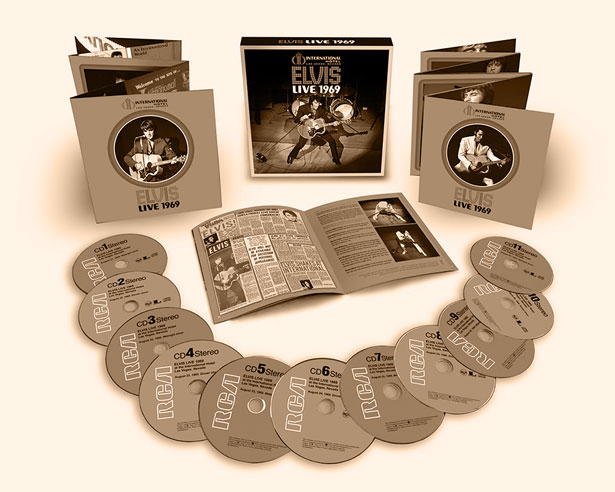
This is the finale of a 4-part look at Sony’s 2019 Elvis Live 1969 boxed set, which contains all 11 concerts RCA recorded during Elvis Presley’s August 1969 engagement at the International Hotel in Las Vegas.

[Read Part 1 | Read Part 2 | Read Part 3]

To paraphrase Elvis, there ain’t no end to this post, baby! I have committed not to push this review to five parts, however, as to move on to other topics next week.

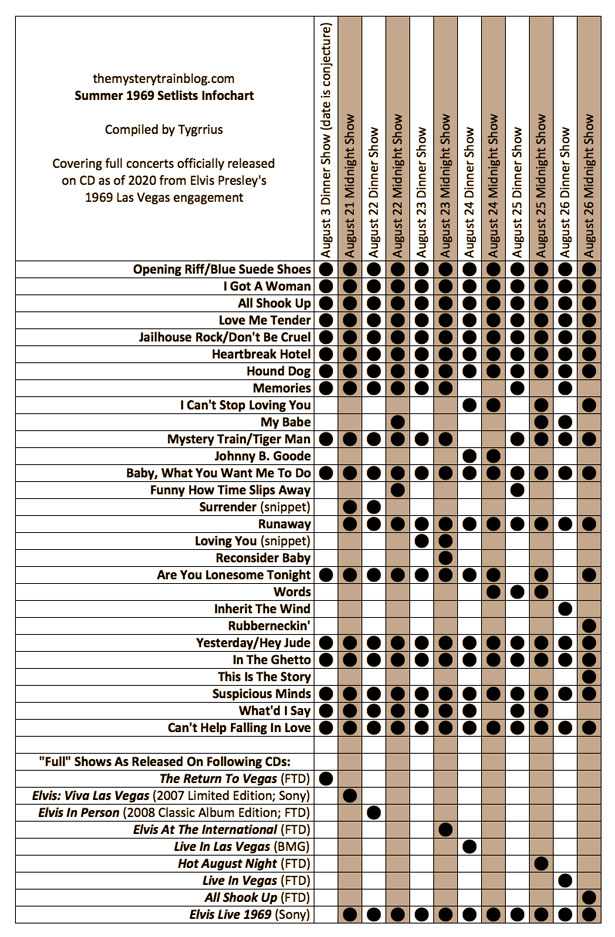
That said, I still want to delve into some song and show specifics for the 1969 engagement, so today’s post is going to run long, amounting to a double ride. No extra charge. To help with this portion of the discussion, my analytical side provided the following infochart.

Elvis Presley Summer 1969 Setlists Infochart | Click image for larger version | Compiled by TY

Though not part of the 11-CD Elvis Live 1969 boxed set, which focuses on RCA’s multitrack recordings, I included the informal soundboard recording from the early days of the engagement for reference as well. To date, its only official CD release as a more-or-less “full” show remains FTD’s The Return To Vegas. It would have made a great bonus disc on the Elvis Live 1969 set, as the overall feel of this show is slightly different than a few weeks later, and it even features an extended version of “Mystery Train” and a couple of alternate arrangements. Perhaps it was a cost-saving measure.

Anyway, focusing on the 11 shows that RCA recorded, Elvis performed 13 of the songs every single night – most of which formed the beginning and end of the shows. Of these, the strongest are “Suspicious Minds,” “Can’t Help Falling In Love,” “Runaway,” “In The Ghetto,” “Blue Suede Shoes,” and “All Shook Up.” With the studio version released as a single during this engagement and destined to become Elvis’ last number one hit, “Suspicious Minds” is particularly stunning. The 1969 live version stands as an incredible example of how Elvis reinvented his sound for these shows.

Most disappointing among the core songs are “Jailhouse Rock/Don’t Be Cruel” and “Baby, What You Want Me To Do.” “Jailhouse Rock” pales in comparison to the 1957 studio master as well as the 1968 live master. Both it and “Baby, What You Want Me To Do” notably lack the raw power and punch of the ELVIS television special performances from the previous summer. Understandably, there is a difference between performing 4 shows in 2 nights for a television special versus 57 shows in 29 nights for this Vegas engagement. Elvis no doubt needed to save his voice, but these performances in particular come up short.

Though many others are nearly as good, the one song Elvis improves in 1969 over his 1968 rendition is the “Tiger Man” portion of “Mystery Train/Tiger Man,” fueled by James Burton on lead guitar and Ronnie Tutt on drums. Like “Suspicious Minds,” the powerhouse “Mystery Train/Tiger Man” is a true highlight of this engagement. Unfortunately, Elvis drops it in favor of “Johnny B. Goode” for a couple of the shows. Now, one of those “Johnny B. Goode” performances was quite incredible and made it onto Elvis In Person, but I wish Elvis had dropped something else on those two occasions to make room for it, such as “Runaway.” That is no slam on “Runaway,” which I absolutely love and is among the highlights of the engagement for me.

A better substitution that Elvis provides on four nights is replacing the weak “Memories” with “I Can’t Stop Loving You.” I enjoy the studio versions of “Memories,” as recorded for the 1968 ELVIS special, but it just never worked live.

Additional highlights of the overall 11-concert span include three performances of “My Babe” and several of “Are You Lonesome Tonight.”

Of the one-off songs, the only one that really stands out from a performance perspective is “Reconsider Baby,” the blues song that Elvis returned to time and again over the years. “Rubberneckin’,” “Inherit The Wind,” and the abysmal “This Is The Story” are notable solely because these are the only live versions available. “Rubberneckin'” would have worked better with an arrangement closer to the funky studio master.

Though released as a limited edition 2-record set earlier in 2019, the August 23 Dinner Show makes its CD debut here. Not a single performance had previously been released on CD from this show – the only such concert on the set. The show is also unusual in that the Imperials backing group is not present, leaving full duties to the Sweet Inspirations – my preference, anyway. The show features exceptional versions of “Mystery Train/Tiger Man,” “Are You Lonesome Tonight,” “I Got A Woman,” and “What’d I Say” – the last of which benefits from a shorter rendition than the other shows.


“I had sideburns. Long hair. Fourteen years ago, it was weird. You think it’s weird now? Fourteen years ago, I couldn’t walk around the street: ‘Get him! Get him! […] He’s a squirrel.’ So I was […] shaking. In fact, that’s how I got in this business was shaking. It may be how I get out of it, too.”
–Elvis Presley, 1969

Four weeks ago now, I decided to write a post where I would share what I consider the best version of every song that RCA recorded during the Summer 1969 engagement. “I will kick it off by mentioning the Elvis Live 1969 boxed set from last year,” I thought – not intending to write a review. It would be a couple paragraphs and then the song list. Done. An easy post to warm up the engine of The Mystery Train again.

Well, here we are, 4 weeks, 4 posts, and over 4,500 words later, and I am finally coming to the original intent of that very first post (after, of course, having written a rather haphazard review after all).

Before I backed up these shows to iTunes, I separated out the majority of the talking portions as their own tracks (oh, if only Sony would do this, it would save me so much time). This allows me to create playlists more focused on the music – which improves the 1969 experience to a huge degree. To an extent, you can replicate this by pressing skip at the end of most tracks, as Sony normally places all of the talking at the end of a track (even if that talking introduces the next song, another pet peeve of mine — but that’s why I just save them the way I want them).

Here is my “August 1969 Ultimate Show” playlist recipe for this concert engagement. As we just discussed, Elvis’ setlist varied to some extent each night, so no single show actually contained all of these songs.

Disc references are to the Elvis Live 1969 set, but of course, you could use any available previous release as well. This playlist clocks in at about 71 minutes, keeping in mind my iTunes versions of the tracks have most of the talking trimmed out to separate tracks.

  1. Opening Riff/Blue Suede Shoes (8/25/1969 Dinner Show [DS]) 2:36 (Disc 8)
  2. I Got A Woman (8/23/1969 DS) 3:05 (Disc 4)
  3. All Shook Up (8/26/1969 Midnight Show [MS]) 1:32 (Disc 11)
  4. Love Me Tender (8/26/1969 MS) 2:21 (Disc 11)
  5. Jailhouse Rock/Don’t Be Cruel (8/24/1969 DS) 2:12 (Disc 6)
  6. Heartbreak Hotel (8/24/1969 DS) 1:56 (Disc 6)
  7. Hound Dog (8/22/1969 DS) 1:48 (Disc 2)
  8. Memories (8/25/1969 DS) 2:50 (Disc 8)
  9. I Can’t Stop Loving You (8/25/1969 MS) 2:36 (Disc 9)
  10. My Babe (8/22/1969 MS) 2:00 (Disc 3)
  11. Mystery Train/Tiger Man (8/22/1969 MS) 3:21 (Disc 3)
  12. Johnny B. Goode (8/24/1969 MS) 2:10 (Disc 7)
  13. Baby, What You Want Me To Do (8/25/1969 MS) 1:52 (Disc 9)
  14. Funny How Time Slips Away (8/22/1969 MS) 2:21 (Disc 3)
  15. Surrender (8/21/1969 MS) 0:29 (Disc 1)
  16. Runaway (8/23/1969 MS) 2:16 (Disc 5)
  17. Loving You (8/23/1969 DS) 0:21 (Disc 4)
  18. Are You Laughing Tonight (8/26/1969 MS) 2:53 (Disc 11)
  19. Reconsider Baby (8/23/1969 MS) 3:28 (Disc 5)
  20. Words (8/24/1969 MS) 2:31 (Disc 7)
  21. Yesterday/Hey Jude (8/25/1969 DS) 4:15 (Disc 8)
  22. Inherit The Wind (8/26/1969 DS) 2:52 (Disc 10)
  23. Rubberneckin’ (8/26/1969 MS) 2:21 (Disc 11)
  24. This Is The Story (8/26/1969 MS) 2:46 (Disc 11)
  25. In The Ghetto (8/25/1969 DS) 2:47 (Disc 8)
  26. Suspicious Minds (8/25/1969 MS) 7:14 (Disc 9)
  27. What’d I Say (8/23/1969 DS) 1:57 (Disc 4)
  28. Can’t Help Falling In Love (8/26/1969 DS) 2:10 (Disc 10)

While it was not my intent, nor even a consideration in crafting this list, it turns out that all 11 shows are represented – an indication of Elvis’ strength and consistency during this Vegas engagement (though the August 21 Midnight Show barely squeaks in with a short version of “Surrender”).

For those of you who want to include them (you know who you are), you could slot in the “Monologue” career retrospective from the August 24 Dinner Show before “Baby, What You Want Me To Do” and add “Introductions By Elvis” from the August 21 Midnight Show prior to “In The Ghetto.” This adds less than nine minutes, resulting in a total length of just under 80 minutes for the August 1969 Ultimate Show. That’s right in line with the length of the August 23 Midnight Show, but with nine more songs due to less talking throughout.

After careful analysis, my favorite show of the 1969 engagement is the August 25 Midnight Show, disc 9 of Elvis Live 1969 and previously released on FTD’s excellent Hot August Night. It features top-notch versions of “Mystery Train/Tiger Man,” “Suspicious Minds,” “Runaway,” “My Babe,” “Are You Lonesome Tonight,” “Hound Dog,” “Blue Suede Shoes,” “All Shook Up,” “I Can’t Stop Loving You,” among others. In fact, 7 of the 12 masters that RCA chose for Elvis In Person came from this show. That is probably the only reason it is not better represented in my August 1969 Ultimate Show playlist above, as I was tending to avoid master versions in the event of a tie with another version. Elvis may have put a little extra into this particular show due to the celebrities in attendance, including Tom Jones, Nancy Sinatra, Lightnin’ Hopkins, Buddy Hackett, and Shelley Fabares.


ELVIS LIVE 1969 (Sony, 2019) | Click image for larger, full-color version | Original image credit: Sony

“If I take time out to drink water, just look at me and say, ‘Is that him? I thought he was bigger than that. Squirrelly-looking guy.'”
–Elvis Presley, 1969

If you’re not in for the whole Elvis Live 1969 boxed set, 2010’s On Stage: Legacy Edition (Sony) is probably sufficient for casual or budget-minded fans, as it neatly highlights Elvis’ Summer 1969 and Winter 1970 Vegas engagements on 2 CDs and can still be found for about $12 US. CD 2 features Elvis In Person as well as additional songs recorded live in 1969. Keep in mind that both “Runaway” and “Yesterday” on the On Stage album, featured on CD 1, are from August 1969 as well.

If you are more on the obsessive side like me, but don’t already have most of these shows, I can definitely recommend Elvis Live 1969. Just be sure to shop around, as Elvis Live 1969 can often be found quite reasonably priced – considering the number of included shows. For example, Graceland is charging full list price as of this writing, but you can find it elsewhere for less than 60% of that price.

Among Elvis’ Las Vegas engagements at the International/Hilton Hotel, Summer 1969 ranks second only to Summer 1970 for me. I place Winter 1970 third. While the number of available shows in official releases is significantly less and disallows detailed comparisons, subsequent Vegas seasons in 1971-1976 are nowhere close to the 3 of 1969 & 1970.

To see one of these 1969 shows must have been something really special.

Blessings,
TY


“You can make many plans, but the LORD’s purpose will prevail.”
Proverb 19:21

A Squirrel Loose at the Big, Freaky International Hotel (Part 3)

This is Part 3 of a look at Sony’s 2019 Elvis Live 1969 boxed set, which contains all 11 concerts RCA recorded in Elvis Presley’s August 1969 concert engagement at the International Hotel in Las Vegas.

[Read Part 1 | Read Part 2]

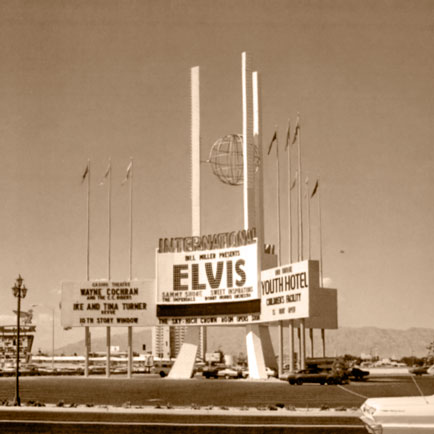
International Hotel marquee as displayed on back of a CD holder from Sony Legacy’s ELVIS LIVE 1969 boxed set (2019, from TY’s collection)

“When I was in the Army, the guys would say […], ‘Watch him, boy, he’s a squirrel, he’s just out of the trees.'”
–Elvis Presley, 1969

I mentioned last week that I prefer Elvis Presley’s overall Summer 1970 Las Vegas shows over the Summer 1969 Vegas shows – even though the 1969 versions of songs performed in both seasons win out in most cases.

One of the reasons I prefer the Summer 1970 engagement is the expanded setlist. Newly added songs like “You’ve Lost That Lovin’ Feelin'”, “Just Pretend”, and “I’ve Lost You” expanded the dimensions of the show for his third concert engagement at the International Hotel. Not to mention songs that Elvis retained after first introducing them in his second concert engagement earlier that year, like “Walk A Mile In My Shoes” and the show-stopping “Polk Salad Annie.”

Another reason I prefer the Summer 1970 engagement over the previous year is the amount of talking by Elvis in 1969. Though I prefer a “talkative Elvis” over the “all business Elvis” of, say, June 1972’s Madison Square Garden concerts, where he barely says a word between songs beyond the customary “thank you,” in the 1969 shows Elvis simply talks too much. Way too much.

Don’t believe me? Here are a couple of examples, using the shortest and the longest shows on the 1969 set:

  • The August 23 Midnight Show clocks in at just under 80 minutes (in fact, I wonder if Sony edited any bits out to get it to fit the 80-minute capacity of a CD). The actual musical content on this show is just over 56 minutes. Elvis talks for a whopping 24 minutes during this show – about 30% of the time!
  • The shortest show on the set is actually the very next night, the August 24 Midnight Show. I suspect management complained to Elvis about keeping the audience away from the casino too long the previous night, as he alludes to such conversations a couple days later in the engagement. This show is nearly 63 minutes long and features about 45 minutes of music. Elvis talks for about 18 minutes during this show – about 29% of the time.

The worst offender in driving up the talking times in 1969 is the “monologue” in the middle of each show where Elvis provides a joke-infused retrospective of his career for about ten minutes. While I’m sure it was entertaining to audiences in the showroom, it becomes a tough listen show after show on CD.

I understand he probably needed a cool down after “Tiger Man” or “Johnny B. Goode,” but the energy of the show is completely sapped each time before Elvis finally resumes singing – with an often uninspired version of “Baby, What You Want Me To Do,” completely lacking the raw magic of his versions from the previous year’s ELVIS special. For these Vegas shows, if only Elvis had bought himself a Gibson Super 400 CES like he borrowed from Scotty Moore in the special’s “sit down” shows, as Elvis accompanied himself so well on that electric guitar compared to anything else I have ever heard him play.

Overly long and bizarre introductions to “Hound Dog” and similar bits also detract from the listening experience when heard show after show. Repetitive jokes with the lyrics of “Jailhouse Rock,” “Yesterday,” and others become tiring, too. I imagine poor Felton Jarvis (producer), trying to capture material for the Elvis In Person album, getting his hopes up, thinking, “He’s going to sing it straight this time” and then, “Nope, not this time. Maybe tomorrow night.” Elvis did eventually perform straight versions of each song, probably after being asked to “clean up the act” as he mentions in some of the later shows as well.

Occasional lyrics twists are fun, don’t get me wrong. It is just hearing the same ones over and over that gets old. Of course, Elvis never intended or envisioned that someone like me would be listening to a complete collection of these shows over 50 years after the fact. From Elvis’ perspective, these shows served their purpose at the time in entertaining those audiences (of course) and supplying the 12 songs featured as masters on Elvis In Person. Yet, here I am, blessed to hear them all, so I might as well comment on them.

Anyway, it is actually a lyric twist on “Are You Lonesome Tonight” during the August 26 Midnight Show that results in one of my all-time favorite Elvis recordings – the “laughing version” of the song or, as I like to call it, “Are You Laughing Tonight.” If only movie cameras had been rolling like they were the next summer. Incidentally, the other eight versions of “Are You Lonesome Tonight” on this set are serious. I suspect if he performed a laughing version night after night, it would have lost much of its appeal.

I first heard “Are You Laughing Tonight” on the radio for what would have been Elvis’ 50th birthday in 1985. I recorded a radio special with a little cassette tape player my older sister gave me a Christmas or two before that, so Mom and I must have listened to that tape 500 times in the car before I finally found and bought a proper version of the song in 1991 (Collectors Gold).

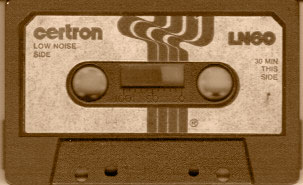
I don’t have a tape player anymore, but I still have that cassette (below). It was one of the cheapest tape brands you could buy, yet it has survived all these years. I even played it several years ago so I could write down the song titles (of course, I have lost that list).

1985 cassette tape of “Elvis On The Air” radio special, including “Are You Laughing Tonight”

Mom went to see Jesus over a year ago now, but every time I hear “Are You Laughing Tonight,” I remember her laughing right along with Elvis. I still feel her with me sometimes, and I turn this one up for her.

Next week, (I promise) I’ll wrap up my unintended review of Elvis Live 1969, and we’ll even get to my original idea for this post!

Blessings,
TY

[Read Part 4]


“You have turned my mourning into joyful dancing. You have taken away my clothes of mourning and clothed me with joy, that I might sing praises to you and not be silent. O LORD my God, I will give you thanks forever!”
Psalm 30:11-12