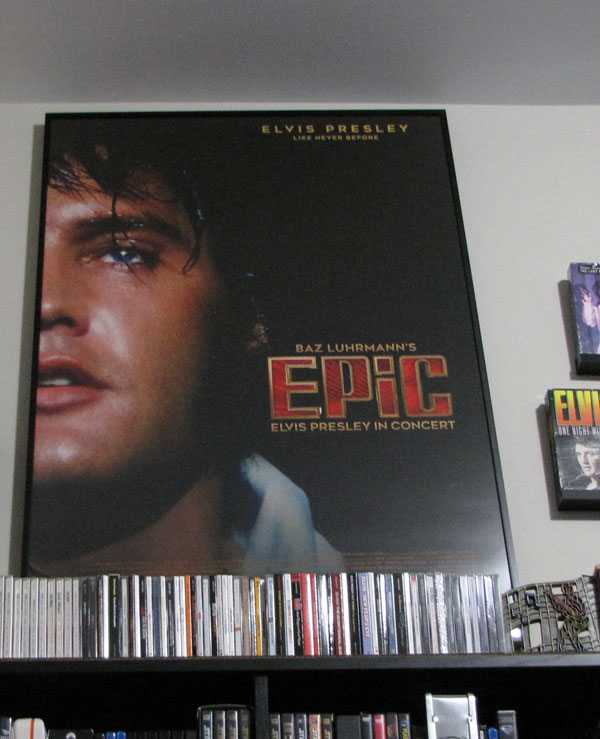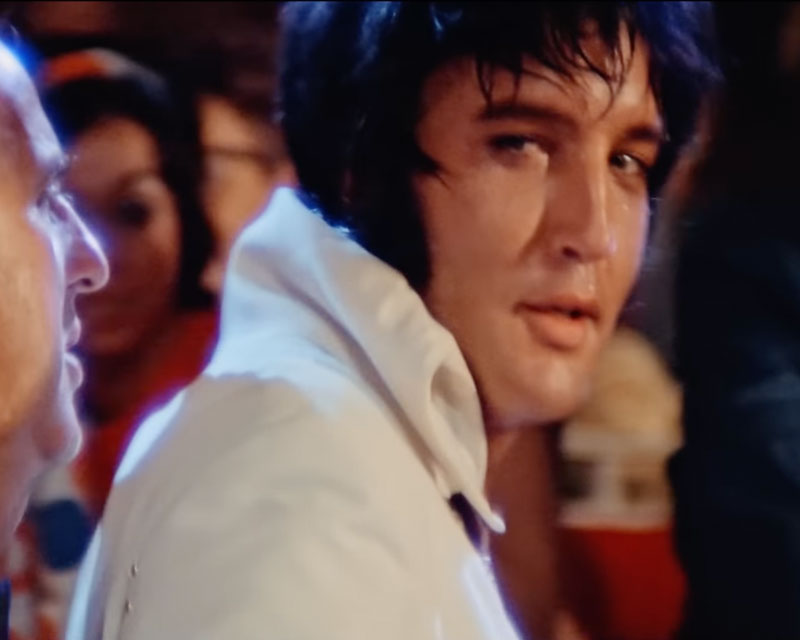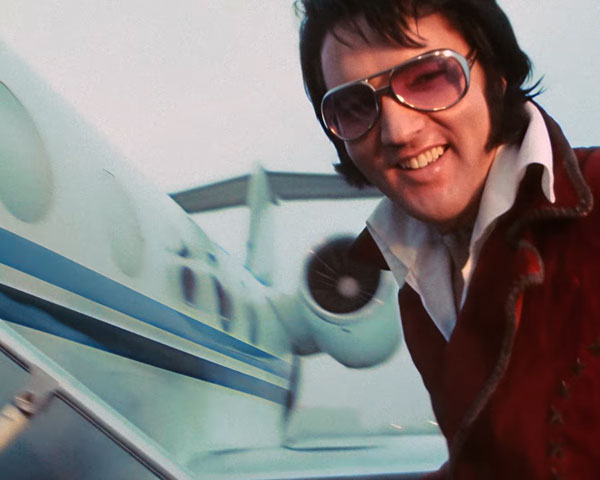
EPiC: Elvis Presley in Concert | An In-Depth Review

Elvis Presley in EPiC (NEON, 2026)

After nearly wall-to-wall coverage since the movie’s release in February, some of you might be wondering if I’m going to change the name of this site to The EPiC Train. Well, no, but I love Baz Luhrmann’s EPiC: Elvis Presley in Concert so much that I keep finding more to say about it.

My first viewing of EPiC at an IMAX Early Access screening on February 18 was an emotional experience.

Finally, here was a movie that understood and loved Elvis in the same ways I do. Here was a movie that gave Elvis his voice back. Here was a movie that rescued Elvis the man from Elvis the image.

I realized then that I wasn’t ready to dig into the weeds and analyze EPiC just yet. Though I wrote a first reaction piece, I held off on a formal review.

Through multiple rewatches with family and friends, I continued to experience EPiC in an emotional rather than analytical way. Oh, I found ways to write about it, because the movie certainly inspires me in that way. I’m even discussing the movie in detail with my bride on our new radio show (podcast).

Through all that, I tried to stay true to my original thoughts on EPiC, to experience and feel it rather than analyze it. It wasn’t until my final two theatrical rewatches, numbers eight and nine in mid-April, that I began to analyze things, such as how much of the footage was new.

Now that EPiC is available to buy or rent in digital format, I thought this would be a good time fully to let loose my analytical side. What follows will be a collection of observations, criticisms, and even nitpicks. It is part review, part viewer’s companion, and part tribute not only to Elvis but to those who helped him make the music that brings so much comfort to my life.

WARNING: Massive spoilers beyond this point.


NOTE: Footage tags refer only to whether a performance has been previously released in an official project. Previously unseen portions of performances already represented in official releases are not considered new footage for these purposes. However, low-quality bonus material from Elvis: That’s the Way It Is – Special Edition is excluded from consideration.

EPiC begins in perfect fashion, using a variant of one of my favorite Elvis quotes. I even used it to kick off my own Elvis Odyssey series last year.

Elvis: “I’d like to talk to you a little bit, ladies and gentlemen, about how I got in this business. There’s been a lot written and a lot said, but never from my side of the story.” (August 1969)

“The Battle Hymn Of The Republic” (from “An American Trilogy”) | April 9, 1972 Evening Show (ES), Hampton Roads, Virginia | Footage previously released in This Is Elvis

The movie then mirrors the opening of Luhrmann’s ELVIS (2022), with “Also Sprach Zarathustra,” better known as the theme from 2001: A Space Odyssey, segueing into “The Battle Hymn Of The Republic” from “An American Trilogy.” Only this time, a different guy is playing the main character instead of Austin Butler.

That’s right, it’s Elvis himself. As fantastic of a job Butler did in ELVIS, EPiC is all the better film for featuring the genuine article.

Artificially melding the opening “Also Sprach Zarathustra” with the climactic “The Battle Hymn Of The Republic” felt off to me in ELVIS, and it feels off to me again in EPiC. However, this is Elvis’ finest version of “An American Trilogy.”

I love how the EPiC team adds a breathing sound effect as Elvis walks up to the camera while in the process of leaving the stage and the movie proper begins. It is a reminder, as is the rest of the film, that Elvis Presley was a real man. His image as a legend has almost overtaken him, but there was a living and breathing human there.

EPiC now moves into a brief overview of Elvis’ career in the 1950s and 1960s. It is wonderful hearing Elvis narrating his story, sourced from interviews, concerts, and press conferences from 1956 to 1972.

A quibble I have is the use of Elvis’ audio from The Truth About Me, a recording he did as a promotional tie-in for a teen magazine in August 1956. Compared to his more sincere comments throughout EPiC, this audio sounds stilted. Elvis is reading a script, one that he almost certainly did not write, and sounds uncomfortable. Elvis Presley: The Searcher, Thom Zimny’s 2018 documentary, made the same misstep of using this audio. While EPiC relies on many interview sources, it is grating when it falls back on The Truth About Me. Here are just a few examples of The Truth About Me excerpts used in the movie:

Elvis: “Hi, this is Elvis Presley. I guess the first thing people want to know is why I can’t stand still when I’m singing. . . .”

Elvis: “I watch my audience and listen to them, and I know that we’re all getting something out of our system. None of us knows what it is. The important thing is that we’re getting rid of it, and nobody’s getting hurt.”

Elvis: “In a lot of the mail I get, people ask questions about the kind of things I do and all that sort of stuff. Well, I don’t smoke, and I don’t drink, and I love to go to movies.”

Luhrmann does a great job of encapsulating about 15 years of Elvis history into 10 minutes of movie. The editing is phenomenal here, which sets the stage for the visual extravaganza which is to follow.

The preacher complaining about “the beat, the beat, the beat” shows up here, as he does in just about every Elvis documentary covering the 1950s.

“Elvis Presley Arrested”

Luhrmann takes a wrong turn, however, by implying that Elvis is arrested for his stage movements and music. “Elvis Presley Arrested” appears on screen as EPiC covers the controversies surrounding the young singer. Footage is shown of Elvis in court. The problem? The actual incident stems from an October 1956 gas station fight in Memphis, for which he was cleared. This is reminiscent of some of the fictionalized aspects of Luhrmann’s ELVIS biopic. Though I raise an eyebrow at the necessity, I can excuse it in the biopic. False narratives have no place in a documentary.

We get the Elvis “running for his life” to the car footage from 1972 as Elvis’ father, Vernon Presley, talks about Elvis’ wild fans.

Luhrmann also trots out the typical Hy Gardner Calling footage from July 1956, but fortunately doesn’t linger with it too long.

Home movie footage of Elvis and friends in 1961 attempting to right the sign of Tupelo’s Elvis Presley Youth Recreation Center is shown that I don’t personally recall seeing before. Though the audio is not used in EPiC, Elvis references the moment in a February 1961 press conference in Memphis.

“Presley Back Home To Resume Career As Teenage Idol”

After Elvis is drafted and serves in the US Army, Luhrmann uses the singer’s classic “I was in tanks for a long time, you see. They rock and roll quite a bit” reply when a reporter asks if “two years of sobering Army life” had changed Elvis’ mind about rock ‘n’ roll.

“Hollywood”

Luhrmann offers a wonderful review of Elvis’ 1960s films in the “Hollywood” segment. We finally have an alternative to the “Too Much Monkey Business” sequence from This Is Elvis to encapsulate many of his films. EPiC includes clips from a whopping 20 of the 31 narrative films that Elvis appeared in as an actor, many of them in this segment. Some of them are shown, whether intentionally or otherwise, in the wrong aspect ratio. In the fast pace of this portion, it is not very noticeable.

Generally, I can’t stand it when people talk over an Elvis song in documentaries. One of the interesting things I discovered through EPiC is that I don’t mind it if Elvis is the one doing the talking. It really does feel like Elvis is telling you his story. If anyone should be allowed to talk over an Elvis performance, it’s Elvis.

A version of “A Change Of Reality,” a new mashup of multiple songs including “Change Of Habit,” “Edge Of Reality,” and “Charro,” appears here. I mean, wow. The version in the end credits is even better, but I’m getting ahead of myself.

Another strong editing scene of EPiC is when Elvis is shown driving in multiple movies. I realize the point of this segment is to show how repetitive Elvis movies had become, but he looks so cool driving. I mean, who else could have made those movies so watchable?

While I had heard the 1972 audio of Elvis talking about the disappointments of his movie career before, it is really striking to hear his words as visuals from his movies are shown on screen.

“But it did not change. It did not change” Elvis laments. Then we get references to Tom Parker as a gun is held to the head of one of Elvis’ characters, more driving, Vietnam, the Beatles, wrecked cars.

“Did not change” is repeated over and over as the visuals build to a gunshot sound effect when Elvis points his guitar at the camera in 1970 and pretends to fire it like a rifle.

What a sequence. By this point, EPiC had me.

“So, I had to change it, which I did,” says Elvis. We move to Elvis in July 1970, as captured for Elvis: That’s The Way It Is. The often-used scene of Elvis firing his guitar at the camera takes on a new meaning here. “Shoot that Hollywood camera,” Elvis says.

All of the 1970 footage filmed for Elvis: That’s The Way It Is that appears in EPiC is in the wrong aspect ratio – everything is squeezed narrower than it should be. Mistake or dubious artistic choice? You be the judge.

The captions in many places throughout EPiC, as seen in both the Apple and YouTube digital versions, are also laughably wrong. I am not going to point out all of them, but there are a couple I want to mention in the course of this review. One is here. Instead of “Shoot that Hollywood camera,” the caption claims that Elvis says, “Should be all on camera.” Uh, no, that ruins the entire moment that editor Jonathan Redmond and director Baz Luhrmann were building towards.

EPiC makes great use of a remix of “I Got A Feelin’ In My Body” in this and other segments. Recorded in December 1973 at Stax Studios in Memphis, the underlying song is the only post-1972 Elvis performance heard in EPiC.

EPiC makes interesting use of the 1972 audio of Elvis talking about preparing for his Las Vegas shows over the 1970 rehearsals. It works very well! The original Elvis: That’s The Way It Is, as much as I love it, could have benefited from a little more insight like this.

“Stranger In The Crowd” | July 29, 1970, Hollywood, California | Footage previously released in Elvis: That’s The Way It Is

“A Fool Such As I” | July 29, 1970, Hollywood, California | Footage previously unseen

After a familiar “Stranger In The Crowd,” we suddenly get a new snippet of “A Fool Such as I.” Look, I’m not going to count seconds of “new” versus old footage. That’s not my thing. “A Fool Such As I” is not long enough here, true, but I love seeing it nonetheless after first hearing him rehearse it over 25 years ago.

“What’d I Say” | July 29, 1970, Hollywood, California | Footage previously released in Elvis: That’s The Way It Is

“I Was The One” | July 29, 1970, Hollywood, California | Footage previously released in Elvis: The Lost Performances

As I’ve mentioned here many times in the past, 1992’s Elvis: The Lost Performances is one of my favorite Elvis releases ever, so it is wonderful to see aspects of it be preserved in EPiC, including a portion of “I Was The One.”

“You Don’t Have To Say You Love Me” | August 4, 1970, Las Vegas, Nevada | Footage previously unseen

In a jarring moment, EPiC cuts from visuals of a previously unseen 1970 rehearsal of “You Don’t Have To Say You Love Me” to Elvis in 1972 discussing his love of music. Physically, Elvis looks noticeably different due to a little weight gain and a shaggier haircut. He also looks and sounds exhausted or even depressed.

However, I love seeing these interview segments, originally filmed for Elvis On Tour. I have heard this interview for many years, but finally to see it in full color quality like this is really something special, one of the many gifts of EPiC. His words resonate more when you can see him saying them.

This 1972 interview, along with an interview conducted by Lloyd Shearer a decade earlier, represents one of the most introspective interviews of Elvis’ life. If you are interested in digging deeper into Elvis the man, the complete audio of both interviews is worth checking out. You can find them in many places throughout the web, including over at Keith Flynn’s incredible Elvis Presley Pages site.

“Ghost Riders In The Sky” | July 15, 1970, Culver City, California | Footage previously unseen

“Alla En El Rancho Grande” | July 15, 1970, Culver City, California | Footage previously unseen

It is so cool finally to see Elvis singing “Ghost Riders In The Sky”! Again, the snippet is tantalizingly brief, but what a fun moment to see him hamming it up with his band. Even less time is given to “Alla En El Rancho Grande,” which lasts only seconds.

“Runaway” | July 15, 1970, Culver City, California | Footage previously unseen

Wow! All is forgiven because “Alla En El Rancho Grande” cuts to “Runaway.” I’ve been listening to Elvis sing “Runaway” since I was 12-years old and my brother gave me the On Stage album for Christmas. That was a long time ago because I’m 51 now, and it’s wonderful to see at least some of “Runaway” before EPiC cuts the visual away to Elvis and his friend Joe Esposito riding the bicycle built for two.

“Yesterday” | July 15, 1970, Culver City, California | Footage previously unseen

“Something” | July 29, 1970, Hollywood, California | Footage previously unseen

Next, Elvis rehearses a couple of Beatles classics, including “Yesterday,” which also featured on the On Stage album. Though edited, both “Yesterday” and “Something” are given a little more room to breathe than previous rehearsals in EPiC thus far.

As EPiC moves closer to raising the curtain on the Elvis Presley Show, portions of 1964’s “Little Egypt” are used as background music, including “I went and bought myself a ticket and sat down in the very first row,” which is just a cheesy way to incorporate such a poor song. I do enjoy watching the preparations for his Las Vegas shows, though.

Note in the beautiful 1970 marquee shots that the “r” is missing from comedian Sammy Shore’s name, as is the “s” from the name of The Imperials vocal group.

We see the familiar footage of Elvis, other vocalists, and some of his friends walking through the backstage area for opening night on August 10, 1970. This time, we also get to hear Elvis calling for Charlie Hodge, his friend and stage manager, and the two apparently tune his guitar. As Elvis in 1972 talks about stage fright, Elvis in 1970 plays a quick lick and then says something that I can’t quite make out and everyone starts laughing. According to the captions, he says, “That’s bold! That’s bold!” but, as mentioned, they should be taken with a grain of salt.

“That’s All Right” | August 12, 1970 Dinner Show (DS), Las Vegas, Nevada | Footage previously unseen

Finally, Elvis takes the stage and we get a previously unseen version of “That’s All Right,” including a joking start to the show where he begins to sing “Love Me Tender” instead of the intended song.

I get lost in the song, so it’s possible I missed an edit, but I believe “That’s All Right” is the first song in EPiC presented in its entirety. However, Elvis does narrate a bit on top of it. Which I still can’t believe I don’t mind, but I don’t. It’s okay if Elvis does it. I don’t want to hear George Klein (Elvis: The Great Performances), Priscilla Presley (Elvis: The Great Performances, television version), or any other person narrating on top of an Elvis song, though.

“Tiger Man” | August 12, 1970 Midnight Show (MS), Las Vegas, Nevada | Footage previously released in Elvis: That’s The Way It Is

I’ll get my complaint out of the way first for the next song, which is that they edited out the “Mystery Train” portion of the medley with “Tiger Man.” Which, of course, considering this site is The Mystery Train, I must point out. With that out of the way. . . .

“Tiger Man” was AWESOME in the movie theater. This was the moment in EPiC where I first felt I was watching a real concert. I love the strobe light effect as well as Elvis playing air guitar to James Burton’s solos. EPiC shows all of “Tiger Man” and even includes Elvis’ welcome to the audience afterwards and introducing himself as Fats Domino. It unfortunately cuts away before he sings the first four words of “Blueberry Hill,” though.

During the August 10, 1970 Opening Show (OS), Elvis begins to talk about his early years when there is microphone feedback. “Yes, Kirk?” he says in response, a reference to International Hotel owner Kirk Kerkorian. Feedback would plague much of that show. He goes on to talk about the Ed Sullivan Show, and EPiC flashes back to Elvis’ first appearance on that program on September 9, 1956.

“Hound Dog” | August 11, 1970 MS, Las Vegas, Nevada | Footage previously released in Elvis: The Lost Performances

After the brief Sullivan detour, we are back to 1970 with a lightning-fast version of “Hound Dog” from August 11. EPiC then circles back to the August 10 show where Elvis states, “That’s really how I got started,” which feels slightly out of place to me after the August 11 footage.

In that same show, there is a wonderful previously unseen moment where Elvis says, “Catch this, Sam” and then briefly tap dances for Sammy Davis, Jr., who is in the audience for the opening night performance. “That’s it, though. That’s all I can do, man.”

Since first hearing Elvis’ comment over 25 years ago, I have wondered what he meant. EPiC finally reveals what is going on.

“Polk Salad Annie” | Edit of various performances from July and August 1970, California and Nevada | Some footage previously unseen

In a film full of editing highlights, the “Polk Salad Annie” sequence has to rank at or near the top. It is a montage of multiple rehearsal and live performances from July and August 1970. Considering that Elvis’ moves are not choreographed, it all fits together in an amazing fashion.

Things start a bit surprisingly with Elvis at an August 7 rehearsal in Las Vegas singing, “We got a little morphine going on. Give me a little hish hash, baby,” before pretending to smoke a joint and then continuing with, “Polk Salad Annie, where is your fanny at?”

The real song begins, and the sound is so good. We get previously unseen footage from the August 10 OS and the August 11 DS, where Elvis’ distracted marching and vocalizing routine go on a little too long for my taste. Other live footage includes the typical August 12 MS iteration, which was his best version captured for Elvis: That’s The Way It Is and rightly was used in both the theatrical and special edition versions of that movie.

Redmond’s editing work on the “Polk Salad Annie” sequence is so impressive that it is a strong contender for best moment of the film. I might have to watch EPiC a few dozen times more to really say, though.

“You’ve Lost That Lovin Feelin'” | August 11, 1970 MS, Las Vegas, Nevada | Footage previously unseen

I enjoy watching Elvis interacting with the Sweet Inspirations vocal group, how much fun they seem to have together. Here, Elvis playfully echoes one of the Sweets saying, “I’m not doing it tonight” and another prods him to do it again as they all share a laugh. EPiC doesn’t really give us the context of this conversation, nor do we need it to understand that we’re eavesdropping on a moment of family fun.

We also get another brief visual bit of the 1972 interview here, where Elvis talks about how musicians and singers find new sounds that inspire him. Again, this is emphasizing Elvis the man, not the legend. I love those sequences. Only a tiny portion of these interviews were used in the original Elvis On Tour, and EPiC gives us a taste of what might have been.

We are next treated to a portion of a previously unseen version of “You’ve Lost That Lovin’ Feelin'” from the August 11, 1970 MS. Elvis owned this song in August 1970. He never sang it this well again, but it is enough that in this engagement, he provides the definitive versions for all of time.

I know I have mentioned this at least twice already, and I’ll try to make this the last time, but I still marvel at how much I don’t mind the songs being interrupted by Elvis talking. I keep bringing it up because this normally irks me (I’m looking at you, Elvis Lives: The 25th Anniversary Concert).
Elvis Presley in EPiC (NEON, 2026)

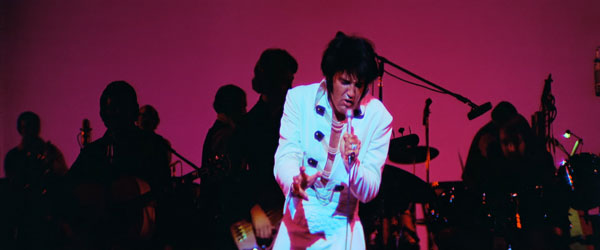
One of the things I’ve always loved about Elvis: That’s The Way It Is and its associated outtakes is the mood lighting behind Elvis, that wall of changing colors, controlled by his friend Lamar Fike. The magenta color during “You’ve Lost That Lovin’ Feelin'” suits the song perfectly.

The “play the hell out of it” scene from the original Elvis: That’s The Way It Is, which unfortunately did not make it into the special edition that has all but replaced it, is up next. Then, we get a kissing and audience walk montage set to the new mashup “Wearin’ That Night Life Look,” which combines “Wearin’ That Loved-On Look” and “Night Life,” among others.

“Little Sister/Get Back” | August 12, 1970 MS, Las Vegas, Nevada | Footage previously unseen

Then, at last, we get the footage of Elvis strapping on his electric guitar at the August 12 MS and singing a medley of “Little Sister” and “Get Back” while sitting on a stool.

I’ll say it right here, it was a mistake for the original director of Elvis: That’s The Way It Is to leave this song on the cutting room floor, and I’ll say the same for the producer of Elvis: That’s The Way It Is – Special Edition, which did at least use a longer edit of the associated rehearsal. Thank you to Luhrmann and Redmond for giving this gem the spotlight it deserves in EPiC.

Near the beginning of the medley, it is unclear who or what Elvis is waving off with a seemingly exasperated look. I have speculated that it was the orchestra, but it also could be Hodge or any number of other things, really.

Speaking of the orchestra, who do not play during the sit-down segment of this show, a few of them appear to be bored in the background. This was a midnight show, after all, so perhaps it was just a long night – their fifth show in three days, plus all of the rehearsals leading up to the engagement. They are also most likely classically trained musicians, and rock ‘n’ roll might not be their thing.

“Little Sister/Get Back” is presented in its entirety.

As Elvis’ 1971 informal studio recording of Bob Dylan’s “I Shall Be Released” plays, EPiC transitions to April 19, 1972, where eight-year-old fan Denise Sanchez, who is battling cancer, meets Elvis before his show in New Mexico in an outtake from Elvis On Tour. Denise, who reportedly met with Elvis again not long before her death, passed away that August.

Denise’s family worked with Parker’s office to arrange the April meeting. It reminds me of the Make-A-Wish program, which did not yet exist in 1972. I would like to encourage interested readers of The Mystery Train to donate to Make-A-Wish or another youth-focused charitable organization in Denise’s name.

As “I Shall Be Released” continues to play, EPiC moves to Elvis apparently on an elevator on the way to a rehearsal and then a light-hearted moment where Elvis successfully ties the largest necktie I’ve ever seen.

We catch the end of a previously unseen rehearsal of “Burning Love,” including Elvis having fun with Bill Baize’s falsetto notes.

“Burning Love” | Edit of various performances from March and April 1972 | Some footage previously unseen

We shift to previously unseen footage of Elvis introducing “Burning Love” in his first-ever live performance of the song during his April 14, 1972, concert in Greensboro, North Carolina. This is just a little over two weeks after he recorded the studio master, and the single is not even out yet.

Before Elvis begins singing, however, EPiC shifts to another rehearsal of “Burning Love” and soon we are into a montage of various rehearsals and the live performance of the song. 1972’s answer to the 1970 “Polk Salad Annie” edit unfortunately doesn’t quite live up to that peak.

The 2015 album If I Can Dream featured Elvis’ vocals with new backing supplied by the Royal Philharmonic Orchestra (RPO). At the time, I enjoyed the concept for what it was, but the use of the RPO version of “Burning Love” as the base for this edit in EPiC is just a poor choice – especially considering that the original studio version is a rock ‘n’ roll classic.

The RPO version is just too much, especially the over-the-top strings at the beginning of the song and at various points throughout. None of it feels right for the mostly unseen footage EPiC is providing.

That aside, we are treated in the montage to multiple different rehearsals of “Burning Love” before picking back up with the Greensboro concert, where he is reading the lyrics. Whether he liked “Burning Love” or not, it was not unusual for Elvis to need a lyric sheet. The proof is in EPiC that he did rehearse the song multiple times.

The 1972 footage captured for Elvis On Tour is presented in the correct aspect ratio. It looks great, but one of the reasons the segment pales compared to “Polk Salad Annie” is because it loses focus. If the edit had stayed with Elvis performing “Burning Love” in rehearsals and in concert, it would have been much stronger. Instead, it replays the footage of him running to the car (why show this again in such a short movie?) and other odd distractions, like:

  • Backstage moments, including Elvis joking around and signing autographs
  • Elvis arriving on stage, multiple times
  • Elvis kneeling and holding his cape up as he prepares to leave the stage, multiple times
  • Elvis greeting fans at an airport

While there are some great shots here, new and old, it just feels too random in such a superbly edited film. A “life on the road” montage just doesn’t fit in the middle of “Burning Love.”

One of the more relevant backstage moments used, however, is Elvis talking about how “they had forgotten the ending” in reference to the Greensboro performance of the song, which was enjoyable to see.

Devil In Disguise

After spending most of his ELVIS biopic pummeling Parker, Luhrmann unfortunately wastes more time in his EPiC documentary taking swipes at Elvis’ manager. The movie takes an unneeded two-minute diversion to remind us that Parker was a “devil in disguise.”

When EPiC promised found footage, I wasn’t expecting it to be of Parker applying suntan oil – a moment that will now live forever in the annals of Elvis history, thanks to EPiC. When I saw someone boast he had watched EPiC 23 times so far, I remembered that means he has watched the Parker suntan oil scene 23 times. As of this writing, I’ve also seen this suntan oil footage 12 times. I’ll probably never catch up.

In all seriousness, those two minutes about Parker could have been put to better use, such as, for example, extending some of those all-too-short rehearsal segments earlier in the film.

I do love seeing the stacks of Elvis records being sold next to all those stuffed hound dogs at the Las Vegas Hilton in 1972, including As Recorded At Madison Square Garden, On Stage, That’s The Way It Is, and both volumes of the Worldwide Gold Award Hits boxed sets.

“Never Been To Spain” | April 9, 1972 ES, Hampton Roads, Virginia | Footage previously unseen

After Elvis talks in a June 1972 press conference about his desire to tour the world, noting that he has never been to Britain or Japan, EPiC moves into a live performance of “Never Been To Spain.” I have no problem with this song in the context of a full Elvis concert, but I feel it drags EPiC down a bit here and that a different song would have been a better choice rather than using “Never Been To Spain” as yet another swipe at Parker, who never did book that world tour Elvis had been talking about since at least 1958. “Before I came in the Army, we were planning a tour of Europe” Elvis told reporters at a press conference marking his departure for Germany in September of that year as part of his military service.

“Love Me” | Edit of various performances from April 1972 and August 1970 | Previously unseen footage

In previously unseen footage, Elvis is shown lying on the floor of the Coliseum in Richmond, Virginia, on April 10, 1972, as he introduces “Love Me.” Unfortunately, EPiC then takes us to another well-known Ed Sullivan Show clip, this time for the opening of his October 28, 1956, performance of “Love Me.”

EPiC then moves to a cool but ultimately unnecessary remix of Elvis’ 1956 studio recording of the song, before finally getting back to the 1970s with previously unseen footage from Hampton Roads, April 9, 1972 ES, where Elvis picks up a bra someone threw on the stage and wears it on his head, and Las Vegas, August 12, 1970 MS, where the edit concludes with Elvis singing a bluesy version of the song during the sit-down segment of that show – the best part of EPiC‘s “Love Me” edit. And again, I love that background wall of color. I’m glad EPiC is making use of the electric guitar segment.

“Twenty Days And Twenty Nights” | August 7, 1970, Las Vegas, Nevada | Footage previously unseen

Near the end of another flashback segment, this one propelled by Elvis’ sublime recording of “Blue Moon” from 1954, Elvis talks about the tragedy of losing his mother, Gladys Presley, who died in August 1958. The “I miss her” ending of “Twenty Days And Twenty Nights” is shown from a Las Vegas rehearsal, effectively using the song to memorialize Gladys. EPiC gets away with it by showing the bit out of context, as the song is actually about a man who is missing his wife after abandoning her.

“I Can’t Stop Loving You” | August 11, 1970 DS, Las Vegas, Nevada | Footage previously released in Elvis: That’s The Way It Is – Special Edition

In the 1972 interview, Elvis talks about how he’ll change up what he’s doing on stage based upon the audience reaction. Appropriately, EPiC then cuts to Elvis telling the band during the August 11, 1970 DS in Las Vegas, “Forget ‘Patch It Up.’ Let’s do ‘Can’t Stop Loving You.'”

As it weakens the moment EPiC is obviously intending to highlight, I will point out that the caption is wrong here, too. The caption states, “We’ll get past it. Let’s do ‘Can’t Stop Loving You.'”

For an artist who is sometimes wrongly portrayed as detached from his art, Elvis is shown in EPiC as truly involved in every aspect of his show, even down to the lighting as demonstrated in a brief scene that I especially appreciate.

In another scene, which appears to be August 11 or 12, 1970, Elvis and his team discuss in his dressing room how the sound has improved since opening night a day or two earlier. In one of the stranger moments of EPiC, Elvis asks Hodge to show the camera his “crystal clear look” and Hodge proceeds to do so. I’ve seen this 12 times, too.

“Are You Lonesome Tonight” | August 12, 1970 MS, Las Vegas, Nevada | Footage previously released in Elvis Lives: The 25th Anniversary Concert

Up next, we get an incredible version of “Are You Lonesome Tonight” from the sit-down segment of the August 12, 1970 MS. This performance is presented in its entirety. Though it is simple compared to many other segments, this is one of EPiC‘s best moments.

“Always On My Mind” | March 30, 1972, Hollywood, California | Footage previously released in This Is Elvis

“Are You Lonesome Tonight” | April 9, 1972 ES, Hampton Roads, Virginia | Footage previously released in Elvis: The Lost Performances

The “Always On My Mind” segment begins next, and there is really some creative editing to the opening as it also mashes with Elvis singing “Are You Lonesome Tonight” in Hampton Roads in 1972, interviews where Elvis discusses loneliness, and various home movies.

“Always On My Mind” is a “breakup” song, so I did find it a little odd that Luhrmann concentrates many of the visuals on Elvis’ daughter, Lisa Marie Presley. Perhaps he was trying to distinguish his use of “Always On My Mind” from how previous Elvis documentaries used it.

It might have also been an attempt to pay tribute to Lisa, who was a vocal supporter of Luhrmann’s ELVIS biopic and passed away in 2023. If so, “All My Trials,” later in the film, might have been a better opportunity:

“So hush little baby, don’t you cry. You know your daddy’s bound to die. But all my trials, Lord, soon be over.”

Every official use thus far of this “Always On My Mind” footage, originally filmed for Elvis On Tour, has included home movies interspersed with Elvis singing the song. Perhaps the raw footage is incomplete. If a complete version exists, however, I would love to see it uninterrupted one day. It is one of my all-time favorite Elvis performances.

“Oh Happy Day” | August 7, 1970, Las Vegas, Nevada | Footage previously unseen

Wow! Elvis wakes us up next with a rousing rendition of “Oh Happy Day.” This is actually a remix, and it works perfectly. So awesome finally to see Elvis singing this song. I first heard his version back in 2000, with fairly low quality sound, so this is another one that has been a long time coming. “Oh Happy Day” serves as a great introduction to the gospel portion of EPiC.

“How Great Thou Art” | April 9, 1972 ES, Hampton Roads, Virginia | Footage previously released in Elvis: The Lost Performances

“How Great Thou Art” from Hampton Roads is used effectively as a framing device for a discussion of gospel music and what it means to Elvis and those around him, including a few more songs shown in rehearsals. I am really glad that EPiC leans so much into gospel, more so than any other Elvis documentary that wasn’t exclusively focused on that topic.
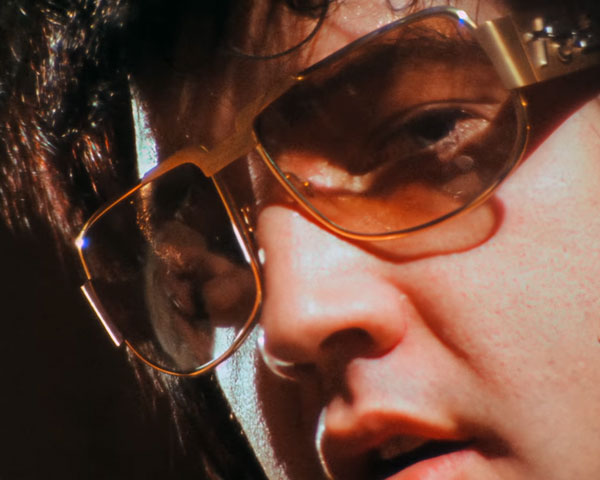
Elvis Presley in EPiC (NEON, 2026)

“I, John” | April 5, 1972, Buffalo, New York | Footage previously released in Elvis On Tour

“Nearer My God To Thee” | March 31, 1972, Hollywood, California | Footage previously unseen

I’ve wondered why Luhrmann includes a bit of “When It’s My Time,” which features Baize and the other members of the Stamps, versus some of the other songs from that gospel jam session that might have had a more pleasing sound. I discovered that Baize apparently sang the same song at Elvis’ private funeral on August 18, 1977, so perhaps that is why Luhrmann chose to use it.

When the segment circles back to “How Great Thou Art,” I love the upbeat ending Elvis used on his live versions. He really was something. One of my favorite moments in Elvis On Tour is watching Elvis listen to the Stamps sing “Sweet, Sweet Spirit” and you can see a similar joy in his face here as he listens to them.

Other than the interlude that splits it, “How Great Thou Art” is presented in its entirety.

“A Big Hunk O’ Love” | Edit of various performances from March and April 1972 | Some footage previously unseen

A previously unseen rehearsal of “A Big Hunk O’ Love” from March 31, 1972, kicks things off next and a previously unseen live version from his April 14, 1972, concert in Greensboro soon takes over. EPiC stays with this one for awhile. I do wish they had used some footage of Glen Hardin on piano during his solo, as it seems off not to show him then–even if they had to grab it from a different concert or a rehearsal. During the James Burton guitar solo, EPiC moves us over to the familiar version from the Hampton concert, as seen in Elvis On Tour.

“Bridge Over Troubled Water” | August 4, 1970, Las Vegas, Nevada | Footage previously released in Elvis: That’s The Way It Is

“Bridge Over Troubled Water” | April 9, 1972 ES, Hampton Roads, Virginia | Footage previously unseen

“Bridge Over Troubled Water” is another song that Elvis owned in 1970. His definitive versions are from that year. EPiC presents only a brief rehearsal snippet of “Bridge Over Troubled Water” from August 4, 1970, before turning to a previously unseen live version from April 9, 1972, in Hampton Roads. It’s a good version, but he did it so much better in 1970. I don’t want to harp on this because the performance for its own sake is perfectly fine. It’s only the comparison to Elvis at his peak that makes it feel disappointing.

“In The Ghetto” | August 13, 1970 DS, Las Vegas, Nevada | Footage previously released in Elvis: The Lost Performances

“Men With Broken Hearts” | August 11, 1970 MS, Las Vegas, Nevada | Footage previously released in Elvis: The Lost Performances

“Walk A Mile In My Shoes” | August 11, 1970 MS, Las Vegas, Nevada | Footage previously released in Elvis: The Lost Performances

One of the most powerful segments of EPiC is up next. It begins with a remix of “In The Ghetto.” The underlying track of the remix is from the RPO version, which uses his 1969 studio audio, so unfortunately it does not sync to his lips in the 1970 live footage as well as it might have. While I do wish they had used Elvis’ actual August 13, 1970 DS vocals as the underlying source for this remix rather than the RPO version, I love the outcome enough to let that go.

EPiC uses the familiar “I’m just an entertainer, and I’d rather not say” comment from Elvis in 1972 at his Madison Square Garden press conference in a brilliant way here by juxtaposing it against “In The Ghetto,” “Men With Broken Hearts,” and “Walk A Mile In My Shoes.” Despite the ever-watchful Parker, Elvis did not always keep his social views to himself. You just had to know where to listen.

“Men With Broken Hearts” serves as a perfect bridge between “In The Ghetto” and “Walk A Mile In My Shoes.” Elvis himself paired “Walk A Mile In My Shoes” in a medley with “In The Ghetto” during his Winter 1970 Vegas engagement, so EPiC honors his instincts here in this segment.

While the August 11, 1970 MS “Walk A Mile In My Shoes” is edited here, it is at least creatively and effectively done. I was actually disappointed they didn’t carry that edit over to the soundtrack, since I already have the full version on other releases.

Watching the incredible “Men With Broken Hearts” and “Walk A Mile In My Shoes” on Elvis: The Lost Performances back in 1992 helped turn me into the obsessive Elvis fan I am today.

“Suspicious Minds” | August 11, 1970 DS, Las Vegas, Nevada | Footage previously released in Elvis: That’s The Way It Is – Special Edition

I will get my gripe out of the way first. In an overzealous attempt to tout more “previously unreleased footage,” one of the mistakes of Elvis: That’s The Way It Is – Special Edition was replacing the greatest version of “Suspicious Minds” ever filmed, the August 12, 1970 MS, with the inferior August 11, 1970 DS version.

I was really hoping EPiC would repair this rip in the Elvis history continuum, but, alas, EPiC also uses the August 11, 1970 DS rather than the superior version from the following night.

That out of the way, this version of “Suspicious Minds” is still fantastic. It is slightly edited, but not in an annoying fashion (unlike, say, the horrible editing of the August 12, 1970 MS version in This Is Elvis). “Suspicious Minds” was wonderful to see in the theater. The drums sound like machine guns, reminiscent of 1956’s “Hound Dog.”

Switching over to primarily using footage from the August 12, 1970 DS, there is then an extended drum solo at the end which evidently combines that audio element from multiple shows or loops it. The solo is about seven seconds longer than the actual solo on the August 12, 1970 DS, which was the longest ending drum solo I found among the five versions of “Suspicious Minds” recorded during that engagement.

This brings up another technical item that I do not want to spend too much time on, but the sound of some of the songs, even those that were not formally remixed, has been sweetened in various ways for EPiC, including the drums. I will just say that the approach works for this film, but my go-to versions as a listener will remain the originals. That said, many of the true mashups and remixes from EPiC have earned permanent spots in my Elvis rotation.

Things are winding up now. We pull away from the stage to a party in Elvis’ dressing room after the August 10, 1970 OS. Most if not all of this footage was previously seen in Elvis: That’s The Way It Is – Special Edition. I enjoy seeing Elvis interacting with Sammy Davis, Jr., and Cary Grant. There is then another montage of Elvis kissing and interacting with fans, both onstage and off.

“All My Trials” (from “An American Trilogy”) | April 9, 1972 ES, Hampton Roads, Virginia | Footage previously released in This Is Elvis

We now circle back to “An American Trilogy” in Hampton Roads with “All My Trials” and just a hint of “Dixie” in the flute solo. This is all part of a beautiful new mashup called “Bring The Curtain Down,” which also contains elements of “I’m Yours” and “Are You Lonesome Tonight.” It gives me chills, even after watching and hearing it multiple times.

“Can’t Help Falling In Love” | August 10, 1970 OS, Las Vegas, Nevada | Footage previously unseen

The concert portion of EPiC ends on a high note with a previously unseen and complete version of “Can’t Help Falling In Love” from the August 10, 1970 OS. Elvis looks absolutely worn out. By the close of the engagement on Labor Day, September 7, he will have performed 57 more shows with no days off.

The Las Vegas curtain coming down as the show ends is always so cool. EPiC again shifts between multiple shows here, but for a quick moment you can see Elvis jumping up from his kneeling position while pumping his fist in the air after the curtain closes on the August 12, 1970 MS, which may well have been the best concert of his life.

We then follow Elvis from a different show to the elevator while he talks in voiceover about performing live.

Exhausted, he smiles as he disappears behind the elevator doors. He is gone.

It gets me every time.

There is something so perfect about that moment. Redmond or Luhrmann or whoever thought of it really deserves credit. How many people before them passed on using this footage?

Elvis’ face as the doors shut actually makes me think of a similar exhausted smile at the end of 1977’s Elvis In Concert. A lot changed for Elvis between 1970 and 1977, but he was still at heart the same man trying his best to entertain us.

EPiC has a perfect landing right here.

Unfortunately, it doesn’t land here.

“American David”

Instead, at the end of a movie that did so much to restore Elvis’ voice such that he could finally tell his own story, we get U2’s Bono reciting a portion of his 1995 poem “American David,” which is apparently intended as a tribute to Elvis.

I won’t include any of it here, but it leaves a stain on EPiC that only the sheer power of what came before is able to overcome.

Bono read a portion of his “American David” at the end of another Elvis documentary, 2002’s Elvis Lives, which aired on NBC the same night that network ran a restored version of Loving You (1957). [Elvis Lives is not to be confused with Elvis Lives: The 25th Anniversary Concert, an entirely different project that was taped in 2002 but not released until 2007.]

After the reading of said poem, Elvis asks us, “Do you miss me?” one more time.

The Credits

I don’t remember ever reviewing credits before, but it has to be done with EPiC. For one thing, the two mashups that play over the credits are spectacular – “A Change Of Reality” and “Don’t Fly Away.” “Don’t Fly Away” was also used in ELVIS, but I failed to recognize its masterpiece status back then.

There’s also a bit more footage shown, including some previously unreleased. That portion ends with Elvis’ dressing room door closing to reveal a “No Smoking” sign, which is quite funny since we have just watched people smoking around Elvis almost constantly for the last 95 minutes.

The credits are fun, but they are lacking acknowledgement not only of the original directors of Elvis: That’s The Way It Is and Elvis On Tour, but of the other performers who supported Elvis during those films.

The RPO gets credited on their songs. The remixers get credited on their songs, but most of the original performers besides Elvis receive nothing. The sole exception is “When It’s My Time,” for which Baize and the Stamps are acknowledged. While the actual movie excludes them, the EPiC soundtrack album at least provides credit for the original performers.

EPiC ends where it began, with Elvis saying, “I’d like to talk to you a little bit, ladies and gentlemen, about how I got in this business. There’s been a lot written and a lot said, but never from my side of the story.” Maybe he heard that Bono poem and felt we needed to listen again?


Despite how much I love EPiC, there are two issues that are worthy of changing in future editions of the film, hopefully including the physical media versions coming out later this year.

The most critical change is that the original performers who backed Elvis during Elvis: That’s The Way It Is and Elvis On Tour and the original directors of those movies should be properly credited or, at the very least, acknowledged by name in the “Special Thanks” section.

I don’t know the legalities or politics involved in movie credits, but I do know that Elvis took the time in every show of that era to introduce his fellow performers. In turn, they even supported Elvis in his later years by playing extra long solos during those introductions such that he could take extensive breaks between numbers. They were also credited in the original movies.

The credits of EPiC should be changed because it’s the right thing to do. Without the original performers and creative teams, there is no EPiC.

The second change that should occur is that all of the 1970 footage that was originally filmed for Elvis: That’s The Way It Is should be revised to its correct aspect ratio. I am not going to belabor this point. You either see it or you don’t. I saw the issue in the initial trailers and during my first viewing of the film. I managed to force myself to ignore it due to how fantastic the film is. But why not show the original footage as it was meant to be seen? If it was an artistic choice, then it was a poor one that should be reconsidered and abandoned. If it was a mistake, then it should be fixed.

EPiC is now an important part of the legacy of Elvis Presley. As such, it also has a responsibility to credit those who shared the stage and screen with him as well as to properly preserve and present the footage it uses.


As of now, EPiC: Elvis Presley in Concert stands as my third favorite film of all time, behind only Star Wars (1977) and The Empire Strikes Back (1980).

Those two have been at or near the top of my list for decades, and recency bias might be helping EPiC.

I’ll let you know in another decade or two if it manages to hold or even gain from that position.


For reference, here is my working breakdown of the 1970 (highlighted in yellow) and 1972 (highlighted in red) performances featured in EPiC.

Song Date Location Footage Status
The Battle Hymn Of The Republic (from “An American Trilogy”) April 9, 1972 ES Hampton Roads Previously released in This Is Elvis
Stranger In The Crowd July 29, 1970 Hollywood Previously released in Elvis: That’s The Way It Is
A Fool Such As I July 29, 1970 Hollywood Previously unseen
What’d I Say July 29, 1970 Hollywood Previously released in Elvis: That’s The Way It Is
I Was The One July 29, 1970 Hollywood Previously released in Elvis: The Lost Performances
You Don’t Have To Say You Love Me August 4, 1970 Las Vegas Previously unseen
Ghost Riders In The Sky July 15, 1970 Culver City Previously unseen
Alla En El Rancho Grande July 15, 1970 Culver City Previously unseen
Runaway July 15, 1970 Culver City Previously unseen
Yesterday July 15, 1970 Culver City Previously unseen
Something July 29, 1970 Hollywood Previously unseen
That’s All Right* August 12, 1970 DS Las Vegas Previously unseen
Tiger Man August 12, 1970 MS Las Vegas Previously released in Elvis: That’s The Way It Is
Hound Dog August 11, 1970 MS Las Vegas Previously released in Elvis: The Lost Performances
Polk Salad Annie July-August 1970 Various Portions previously unseen
You’ve Lost That Lovin Feelin’ August 11, 1970 MS Las Vegas Previously unseen
Little Sister/Get Back* August 12, 1970 MS Las Vegas Previously unseen
Burning Love March-April 1972 Various Portions previously unseen
Never Been To Spain April 9, 1972 ES Hampton Roads Previously unseen
Love Me April 1972 and August 1970 Various Previously unseen
Twenty Days And Twenty Nights August 7, 1970 Las Vegas Previously unseen
I Can’t Stop Loving You August 11, 1970 DS Las Vegas Previously released in Elvis: That’s The Way It Is – Special Edition
Are You Lonesome Tonight* August 12, 1970 MS Las Vegas Previously released in Elvis Lives: The 25th Anniversary Concert
Always On My Mind March 30, 1972 Hollywood Previously released in This Is Elvis
Are You Lonesome Tonight April 9, 1972 ES Hampton Roads Previously released in Elvis: The Lost Performances
Oh Happy Day August 7, 1970 Las Vegas Previously unseen
How Great Thou Art* April 9, 1972 ES Hampton Roads Previously released in Elvis: The Lost Performances
I, John April 5, 1972 Buffalo Previously released in Elvis On Tour
Nearer My God To Thee March 31, 1972 Hollywood Previously unseen
A Big Hunk O’ Love March-April 1972 Various Portions previously unseen
Bridge Over Troubled Water August 4, 1970 Las Vegas Previously released in Elvis: That’s The Way It Is
Bridge Over Troubled Water April 9, 1972 ES Hampton Roads Previously unseen
In The Ghetto August 13, 1970 DS Las Vegas Previously released in Elvis: The Lost Performances
Men With Broken Hearts August 11, 1970 MS Las Vegas Previously released in Elvis: The Lost Performances
Walk A Mile In My Shoes August 11, 1970 MS Las Vegas Previously released in Elvis: The Lost Performances
Suspicious Minds August 11, 1970 DS Las Vegas Previously released in Elvis: That’s The Way It Is – Special Edition
All My Trials (from “An American Trilogy”) April 9, 1972 ES Hampton Roads Previously released in This Is Elvis
Can’t Help Falling In Love* August 10, 1970 OS Las Vegas Previously unseen

* Presented complete in EPiC.

EPiC: Through Elvis’ Voice | Along For The Ride Ep. 1.2

ALONG FOR THE RIDE episode 2 is now available from The Mystery Train (underlying radio image created by generative AI)

In episode 2 of the Along For The Ride radio show, our discussion of Baz Luhrmann’s EPiC: Elvis Presley in Concert continues with topics including:

  • Elvis’ Onstage Humor
  • “Polk Salad Annie”
  • “I Like Elvis” & “I Hate Elvis” Buttons
  • The Strange Dog Scene
  • Elvis’ Jumpsuits & Capes
  • The TCB Band
  • Elvis’ Compassion

The second episode is embedded below or you can jump directly to YouTube.

Exclusive bonus for readers of The Mystery Train

Listen to an outtake from episode 2 below, where Elvis takes over as producer.

The Mystery Train Presents: Along For The Ride

ALONG FOR THE RIDE episode 1 is now available from The Mystery Train (underlying radio image created by generative AI)

We’ve been working on something here at The Mystery Train for the last six weeks, and I’m excited finally to be able to share it with you.

Not long after we saw Baz Luhrmann’s EPiC: Elvis Presley in Concert back in February, my bride came up with the idea for an online radio show or podcast that we would co-host on The Mystery Train. The concept grew directly out of real conversations we were already having after the film. Neither of us had ever done anything like this, so much research ensued.

The underlying idea of Along For The Ride is simple: My bride is literally along for the ride with a lifelong Elvis fan as her husband. She has now seen EPiC in theaters with me twice, and projects like that naturally spark questions for her. Along For The Ride gives you a chance to listen in on those unscripted conversations.

I am not an “Elvis expert.” However, I have been listening to his music, watching his performances and movies, and reading about him for just about my entire life. Her fresh perspective often helps me see Elvis and his world in new ways.

The first episode is embedded below or you can jump directly to YouTube.

Exclusive bonus for readers of The Mystery Train

All I had to say was, “. . . . Baz Luhrmann used audio from Bono of the band U2. . . .” That doesn’t sound so difficult, does it? Play my attempt below.

The Look

Last month, NEON released the official teaser trailer for Baz Luhrmann’s latest project, EPiC: Elvis Presley in Concert. Check it out over on YouTube.

As Elvis Presley fans we could say a lot of things about that trailer, couldn’t we? We could quibble over dates, for instance, or debate the definition of “lost.”

None of that matters.

There’s a blink-and-you-miss-it moment in the trailer that clinches EPiC for me. Watching Elvis over the years, you become familiar with a certain look in his eyes. It’s a quick glance. Sometimes directly to fans. Sometimes to cameras. He seems to say, “You’re in on this with me, aren’t you?”

In the EPiC teaser, it occurs at 0:58. Here it is:

Elvis Presley in 1970, from the EPiC: Elvis Presley in Concert teaser, 2025, NEON

Elvis Presley in 1970, from the EPiC: Elvis Presley in Concert teaser (2025, NEON)

The film hits IMAX theaters worldwide on February 20, with early access showings beginning on February 18, and then expands to wide release on February 27 globally.

While there have been limited-run screenings over the years, EPiC represents the first wide release of an Elvis documentary in cinemas since 1981’s This Is Elvis.

We’ve lost many first generation Elvis fans since that time. For many second (and beyond) generation fans, like myself, events like EPiC are the closest we’ll ever come to experiencing Elvis in person.

EPiC allows Elvis to tell his own story, using audio from multiple sources. It also features fully restored video of previously released and unreleased content. Most of the footage used was originally filmed for the documentaries Elvis: That’s The Way It Is (1970) and Elvis On Tour (1972).

The film left stellar reviews in its wake after the world premiere at the Toronto International Film Festival in September last year, the European premiere at the Zurich Film Festival in September and October, and the United States premiere in Memphis at the TCB Showroom on January 8, the 91st anniversary of Elvis’ birth.

Footage from other eras is also featured to help round out the narrative. Most notably, color footage of Elvis performing in Hawaii in 1957 is included–30 seconds of which was first released by Graceland with little fanfare on the Aloha From Hawaii: 40th Anniversary Edition DVD (2013).

Sony on January 8 announced plans for the EPiC soundtrack, which will be available February 20 on digital and CD and April 24 on vinyl.

You can preview one of the songs on YouTube here: “Wearin’ That Night Life Look.”

This mashup combines elements from “Wearin’ That Loved-On Look,” “Night Life,” “Let Yourself Go,” and “I, John.” On paper it sounds like a mess, but it manages to work. I love it. As Elvis says, “Just play the hell out of it!”

Luhrmann produced and directed EPiC. He also co-produced, co-wrote, and directed ELVIS (2022), a fictionalized account of the singer’s life that starred Austin Butler (Elvis Presley), Tom Hanks (“Colonel” Tom Parker), and Olivia DeJonge (Priscilla Presley). That film earned nearly $300 million worldwide in its box office run. Butler won a Golden Globe for his portrayal and the movie earned eight Academy Award nominations, including Best Picture and Best Actor (Butler).

That the editor of the teaser trailer included “the look” gives me confidence that EPiC will do Elvis justice. We need to experience and support this one at our local theaters. Don’t make the mistake of waiting to watch it at home. Find it at a theater near you.

And, yes, we’re still in on it with you, Elvis.

Electric Dawn

Anticipation - Artwork created for The Mystery Train with assistance from ChatGPT

“Anticipation” (Artwork created for The Mystery Train with assistance from ChatGPT)

The Elvis Odyssey

Part V: Electric Dawn

With his movie career beginning to flounder and his recent singles receiving little notice, Elvis Presley is at a crossroads. As part of a package deal with yet another movie, he signs on to his first television appearance since a brief guest spot in 1960.

Slated to air on the NBC television network in December 1968, the pre-recorded special is supposed to feature Elvis singing Christmas songs for an hour.

Executive Producer Bob Finkel, however, convinces principal sponsor The Singer Company, NBC, and Elvis’ manager, Tom Parker, to widen the scope of the program beyond Christmas music. Finkel also meets with Elvis, who tells Finkel he wants the special to be completely different than anything in his past, especially his movies.

Elvis: “I want everyone to know what I can really do.”AM

Finkel then hires Steve Binder as Producer/Director of the Singer Presents ELVIS special.

Pre-production begins on June 3 with two weeks of informal rehearsals at NBC Studios in Burbank. Elvis and the crew are working 12-16 hour days, followed by jam sessions in the star’s dressing room.

On June 5, Senator Robert F. Kennedy is assassinated about thirty minutes away in Los Angeles while campaigning for President. Binder is taken with Elvis’ reaction to the news as well as his commentary on the assassination of Reverend Doctor Martin Luther King, Jr., in Memphis only two months earlier.

As a nation mourns, the rest of June is consumed with production of the ELVIS special. Elvis practically lives at NBC while making the program, even moving into his dressing room for a period of time. . . .

Listen along on Spotify.

#183 Trouble/Guitar Man (Alternate-1968)
Memories
June 22, Burbank, CA Master [alternate mix]

The ELVIS special begins with a tight close-up on Elvis’ face as he announces, “If you’re lookin’ for trouble, you came to the right place.” The opener is one of multiple production numbers in the show and begins a light storyline through the motif of “Guitar Man.”

I can only imagine what it must’ve been like to be an Elvis fan in 1968. To tune into this special after all of those years of mostly silly movies and see Elvis practically assault the television screen. Within seconds, it was obvious that he had something to prove.

#184 That’s All Right (Live-1968)
Tiger Man
June 27 8 PM, Burbank, CA

Elvis’ dressing room jam sessions inspire Binder to incorporate something similar into the special. When taping in the dressing room proves unfeasible, Binder instead plans to seat Elvis and his friends on a small stage completely surrounded by a studio audience. Elvis agrees to the concept on the condition that the surviving members of his original band, Scotty Moore (guitar) and DJ Fontana (drums), join him as well.

However, shortly before the first show, Elvis changes his mind and decides he cannot go on for what would be his first appearance since the Pearl Harbor concert in 1961. Binder convinces him to go on stage, telling him he can come right back if he wants. Clad entirely in black leather, Elvis even jokes, “Well, goodnight!” shortly after the audience applauds his entry.

Elvis: “I’ve never gotten over what they call stage fright. I go through it every show.”AM1

In addition to Moore and Fontana, on stage are Elvis’ friends Charlie Hodge and Alan Fortas. Lance LeGault, another friend, plays tambourine at the edge of the audience near Elvis.

Elvis: “It’s more important to try to surround yourself with people who can give you a little happiness because you only pass through this life once, jack. You don’t come back for an encore.”AN

Though dozens are recorded, only five or six of the informal songs make it in the actual special and album.

Among those left out is a rousing performance of “That’s All Right,” the song that started it all for Elvis.

The night, which includes tapings of two “sit-down” shows with similar setlists, is unlike any other in Elvis’ entire body of work.

#185 Baby, What You Want Me To Do (Live-1968)
Tiger Man
June 27 8 PM, 2nd version, Burbank, CA

Early on in both shows, Elvis trades his acoustic guitar for Moore’s burnt-orange electric guitar.19 Producing a raw, raucous sound, Elvis then drives the shows hard, including multiple versions of the Jimmy Reed blues number “Baby, What You Want Me To Do.” This particular rendition also goes unused.

#186 Blue Suede Shoes (Live-1968)
Memories
June 27 6 PM,20 Burbank, CA

“Blue Suede Shoes” is not used in the special or album.

#187 Lawdy, Miss Clawdy (Live-1968)
Memories
June 27 6 PM, Burbank, CA

For the special and album, the 8 PM version of “Lawdy, Miss Clawdy” is used.

From the 6 PM show, this live version manages to be even better than Elvis’ 1956 studio master of “Lawdy, Miss Clawdy.”

#188 Tryin’ To Get To You (Live-1968)
Memories
June 27 6 PM, Burbank, CA

“Tryin’ To Get To You” is not used in the special or album.

Again, Elvis improves upon his original 1955 studio master of “Tryin’ To Get To You” with this rock-infused live version.

#189 One Night (Live-1968)
Memories
June 27 6 PM, 1st version, Burbank, CA

This particular rendition of “One Night” is not used in the special or album.

#190 Baby, What You Want Me To Do (Live-1968)
Memories
June 27 6 PM, 3rd version, Burbank, CA

A portion of this rendition of “Baby, What You Want Me To Do” is used in the special, though it does not appear on the album.

It is difficult to choose between this one and the version already covered from the 8 PM show (track 185 above), but this is probably Elvis’ best-ever version of “Baby, What You Want Me To Do.” While he would return to the song in his first engagement at the International Hotel in Las Vegas the next year, it just was not the same.

#191 No Strap/One Night (Live-1968)
Memories
June 27 6 PM, 2nd version, Burbank, CA

As the sit-down show nears its end, Elvis declares that he wants to stand up–an idea he had been flirting with throughout the performance. He asks Moore if he has a strap for the borrowed electric guitar that Elvis has been using for most of the show. Moore says there is no strap, leading Elvis and the gang to begin singing joking lyrics to the tune of “One Night”:

“No strap today is what I’m now looking for. The things I did and I saw would make the dream–where, where, where, where’s the strap?”

Finally, Elvis stands up, props his foot on his chair and the guitar on his knee and completes another rendition of “One Night” which appears in both the special and on the album.

A truly incredible performance.

#192 Memories (Alternate-1968)
ELVIS: ’68 Comeback Special – 50th Anniversary Edition
June 24, Burbank, CA Take 2 Master [stereo mix]

#193 Saved (Alternate-1968)
Let Yourself Go!
June 22, Burbank, CA Take B7

Among its production numbers, the ELVIS special includes a nine-minute gospel medley.21 For the first minute of the medley, Elvis steps aside such that the spotlight can shine on dancer and choreographer Claude Thompson and the voice of Darlene Love. In addition to Elvis, the segment then features the Blossoms vocal group (Love, Jean King, Fanita James) and a host of other spirited dancers.

Elvis: “Rock ‘n’ roll music is basically gospel or rhythm & blues, or it sprang from that. And people have been adding to it, adding instruments to it, experimenting with it.”AO

It’s an exciting sequence, and I get breathless on behalf of all of the dancers just watching it. The medley was recorded in segments prior to the taping. This particular version of “Saved” is actually an outtake, but it’s my favorite.

#194 Heartbreak Hotel/Hound Dog/All Shook Up (Live-1968)
Memories
June 29 6 PM, Burbank, CA

Two days after the sit-down shows, Elvis appears alone on the same stage in his black leather suit to perform two formal stand-up shows featuring updated arrangements of many of his biggest hits. Elvis is again surrounded by a small studio audience, but this time a full band and orchestra are set just beyond one side of the stage.

This medley of “Heartbreak Hotel,” “Hound Dog,” and “All Shook Up” is featured in both the special and on the album.

This is a powerhouse moment in the ELVIS special, particularly the reinvention of “Heartbreak Hotel” as a rock anthem. Elvis never sang it like this again, preferring a bluesy approach in 1969 and onwards.

#195 Can’t Help Falling In Love (Live-1968)
Memories
June 29 6 PM, Burbank, CA

This version of “Can’t Help Falling In Love” is used in both the special and the album.

This is a beautiful rendition of the song that is on par with his original studio master (1961).

#196 Jailhouse Rock (Live-1968)
ELVIS: ’68 Comeback Special – 50th Anniversary Edition
June 29 8 PM, Burbank, CA

This version of “Jailhouse Rock” is used in both the special and the album.

Though not quite as stellar as his original studio version (1957), this is, by far, Elvis’ best live recording of “Jailhouse Rock.”22

#197 Love Me Tender (Live-1968)
ELVIS: ’68 Comeback Special – 50th Anniversary Edition
June 29 8 PM, Burbank, CA

This version of “Love Me Tender” is used in both the special and the album.

This is another example of a 1968 live version exceeding the original studio master (in this case, 1956).

#198 Baby, What You Want Me To Do (Live-1968)
Memories
June 29 6 PM, Burbank, CA

Once the main portion of each stand-up show concludes, Elvis works on a couple of segments intended for larger production numbers in front of the same audience. During the 6 PM show, there is a brief pause while pre-recorded music is being cued. Left standing with nothing to do, Elvis begins to appear uneasy. “Give me my guitar, man. I’ll play something,” he says. He picks up yet another borrowed electric guitar, this time a cherry red one from session musician Al Casey, and riffs into his go-to comfort song, “Baby, What You Want Me To Do,” eventually dropping to his knees as he plays to an audience member. This rendition is not used in the special or album.

#199 Trouble/Guitar Man (Live-1968)
ELVIS: ’68 Comeback Special – 50th Anniversary Edition
June 29 8 PM, Burbank, CA

To serve as a conclusion to the storyline that began at the opening, a new verse is written for Jerry Reed’s “Guitar Man”:

“Well, I come a long way from the carwash, got to where I said I’d get. Now that I’m here, I know for sure I really ain’t got there yet. So, I think I’ll start all over, sling my guitar over my back. I’m gonna get myself back on the track, I ain’t never, ever gonna look back. I’ll never be more than what I am, oh, wouldn’t you know, I’m a swingin’ little guitar man? Take it home, son, take it home.”23

A portion of this live reprise of “Trouble/Guitar Man” is used in the special.

#200 If I Can Dream (Alternate-1968)
Memories
June 30, Burbank, CA TV-Take 4 Master

After ELVIS was restructured into something more than a Christmas special, “I’ll Be Home For Christmas” was at first still intended as the closing song. Based on Elvis’ reactions to the murders of King and Kennedy, Binder is convinced that Elvis should make a statement of some sort after singing the song. Earl Brown, who is creating vocal arrangements for the show, suggests using “You’ll Never Walk Alone” instead of “I’ll Be Home For Christmas.” When this idea is rejected, Brown writes the music and lyrics of an original song, “If I Can Dream,” which allows Elvis to make his statement in the medium he is most comfortable, music.

From “If I Can Dream”: “If I can dream of a better land where all my brothers walk hand in hand, tell me why, oh why, oh why can’t my dream come true?”

Taped on the last day of the special’s production, with Elvis dressed in a white double-breasted suit, “If I Can Dream” represents for me the greatest musical achievement of Elvis’ life.24

The ELVIS special airs on Tuesday, December 3, at 9:00 PM Eastern and becomes the most-watched program of the week and the highest-rated television special of the year.

“If I Can Dream” climbs to #12 on the charts, while the ELVIS-TV Special album makes it to #8.

Elvis: “I’m never going to sing another song I don’t believe in. I’m never going to make another picture I don’t believe in.”AP


It has been a long night, but the sun is starting to rise. You are back in your seat in one of the Mystery Train’s passenger cars. “So, this is it?” you ask. “The end of the line?”

I smile and shake my head. “Not at all. That’s the beauty of Elvis. There’s no end to his odyssey. Just when you think he’s done, you start all over.”

Somewhere, you hear a familiar song. Faint. Something from your childhood.

As the train rumbles along, you make your way into the dining car and enter a new world.

Elvis Presley returns in The Elvis Odyssey: A New Summit.

Dialogue from a teleplay, father to son: “Maybe there’s only one summer to every customer.” Only one summer? Only one ride? Only one Elvis? Experience them while you can between Heaven, the Earth, and . . . the edge of reality.

[With apologies to Serling.]


Assorted Rambles

19While some out there have tried to insinuate this was some kind of power play by Elvis, the trading of guitars is a scripted moment, as evidenced by a recording of Binder discussing it with Elvis and Moore during a rehearsal.↩︎

20I really could have added the entire June 27 6 PM Show to The Elvis Odyssey, but I had to at least attempt to control myself. The video of the complete 6 PM show made its debut on the fantastic HBO special Elvis: One Night With You (1985). Missing the boat at that time, RCA/BMG finally released the full audio of the show on Memories: The ’68 Comeback Special (1998) CD. Don’t get me wrong, the 8 PM show is great, too, but there’s something special about that first show. The full audio of the 8 PM show was first released on the Tiger Man CD (1998) and the full video on ELVIS: ’68 Comeback Special – Deluxe Edition DVD set (2004).↩︎

21The full medley consisted of “Sometimes I Feel Like A Motherless Child,” “Where Could I Go But To The Lord,” “Up Above My Head,” “I Found That Light,” and “Saved.”↩︎

22I hope that a 1957 live version of “Jailhouse Rock” will see the light of day at some point in my lifetime, for I suspect it would top even the 1968 one.↩︎

23For me, this new verse sums up the entire ELVIS special. In fact, I’d rather they call it ELVIS: Back On The Track today than ELVIS: ’68 Comeback Special.↩︎

24The version of “If I Can Dream” for the album and single was recorded at Western Recorders studio a week earlier and is just as good as the television version. According to Brown in Elvis Presley: Writing For The King – The Stories Of The Songwriters by Ken Sharp, all three of the Blossoms were in tears at the conclusion of Elvis’ performance of “If I Can Dream” with Love stating, “He really believes in the song and means every word of it.”

Once Parker saw the rough cut of ELVIS in August 1968, he was reportedly outraged that no Christmas songs remained in the special. To appease him, a live performance of “Tiger Man” from the 8 PM sit-down show was dropped from the special in favor of an edited version of “Blue Christmas” from that same show.↩︎

I’ve also created a Spotify version of the complete playlist for The Elvis Odyssey, incorporating all five parts of the series.

I originally planned for this series to be a single post, but my bride wisely convinced me that I needed to split it. Thank you to her for ongoing prayers and encouragement and for reading every word I ever write.


Sources for Elvis Quotes

AMMay 14, 1968 Private Conversation (as reported in Elvis Presley: A Life In Music – The Complete Recording Sessions by Ernst Jorgensen)↩︎

AM1ca. March 1972, Interview, Hollywood, CA↩︎

ANca. September 1962, Interview, Hollywood, CA↩︎

AOJune 27, 1968, 6 PM Show, Burbank, CA↩︎

APca. June 23, 1968 Private Conversation, Burbank, CA (as reported in Elvis Presley: A Life In Music – The Complete Recording Sessions by Ernst Jorgensen)↩︎


Additional Sources For The Entire Series/Further Reading

Any mistakes you might find in this series are purely my own. As for the stuff I got right, I primarily consulted the following sources for this series of posts. I also consider them as recommended reading if you want a deeper dive into the career and life of Elvis Presley than I could provide here.

  • Keith Flynn’s Elvis Presley Pages.
  • Elvis Presley: A Life In Music – The Complete Recording Sessions by Ernst Jorgensen, St. Martin’s Press, New York, 1998.
  • Elvis Day By Day: The Definitive Record Of His Life And Music by Peter Guralnick and Ernst Jorgensen, Ballantine Books, New York, 1999.
  • Last Train To Memphis: The Rise Of Elvis Presley by Peter Guralnick, Little, Brown And Company, Boston, 1994.
  • Careless Love: The Unmaking Of Elvis Presley by Peter Guralnick, Little, Brown And Company, Boston, 1999.
  • Elvis Presley: Writing For The King – The Stories Of The Songwriters by Ken Sharp, Follow That Dream Records, Denmark, 2006.
  • Elvis Presley In Concert.

Thank you for reading. May your 2026 be full of peace, love, and health.

Blessings,
TY


Update

January 18, 2026

Out of the installments for The Elvis Odyssey, Electric Dawn is the one that has continued to feel unsatisfying to me in terms of representing the 1968 ELVIS special. I’m happy with the text of the post, but I had to leave out some music selections in order to maintain my arbitrary overall 200 song count for the Odyssey.

Writing is inherently a self-indulgent exercise. Sure, I hope a reader or two out there enjoys my thoughts on Elvis, but I’m really just doing this for fun. With that in mind, I decided to make an expanded edition.

ELVIS: Back On The Track – Electric Dawn (2026 Expanded Edition)

01. Trouble/Guitar Man (Alternate-1968)
Memories
June 22, Burbank, CA Master [alternate mix]

02. That’s All Right (Live-1968)
Tiger Man
June 27 8 PM, Burbank, CA

BONUS: 03. Heartbreak Hotel (Live-1968)
Memories
June 27 6 PM, Burbank, CA

BONUS: 04. Love Me (Live-1968)
Memories
June 27 6 PM, Burbank, CA

05. Baby, What You Want Me To Do (Live-1968)
Tiger Man
June 27 8 PM, 2nd version, Burbank, CA

06. Blue Suede Shoes (Live-1968)
Memories
June 27 6 PM, Burbank, CA

07. Lawdy, Miss Clawdy (Live-1968)
Memories
June 27 6 PM, Burbank, CA

BONUS: 08. Are You Lonesome Tonight (Live-1968)
Memories
June 27 6 PM, Burbank, CA

BONUS: 09. Tiger Man (Live-1968)
Tiger Man
June 27 8 PM, Burbank, CA

10. Tryin’ To Get To You (Live-1968)
Memories
June 27 6 PM, Burbank, CA

11. One Night (Live-1968)
Memories
June 27 6 PM, 1st version, Burbank, CA

12. Baby, What You Want Me To Do (Live-1968)
Memories
June 27 6 PM, 3rd version, Burbank, CA

13. No Strap/One Night (Live-1968)
Memories
June 27 6 PM, 2nd version, Burbank, CA

14. Memories (Alternate-1968)
ELVIS: ’68 Comeback Special – 50th Anniversary Edition
June 24, Burbank, CA Take 2 Master [stereo mix]

15. Saved (Alternate-1968)
Let Yourself Go!
June 22, Burbank, CA Take B7

16. Heartbreak Hotel/Hound Dog/All Shook Up (Live-1968)
Memories
June 29 6 PM, Burbank, CA

17. Can’t Help Falling In Love (Live-1968)
Memories
June 29 6 PM, Burbank, CA

18. Jailhouse Rock (Live-1968)
ELVIS: ’68 Comeback Special – 50th Anniversary Edition
June 29 8 PM, Burbank, CA

BONUS: 19. Don’t Be Cruel (Live-1968)
ELVIS: ’68 Comeback Special – 50th Anniversary Edition
June 29 8 PM, Burbank, CA

BONUS: 20. Blue Suede Shoes (Live-1968)
ELVIS: ’68 Comeback Special – 50th Anniversary Edition
June 29 6 PM, Burbank, CA

21. Love Me Tender (Live-1968)
ELVIS: ’68 Comeback Special – 50th Anniversary Edition
June 29 8 PM, Burbank, CA

22. Baby, What You Want Me To Do (Live-1968)
Memories
June 29 6 PM, Burbank, CA

23. Trouble/Guitar Man (Live-1968)
ELVIS: ’68 Comeback Special – 50th Anniversary Edition
June 29 8 PM, Burbank, CA

24. If I Can Dream (Alternate-1968)
Memories
June 30, Burbank, CA TV-Take 4 Master

I’ve also created a new Spotify playlist with this version of Electric Dawn. I left the original out there as well.

But wait, there’s more!

Once I broke the 200 barrier, I went back and added even more songs to make an expanded edition of The Elvis Odyssey overall. It’s not as tight as the original, but it gives more of the story. Check it out over on Spotify. I also left the original version of this playlist out there. While I will leave the original version alone, I will keep updating the expanded version as the mood strikes me.


“The Light shines in the darkness, and the darkness has not overcome it.”
John 1:5

Valley Of Echoes

You’re traveling through a curious dimension of ideas . . . the edge of reality.

 Where Nothing's Real - Artwork created for The Mystery Train with assistance from ChatGPT

“Where Nothing’s Real” (Artwork created for The Mystery Train with assistance from ChatGPT)

The Elvis Odyssey

Part IV: Valley of Echoes

It is a time of transition. Fresh from two years of military service, Elvis Presley has returned to the top of the music world, his voice more powerful than ever.

As the industry begins to shift, however, a quiet threat emerges. Lucrative movie deals bring steady success, but at the cost of creative fire.

For loyal fans, glimpses of the dwindling spark that once ignited almost every recording can still shine through. . . .

Listen along on Spotify.

#145 I’m Comin’ Home (1961)
Something For Everybody
Nashville, TN

This song. Wow, just wow. Give me a second, I need to turn the jukebox up again.

I’ve loved “I’m Comin’ Home” since first hearing it in 1987. Floyd Cramer’s magnificent piano absolutely drives this one. The song takes interesting lyrical turns between an almost blues quality and a hopeful note.

This stretch of three songs–“I’m Comin’ Home” through “I Want You With Me”–is another of my favorite sequences in The Elvis Odyssey. All three were recorded in March 1961 at RCA’s Nashville studio.

#146 I Feel So Bad (1961)
I Feel So Bad (Single)
Nashville, TN

“I Feel So Bad” peaks at #5.

In the stereo version of “I Feel So Bad,” listen out for the sax of Boots Randolph moving from left to center in the midst of his solo. This was reportedly due to Elvis being so enthralled by Randolph’s performance that he walked over to him, causing the sax to be picked up through his vocal microphone.

#147 I Want You With Me (1961)
Something For Everybody
Nashville, TN

More Cramer goodness on piano here. That man could play! You’ll hear him on many songs in today’s segment of The Elvis Odyssey. Elvis was blessed to be able to surround himself with top-notch musicians for most of his recordings.

#148 No More (1961)
Blue Hawaii
Hollywood, CA

As Elvis soundtrack albums go, Blue Hawaii is certainly one of the better ones. It is cohesive and has several great songs.

#149 Can’t Help Falling In Love (1961)
Blue Hawaii
Hollywood, CA

“Can’t Help Falling In Love” peaks at #2.

#150 Rock-A-Hula Baby (1961)
Blue Hawaii
Hollywood, CA

After recording the Blue Hawaii soundtrack in Hollywood, Elvis arrives in Hawaii. Before location shooting begins, he performs a benefit concert for the USS Arizona Memorial at Pearl Harbor, which gives the long-stalled tribute to fallen heroes the final push it needs after more than a decade of fundraising struggles.

#151 His Latest Flame (1961)
His Latest Flame (Single)
Nashville, TN

“His Latest Flame” peaks at #4.

#152 Little Sister (1961)
His Latest Flame (Single)
Nashville, TN

“Little Sister” peaks at #5.

#153 Follow That Dream (1961)
C’mon Everybody
Nashville, TN

#154 Good Luck Charm (1961)
Good Luck Charm (Single)
Nashville, TN

“Good Luck Charm” earns Elvis a number one hit.

#155 Night Rider (1961)
Pot Luck With Elvis
Nashville, TN

“Night Rider” is yet another stellar Elvis album cut that should have been a single.

#156 King Of The Whole Wide World (Alternate-1961)
Return Of The Rocker16
Hollywood, CA M7-Take 4 [unedited master]

This extended version of “King Of The Whole Wide World” included the full Randolph sax solo that was unfortunately truncated in the released master.16A Randolph was another key session player from this period that featured on a number of highlights from this timeframe.

#157 You’ll Be Gone (1962)
Do The Clam (Single)
Nashville, TN

I’m not saying that “You’ll Be Gone” would have lit up the charts when it was finally released in 1965, but surely it would have made a better A-Side than “Do The Clam” from the Girl Happy movie? Of course, that would have gone against the approach of Elvis’ manager, Tom Parker, to let the music sell the movies and the movies sell the music.

#158 Suspicion (1962)
Pot Luck With Elvis
Nashville, TN

#159 She’s Not You (1962)
She’s Not You (Single)
Nashville, TN

“She’s Not You” peaks at #5.

#160 Return To Sender (1962)
Return To Sender (Single)
Hollywood, CA

“Return To Sender” peaks at #2.

Elvis: “I’d like to do something someday where I feel that I’ve really done a good job as an actor in a certain type role, but I feel that it comes with time and a little living and a few years behind you. I think that, really. I think that it will come, eventually. That’s my goal.”AF

#161 Bossa Nova Baby (1963)
Bossa Nova Baby (Single)
Hollywood, CA

“Bossa Nova Baby” peaks at #8.

#162 Devil In Disguise (1963)
Devil In Disguise (Single)
Nashville, TN

“Devil In Disguise” peaks at #2.

#163 Witchcraft (1963)
Bossa Nova Baby (Single)
Nashville, TN

#164 Long Lonely Highway (1963)
I’m Yours (Single)
Nashville, TN

Elvis: “[My mother] never really wanted anything, anything fancy. She just stayed the same all the way through the whole thing. I wish–there’s a lot of things happened since she passed away that I wish she could have been around to see that would’ve made her very happy and very proud, but that’s life. I can’t help it.”AG

#165 Viva Las Vegas (1963)
Viva Las Vegas (Single)16B
Hollywood, CA

“Viva Las Vegas” is a stone-cold Elvis classic.

#166 It Hurts Me (Alternate-1964)
Kissin’ Cousins (Single-Italy)16C
Nashville, TN [master, alternate mix]

From “It Hurts Me”: “If you ever tell him you’re through, I’ll be waiting for you. Waiting to hold you so tight. Waiting to kiss you goodnight. Yes, darling, if I had someone like you.”

Elvis is now averaging three movies a year. His music begins to take a backseat to those demands. Other than three songs recorded in January 1964, including “It Hurts Me,” 1964-1965 consists only of movie soundtrack sessions for Roustabout, Girl Happy, Harum Scarum, Frankie and Johnny, and Paradise, Hawaiian Style.17

Meanwhile, the Beatles arrive in America and begin the “British Invasion” with an appearance on the Ed Sullivan Show in February 1964.

Elvis: “At a certain stage, I had no say-so in it. I didn’t have final approval of the script, which means I couldn’t say, ‘This is not good for me.’ . . . I don’t think anybody was consciously trying to harm me. It was just Hollywood’s image of me was wrong, and I knew it, and I couldn’t say anything about it. I couldn’t do anything about it.AH

#167 Run On (1966)
How Great Thou Art
Nashville, TN

In 1966, Elvis’ passion for music finally begins to re-emerge with the recording of How Great Thou Art, a gospel album that earns him his first Grammy Award.

Elvis: “Gospel is really what we grew up with, more than anything else.”AI

#168 In The Garden (1966)
How Great Thou Art
Nashville, TN

#169 Indescribably Blue (1966)
Indescribably Blue (Single)
Nashville, TN

“Indescribably Blue” is one of those midnight brooding Elvis songs, in the vein of “Blue Moon” or “Mystery Train.”

On May 1, 1967, 32-year-old Elvis marries Priscilla Beaulieu in Las Vegas, shortly before her 22nd birthday.

#170 You Don’t Know Me (1967)
Elvis Sings Guitar Man
Nashville, TN

#171 Speedway (1967)
Speedway
Hollywood, CA

Elvis: “I was doing a lot of pictures close together. And the pictures got very similar. A lot of them got very similar. If something was successful, they’d try to re-create it the next time around. So, I’d read the first four or five pages, and I knew it was just a different name with twelve new songs in it. The songs were mediocre in most cases. You can’t get good songs.”AJ

#172 Suppose (Alternate-1967)
Double Features: Easy Come, Easy Go/Speedway
Hollywood, CA Take 1

#173 Guitar Man (1967)
Clambake
Nashville, TN

When no one can duplicate rising country star Jerry Reed’s original guitar style for Elvis’ cover of his “Guitar Man,” producer Felton Jarvis calls in Reed himself, who then plays in a couple of Elvis sessions.

#174 Mine (1967)
Speedway
Nashville, TN

#175 High Heel Sneakers (1967)
Guitar Man (Single)
Nashville, TN

With “High Heel Sneakers,” we hear a hint of the raw, bluesy voice that Elvis will spotlight in his 1968 television special.

#176 Singing Tree (1967)
Clambake
Nashville, TN

#177 You’ll Never Walk Alone (Alternate-1967)
A Life In Music
Nashville, TN Take 2

“You’ll Never Walk Alone” features Elvis on the piano, and in this alternate take he just won’t let the song go. A beautiful performance. While “You’ll Never Walk Alone” is technically a non-secular song, Elvis transforms it into a spiritual song of inspiration.

#178 All I Needed Was The Rain (1967)
Singer Presents Elvis Singing Flaming Star And Others
Nashville, TN

Elvis: “I was never indifferent [about the movies]. I was so concerned until that’s all I talked about. It worried me sick. . . . It was nobody’s fault except maybe my own. I didn’t know what to do. I just felt I was obligated very heavy at times to things I didn’t fully believe in, and that was very difficult.”AK

#179 Stay Away (1968)
US Male (Single)
Nashville, TN

On February 1, 1968, Lisa Marie Presley is born in Memphis to Priscilla and Elvis.

#180 Wonderful World (1968)
Singer Presents Elvis Singing Flaming Star And Others
Hollywood, CA

From “Wonderful World”: “Heaven is found right here on the Earth. It surrounds us in wonderful things all around in this wonderful, wonderful, wonderful, wonderful world.”

#181 Edge Of Reality (Alternate-1968)
Double Features: Live A Little, Love A Little / Charro / The Trouble With Girls / Change Of Habit
Hollywood, CA [unedited master]

Elvis: “So, I had thought they would try to get a new property for me or give me a chance to show some kind of acting ability or do a very interesting story, but it did not change. It did not change. And so I became very discouraged. They couldn’t have paid me no amount of money in the world to make me feel any self-satisfaction inside.”AL

#182 A Little Less Conversation (Alternate-1968)
Memories
Hollywood, CA Take 2 [acetate version]18

Recorded for the movie Live A Little, Love A Little, the single version of “A Little Less Conversation” barely makes it into the top 70.

With Elvis’ movies and records no longer attracting the audiences they once did, no one is sure how an upcoming television special devoted to the star will turn out.

Elvis Presley will return in The Elvis Odyssey Part V: Electric Dawn.


Assorted Rambles

16Return Of The Rocker (1986) was the first Elvis album I ever personally owned. I was 11-years-old. It obviously influenced me for I realized just now that all 12 songs on that compilation made The Elvis Odyssey. Not even That’s The Way It Is, another favorite album of mine, can say that.

Return Of The Rocker is another well-edited and sequenced release from the Gregg Geller era. It really is a perfect compilation of the 1960-1963 timeframe for Elvis, managing to blend his soundtrack and non-soundtrack recordings in an effective way.

While Ernst Jorgensen’s much broader ELVIS: From Nashville To Memphis – The Essential 60s Masters I (1994) was revelatory in that it resurrected tons of Elvis’ non-soundtrack recordings from being filler cuts on albums otherwise devoted to often poor movie tunes, it also can feel a bit antiseptic. Intersperse the tracks of ELVIS: Command Performances – The Essential 60s Masters II into the former’s sequence, though, for quite a different and improved listening experience. Adhering so strictly to the 5-CD format established by the ’50s set was a detriment to both the ’60s and ’70s sets.↩︎

16AThough I don’t know that it was really publicized at the time, Return Of The Rocker actually featured the debut of this extended master of “King Of The Whole Wide World” with the full concluding sax solo by Randolph. The standard version fades way too early and always sounds incomplete to me. Unfortunately, Spotify had only the standard master and an inferior outtake to choose from so I went with the standard master on that variant of this playlist.↩︎

16BDecember 21, 2025 Original Text and Footnote: The fact that a stone-cold Elvis classic like “Viva Las Vegas” was apparently released as a B-Side to an inferior cover of a Ray Charles tune [“What’d I Say”] boggles my mind.

I say “apparently” because some sources list “Viva Las Vegas” as the A-Side, but I’m going by Ernst Jorgensen’s definitive Elvis Presley: A Life In Music – The Complete Recording Sessions from 1998 for this kind of information. However, I have discovered in life that “definitive” does not always mean “perfect.”

January 19, 2026 Update: Neal Umphred of Elvis: A Touch of Gold pointed me to a scan of the single’s RCA listing notice hosted on Keith Flynn’s Elvis Presley Pages site that indicates “Viva Las Vegas” was the intended A-Side. I’ve accordingly updated the reference above. Thank you to Neal and Keith!↩︎

16CWhen “It Hurts Me” was first released as a single in Italy, it sounded quite different from its U.S. counterpart. It turned out that solely the left channel from the stereo recording had been accidentally used for the mono version in Italy, rather than including the right channel as well. This had the distinct advantage of leaving out the Jordanaires, which makes it my go-to version of the song. Though I had to use the standard version on the Spotify playlist, the standard version actually would not have made The Elvis Odyssey and we would have jumped from 1963 to 1966. ↩︎

171964-1965 was the true nadir of Elvis’ career. Though The Elvis Odyssey is essentially a career-spanning retrospective, it is, admittedly, a bit of a cheat. It is most noticeable here in the “valley.” We skip more than 95% of 1964 and 100% of 1965. I could have included a couple of those songs, I suppose. Despite how bad the movie and most of the tunes are, there are actually two or three good songs on the Paradise, Hawaiian Style album, for instance. But are they better than any of the 200 songs of The Elvis Odyssey? Not to me, anyway. At least not at this time in my life when I am compiling this list.

The problem with skipping all of these low points, though, is that it makes the slow comeback a little less noticeable when playing through. A false impression could be given listening to the tracks the way I have arranged them here that Elvis was solid throughout the 1960s. The thing to keep in mind, though, is that these are the fleeting “glimpses” of his old creative fire that will soon be returning in force. Whereas this 1961–March 1968 stretch produced a whopping 43% of his lifetime studio masters, I’ve cherrypicked to such a degree that this timeframe represents only 19% of the tracks of The Elvis Odyssey.↩︎

18When first released in 1998, this backup acetate recording of “A Little Less Conversation” was reported to be an unused vocal from a remake of the song dropped from Elvis’ 1968 television special. The previously unreleased performance soon took on a life of its own far beyond the original single. It was included in the remake of Ocean’s Eleven (2001) and became the theme song to the television series Las Vegas (2003-2008). It has also shown up in multiple other projects.

In 2002, most notably, the track was remixed by DJ and producer Junkie XL (JXL) for a Nike commercial and later released as a single that topped the charts in multiple countries. While the remix reached only #50 in the US, its inclusion on ELV1S: 30 #1 Hits (2002) helped propel that compilation to the top of the US album charts.

Though it is often still wrongly associated with the June 1968 recordings for the television special, the acetate recording of “A Little Less Conversation” was later revealed to be take 2 from the original March 1968 studio session, whereas the single master had been take 16 from the same date. I have to say, Take 2 has a heck of a lot more bite to it than Take 16 or even Take 10, the version used on the Almost In Love (1970) album. It is unfortunate that the blander takes were chosen for release during his lifetime.↩︎


Sources for Elvis Quotes

AFca. September 1962, Interview, Hollywood, CA↩︎

AGca. September 1962, Interview, Hollywood, CA↩︎

AHca. July 1972 Interview↩︎

AIca. July 1972 Interview↩︎

AJca. July 1972 Interview↩︎

AKca. July 1972 Interview↩︎

ALca. July 1972 Interview↩︎


“But those who trust in the LORD will find new strength. They will soar high on wings like eagles. They will run and not grow weary. They will walk and not faint.”
Isaiah 40:31

Storming The Mountain

You’re entering a fantastic land of imagination . . . the edge of reality.

You are alone in the Mystery Train Diner.

The lights are out. The jukebox is dead.

In the empty restaurant, you hear only silence. Not even the noise of the train interrupts the stillness.

There is nothing.

A world without Elvis.

* * *

In the darkness, you slowly realize I am once more sitting in front of you.

“Nobody will ever know who it was,” I whisper, “But out there somewhere, somebody became the first person to play an Elvis song again after he died. The music was too strong to be silenced.”

Without warning, lightning flashes outside and illuminates the restaurant.

The Memphis Flash - Artwork created for The Mystery Train with assistance from ChatGPT

“The Memphis Flash” (Artwork created for The Mystery Train with assistance from ChatGPT)

As the train rumbles with the thunder, the diner and the jukebox hum back to life. You hear a simple but familiar melody begin with an acoustic guitar followed by an upright bass.

Listen along on Spotify.


The Elvis Odyssey

Part III: Storming The Mountain

On Monday, July 5, 1954, at Sun Studio in Memphis, producer Sam Phillips gives young Elvis Presley, a truck driver for Crown Electric, a chance to prove himself. Nothing clicks until Elvis and bassist Bill Black start having fun with a blues song by Arthur “Big Boy” Crudup. Guitarist Scotty Moore soon joins in. . . .

#95 That’s All Right (1954)
That’s All Right (Single)
Memphis, TN

Elvis had actually made his first recording about a year earlier, an informal demonstration record at Phillips’ Memphis Recording Service, located within Sun Studio, as a surprise for his mother.

Elvis: “I started out when I was just out of high school. I was driving a truck, and I was training to be an electrician, and I got wired the wrong way, baby. That’s what happened to me. . . . One day on my lunch break I went into a . . . record company to make a record for my own use. I really wasn’t trying to get into the business.”Q

Elvis: “I made the record. In fact, we’ve still got the record at home. It’s so thin, you can’t play it now. The record I made was ‘My Happiness’ and one of the Ink Spots’ numbers. . . . I had a little $20 guitar. It sounded like somebody beating on a bucket lid or something.”R

Marion Keisker, who worked at Memphis Recording Service, made a note of the singer who paid to record the My Happiness/That’s When Your Heartaches Begin acetate, but nothing came of it at first. Elvis came back a few months later and recorded another acetate demo, apparently hoping to get Phillips’ attention. His persistence eventually paid off in the formal session that resulted in “That’s All Right.”

Impressed by the singer’s take on “That’s All Right,” Phillips signs Elvis to the Sun label about a week later. Elvis’ first single, That’s All Right/Blue Moon Of Kentucky, becomes a regional hit, slowly spreading from Memphis.

Elvis: “My very first appearance after I started recording, I was on a show in Memphis . . . as an extra added singer, a big jamboree in an outdoor theater, outdoor auditorium.

“I came out on stage, and I was scared stiff. It was my first big appearance in front of an audience. I came out, and I was doing a fast-type tune, one of my first records. Everybody was hollering, and I didn’t know what they were hollering at.

“Everybody was screaming and everything, and then I came off stage and my manager told me that they was hollering because I was wiggling my legs. I was unaware of what I was doing. Bob Neal was my manager.

“And so I went back out for an encore and kinda did a little more, and the more I did, the wilder they went.”S

#96 Blue Moon (1954)
A Boy From Tupelo: The Complete 1953-55 Recordings
Memphis, TN Take 9 [master, alternate source]

A few weeks later, Elvis is back at Sun Studio experimenting. He records a haunting version of “Blue Moon,” but Phillips decides against releasing it. The recording eventually shows up in 1956 on his debut album, Elvis Presley.

#97 Good Rockin’ Tonight (1954)
Good Rockin’ Tonight (Single)
Memphis, TN

Elvis: “My daddy had seen a lot of people who played the guitar and stuff who didn’t work, so he said, ‘Make up your mind about either being an electrician or playing the guitar. I never saw a guitar player that was worth a damn!'”T

By late 1954, even Billboard is taking notice of Elvis with a positive review of his third single, Milkcow Blues Boogie/You’re A Heartbreaker. Music promoter “Colonel” Tom Parker, currently managing Hank Snow, also starts paying attention around this time and slowly begins working his way into the singer’s life.

#98 Baby, Let’s Play House (1955)
Baby, Let’s Play House (Single)
Memphis, TN

#99 I’m Left, You’re Right, She’s Gone (Alternate-1955)
A Boy From Tupelo: The Complete 1953-55 Recordings
Memphis, TN Take 5 (AKA “My Baby’s Gone”)

#100 Mystery Train (1955)
I Forgot To Remember To Forget (Single)
Memphis, TN

I don’t know that Elvis ever quite achieved another performance like his studio version of “Mystery Train” in terms of mood. I’m hard-pressed to think of one. Maybe the studio version of “Are You Lonesome Tonight,” which, of course is a whole different genre. Or “Blue Moon,” mentioned earlier. In any event, there’s something dark and contemplative about the 1955 “Mystery Train” that I love to my core.

#101 Tryin’ To Get To You (1955)
A Boy From Tupelo: The Complete 1953-55 Recordings
Memphis, TN

Over time, Parker lures Elvis away from Phillips and Sun Records by orchestrating a lucrative deal with RCA Records. Under Parker’s deal, Phillips sells Elvis’ recording contract and tapes to RCA Records in November 1955 for $35,000 (over $400,000 in 2025).

In January 1956, Elvis records in RCA’s Nashville studio for the first time.

#102 Heartbreak Hotel (1956)
Heartbreak Hotel (Single)
Nashville, TN

“Heartbreak Hotel” becomes Elvis’ first number one hit.14

From here at “Heartbreak Hotel” through “Lawdy, Miss Clawdy” is one of my favorite stretches of songs on the entire Elvis Odyssey.

#103 Money Honey (1956)
Elvis Presley
Nashville, TN

#104 I Was The One (1956)
Heartbreak Hotel (Single)
Nashville, TN

#105 Blue Suede Shoes (1956)
Elvis Presley
New York, NY

#106 My Baby Left Me (1956)
I Want You, I Need You, I Love You (Single)
New York, NY

#107 Lawdy, Miss Clawdy (1956)
Shake, Rattle And Roll (Single)
New York, NY

In March, Parker officially becomes Elvis’ manager. Around this time, Parker also parts ways with Snow. Parker eventually commands a 50% fee from Elvis, his sole client. Among other deals, Parker begins shopping Elvis around to the major movie studios.

Elvis: “I’ve had people ask me was I gonna sing in the movies. I’m not, I mean as far as I know, because I took strictly an acting test, and I wouldn’t care too much about singing in the movies.”U

#108 I Want You, I Need You, I Love You (1956)
I Want You, I Need You, I Love You (Single)
Nashville, TN

“I Want You, I Need You, I Love You” becomes Elvis’ second number one hit.

In the first six months of 1956, Elvis appears on national television eight times, with six appearances on Jackie Gleason’s Stage Show (CBS), hosted by the Dorsey Brothers, and two appearances on the Milton Berle Show (NBC).

Elvis: “It happened very fast to all of us–my mother, my father and all of us. Everything happened overnight and so we had to adjust to a lot of things very quickly. A lot of good things, I might say.”V

Elvis’ June appearance on the Milton Berle Show includes a wild performance of “Hound Dog,” which he has not yet formally recorded.

Elvis: “At that particular time, there was a lot of controversy. You didn’t see people moving out in public. They were getting it on in the back rooms, but you didn’t see it out in public too much.”W

It was really a toss-up for me to include Elvis’ live version of “Hound Dog” from the Berle show versus his studio master. I eventually went with the studio version because of its iconic status, but it’s another track that I could just as easily swap out next week.

On July 1, Elvis appears on the Steve Allen Show (NBC) and sings “Hound Dog” again. This performance is more subdued, but only adds to the legend.

Elvis: “They were going to tame me down, so they had me dressed in a tuxedo, had me singing to a dog on a stool.”X

Later in the evening, after the Steve Allen Show, a weary Elvis appears on a New York NBC affiliate’s Hy Gardner Calling interview program and is asked to address the controversy surrounding his music:

Elvis: “I don’t see that any type of a music would have any bad influence on people, when it’s only a music, I mean. I can’t figure it out. In a lot of the papers, they say rock ‘n’ roll is a big influence on juvenile delinquency. I don’t think that it is. . . . I don’t see how music would have anything to do with it at all.”Y

The next day, Elvis steps into RCA’s New York studio and records one of the biggest singles of his career.

#109 Hound Dog (1956)
Don’t Be Cruel (Single)
New York, NY

#110 Don’t Be Cruel (1956)
Don’t Be Cruel (Single)
New York, NY

Both sides of Don’t Be Cruel/Hound Dog become number one hits as controversy continues to follow the singer.

Elvis: “The police filmed the show one time in Florida because the PTA, the YMCA, or somebody, they thought I was something. They said, ‘Man, he’s gotta be crazy.’ So, the police came out, and they filmed the show. So, I couldn’t move. I had to stand still. The only thing I’d move was my little finger, like that.”Z

Meanwhile, the movie deal that has been percolating for some time comes to fruition.

Elvis: “My next move was Hollywood. That’s how it happens: You get a record, and you get on television, then you go to Hollywood. I wasn’t ready for that town, and they wadn’t15 ready for me.”AA

Elvis’ first movie, The Reno Brothers, goes into production in August.

Despite Elvis’ early belief to the contrary, there was no way the movie studios were going to feature the chart-topping star solely as an actor. That same month, he records the soundtrack to The Reno Brothers: Three awful songs that The Elvis Odyssey will skip and one with new lyrics set to the traditional tune of “Aura Lee.”

#111 Love Me Tender (1956)
Love Me Tender (Single)
Hollywood, CA

“Love Me Tender” becomes another number one hit for Elvis, with sales so strong that The Reno Brothers is renamed Love Me Tender prior to the film’s release. As for the film itself, Elvis is not happy with how it turns out.

Elvis: “They wanted to put me in a movie real quick. Love Me Tender, the first one, almost finished me off in the business. Well, it almost killed me. It was a rush deal. They rushed me in the thing just to get my name. . . . So, they did, and the picture wasn’t all that good of a picture. It was an old picture, I mean story-wise, and I shouldn’t have been in it from the beginning. And I started trying to act in it. I was trying to act in it, and the minute you start trying to act on the screen, you’re dead.”AA1

#112 Love Me (1956)
Elvis
Hollywood, CA

Though not released as a single, “Love Me” climbs to #2 on the charts on the strength of radio airplay and sales of the Elvis Vol. 1 Extended Play (EP) on which it features.

#113 Too Much (1956)
Too Much (Single)
Hollywood, CA

“Too Much” becomes a number one hit.

Elvis: “Then I went to the Ed Sullivan Show. . . . They photographed me from the waist up. And Sullivan’s standing over there saying, ‘Sumbitch.’ So, I said, ‘Thank you, Ed, thank you.’ I didn’t know what he was calling me at the time. . . . I did the Sullivan Show two or three times.”AB

On his third and final Ed Sullivan Show (CBS) appearance, television cameras show Elvis only from the waist up. Once again, an attempt to undermine the controversial singer only adds to his legend.

“Don’t Be Cruel” from that January 1957 Sullivan appearance is one of my favorite live recordings of that song. Though I defaulted to the 1956 studio master for this iteration of The Elvis Odyssey, this 1957 version, inspired by Jackie Wilson’s Las Vegas imitation of Elvis that the latter happened to see, is just as strong.

#114 All Shook Up (1957)
All Shook Up (Single)
Hollywood, CA

“All Shook Up” becomes a number one hit.

#115 Loving You (1957)
Teddy Bear (Single)
Hollywood, CA

#116 Teddy Bear (1957)
Teddy Bear (Single)
Hollywood, CA

Featured in Loving You, Elvis’ second movie, “Teddy Bear” becomes a number one hit.

#117 Is It So Strange (1957)
A Date With Elvis
Hollywood, CA

#118 I Beg Of You (1957)
Don’t (Single)
Hollywood, CA

“I Beg Of You” peaks at #8.

#119 One Night (1957)
One Night (Single)
Hollywood, CA

“One Night” peaks at #4.

I consider “One Night” to be one of the greatest of all Elvis songs, so it’s funny to see that it peaked at “only” number four. This is partially explained by the fact that, though recorded in 1957, it wasn’t actually released until Elvis was months into his U.S. Army service in late 1958. It could also just be my taste differs from typical listeners of 1958.

#120 When It Rains, It Really Pours (1957)
Elvis For Everyone!
Hollywood, CA

This fine 1957 recording of “When It Rains, It Really Pours” was held back even longer than “One Night,” not escaping from the vaults until it became an album cut in 1965. Elvis had also tried out the same song while at Sun in 1955. That early recording did not see the light of day until 1983.

After struggling to find privacy for him and his parents at various residences, Elvis buys a 1939 home in Memphis, called “Graceland” by its former owners, in March 1957 for $102,500 (over $1 million in 2025). He then spends another $500,000 renovating it (over $6 million in 2025). The property includes over 13 acres.

#121 Jailhouse Rock (1957)
Jailhouse Rock (Single)
Hollywood, CA

The title song of Elvis’ third movie, “Jailhouse Rock” is perhaps the best rock ‘n’ roll performance of his career.

“Jailhouse Rock” becomes a number one hit.

#122 Baby, I Don’t Care (1957)
A Date With Elvis
Hollywood, CA

Be sure to listen out for Elvis playing electric bass on “Baby, I Don’t Care.” I never realized this was him until reading Peter Guralnick’s liner notes to The King of Rock ‘n’ Roll: The Complete 50s Masters (1992) as a teen.

#123 Treat Me Nice (1957)
Jailhouse Rock (Single)
Hollywood, CA

#124 Don’t (1957)
Don’t (Single)
Hollywood, CA

“Don’t” becomes a number one hit.

#125 King Creole (1958)
King Creole
Hollywood, CA

#126 Hard Headed Woman (1958)
Hard Headed Woman (Single)
Hollywood, CA

Michael Curtiz, best known for 1942’s Casablanca, directs Elvis in his fourth movie, King Creole. Though the bulk of the song will be cut from the 1958 film, “Hard Headed Woman” becomes a number one hit.

#127 Trouble (1958)
King Creole
Hollywood, CA

#128 As Long As I Have You (1958)
King Creole
Hollywood, CA

Elvis: “I did four pictures, and I was getting used to the movie star bit. . . . I had a pair of sunglasses and riding in the back of a Cadillac, my feet up on the seat, saying, ‘I’m a movie star!’ . . . I was livin’ it up, eating hamburgers and drinking Pepsis. And then, I got drafted. So overnight, it all changed.”AC

Elvis is inducted into the U.S. Army in March 1958. He undergoes basic training at Fort Hood, Texas.

#129 A Big Hunk O’ Love (1958)
A Big Hunk O’ Love (Single)
Nashville, TN

During a short furlough after basic training, Elvis records a few songs in RCA’s Nashville studio at a one night session in June 1958. This is his only recording session while in the Army.

“A Big Hunk O’ Love” becomes a number one hit.

#130 A Fool Such As I (1958)
A Fool Such As I (Single)
Nashville, TN

“A Fool Such As I” peaks at #2.

Elvis’ mother, Gladys, passes away in August 1958 at the age of 46.

Elvis: “My mother, I suppose since I was an only child, that we might have been a little closer. Everyone loves their mother, but I was an only child, and Mother was always right with me, all my life.

“It wasn’t only like losing a mother, it was like losing a friend, a companion, someone to talk to. I could wake her up any hour of the night, and if I was worried or troubled about something, she’d get up and try to help me.”AD

Shortly after his mother’s death, Elvis is transferred to Germany, where he will spend the remaining 18 months of his military service.

Elvis: “At first, in the service, the guys just watched me to see what I was gonna do. . . . They saw I was doing the same thing that they were. They started to come around and talk, and everything went okay.

“I’ve had people ask me was it harder on me or was it easier or so forth. It was about the same. They didn’t make it any harder or any easier on me. I was just like everybody else.”AE

While his manager and record label do a good job of issuing singles from vault material while he is serving in the Army, Elvis returns from his two years of military service in March 1960 and almost immediately goes into the Nashville studio to close the nine-month gap since his last single release. He also records a new album. The sessions are his first in true stereo.

#131 Make Me Know It (1960)
Elvis Is Back!
Nashville, TN

#132 Stuck On You (1960)
Stuck On You (Single)
Nashville, TN

Elvis’ first single after the Army, “Stuck On You” hits number one.

#133 A Mess Of Blues (1960)
It’s Now Or Never (Single)
Nashville, TN

#134 Like A Baby (1960)
Elvis Is Back!
Nashville, TN

#135 It’s Now Or Never (1960)
It’s Now Or Never (Single)
Nashville, TN

“It’s Now Or Never,” which offers new lyrics to the tune of “O Sole Mio,” becomes a number one hit and Elvis’ biggest seller.

#136 Such A Night (Alternate-1960)
Fame And Fortune
Nashville, TN Take 1

#137 Are You Lonesome Tonight (1960)
Are You Lonesome Tonight (Single)
Nashville, TN

“Are You Lonesome Tonight” tops the chart.

Comparing the stellar recordings of “Are You Lonesome Tonight” or “Can’t Help Falling In Love” (1961) against “Love Me Tender” (1956) illustrate how much Elvis’ voice had matured by the early 1960s.

#138 Reconsider Baby (1960)
Elvis Is Back!
Nashville, TN

Either “Reconsider Baby” or “Santa Claus Is Back In Town” (1957) is Elvis’ best blues number. Here, he is aided by Boots Randolph on saxophone. A perfect track.

With a solid album, several successful singles, and a brief television appearance on The Frank Sinatra-Timex Show (ABC) under his belt, Elvis is back in Hollywood and in uniform for the comedy G.I. Blues.

#139 Doin’ The Best I Can (Alternate-1960)
Close Up
Hollywood, CA Take 12

Compared to his other top-notch 1960 albums, Elvis Is Back! and His Hand In Mine, the G.I. Blues soundtrack is a mixed bag of often mediocre or worse material. It is also the biggest seller of the three, proving Parker’s concept that the soundtracks would promote the movies while the movies would promote the soundtracks. It sets an unfortunate precedent that will recur multiple times in the 1960s.

#140 Pocketful Of Rainbows (1960)
G.I. Blues
Hollywood, CA

Don Siegel (Invasion of the Body Snatchers [1956], Dirty Harry [1971]) directs Elvis in his second movie of 1960, Flaming Star. The western, which includes minimal singing, features Elvis as a half-Native American, half-white character. Compared to G.I. Blues, the drama finds only moderate success at the box office.

In 1963, artist Andy Warhol would make a series of popular works based on a publicity still from Flaming Star, including Triple Elvis.

#141 Surrender (1960)
Surrender (Single)
Nashville, TN

“Surrender” becomes a number one hit.

#142 Crying In The Chapel (1960)
Crying In The Chapel (Single)
Nashville, TN

Elvis records “Crying In The Chapel” for His Hand In Mine, but it is left off the 1960 album. Though not released until 1965, “Crying In The Chapel” peaks at #3.

#143 Working On The Building (1960)
His Hand In Mine
Nashville, TN

#144 Lonely Man (Alternate-1960)
Today, Tomorrow & Forever
Hollywood, CA Solo-Take 1

From “Lonely Man”: “Searching, always searching for something he can’t find.”

In only six years, including two spent in the Army, Elvis has climbed from humble truck driver to the very top of the entertainment world—an ascent almost impossible to imagine.

Elvis Presley will return in The Elvis Odyssey Part IV: Valley Of Echoes.


Assorted Rambles

14While my posts for The Elvis Odyssey primarily look at the pop charts, an RCA reissue of “I Forgot To Remember To Forget” actually hit number one on the country & western charts prior to the success of “Heartbreak Hotel.”

I should also note that the (perhaps dubious) source I am using primarily for chart information is the 1987 double LP The Top Ten Hits, which is largely for nostalgic reasons. Though not made clear, I believe this album uses a combination of Billboard pop charts for its reference tables on the back cover.

If other charts are considered, such as Cashbox, Elvis’ hit total expands even further. However, I’m choosing to draw the line with The Top Ten Hits because it was a favorite of my teen years.↩︎

15That’s Southern for “wasn’t” or, in this case, “weren’t.”↩︎


Sources for Elvis Quotes

QAugust 24, 1969, Dinner Show, Las Vegas, NV↩︎

RMarch 24, 1956, Interview, New York, NY↩︎

SAugust 6, 1956, Interview, Lakeland, FL↩︎

Tca. July 1972 Interview↩︎

UApril 15, 1956, Interview, San Antonio, TX↩︎

VJune 9, 1972, Press Conference, New York, NY↩︎

WAugust 24, 1969, Dinner Show, Las Vegas, NV↩︎

XAugust 24, 1969, Dinner Show, Las Vegas, NV↩︎

YJuly 1, 1956, Interview, New York, NY↩︎

ZJune 27, 1968, 6 PM Show, Burbank, CA↩︎

AAAugust 24, 1969, Dinner Show, Las Vegas, NV↩︎

AA1ca. Late 1956, Phone Interview with “Buddy”↩︎

ABAugust 24, 1969, Dinner Show, Las Vegas, NV↩︎

ACAugust 24, 1969, Dinner Show, Las Vegas, NV↩︎

ADSeptember 22, 1958, Interview, New York, NY↩︎

AEAugust 24, 1969, Dinner Show, Las Vegas, NV↩︎


“Even in darkness light dawns for the upright, for those who are gracious and compassionate and righteous.”
Psalm 112:4