Elvis’ Christmas special

For today’s Christmas edition of The Mystery Train Elvis Blog, I originally planned to write a short retrospective of the 1982 album Memories Of Christmas. Last week, I browsed over to the Elvis Today blog and found that Thomas had just written almost the exact same “Memories Of Christmas” post I had planned (even down to beginning with a reference to 1994’s If Every Day Was Like Christmas album). Hey Thomas, get out of my head, man!

In all seriousness, Thomas and I have very similar views and approaches when it comes to Elvis, so these things happen to us from time-to-time. There was one small element of Memories Of Christmas that he did not mention in that particular post, however, so I decided to use that as a springboard to a new idea. This time, I ran it past him first to make sure he did not already have it in the works for this week.

Thomas gave me the all clear, so today I’m going to talk about Elvis’ 1967 Christmas special.

Wait, wait, wait. Don’t fire off a correction message to me just yet.

Yes, I said 1967 Christmas special. That was not a typo.

While Elvis’ 1968 Christmas special is legendary, nearly lost to time is Elvis’ Christmas special from the previous year. His 1967 Christmas special no doubt inspired the original concept of the ELVIS (’68 Comeback) special.

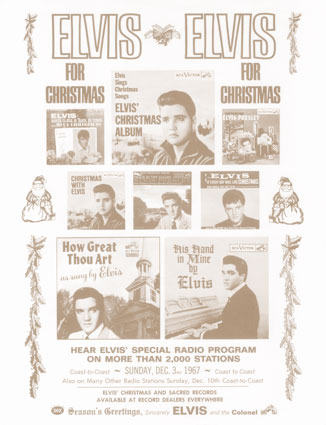
Season's Greetings From Elvis flyer (1967)

Season’s Greetings From Elvis flyer (1967)

On Sunday, December 3, 1967, a special called Season’s Greetings From Elvis aired on over 2,000 stations across the United States. Why is it mostly forgotten? Season’s Greetings From Elvis was a radio special.

The special contained no new numbers by Elvis, but instead featured previously released Christmas and religious music. The songs in the half-hour show included:

  • Here Comes Santa Claus (1957)
  • Blue Christmas (1957)
  • O Little Town Of Bethlehem (1957)
  • Silent Night (1957)
  • I’ll Be Home For Christmas (1957)
  • I Believe (1957)
  • If Every Day Was Like Christmas (1966)
  • How Great Thou Art (1966)
  • His Hand In Mine (1960)
  • I’ll Be Home For Christmas (1957)

The special’s finale, “I’ll Be Home For Christmas,” contained a new voice-over by Elvis: “Thank you for listening. I’d like to wish you a merry Christmas and a wonderful New Year.” Oddly, this 1967 audio was later placed on top of “Silent Night” on Memories Of Christmas (and re-released on 1994’s If Every Day Was Like Christmas). However, the beginning music of “I’ll Be Home For Christmas” and not “Silent Night” can still be heard in the background on those releases as Elvis speaks the lines.

Exactly one year later, on December 3, 1968, the more famous Elvis Christmas special aired for the first time. Colonel Tom Parker’s original concept for the ’68 special sounded like little more than a TV version of Season’s Greetings From Elvis. The eventual show turned out much different, of course, and changed everything.

To fellow Elvis fans across the world, I’d like to wish you and your families a wonderful Christmas.

* * *

Image Source
Thank you to Holger Bock at Rare Elvis for providing the original image of an RCA promotional flyer for the 1967 radio special. Please do not reproduce this image without obtaining permission of Holger at Rare Elvis.

Research Sources

  • Careless Love: The Unmaking Of Elvis Presley by Peter Guralnick, Little, Brown And Company, Boston, 1999 (page 282).
  • Season’s Greetings From Elvis, Elvis In Norway, 2010.
  • Elvis: Word For Word by Jerry Osborne, Harmony Books, New York, 2000 (page 204).
  • Elvis: The Biography by Jerry Hopkins, Plexus, London, 2007 (page 205).
  • ELVIS: His Life From A To Z by Fred Worth and Steve Tamerius, Wings Books, New York, 1992 (page 560).

Lisa Marie Presley offers new insight into Michael Jackson and her father [The Film Frontier blog]

When news broke yesterday of Michael Jackson’s sudden death, I instantly thought back to August 16, 1977, when Elvis died. The coverage had an eerie sense of familiarity, as if I was re-living that event in some way. Some of it I can vaguely remember from back then, while other parts I have watched on videos over the years. I felt sympathy for Jackson’s many fans because, as an Elvis fan, I know some of what they will go through in the coming days and years.

I also felt sympathy for Lisa Marie Presley. If someone like me, who never met either person and was only a fan of one of them, could feel the sense of déjà vu between the two experiences, I could only wonder what Elvis’ daughter and Jackson’s ex-wife would feel.

Lisa Marie released a brief statement yesterday, which you can read at Elvis.com. Today, she released a much longer blog post about the topic, “He Knew,” on her MySpace page. In the post, she offers new perspectives on why she was attracted to Michael Jackson and on the deaths of both Jackson and her father. It is a compelling read.

Incidentally, today marks the 32nd anniversary of what would prove to be Elvis’ last concert. It is also the 30th anniversary of the death of Elvis’ father and Lisa Marie’s grandfather, Vernon Presley. Today is also the 100th anniversary of the birth of Elvis’ longtime manager, Colonel Tom Parker.

“Colonel” Parker dies at age 87 [The Elvis Beat newsletter]

I was 22 when I wrote this article back in 1997 for The Elvis Beat #16, which turned out to be the final issue of my official Elvis Presley Fan Club newsletter.


“Colonel” Tom Parker, Elvis’ manager for over 20 years, died on January 21. He was 87 and lived in Las Vegas with his wife, Loanne.

Although not yet his manager, Parker began guiding Elvis’ career in mid-1955 while the singer was still on Memphis’ Sun Records label and slowly rising in popularity. He helped secure a contract for Elvis with RCA Records later that year.

Parker officially became Elvis’ manager in early 1956 for a 25 percent fee. Elvis would remain Parker’s sole client until Elvis’ death in 1977.

Parker’s innovative management style helped to transform Elvis from a relative unknown at the beginning of 1956 to an international celebrity with six number one hits, several million-sellers, and a starring role in a successful movie by the end of that same year.

Parker was often blamed for allowing Elvis’ movies to deteriorate into Grade C formula films in the 1960s. Parker once admitted that he didn’t even bother to read the scripts. “Anybody who’ll pay my boy a million dollars can make any kind of picture he wants,” Parker said. Despite the low quality of many of them, nearly all 33 of Elvis’ movies were box office successes.

In 1967, Parker renegotiated his contract with Elvis, increasing his own share to 50 percent with the argument that Elvis was his only client. [. . . .]

Parker negotiated lucrative deals for Elvis to appear in Las Vegas for extended engagements beginning in 1969. In the 1970s, Parker staged multi-city concert tours across the US for Elvis, who played 150 shows a year.

Parker orchestrated the 1973 Elvis: Aloha From Hawaii television special, which used satellite technology and drew millions of viewers.

Parker was born Andreas Cornelius van Kuijk in Holland on June 26, 1909. He immigrated to the US illegally in 1929, claiming West Virginia as his birthplace. He served in the US Army with the 64th Coast Artillery from 1929 to 1932. He married his first wife, Marie Ross, in 1932. A state governor made him an honorary Colonel in 1953.

In the 1950s, Parker became the promoter of singer Gene Austin and manager of country singers Eddy Arnold, from 1942 to 1951, and Hank Snow, from 1954 to 1956, before becoming Elvis’ manager.

In recent years, he was associated with country singer George Strait, negotiating for him to star in the movie Pure Country.

Joe Esposito, one of Elvis’ friends, said, “The bottom line is that Elvis would never have been so popular as he was without the Colonel’s brilliant management. Nor would the Colonel have had so much success with anyone else.”

Review – ELVIS AND THE COLONEL: THE UNTOLD STORY (1993) [The Elvis Beat newsletter]

I was 18 when I wrote this review back in 1993 for The Elvis Beat #4, my official Elvis Presley Fan Club newsletter.


Elvis And The Colonel: The Untold Story (NBC), starring Beau Bridges, directed by William A. Graham, aired January 10, 1993.

Elvis And The Colonel: The Untold Story is a story that should have remained untold. Not only is this the worst movie ever made about Elvis, but this is also probably the worst movie ever.

The initial concept behind this television movie was actually a good idea – an examination of the well-documented mismanagement of Elvis’ career by Colonel Tom Parker. But the end result is an absolute failure.

Elvis And The Colonel is one big mistake after another. A listing of some of the many factual errors contained in this movie appears on page 5 of this newsletter.

The biggest mistake of all occurred in the casting department when Robb Youngblood was chosen to play “Elvis.” Youngblood does not bear the slightest resemblance to Elvis, so one can only assume that he was selected for his acting ability. The problem with that theory is that [. . .] at no time during the entire two-hour movie is he convincing as “Elvis.” [. . . .]

It is also obvious that no effort was made to make Youngblood look like Elvis. Throughout the 22 years of “Elvis”‘ life that this movie portrays, Youngblood wears basically the same hairstyle–even while in the Army. It looks awful and resembles none of the many different styles Elvis wore his hair in over the years.

Youngblood’s clothes in the movie look so cheap that even the local [discount store] would be embarrassed to sell them. Once again, they resemble nothing the real Elvis ever wore. The styles may have changed since his time, but Elvis never looked cheap the way Youngblood does.

All of these cosmetic problems could have been overlooked had Elvis And The Colonel been a good story but, as mentioned before, it is filled with errors. And even beyond those errors, the script is poorly written and the entire movie is poorly made. [. . . .]

Beau Bridges, who was obviously chosen only to draw more viewers, stars as “Colonel Parker” and does a poor job also, but in a different way than Youngblood. Bridges makes the Colonel appear too likable and too nice, defeating the purpose of the movie.

Youngblood seems to have accidentally studied Gomer Pyle videos instead of Elvis ones for his part, for he plays Elvis as an extremely stupid fool – which could not be further from the truth.

Appropriately, even the house that is supposed to be Graceland looks nothing like the real thing.

The ELVIS television special, or the ’68 Comeback Special as it has come to be known, featured Elvis in top form. Of course, this movie slaughters this as well. One of the most ludicrous moments in the movie, and there are many, occurs when Youngblood is shown standing in front of a series of waist-high letters that spell “ELVIS” in red lights. The real version was over two stories tall and looked much better.

One of the many myths that Elvis And The Colonel perpetuates is everyone’s old favorite: “Elvis” appears overweight throughout the 1970s in this movie while the real Elvis did not begin to experience significant weight problems until about two years before his death. Youngblood is shown obese by 1971, while the real Elvis at the time was in shape and would remain so for a few more years. Of course, in such an inaccurate movie, such mistakes are not surprising.

Half of the “Elvis” songs used in the movie were apparently taken from Ronnie McDowell’s work for the 1979 television movie Elvis, starring Kurt Russell, and not surprisingly, Youngblood does a poor job lip-synching to them. The rest of the songs were performed by Youngblood himself and are awful. One particularly bad scene uses a combination of McDowell’s and Youngblood’s vocal tracks.

The most surprising thing about this movie is that Dick Clark was its executive producer. Clark also executive produced the Kurt Russell Elvis movie, directed by John Carpenter, which is one of the better movies based on Elvis’ life.

With this new movie, Clark has gone wrong. He has stated his respect for Elvis in the past and his disdain for the Colonel, but this movie serves only to slam Elvis instead of its intended target.

Incidentally, Elvis And The Colonel was directed by William A. Graham, who directed the real Elvis in Change Of Habit, which was one of Elvis’ better films.

It is apparent that no one connected with this movie bothered to do any significant research about its topic. It is also apparent that the movie’s production was rushed, probably to have it ready in time to cash in on the free publicity of the Elvis stamp release two days prior to this movie airing. They need not have bothered, for The Carol Burnett Show: A Reunion special beat it soundly in the ratings.

The worst part about Elvis And The Colonel: The Untold Story is that some people, who knew nothing about Elvis, probably watched this irresponsible movie and now think that this is what Elvis was really like.

Songs include:

  • “Lawdy, Miss Clawdy”
  • “Rip It Up”
  • “Tutti Frutti”
  • “Long Tall Sally”
  • “Heartbreak Hotel”
  • “Trouble”
  • “Blue Moon Of Kentucky”
  • “Are You Lonesome Tonight”
  • “The Wonder Of You”
  • “Dixie/The Battle Hymn Of The Republic”

Rating: 1 out of 10

Elvis and the Colonel: Clark takes jabs at Parker [The Elvis Beat newsletter]

I was 18 when I wrote this article back in 1993 for The Elvis Beat #4, my official Elvis Presley Fan Club newsletter.


Dick Clark, executive producer of the NBC television movie Elvis and the Colonel: The Untold Story, launched an attack against Colonel Tom Parker during a January press tour promoting the American Music Awards.

“I’ve held that story for 20 years,” he said. “I wanted it told so badly because it’s the classic example of horrendous mismanagement. Elvis was a great talent, a national treasure.”

He went on to state some facts about Colonel Parker’s mismanagement of Elvis’ career. The comments were out of character for Clark, who almost never comments negatively on anyone. He has been inside the music industry for over 40 years, launching the careers of countless performers, and his influence is a contributing factor in the continued popularity of rock music.

Clark is a genuine rock ‘n’ roll legend and must have many more horror stories to tell, yet this is the first time he has truly opened up.

“It’s my contention that had Elvis been handled properly and had loved ones around him who really cared, who weren’t just sucking his blood dry, he might be alive today,” he said.

These comments lead one to wonder how Clark could have possibly been satisfied by Elvis and the Colonel: The Untold Story, a poorly-made movie which did little to bring down the Colonel and instead made Elvis a villain. [Perhaps] this movie somehow got away from Clark, and, before he knew it, his original idea had been transformed into the fiasco which aired on NBC in January.

“(Parker) kept (Elvis) in a cage like an animal. He trotted him out like a trained bear,” Clark said. “Oopsy daisy. Stop. Time. I can’t say these things. You draw your own conclusions.”

See Elvis and the Colonel review on page 10.

Elvis and the Colonel: The Way It Was [The Elvis Beat newsletter]

I was 18 when I wrote this article back in 1993 for The Elvis Beat #4, my official Elvis Presley Fan Club newsletter.


One mistake after another occurred in the NBC television movie Elvis and the Colonel: The Untold Story, which aired in January. On the rare occasions when the movie’s makers did decide to check their sources, it appears the only reference they bothered to use was the 1979 TV movie Elvis starring Kurt Russell and directed by John Carpenter.

Below is a listing of some of the many factual errors which appeared in Elvis and the Colonel:

  • “Elvis” is shown giving his mother a pink cadillac after they were already living at Graceland. In reality, Elvis gave her the car in 1956, while they did not move into Graceland until May 1957.
  • “Elvis” is shown in Elvis and the Colonel filming the movie Change of Habit in the 1950s. In actuality, Change of Habit was filmed in 1969 and was his last acting role.
  • “Colonel Parker” mentions that “Elvis”‘ gold cadillac could be toured while he was in the Army. The real Elvis did not even purchase the gold car until after his service in the Army.
  • Preparations for the taping of the 1968 ELVIS television special (now known as ELVIS: ’68 Comeback Special) are shown occurring in November of 1968. In reality, the special was taped in June of 1968.
  • The ELVIS special is a live broadcast in the movie. In actuality, ELVIS, as mentioned above, was taped in June 1968 and did not air until December of that year. It was the 1973 television special Elvis: Aloha From Hawaii that was broadcast live to some locations around the world.
  • “Elvis” is shown singing “Are You Lonesome Tonight” in a white, double-breasted suit during the ELVIS television special. In reality, “If I Can Dream” was the only song Elvis performed in the special wearing that suit.
  • “Heartbreak Hotel” in the movie concludes the ELVIS special. In actuality, “If I Can Dream” was the final song sung by Elvis in the special.
  • “Also Sprach Zarathustra” (theme from 2001: A Space Odyssey) opens “Elvis”‘ opening night performance in July 1969 at the Las Vegas International Hotel in the movie. The fact is, the real Elvis did not begin using “Also Sprach Zarathustra” until 1971.
  • “Elvis” wears a white jumpsuit for the July 1969 opening performance in the movie. In reality, Elvis wore a simple black outfit for his first concert in years. The jumpsuit worn by the actor is a distorted version of one worn by Elvis in the film Elvis: That’s The Way It Is, which was from an August 1970 performance.
  • “Elvis” sings “The Wonder Of You” at the 1969 concert in the movie, while the song was not really performed by Elvis until 1970.
  • “Elvis” is shown extremely overweight by September of 1971 in the movie, which escalates until a 1973 performance in which he appears obese. In reality, Elvis was at or near his ideal weight during these years, as proven by video and photographs.
  • “Elvis” is shown in the movie complaining to “Colonel Parker” about turning down A Star Is Born in August 1973. In actuality, Elvis had not yet been offered a role in this 1976 movie.
  • “Elvis” and “Priscilla” never divorce in the film! Despite the fact that the real couple divorced in October 1973, the movie “Elvis” tells of a nightmare in July 1976 in which he dreamed that “Priscilla” had left him. In a 1981 courtroom scene, the judge refers to “Elvis” as “Priscilla”‘s late “husband,” instead of “ex-husband.”

Five disc set to be released for fifteenth anniversary [The Elvis Beat newsletter]

I was 16 when I wrote this article back in 1992 for The Elvis Beat #1, the first issue of my official Elvis Presley Fan Club newsletter.


The King of Rock and Roll is the tentative name of a 5-CD set to be released for the fifteenth anniversary of Elvis’ death. This will be a “definitive 50s” set, according to Ernst Jorgensen of BMG International who is a co-producer of the set.

Along with “pristine” versions of the standard fifties songs, the set will also feature unreleased material obtained by Graceland from Colonel Parker in their recent multi-million dollar purchase of his Elvis memorabilia. Parts of his collection will be displayed in a new museum under construction across the street from Graceland.

The King of Rock and Roll should be a good companion piece to 1991’s 3-CD set Collectors Gold, which contained unreleased songs from the sixties (including a disc devoted to his 1969 Las Vegas concerts).